SA-CONTRIB-2014-097 – nodeaccess – Access Bypass

Description

Nodeaccess is a Drupal access control module which provides view, edit and delete access to nodes.

This module enables you to inadvertently allow an author of a node view/edit/delete the node in question (who may not have access). The module over-eagerly grants read/write/delete access to all authors of nodes.

In addition, a node that is unpublished, but is granted node specific permissions will obey the node specific permissions and not the unpublished content permission for the role.

CVE identifier(s) issued

  • A CVE identifier will be requested, and added upon issuance, in accordance
    with Drupal Security Team processes.

Versions affected

  • Nodeaccess 6.x-1.x versions prior to 6.x-1.5.
  • Nodeaccess 7.x-1.x versions prior to 7.x-1.4.

Drupal core is not affected. If you do not use the contributed Nodeaccess module,
there is nothing you need to do.

Solution

Ensure that you are using the latest version of the Nodeaccess module when installing. For existing nodes, please ensure that the author permissions are correct.

Also see the Nodeaccess project page.

Reported by

Fixed by

Coordinated by

Contact and More Information

The Drupal security team can be reached at security at drupal.org or via the contact form at
https://www.drupal.org/contact.

Learn more about the Drupal Security team and their policies,
writing secure code for Drupal, and
securing your site.

Drupal version: 

SA-CONTRIB-2014-096 – OAuth2 Client – Cross Site Scripting (XSS)

Description

OAuth2 Client is an API support module, enabling other modules to connect to services using OAuth2 authentication.

Within its API code the Client class exposes variables in an error message, which originate from a third party source without proper sanitisation thus leading to a Cross Site Scripting vulnerability.

CVE identifier(s) issued

  • A CVE identifier will be requested, and added upon issuance, in accordance
    with Drupal Security Team processes.

Versions affected

  • OAuth2 Client 7.x-2.x versions prior to 7.x-1.2.

Drupal core is not affected. If you do not use the contributed OAuth2 Client module,
there is nothing you need to do.

Solution

Install the latest version:

Also see the OAuth2 Client project page.

Reported by

Fixed by

Coordinated by

Contact and More Information

The Drupal security team can be reached at security at drupal.org or via the contact form at
https://www.drupal.org/contact.

Learn more about the Drupal Security team and their policies,
writing secure code for Drupal, and
securing your site.

Drupal version: 

The Source of Vulnerabilities, How Red Hat finds out about vulnerabilities.

Red Hat Product Security track lots of data about every vulnerability affecting every Red Hat product. We make all this data available on our Measurement page and from time to time write various blog posts and reports about interesting metrics or trends.

One metric we’ve not written about since 2009 is the source of the vulnerabilities we fix. We want to answer the question of how did Red Hat Product Security first hear about each vulnerability?

Every vulnerability that affects a Red Hat product is given a master tracking bug in Red Hat bugzilla. This bug contains a whiteboard field with a comma separated list of metadata including the dates we found out about the issue, and the source. You can get a file containing all this information already gathered for every CVE. A few months ago we updated our ‘daysofrisk’ command line tool to parse the source information allowing anyone to quickly create reports like this one.

So let’s take a look at some example views of recent data: every vulnerability fixed in every Red Hat product in the 12 months up to 30th August 2014 (a total of 1012 vulnerabilities).

Firstly a chart just giving the breakdown of how we first found out about each issue: Sources of issues
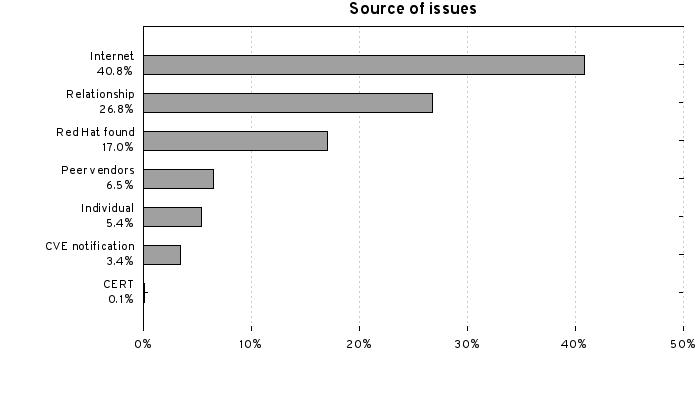
  • CERT: Issues reported to us from a national cert like CERT/CC or CPNI, generally in advance of public disclosure
  • Individual: Issues reported to Red Hat Product Security directly by a customer or researcher, generally in advance of public disclosure
  • Red Hat: Issues found by Red Hat employees
  • Relationship: Issues reported to us by upstream projects, generally in advance of public disclosure
  • Peer vendors: Issues reported to us by other OS distributions, through relationships
    or a shared private forum
  • Internet: For issues not disclosed in advance we monitor a number of mailing lists and security web pages of upstream projects
  • CVE: If we’ve not found out about an issue any other way, we can catch it from the list of public assigned CVE names from Mitre

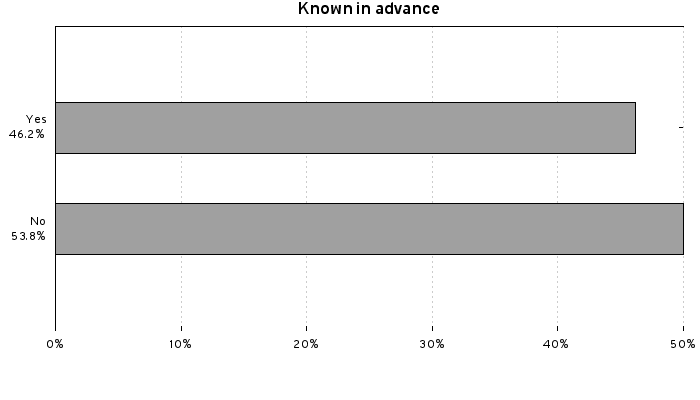
Next a breakdown of if we knew about the issue in advance. For the purposes of our reports we count knowing the same day of an issue as not knowing in advance, even though we might have had a few hours notice: Known in advanceThere are few interesting observations from this data:
  • Red Hat employees find a lot of vulnerabilities. We don’t just sit back and wait for others to find flaws for us to fix, we actively look for issues ourselves and these are found by engineering, quality assurance, as well as our security teams. 17% of all the issues we fixed in the year were found by Red Hat employees. The issues we find are shared back in advance where possible to upstream and other peer vendors (generally via the ‘distros’ shared private forum).
  • Relationships matter. When you are fixing vulnerabilities in third party software, having a relationship with the upstream makes a big difference. But
    it’s really important to note here that this should never be a one-way street, if an upstream is willing to give Red Hat information about flaws in advance,
    then we need to be willing to add value to that notification by sanity checking the draft advisory, checking the patches, and feeding back the
    results from our quality testing. A recent good example of this is the OpenSSL CCS Injection flaw; our relationship with OpenSSL gave us advance
    notice of the issue and we found a mistake in the advisory as well as a mistake in the patch which otherwise would have caused OpenSSL to have to have
    done a secondary fix after release. Only two of the dozens of companies prenotified about those OpenSSL issues actually added value back to OpenSSL.
  • Red Hat can influence the way this metric looks; without a dedicated security team a vendor could just watch what another vendor does and copy them,
    or rely on public feeds such as the list of assigned CVE names from Mitre. We can make the choice to invest to find more issues and build upstream relationships.

CVE-2014-3189 (chrome)

The chrome_pdf::CopyImage function in pdf/draw_utils.cc in the PDFium component in Google Chrome before 38.0.2125.101 does not properly validate image-data dimensions, which allows remote attackers to cause a denial of service (out-of-bounds read) or possibly have unspecified other impact via unknown vectors.

CVE-2014-3190 (chrome)

Use-after-free vulnerability in the Event::currentTarget function in core/events/Event.cpp in Blink, as used in Google Chrome before 38.0.2125.101, allows remote attackers to cause a denial of service (application crash) or possibly have unspecified other impact via crafted JavaScript code that accesses the path property of an Event object.

CVE-2014-3192 (chrome)

Use-after-free vulnerability in the ProcessingInstruction::setXSLStyleSheet function in core/dom/ProcessingInstruction.cpp in the DOM implementation in Blink, as used in Google Chrome before 38.0.2125.101, allows remote attackers to cause a denial of service or possibly have unspecified other impact via unknown vectors.

CVE-2014-3188 (chrome, chrome_os)

Google Chrome before 38.0.2125.101 and Chrome OS before 38.0.2125.101 do not properly handle the interaction of IPC and Google V8, which allows remote attackers to execute arbitrary code via vectors involving JSON data, related to improper parsing of an escaped index by ParseJsonObject in json-parser.h.

CVE-2014-3191 (chrome)

Use-after-free vulnerability in Blink, as used in Google Chrome before 38.0.2125.101, allows remote attackers to cause a denial of service or possibly have unspecified other impact via crafted JavaScript code that triggers a widget-position update that improperly interacts with the render tree, related to the FrameView::updateLayoutAndStyleForPainting function in core/frame/FrameView.cpp and the RenderLayerScrollableArea::setScrollOffset function in core/rendering/RenderLayerScrollableArea.cpp.