Tuning in to Cybercrime

The BBC has begun airing a six-part series, presented by British technologist, writer and “futurist” Ben Hammersley.

Called “Cybercrimes with Ben Hammersley,” the series was produced in partnership with The Open University. It looks at the range of cybercrime – from the scam emails that fill up our inboxes to drugs and guns that can be bought anonymously on what is called the shadowy business of “darknet,” and even governments spying on their own citizens.

Hammersley emphasizes that 2013 was a very bad year for cybercrime in businesses. He notes: “In February, $45 million was stolen from ATMs around the world after cyber criminals hacked credit cards and gave them unlimited withdrawal limits. Then, in November, 40 million credit card numbers were removed from the point-of-sale terminals of US retailer Target.”

Video

Cybercrimes with Ben Hammersley

We’ve chronicled other recent major breeches here. The fact is, major data breaches are occurring at a regular pace now, and are having an impact on our most standard, or reliable, institutions.

The global annual cost of cybercrime has been estimated at several hundred billion dollars. PwC’s 2014 Global Economic Crime Survey found that 7% of US organizations lost $1 million or more due to cybercrime incidents in 2013; furthermore, 19% of US entities reported financial losses of $50,000 to $1 million.

As Hammersly points out, ” Cybercrime affects each and every one of us. Every aspect of our lives is vulnerable to the criminal abuse of our networked world…”

It’s good to see the issue of cybercrime getting more in-depth attention in mainstream venues such as the BBC… I’m hoping there will be a large audience tuning in for what promises to be a very interesting and educational series.  The more educated people are, the better equipped we all will be to protect ourselves online.

Of course, cybercrime is a major issue to us at AVG: Our mission is to secure devices, data and people – and we are always working to give people and businesses the tools and information they need to better protect themselves online.  We haven’t talked about it a lot, but AVG Innovations Lab monitors current trends and develops software and apps to meet the needs of today’s consumer – as well as looks to future vulnerabilities to meet those needs too. In fact, we will be showcasing some of the work of our labs –including solutions to growing threats in mobile and the Internet of Things– during a press-only event we are calling “AVG Experiential Lab,” in San Francisco on Sept. 18.

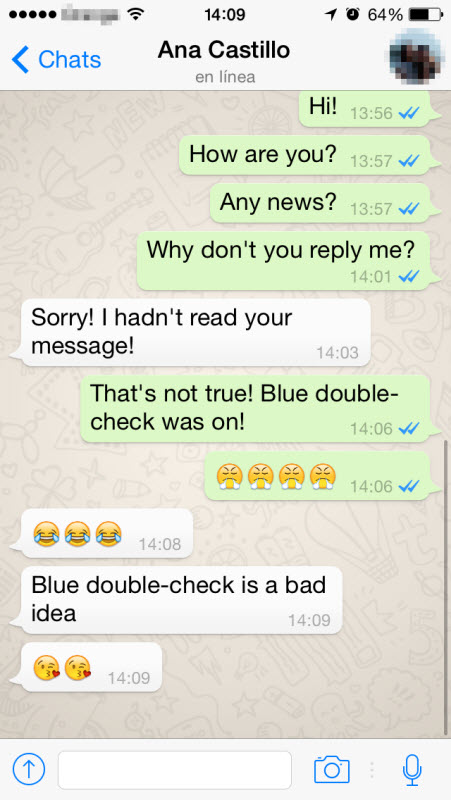
Blue double-check in WhatsApp. Your message has been read.

blue-double-check

Remember we said a few days ago that WhatsApp would be able to tell you whether your message had been read? Well, the blue double-check is now here. And what does it mean? The dream of some and nightmare of others: it’s the confirmation that your message has been read.

blue-double-check-whatsapp


But that’s not all. The blue double-check has also been included for groups and appears once all members of the group have read the message.

What do you think? Too much information? A loss of privacy? What’s clear is that you will no longer be able to say: “Sorry, I didn’t see your message…”

The post Blue double-check in WhatsApp. Your message has been read. appeared first on MediaCenter Panda Security.

The secret life of apps revealed

Have you ever noticed that your smartphone has surprisingly little storage space left for things like photos or even the latest updates? Or that battery life and reliability have begun to deteriorate over time? Or perhaps that your monthly data usage is growing inexplicably? Over time, the apps we love and use day in and day out affect our tablets or phones and impact their performance – sometimes while you’re using them, and sometimes completely invisible in the background.


The study

We decided to investigate to see if we could better understand how apps influence devices over time in our first Android App Performance Report.

When it comes to the performance of our phones, we noticed that users care about three things above all else:

  • Storage consumption – how much space do you have left for the files you love?
  • Battery consumption – is your phone making it to the end of the day or not?
  • Data plan consumption – are you constantly hitting your mobile data limit?


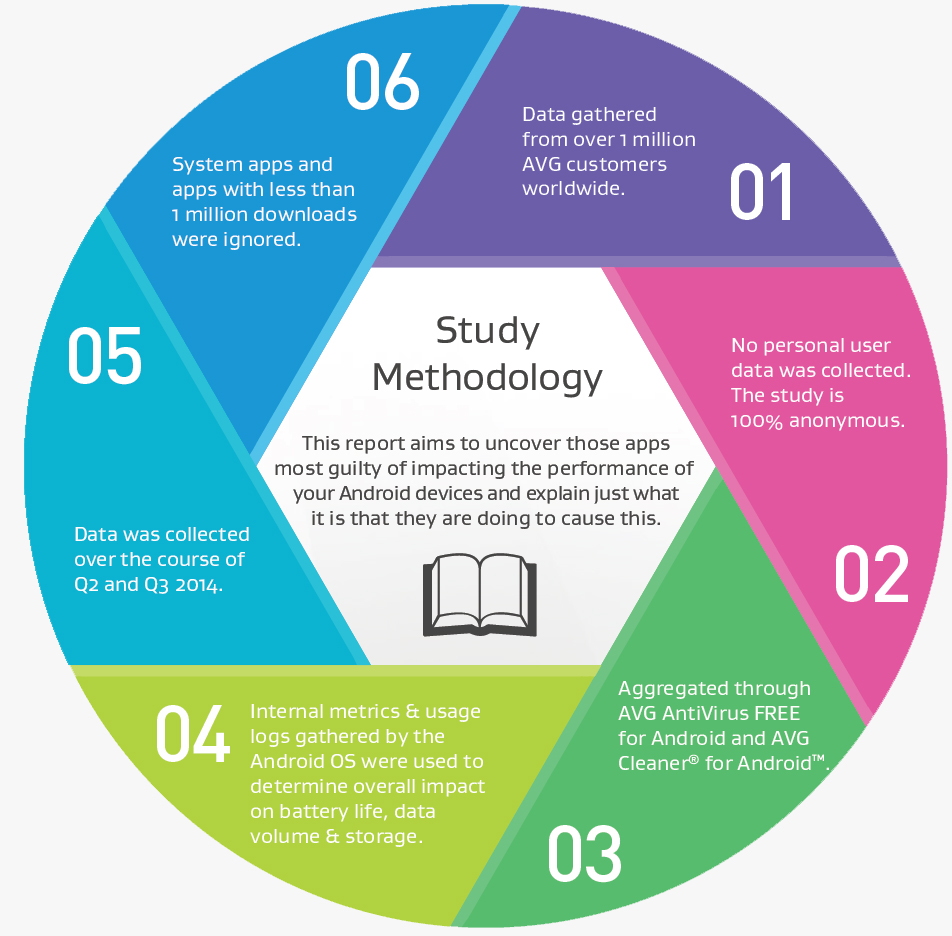
We felt that in order for the report to reflect what is happening to people’s phones out there in the real world, we needed to use data from real devices. Unlike other tests that might conduct benchmarking in a lab environment it was important to us that these results applied to everyday smartphone users.


Methodology


So with that in mind, we analyzed anonymized data from over one million AVG Android app users, so that we could better understand which apps they are using and how those apps affect their devices.

Some of the results were quite surprising.


Key Findings


Pre-installed apps

One of the most interesting learnings we made in the first report is that many devices are still carrying around a lot of apps that were installed by the manufacturer. These can take up a lot of storage space but more importantly can drain battery life – something that is already under strain with the constant use of most smartphones.


Apps with background activity

Another thing that became clear was that as we add more apps to our devices, we seldom remove the ones we no longer want or need. Over time this means that the limited resources of our devices are divided over an ever growing number of apps, affecting performance.

The reason for this is simple: the “always on” nature of apps means that they often-times continue to run in the background to check for notifications, updates or download data which uses valuable battery and data.


Social and News apps

It will come as little surprise that with its constant background notification checks, which run even when the app is not open, the social networking app from Facebook emerged as having the biggest impact on your mobile device when it comes to overall performance. The constant demand and transmission of data makes the app a real drain on both battery life and data use.


App growth

As we ran the report over several months, we observed some interesting behavior amongst apps that are automatically updated. Over time, their storage footprint and battery drain both increased. This is mostly due to downloaded content (songs for Spotify, items in games etc.), but is also in part thanks to automatic updates. With automatic updates enabled, developers can push out new versions and features that take up more space and are more resource heavy without having to ask the users permission. Combine this with the steadily growing number of apps we have on our devices (including those that we’ve downloaded and no longer use) and very soon you begin to observe a noticeable dip in performance.


What can you do to improve your device performance?

One of the most fundamental issues that the report has raised is that keeping your smartphone running in top condition is quite a labor intensive task. Keeping check of which apps are running in the background and removing apps that you don’t use is more than enough for most of us to commit to.

There are products that are designed to make your life easier though like AVG Cleaner for Android which can show you how much data, storage and battery life each of your apps is consuming to help you take the right actions to tackle any issues.


Our full report doesn’t just detail what apps are the most consuming of them all, it also details best practices and helps you get rid of performance hogs on your Android smartphone or tablet.


Full Report

Androidâ„¢ is a trademark of Google Inc. in the US and other countries.

SEC Consult SA-20141106-0 :: XXE & XSS & Arbitrary File Write vulnerabilities in Symantec Endpoint Protection

Posted by SEC Consult Vulnerability Lab on Nov 06

SEC Consult Vulnerability Lab Security Advisory < 20141106-0 >
=======================================================================
title: XXE & XSS & Arbitrary File Write vulnerabilities
product: Symantec Endpoint Protection
vulnerable version: 12.1.4023.4080
fixed version: 12.1.5 (RU 5)
impact: Critical
CVE number: CVE-2014-3437, CVE-2014-3438, CVE-2014-3439…