

“Installing an antivirus product is the first, not last, step to having a safe and secure computer.”
Avast is the leader in the cyber security arms race.
There are others fighting the fight, but a 21.4% share makes Avast the leader in the antivirus vendor market as reported in OPSWAT’s quarterly market share report.
That’s good news for individuals and business owners concerned about protecting themselves from vulnerable networks, swiped passwords, pilfered finanical data, erased online identities, and stolen Social Security or national ID numbers. Opinions about the future of cyber-attacks range from doom and gloom to optimism about the steady progress in security, but the fact remains that in today’s world, we have to work around the Internet’s vulnerable design and motivated hackers challenging businesses and home users.
“Installing an antivirus product is the first, not last, step to having a safe and secure computer,” said OPSWAT’s Gears product manager, Adam Winn. “Avast’s popular antivirus and security products are helping to improve security for all. Creating accessible antivirus products for home users contributes to an overall improved security status for everyone, even businesses.”
The OPSWAT report contains the latest figures on antivirus market share and usage, as well as analysis of compromised devices. A disturbing finding from the report stated,
More than 90% of Windows PCs have not run an antivirus full system scan in the last 7 days. Of these, 15% hadn’t even had their antivirus definitions updated within the previous three days which might explain why over3% were found to be seriously infected.
“It’s reasonable to assume in an organization with 400 PCs, a full dozen are compromised,” said Winn as an illustration of the seriousness. “The interconnected state of computing has blurred the lines between home and business, especially with BYOD, remote working, and SaaS. For this reason, it’s in everyone’s best interest that traditional antivirus protection continues to be in place to deter casual and commodity attacks.”
A lack of regular updates and full system scanning is especially problematic. Organizations without robust endpoint management and solutions in place to identify and remediate these risks are giving insecure devices access to their networks and could find themselves in violation of data security regulations.
Avast for Business protects companies for free
A lack of regular updates and full system scanning is especially problematic. Organizations without robust endpoint management and solutions in place to identify and remediate these risks are giving insecure devices access to their networks and could find themselves in violation of data security regulations.
“Our anti-malware engine keeps businesses and individuals protected with up to hundreds of continuous streaming micro-updates throughout the day, providing realtime protection against today’s complex threat landscape,” said Luke Walling, GM and VP of SMB at Avast. “By protecting the most devices we have the best insight into that threat landscape, and that translates into better protection for all of our users. Avast for Business is our answer to providing businesses from startup to maturity a tool for the best protection, and there’s no reason for even the smallest of companies not to use it, because it starts at a price everyone can afford, free.”
The data for the report was collected by OPSWAT GEARS, a free device security and management tool. You can add your computer to the sample if you don’t mind them collecting information regarding the applications installed on your computer. Check it out here, https://www.opswatgears.com/
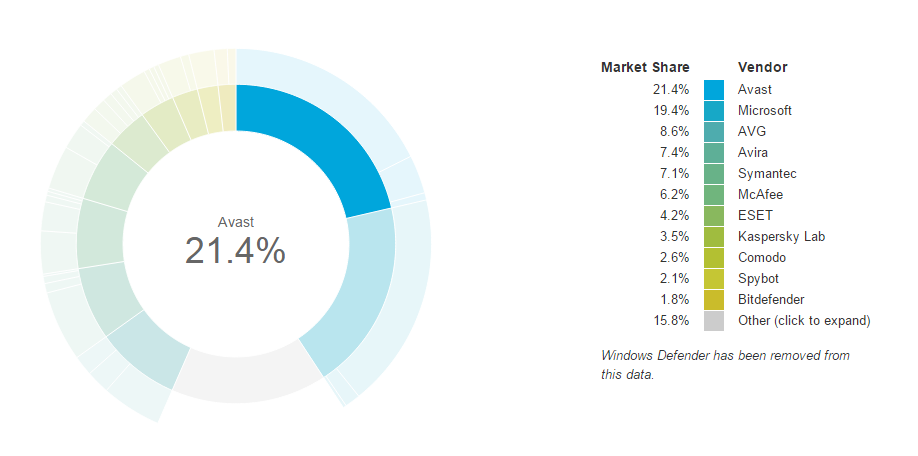
Avast leads in the antivirus vendor market with a 21.4% share