Category Archives: Antivirus Vendors

Antivirus Vendors

How cookies work?

Cookies

We all know the ‘Allow cookies?’ message. This option now appears in practically all websites. In fact, nowadays more people associate the term ‘cookies’ with its Internet use rather than with its edible origin.

Cookies are small data packets which Web pages load on to browsers for a whole range of reasons. Every time you return to the same URL, the computer sends back this little package of information to the server, which detects that you have returned to the page.

When you access your email account or Facebook profile, it is cookies that allow your user name and password to be saved, so the next time you won’t have to enter them again.

But apart from storing strings of digits and letters, webmasters can use these tools for monitoring the activity of Internet users.

These virtual spies collect information about your Internet habits: the pages you visit frequently and the topics that interest you. The problem is that they usually share this information with data analysis firms or those that design targeted marketing campaigns.

If, say, an ad for a food product appears on your screen after you visit a restaurant page, don’t be too surprised. Thanks to cookies, advertising can be tailored to consumers’ preferences.

Even though cookies are safe and won’t usually infect your computer with malware, it is not always clear in whose hands the collected data ends up or where it is stored.

A team of researchers from Queen Mary University, London, has managed to shed some light on this in one of its studies. They have basically been spying on the spies. They analyzed where the data of Internet users from around the world ended up in order to draw up a data circulation map.

The experts have focused on who is running cookies on user’s browsers. External companies (such as those marketing and data analysis firms mentioned above) send these data packets from a domain different to the site so they can be detected when they do this. With this methodology they were able to analyze the 500 most popular pages in 28 countries.

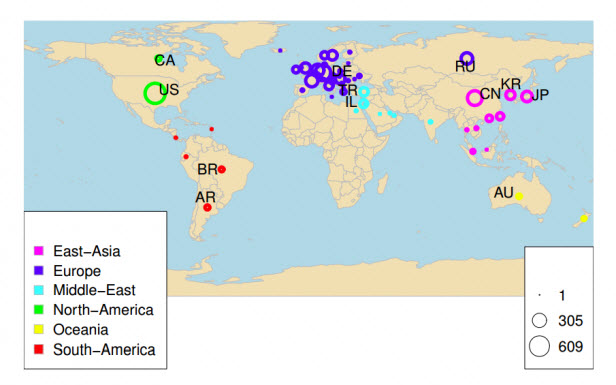
The results have shown that this practice extends across the world. You can also see in the image the areas of the planet where Internet user privacy is most compromised.
cookies map

While in Europe, South America and Oceania the amount of local companies accessing user data is quite similar, the number is greater in Turkey and Israel. The origin of the snoopers is also interesting: most come from Russia or Germany. Those based in the USA often end up on browsers in the Middle East.

Scientists believe that this distribution reflects Internet privacy legislation in different countries. In most European countries, where there are laws regulating third-party access to user data, there aren’t so many ‘spies’ as in China or Turkey, where such rules are scarce. But spies are everywhere, so experts continue to call for tougher measures to combat the trafficking of personal information.


The post How cookies work? appeared first on MediaCenter Panda Security.

Protégez les appareils mobiles de vos ados grâce à Avast.

Les ados passent une grande partie de leur temps sur leurs smartphones ou leurs tablettes. Aidez-les à se protéger grâce à Avast Free Mobile Security et Avast Antivol.


Teenagers_FR


Une étude réalisée par l’UNAF (Union Nationale des Associations Familiales) auprès de 500 élèves de 12 à 17 ans révèle que 73 % d’entre eux possèdent un téléphone portable et que 47 % l’utilisent en classe. Ils utilisent en général leurs smartphones pour surfer sur Internet et accéder aux réseaux sociaux, mais aussi pour s’orienter ou prévenir un proche en cas d’urgence. Beaucoup de parents considèrent le téléphone portable comme un outil de sécurité leur permettant de garder le contact avec leur ado peu importe où ils se trouvent.

La première chose à faire après avoir acheté un smartphone à votre ado. 

La plupart des jeunes utilisent un appareil Android sans protection intégrée. La première chose à faire est de télécharger une application de sécurité afin de protéger l’appareil de votre ados et leurs données.La nouvelle version gratuite d’Avast Mobile Security & Antivirus est enfin disponible. Son interface utilisateur améliorée et simplifiée vous permettra de protéger instantanément votre enfant contre les logiciels espions et les malwares, l’empêchera de télécharger des applications suspectes, sauvegardera ses contacts, ses photos et ses historiques d’appels et de sms.

Téléchargez Avast Mobile Security and Antivirus à partir du Google Play store.

La seconde chose à faire après avoir acheté un smartphone à votre ado.

Les ados sont très actifs et les chances qu’ils perdent leur portable sont élevées. Avast Antivol est une application à installer indépendamment d’Avast Mobile Security. Vous pouvez utiliser la fonctionnalité de localisation afin de retrouver un appareil perdu ou volé, le contrôler à distance et le verrouiller.

Téléchargez Avast Antivol à partir du Google Play store.

Autres conseils : 

  • Protégez le smartphone de votre enfant avec un mot de passe. C’est très facile et cela empêchera les curieux et les hackeurs d’accéder à leurs données.
  • Ajoutez les numéros importants à la liste de contacts. Ajoutez votre numéro de portable, celui de votre travail, des grands-parents, de l’établissement scolaire, des urgences etc.
  • Informez-vous des règles de l’établissement scolaire. Il est important de savoir si l’utilisation du portable y est interdite durant les heures de cours ou durant les pauses.
  • Informez vos enfants sur l’importance de la confidentialité. Cela inclut des sujets comme la publication de photos, le sexting et le comportement à adopter sur les réseaux sociaux.


Merci d’utiliser Avast Antivirus et de nous recommander à vos amis et votre famille. Pour toutes les dernières nouvelles, n’oubliez pas de nous suivre sur Facebook, Twitter et Google+.


WhatsApp Oro, a new scam related to the world famous messaging app

whatsapp oro


Be careful! The Spanish National Police have reported a new type of scam related to WhatsApp. That’s right, another one! We’re beginning to lose count of how many times we’ve reported these types of stories.

It appears that cyber-criminals have invented a new version of the messaging app: WhatsApp Oro (WhatsApp Gold). As you can probably imagine, there is no ‘Gold’ version of WhatsApp, and it’s really just another fraud to subscribe you to Premium SMS services.

Seemingly, criminals have been advertising this service on Twitter and more than a few users have fallen for it.

As you know, the success of WhatsApp has made it a prime target for criminals, so take care and don’t fall into the trap!

The post WhatsApp Oro, a new scam related to the world famous messaging app appeared first on MediaCenter Panda Security.