Mike Mimoso and Chris Brook discuss the news of the week including internet-connected teddy bears, the latest on the Going Dark debate, and whether or not there’s a backdoor in Socat. They also preview next week’s Security Analyst Summit in Tenerife, Spain.
Socat published a security advisory warning users that a hard-coded 1024 Diffie-Hellman prime number was not prime, and that an attacker could listen and recover secrets from a key exchange.
First a brief history of Diffie-Hellman for those not familiar with it
The short version of Diffie-Hellman is that two parties (Alice and Bob) want to share a secret so they can encrypt their communications and talk securely without an eavesdropper (Eve) listening in. So Alice and Bob first share a public prime number and modulus (which Eve can see). Alice and Bob then each choose a large random number (referred to as their private key) and apply some modular arithmetic using the shared prime and modulus. If everything goes as planned Alice sends her answer to Bob, and Bob sends his answer to Alice. They each take the number sent by the other party, and using modular arithmetic, and their respective private keys are able to derive a number that will be the same for both of them, known as the shared secret. Even if Eve listens in she cannot easily derive the shared secret.
However if Eve has sufficiently advanced cryptographic experts, and sufficient computing power it is conceivable that she can derive the private keys for exchanges when a sufficiently small modulus is used. Most keys, today, are in the range of 1024 bit or larger meaning that the modulus is at least several hundred digits long.
Essentially if Alice and Bob agree to a poorly chosen modulus number then Eve will have a much easier time deriving the secret keys and listening in on their conversation. Poor examples of modulus numbers include numbers that are not actually prime, and modulus numbers that aren’t sufficiently large (e.g. a 1024 bit modulus provides vastly less protection than a 2048 bit modulus).
Why you need a good prime for your modulus
A prime number is needed for your modulus. For this example we’ll use 23. Is 23 prime? 23 is small enough that you can easily walk through all the possible factors (1, 2, 3, 4, 5, 6, 7, 8, 9, 10, 11, 12), divide 23 by them and see if there is a remainder. But much larger prime numbers, such as ones that are in the mid to high hundreds of digits long, are essentially impossible to factor unless you have a lot of computational resources, and some really efficient ways to try and factor prime numbers. Fortunately there is a simple solution to this, just use an even larger prime number, such as a 2048, 4096 or even 16384 bit prime number. But when picking such a number how can you be sure it’s a prime and not easily factored? Ignoring the obvious give-aways (like all numbers ending in 0, 2, 4, 5, 6 and 8) there are several clever mathematical algorithms for testing the primality of numbers and for generating prime numbers.
Miller-Rabin, Shawe-Taylor and FIPS 186-4
The Miller-Rabin primality test was first proposed in 1976, and the Shawe-Taylor strong prime generation was first proposed in 1986. One thing that is important to remember, is that back when these algorithms were made public the amount of computing power available to generate/factorize prime numbers was much smaller than is now available. The Miller-Rabin test is a probabilistic primality test, you cannot conclusively prove a number is prime, but by running the Miller-Rabin test multiple times with different parameters you can be reasonably certain that the number in question is probably prime and with enough tests your confidence can approach almost 100%. Shawe-Taylor is also probabilistic, you’re not 100% guaranteed to get a good prime, but the chances of something going wrong and getting a non-prime number are very small.
FIPS 186-4 covers the math and usage of both Miller-Rabin and Shawe-Taylor, and gives specific information on how to use them securely (e.g. how many rounds of Miller-Rabin you’ll need to use, etc.). The main difference between Rabin-Miller and Shawe-Taylor is that Shawe-Taylor generates something that is probably a prime, whereas with Miller-Rabin you generate a number that might be prime, and then test it. As such you may immediately generate a good number, or it may take several tries. In testing on a 3Ghz CPU, using a single core it took me between less than a second and over 10 minutes to generate a 2048 bit prime using the Miller-Rabin method.
Generating primes in advance
The easiest way to deal with the time and computing resources needed to generate primes is to generate them in advance. Also because they are shared publicly during the exchange you can even distribute them in advance, which is what has happened for example with OpenSSL. Unfortunately many of the primes currently in use were generated a long time ago when the attacks available were not as well understood, and thus are not very large. Additionally, there are relatively few primes in use and it appears that there may be a literal handful of primes in wide use (especially the default ones in OpenSSL and OpenSSH for example). There is now public research to indicate that at least one large organization may have successfully attacked several of these high value prime numbers, and as computational power increases this becomes more and more likely.
To generate Diffie-Hellman primes in advance is easy, for example with OpenSSL:
openssl dhparam [bit size] -text > filename
so to generate a 2048 bit prime:
openssl dhparam 2048 -text
Or for example with OpenSSH you first generate a list of candidate primes and then test them:
Please note that OpenSSH uses a list of multiple primes so generation can take some time, especially with larger key sizes.
Defending – larger primes
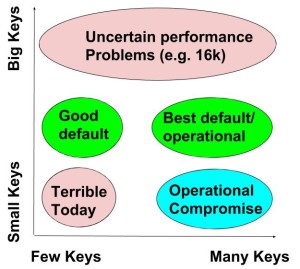
The best defense against someone factoring your primes is to use really large primes. In theory every time you add a single bit to the prime you are increasing the workload significantly (assuming no major advances in math/quantum computing that we don’t know about that make factorization much easier). As such moving from a 1024 bit to 2048 bit prime is a huge improvement, and moving to something like a 4096 bit prime should be safe for a decade or more (or maybe not, I could be wrong). So why don’t we simply use very large primes? CPU power and battery power are still finite resources, and very large primes take much more computational power to use, so much so that very large primes like 16384 bit primes become impractical to use, introducing noticeable delays in connections. The best thing we can do here is set a minimum prime size such as 2048 bits now, and hopefully move to 4096 bit primes within the next few years.
Defending – diversity of primes
But what happens if you cannot use larger primes? The next best thing is to use custom generated prime numbers, this means that an attacker will have to factor your specific prime(s), increasing their workload. Please note that even if you can use large primes, prime diversity is still a good idea, but prime diversity increases the amount of work for an attacker at a much slower rate than using larger prime does. The following apps and locations contain primes you may want to replace:
OpenSSH: /etc/ssh/moduli
Apache with mod_ssl: “SSLOpenSSLCondCmd DHParameters [filename]” or append the DH param to the SSLCertificateFile
Some excellent articles on securing a variety of other services and clients are:
I think the best plan for dealing with this in the short term is deploying larger primes (2048 bits minimum, ideally 4096 bits) right now wherever possible. For systems that cannot have larger primes (e.g. some are limited to 768, 2013 bits or other related small sizes) we should ensure that default primes are not used and instead custom primes are used, ideally for limited periods of time, replacing the primes as often as possible (which is easier since they are small and quick to generate).
In the medium term we need to ensure as many systems as possible can handle larger prime sizes, and we need to make default primes much larger, or at least provide easy mechanisms (such as firstboot scripts) to replace them.
Longer term we need to understand the size of primes needed to avoid decryption due to advances in math and quantum computing. We also need to ensure software has manageable entry points for these primes so that they can easily be replaced and rotated as needed.
Why not huge primes?
Why not simply use really large primes? Because computation is expensive, battery life matters more than ever and latency will become problems that users will not tolerate. Additionally the computation time and effort needed to find huge primes (say 16k) is difficult at best for many users and not possible for many (anyone using a system on a chip for example).
Why not test all the primes?
Why not test the DH params passed by the remote end, and refuse the connection if the primes used are too small? There is at least one program (wvstreams [wvstreams]) that tests the DH params passed to it, however it does not check for a minimum size, it simply tests the DH params for correctness. The problem with this is twofold, one there would be a significant performance impact (adding time to each connection) and two, most protocols and programs don’t really support error messages from the remote end related to the DH params, so apart from dropping the connection there is not a lot you can do.
Summary
As bad as things sound there is some good news. Fixing this issue is pretty trivial, and mostly requires some simple operational changes such as using moderately sized DH Parameters (e.g. 2048 bits now, 4096 within a few years). The second main fix for this issue is to ensure any software in use that handles DH Parameters can handle larger key sizes, if this is not possible then you will need to place a proxy in front that can handle proper key sizes (so all your old Java apps will need proxies). This also has the benefit of decoupling client-server encryption from old software which will allow you to solve future problems more easily as well.
Executive Summary: The IKE daemons in RHEL7 (libreswan) and RHEL6 (openswan) are not vulnerable to the SLOTH attack. But the attack is still interesting to look at .
The SLOTH attack released today is a new transcript collision attack against some security protocols that use weak or broken hashes such as MD5 or SHA1. While it mostly focuses on the issues found in TLS, it also mentions weaknesses in the “Internet Key Exchange” (IKE) protocol used for IPsec VPNs. While the TLS findings are very interesting and have been assigned CVE-2015-7575, the described attacks against IKE/IPsec got close but did not result in any vulnerabilities. In the paper, the authors describe a Chosen Prefix collision attack against IKEv2 using RSA-MD5 and RSA-SHA1 to perform a Man-in-the-Middle (MITM) attack and a Generic collision attack against IKEv1 HMAC-MD5.
We looked at libreswan and openswan-2.6.32 compiled with NSS as that is what we ship in RHEL7 and RHEL6. Upstream openswan with its custom crypto code was not evaluated. While no vulnerability was found, there was some hardening that could be done to make this attack less dangerous that will be added in the next upstream version of libreswan.
Specifically, the attack was prevented because:
The SPI’s in IKE are random and part of the hash, so it requires an online attack of 2^77 – not an offline attack as suggested in the paper.
Weak Diffie-Hellman groups DH22, DH23 and DH24 are not enabled per default.
Libreswan as a server does not re-use nonces for multiple clients.
Libreswan destroys nonces when an IKE exchange times out (default 60s).
Bogus ID payloads in IKEv1 cause the connection to fail authentication.
The rest of this article explains the IKEv2 protocol and the SLOTH attack.
The IKEv2 protocol
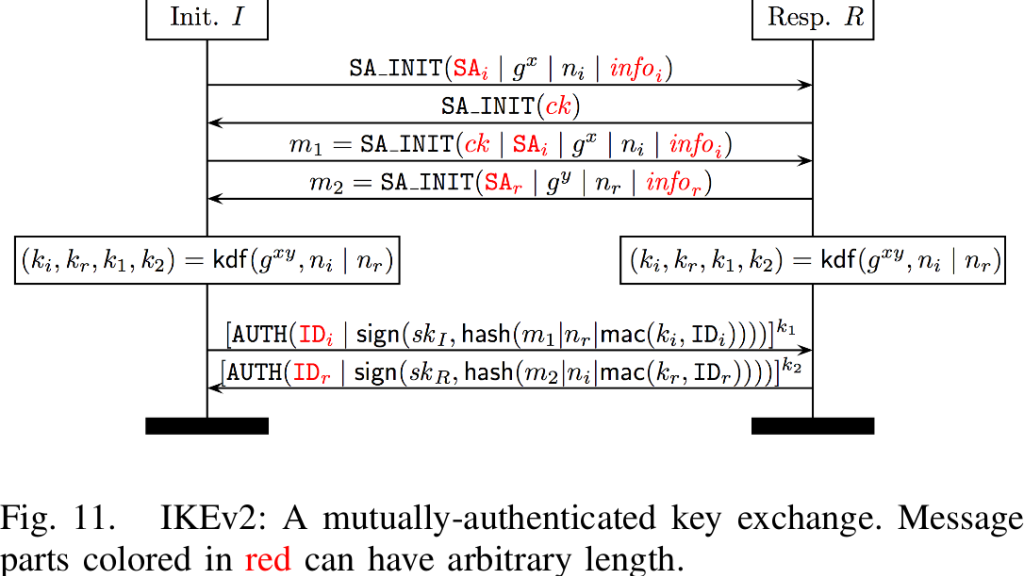
The IKE exchange starts with an IKE_INIT packet exchange to perform the Diffie-Hellman Key Exchange. In this exchange, the initiator and responder exchange their nonces. The result of the DH exchange is that both parties now have a shared secret called SKEYSEED. This is fed into a mutually agreed PRF algorithm (which could be MD5, SHA1 or SHA2) to generate as much pseudo-random key material as needed. The first key(s) are for the IKE exchange itself (called the IKE SA or Parent SA), followed by keys for one or more IPsec SAs (also called Child SAs).
But before the SKEYSEED can be used, both ends need to perform an authentication step. This is the second packet exchange, called IKE_AUTH. This will bind the Diffie-Hellman channel to an identity to prevent the MITM attack. Usually these are digital signatures over the session data to prove ownership of the identity’s private key. Technically, it signs a hash of the session data. In TLS that signature is over the hash of the session data which made TLS more vulnerable to the SLOTH attack.
The attack is to trick both parties to sign a hash which the attacker can replay to the other party to fake the authentication of both entities.
They call this a “transcript collision”. To facilitate the creation of the same hash, the attacker needs to be able to insert its own data in the session to the first party so that the hash of that data will be identical to the hash of the session to the second party. It can then just pass on the signatures without needing to have private keys for the identities of the parties involved. It then needs to remain in the middle to decrypt and re-encrypt and pass on the data, while keeping a copy of the decrypted data.
The IKEv2 COOKIE
The initial IKE_INIT exchange does not have many payloads that can be used to manipulate the outcome of the hashing of the session data. The only candidate is the NOTIFY payload of type COOKIE.
Performing a Diffie-Hellman exchange is relatively expensive. An attacker could send a lot of IKE_INIT requests forcing the VPN server to use up its resources. These could all come from spoofed source IP addresses, so blacklisting such an attack is impossible. To defend against this, IKEv2 introduced the COOKIE mechanism. When the server gets too busy, instead of performing the Diffie-Hellman exchange, it calculates a cookie based on the client’s IP address, the client’s nonce and its own server secret. It hashes these and sends it as a COOKIE payload in an IKE_INIT reply to the client. It then deletes all the state for this client. If this IKE_INIT exchange was a spoofed request, nothing more will happen. If the request was a legitimate client, this client will receive the IKE_INIT reply, see the COOKIE payload and re-send the original IKE_INIT request, but this time it will include the COOKIE payload it received from the server. Once the server receives this IKE_INIT request with the COOKIE, it will calculate the cookie data (again) and if it matches, the client has proven that it contacted the server before. To avoid COOKIE replays and thwart attacks attempting to brute-force the server secret used for creating the cookies, the server is expected to regularly change its secret.
Abusing the COOKIE
The SLOTH attacker is the MITM between the VPN client and VPN server. It prepares an IKE_INIT request to the VPN server but waits for the VPN client to connect. Once the VPN client connects, it does some work with the received data that includes the proposals and nonce to calculate a malicious COOKIE payload and sends this COOKIE to the VPN client. The VPN client will re-send the IKE_INIT request with the COOKIE to the MITM. The MITM now sends this data to the real VPN server to perform an IKE_INIT there. It includes the COOKIE payload even though the VPN server did not ask for a COOKIE. Why does the VPN server not reject this connection? Well, the IKEv2 RFC-7296 states:
When one party receives an IKE_SA_INIT request containing a cookie whose contents do not match the value expected, that party MUST ignore the cookie and process the message as if no cookie had been included
The intention here was likely meant for a recovering server. If the server is no longer busy, it will stop sending cookies and stop requiring cookies. But a few clients that were just about to reconnect will send back the cookie they received when the server was still busy. The server shouldn’t reject these clients now, so the advice was to ignore the cookie in that case. Alternatively, the server could just remember the last used secret for a while and if it receives a cookie when it is not busy, just do the cookie validation. But that costs some resources too which can be abused by an attacker to send IKE_INIT requests with bogus cookies. Limiting the time of cookie validation from the time when the server became unbusy would mitigate this.
COOKIE size
The paper contains an error when it talks about this COOKIE size:
To implement the attack, we must first find a collision between m1 amd m’1. We observe that in IKEv2 the length of the cookie is supposed to be at most 64 octets but we found that many implementations allow cookies of up to 2^16 bytes. We can use this flexibility in computing long collisions.
It is not clear where the authors got the value of 64. The RFC does not mention anything about the maximum cookie size. The COOKIE value is sent as a NOTIFY PAYLOAD. These payloads have a two byte Payload Length value, so NOTIFY data is legitimately 2^16 (65535) bytes. Adding more bytes should not be possible. Any IKE implementation that reads more bytes than specified in the Payload Length value would be very broken. Assuming the COOKIE NOTIFY is the last payload in the packet, the attacker could increase the length specified in the IKE header and stuff additional bytes after this payload, but proper implementations would not read this data. In fact, libreswan encountered some interoperability problems when it did this by mistake when it was padding the IKE packets to a multiple of 8 bytes (as per IKEv1 but not IKEv2) and got its IKE packets rejected by various implementations. Still, the authors claim 65535 bytes is enough for their attack.
Attacking the AUTH hash
Assuming the above works, it needs to find a collision between m1 and m’1. The only numbers they claim could be feasible is when MD5 would be used for the authentication step in IKE_AUTH. An offline attack could then be computed of 2^16 to 2^39 which they say would take about 5 hours. As the paper states, IKEv2 implementations either don’t support MD5, or if they do it is not part of the default proposal set. It makes a case that the weak SHA1 is widely supported in IKEv2 but admits using SHA1 will need more computing power (they listed 2^61 to 2^67 or 20 years). Note that libreswan (and openswan in RHEL) requires manual configuration to enable MD5 in IKEv2, but SHA1 is still allowed for compatibility.
The final step of the attack – Diffie-Hellman
Assuming the above succeeds the attacker needs to ensure that g^xy’ = g^x’y. To facilitate that, they use a subgroup confinement attack, and illustrate this with an example of picking x’ = y’ = 0. Then the two shared secrets would have the value 1. In practice this does not work according to the authors because most IKEv2 implementations validate
the received Diffie-Hellman public value to ensure that it is larger than 1 and smaller than p – 1.They did find that Diffie-Hellman groups 22 to 24 are known to have many small subgroups, and implementations tend to not validate these. Which led to an interesting discussion on one of the cypherpunks mailinglists about the mysterious nature of the DH groups in RFC-5114. Which are not enabled in libreswan (or openswan in RHEL) by default, and require manual configuration precisely because the origin of these groups is a mystery.
The IKEv1 attack
The paper briefly brainstorms about a variant of this attack using IKEv1. It would be interesting because MD5 is very common with IKEv1, but the article is not really clear on how that attack should work. It mentions filling the ID payload with malicious data to trigger the collision, but such an ID would never pass validation.
Counter measures
Work was already started on updating the cryptographic algorithms deemed mandatory to implement for IKE. Note that it does not state which algorithms are valid to use, or which to use per default. This work is happening at the IPsec working group at the IETF and can be found at draft-ietf-ipsecme-rfc4307bis. It is expected to go through a few more rounds of discussion and one of the topics that will be raised are the weak DH groups specified in RFC-5114.
Upstream Libreswan has hardened its cookie handling code, preventing the attacker from sending an uninvited cookie to the server without having their connection dropped.
Juniper Networks has removed the backdoored Dual_EC DRBG algorithm from its ScreenOS operating system, but new developments show Juniper deployed Dual_EC long after it was known to be backdoored.
Mozilla warns Firefox users that the browser’s rejection of new SHA-1 certificates is keeping some users behind security scanners and antivirus software from reaching HTTPS sites.
Researchers at Synacktiv have disclosed a vulnerability in the Cisco Jabber Client for various platforms that exposes devices to man-in-the-middle attacks.