Tag Archives: featured1

Caution! Your smartwatch could reveal what you’re doing on your computer

smartwatch

In case you didn’t know it, according to the latest report issued by the International Data Corporation, sales of smartwatches have increased by 200% during the first quarter of this year, resulting in over 11 million units sold.

Not only do these gadgets attract consumers, but they are also getting the attention of cybercriminals. We’ve already warned you on a few occasions of the vulnerabilities of smartwatches, but a group of investigators from the University of Illinois have just uncovered a new security risk posed by these devices. They have shown that it is possible to use them to detect the information that someone enters into a computer.

Knowing which letters are being keyed in by the owner of a smartwatch could help cybercriminals to discover passwords without needing direct access to your computer.

It also isn’t even necessary to alter any of the settings on the watch or modify it in any way, the American experts were able to do it using an application that they developed. The tool they used captures all of the information obtained by the different sensors that the device is connected to.

With information from the accelerometer and the gyroscope, the app registers the movement of the hands and fingers on the keyboard. What’s more, the investigators have used the special information to construct a 3D map.

They introduced the information into a software that analyzed the rhythm of the inputs. By using two algorithms they were able to know the exact key that was hit, which allowed them to guess the different letters.

One of them detected the exact moment that the user started to input information on the keyboard and created a temperature map which indicated the keys. The other received the resulting information and analyzed the pauses between inputs, allowing them to calculate the number of letter that were hit by the right hand – as the watch was worn on the left.

So, by using this new mathematical tool as a dictionary, they were able to guess the letters used by the person wearing the smartwatch. The tool is efficient but it still needs to be perfected as it can’t yet detect punctuation or other symbols on the keyboard.

The work of these investigators is included in the Motion Leaks Through Smartwatch Sensors project, financed by the National Science Foundation. “Sensor data from wearable devices will clearly be a double-edged sword,” said Associate Professor Romit Roy Choudhury, who is affiliated with the Coordinated Science Laboratory.

Although the devices allow for the monitoring of information related to health, they could also put at risk the security of private information. According to Choudhury, “the real aim is to know the quantity and nature of the information that can be gotten about individuals”.

In this case it was the investigators that developed the app, but they assure us that any cybercriminal could make a similar one and spread it via platforms such as iTunes or Google Play. Because of this, just like with smartphones, it’s advisable to verify where any app comes from before you download it to your smartwatch.

The post Caution! Your smartwatch could reveal what you’re doing on your computer appeared first on MediaCenter Panda Security.

More malware found on third party app stores

As Google Play tightens their security measures on mobile apps, hackers are moving to third party app stores. Fake apps imitating popular apps were found on the Windows Phone Store earlier this week. Now a new batch of infected Android apps imitating the real deal have been found on unofficial third-party Android app stores.

image via the FireEye blog

image via the FireEye blog

The new malicious adware, dubbed Kemoge, reported Wednesday by security researchers at FireEye, also disguises itself as popular applications. The apps trick the user into installing them through in-app ads and ads promoting the download links via websites. The legitimate appearing apps aggressively display unwanted advertisements which seem annoying, but in the FireEye blog researcher Yulong Zhong writes, ” it soon turns evil.”

The fake apps gain root access and gathers device information such as the phones IMEI, IMSI, and storage information, then sends the data to a remote server.

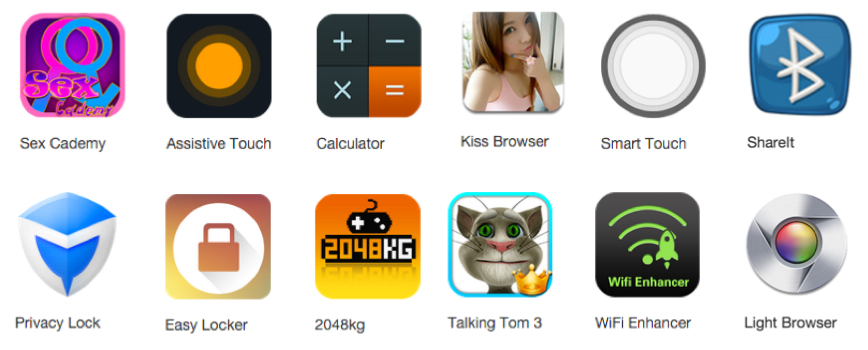
Infections have been discovered in more than 20 countries, including the United States, China, France, Russia, and the United Kingdom. Because of Chinese characters found in the code, it is believed that the malware was written by Chinese developers or controlled by Chinese hackers. The apps included Talking Tom 3, WiFi Enhancer, Assistive Touch, PinkyGirls, and Sex Cademy.

How to protect your Android device from infection

  • Only install apps from trusted stores like Google Play
  • Avoid clicking on links from ads, SMS, websites, or emails
  • Keep your device  and apps up up-to-date
  • Install protection that scans apps like Avast Mobile Security

Follow Avast on FacebookTwitterYouTube, and Google+ where we keep you updated on cybersecurity news every day.

All it takes is a laser pen to confuse the so-called “smart car”

smartcar

Besides radars, cameras, or a GPS system, Google decided that its driverless car would also have a powerful eye mounted on top of the vehicle which is capable of 360 degree vision. LIDAR (Light Detection and Ranging), the aforementioned eye, is capable of measuring distances thanks to a laser light which creates a 3D map of all that surrounds the vehicle.

Despite this technology allowing the car to hit the roads, driverless, without committing any of the errors that befall human drivers, the manufacturers of these autonomous cars aren’t claiming victory just yet as the LIDAR sensors aren’t fully bulletproof. Jonathan Petit, a security expert, has demonstrated their vulnerabilities by showing that they could be easily tricked by external sources.

The investigator managed to fool the sensor by using a laser pen and a pulse generator, which he also claims could be swapped for a Raspberry Pi or an Arduino. So, to trick a smart car, all you need to do is spend around 60 dollars (about 53 euro).

With this system, potential attackers could make the car believe that there is a wall, a person, or another car beside it, obliging it to reduce its speed. They could also send it false signals leading the car to stop itself completely for fear of crashing with these non-existent objects.

While the radars operate on private frequencies, which makes the less vulnerable, Petit was easily able to record and imitate the laser pulses emitted by the LIDAR system. He was able to make various copies of the false obstacles and even move them, thus confusing the sensor and making it believe that the illusion was real from distances of 20 to 350 meters.

google car

Petit will present the details of his investigation at the upcoming Black Hat Europe conference, which takes place in Amsterdam in November. For the moment, however, all that he has revealed is that one of the main selling points of these cars is vulnerable.

Google’s driverless car uses the LIDAR technology of a company called Velodyne, which is based in Silicon Valley and has developed a device capable of storing more than a million pieces of data per second, allowing the car to continue its journey without incident.

This invention doesn’t come cheap, though. Each unit costs 85,000 dollars (around 75,000 euro) and this investigation shows that a high price doesn’t necessarily mean high security protection – even the most expensive ones are at risk.

Although attacks are limited to a specific device for the time being, this expert argues that all manufacturers should keep security in mind and take necessary steps to avoid any dangers on the roads. “If a self-driving car has poor inputs, it will make poor driving decisions,” claims Petit.

The problem could be resolved with a stronger detection system: “A strong system that does misbehavior detection could cross-check with other data and filter out those that aren’t plausible. But I don’t think carmakers have done it yet. This might be a good wake-up call for them.”

It’s not just Google that has tested out these LIDAR systems – the likes of Mercedes, Lexus, and Audi have also tried out prototypes on their cars, which means they also need to keep in mind any potential security risks if they want their driverless cars to become the next step in automobiles.

The post All it takes is a laser pen to confuse the so-called “smart car” appeared first on MediaCenter Panda Security.

Life beyond the screen: Coming face to face with technology addiction

Photo via Telegraph online

Photo via Telegraph online

Believe it or not, there’s more to life than what’s happening online! In its beginnings, technology was intended to make our lives simpler and more convenient. When technology becomes an addiction, however, it can become dangerous to our mental and physical health, not to mention our personal lives.

Avast is a technology and security company. At the same time, we’re also human beings. By sharing cybersecurity news on our blog, alongside our forum and social networks, we aim to make things simpler for our users — providing them with safety tips to avoid headaches and losses of time. In other words, we’d like everyone to reserve as much time as possible for the parts of life that truly matter.

Recently, a study found that students’ performance can significantly decline due to technology addiction. To fight students’ urge to be active on their devices when they shouldn’t be, there are several apps that have been created that close and prevent other apps to be opened, ensuring users to be able to stay focused and concentrated on their classes, research or homework.

Since it has become this difficult to pry ourselves away from our screens, it’s sometimes a good thing to occasionally be left without battery or network coverage. This way, we’re essentially forced to put off our thoughts about what’s being published on social media and focus on the things that are taking place around us.

Here in Brazil, it’s not uncommon to see signs at bars or restaurants that read something similar to “we don’t have Wi-Fi, talk among yourselves” or “we don’t have Wi-Fi, bring a friend to talk to”. These places don’t do this because they need to save money on their Internet bill — instead, it’s about providing their guests with human interactions and a genuine experience.

It’s our job to use our current technology wisely. When it’s time to concentrate and focus, Avast is there to keep our users safe from spam, scams, and hackers — things that cause us to lose time and energy.

You can depend on us to keep your security (and peace of mind) in tact. We urge our users to recommend Avast to the ones who they love and who they want to spend quality time with.


Follow Avast on FacebookTwitterYouTube, and Google+ where we keep you updated on cybersecurity news every day.

The main information security certifications for businesses

security certifications

Just being aware of all the headlines is enough to realize that new threats and vulnerabilities in the field of information security are constantly emerging. As a result, it is essential for a company to be able to rely as much on the preparation of their security professionals as it is their IT governance strategy.

That means there is just one question – what is the best way for both professionals to obtain the adequate training (which makes them more employable), and for businesses to do the same with protocols and security procedures (demonstrating a sense of security to their customers)?

The correct solutions would be the security certifications which allow for a combinations of minimal requirements, a standardized language, and a common, professional code of ethics.

If we as both professionals and leaders within an organization decide to take up a course in IT security management, it is recommended that we opt for certifications given by international and independent organizations.

With this in mind, here are some of the most relevant certifications available:

CISA / CISM

CISA and CISM are the two main accreditations issued by ISACA (Information Systems Audit and Control Association), an international association that has been sponsoring certificates and methodologies since 1967, and is currently made up of more than 95,000 members.

CISA (Certified Information Systems Manager) is newer than CISA, and offers accreditation in the knowledge and experience of IT security management.

What defines CISM are the basic standards of competence and professional development that an IT security director should possess in order to lead or design an IT security program.

CISSP

The Certified Information Systems Security Professional (CISSP) awarded by the ISC is one of the most valued certificates in the sector. Organizations such as the NSA or the United States Department of Defense use it as a reference.

The certificate is also known as being “a mile wide and an inch deep”—indicating the wide breadth of knowledge (a mile wide) that the exam covers and that many questions don’t go into nitty-gritty details of the concepts (only an inch deep).

COBIT

COBIT 5 (the latest version tested) is defined as being a reference point used by governments and for IT management in businesses. It is managed by the ISACA in conjunction with the IT Governance Institute.

COBIT is deigned to adapt itself to businesses of all sizes (including SMEs), different business models, and corporate cultures. Its standards are applied to fields such as information security, risk management, or decision making regards cloud computing.

ITIL

ITIL (IT Infrastructure Library) can be described as a reference of good practice and recommendations for the administration of IT services, with a focus on the administration of processes. The entity that manages this certificate is the OGC (Office of Government Commerce) in the UK.

While COBITS works on the management and standardization of the organization, ITIL centers itself on the processes – COBIT defines the what, and ITIL the how.

ISO / ISEC 27000

The standard that is published by the ISO (International Organization for Standardization) and by the IEC (International Electro-technical Commission) to act as a reference point for a group of standards that provide a framework of IT security management to be used by any type of organization (be they non-profit, public or private, big or small).

As opposed to the other certificates which are aimed at individuals, this one is directed more towards businesses.

The post The main information security certifications for businesses appeared first on MediaCenter Panda Security.

Has the Windows Phone Store become a new target for hackers?

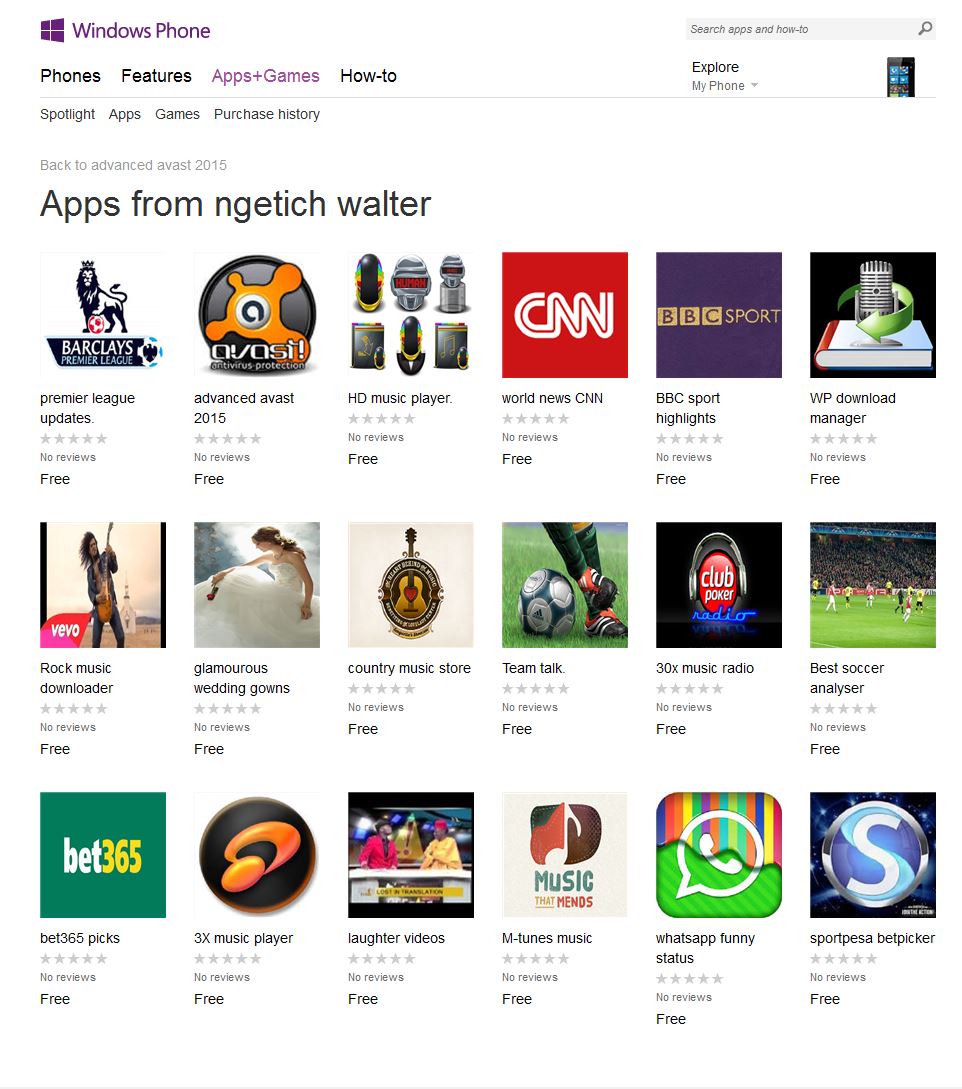
Almost exactly two months ago, we reported on some fake apps found in the Windows Phone Store. Unfortunately, the news hasn’t stopped there – instead, it seems that this third-party app store is becoming an increasingly popular platform for the bad guys. Today, we‘ve uncovered quite a large set of fake apps which includes scams imitating legitimate popular apps such as Facebook Messenger, CNN, BBC, and WhatsApp.

Fake apps advertised by Ngetich Walter on the Windows Phone Store.

Fake apps advertised by Ngetich Walter on the Windows Phone Store.

There are two perpetrators behind these fake apps: Ngetich Walter and Cheruiyot Dennis. Between the two of them, they have 58 different apps available in the Windows Phone Store, all of which are fake. The majority of the apps have certain things in common — they collect basic data about users and display various advertisements that are mostly driven by a user’s location. A portion of the apps try to lead users to pages that force them to submit a request to purchase something. Let’s take a closer look at two of them:

1. World News CNN (a.k.a. Abundant Life): What first appears to be a CNN World News app is actually an evangelical message titled “Abundant Life“.

wp_ss_20151006_0027

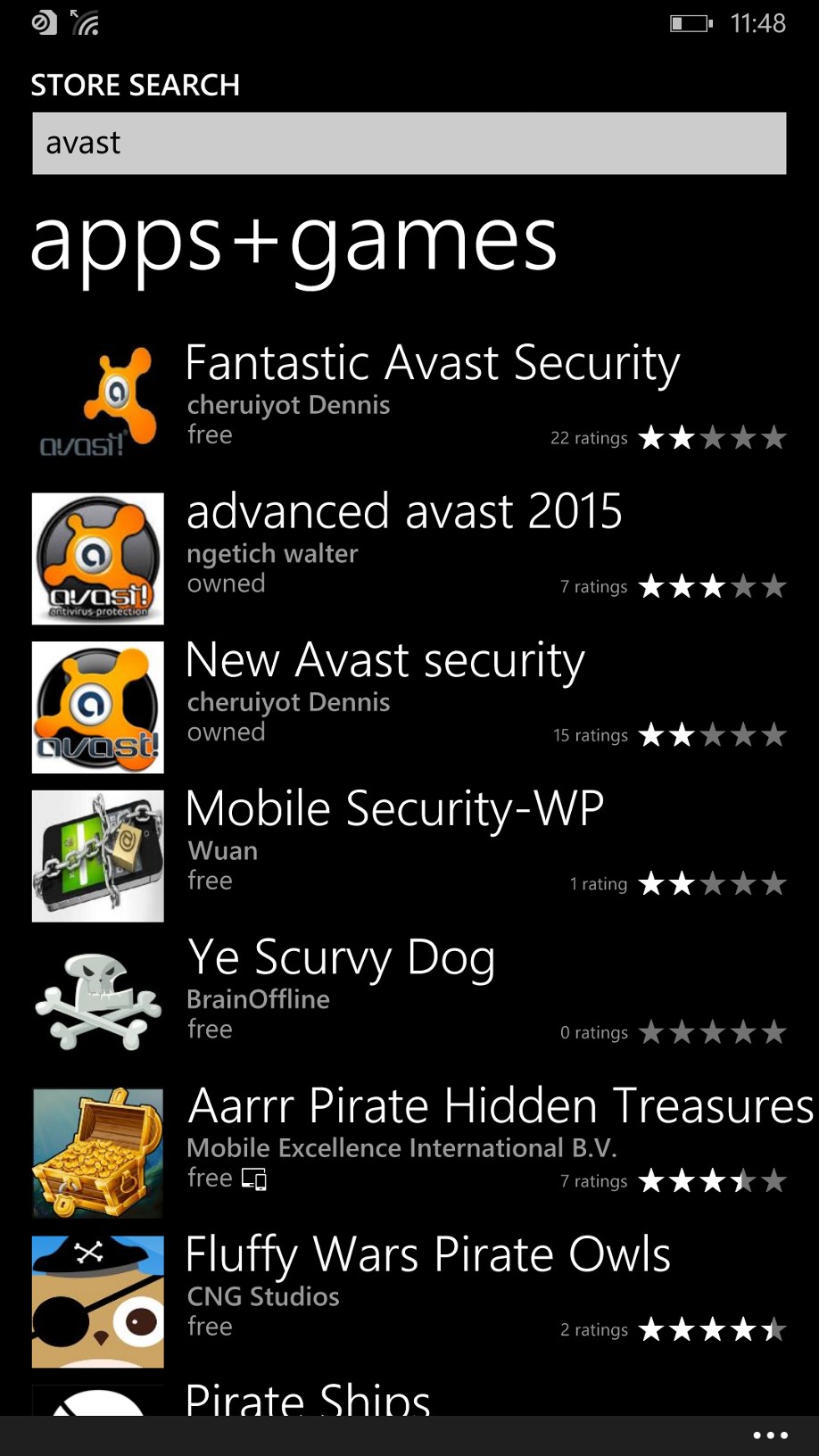
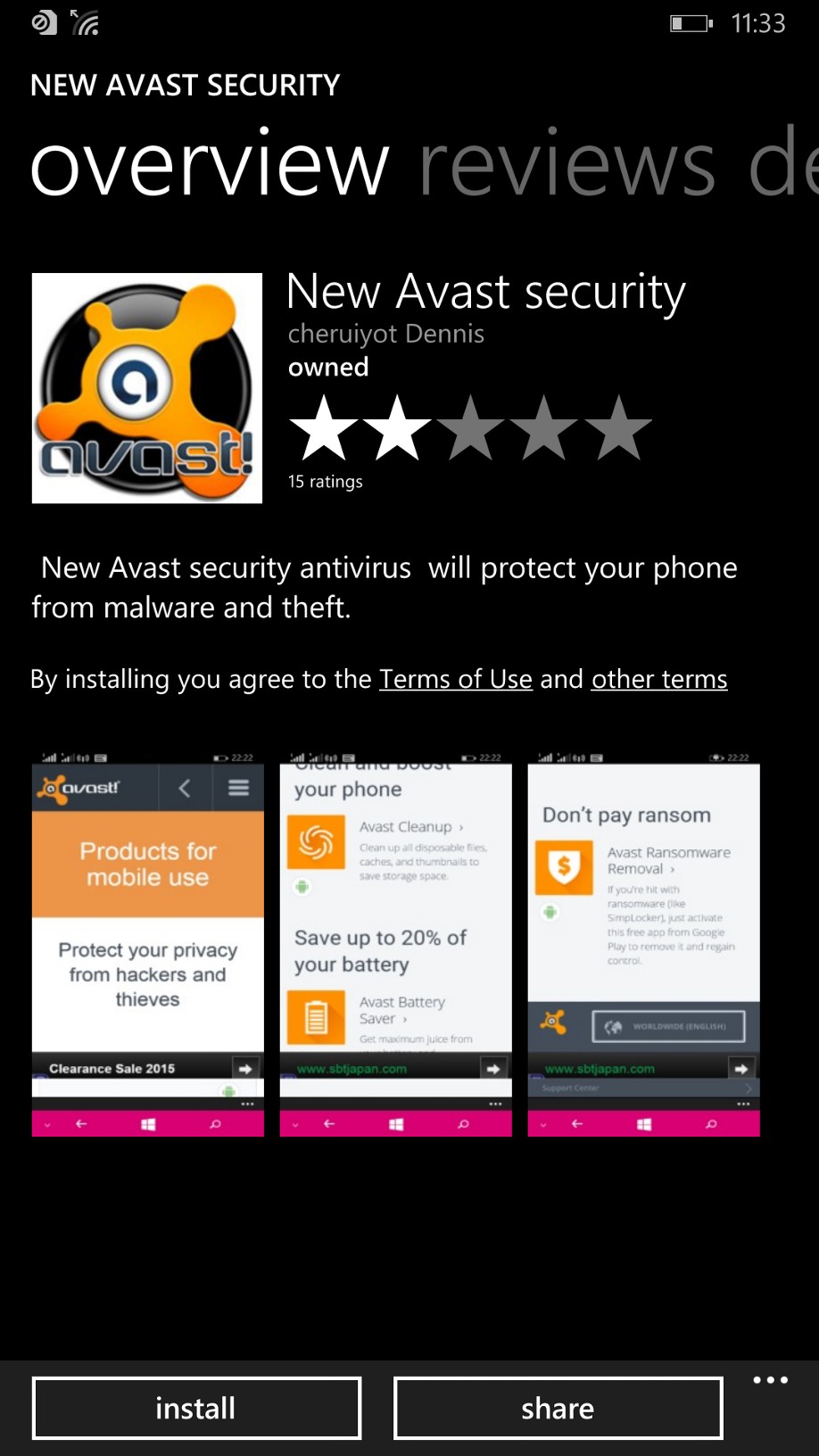
2. Fake Avast Antivirus: Along with the illegitimate social and news apps we discovered, there were even fake Avast apps added into the mix. Fortunately, each of the fake Avast apps are harmless and don’t accomplish anything more else then redirecting users to Avast’s website and displaying advertisements to the user.

wp_ss_20151006_0009

Money, money, money

It’s fairly obvious that hackers don’t do this sort of thing for free. After looking into monetization methods, it appears that hackers are primarly using two ways to profit from producing and circulating fake apps on a large scale:

1. Advertisement clicks: Apps load different kinds of advertisement kits, which are clicked either by the user or, in some cases, the app itself. Theoretically, the bigger the number of apps that you advertise on an app store, the larger number of clicks you would receive – another reason that hackers often offer a large number of fake apps at once.

2. Misleading advertisements: Certain ad servers are remotely controlled, giving them the power to switch different advertisements on and off. In some cases, those ads lead to scammy pages that try to convince you that your device has security issues and that you need to install some other paid product to fix it.

What is the motivation behind propogating fake apps?

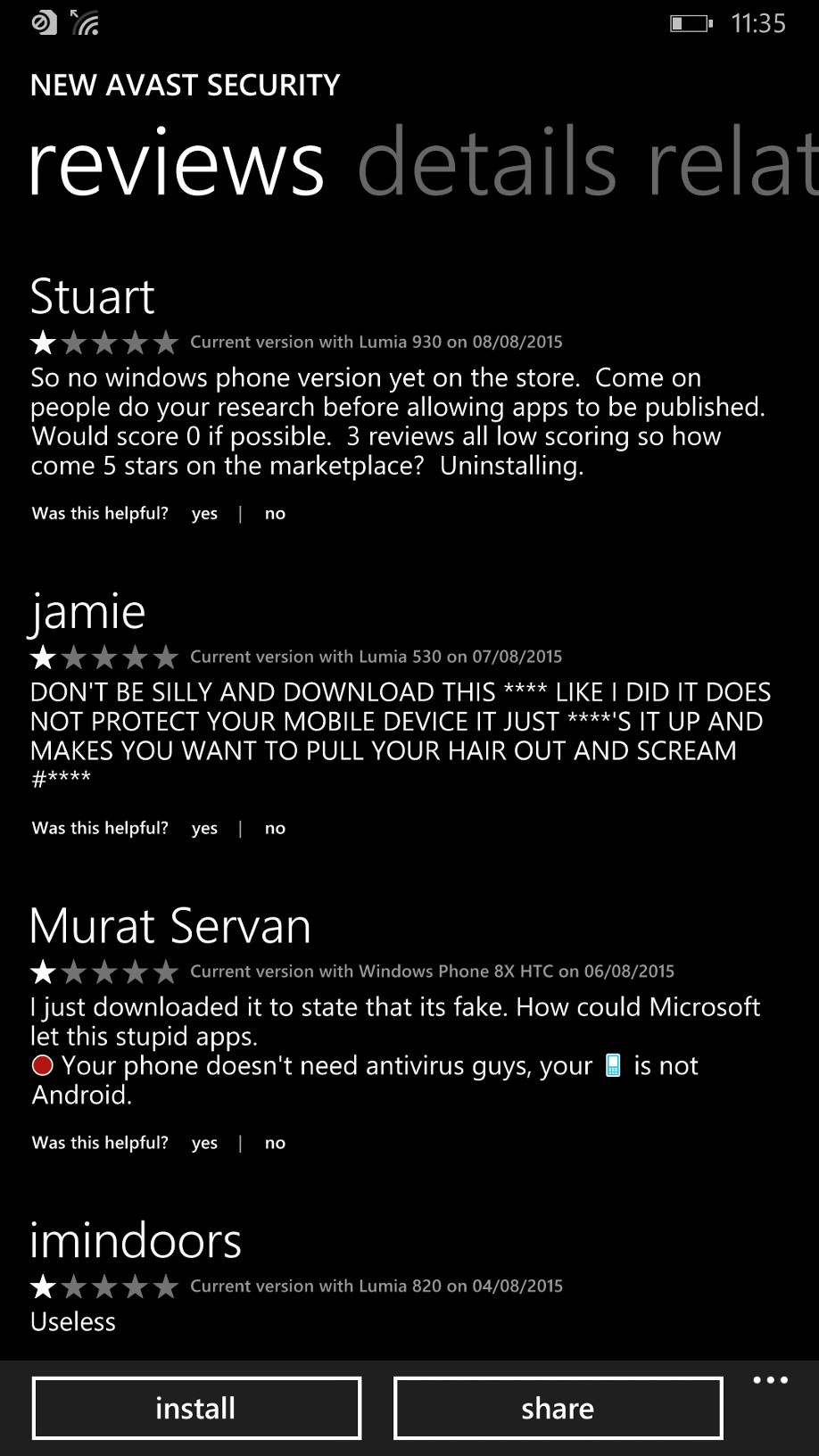
These days, the Google Play store and iTunes continue to implement smarter solutions to protect their entire ecosystems. This approach is making these systems quite difficult to attack and monetize, causing hackers to avoid them altogether. As a result, a less widely used, third-party app store such as the Windows Phone Store is an ideal place for a hacker to hunt for security loopholes. On top of analyzing the reasons behind why these cybercriminals do what they do, it’s also interesting to consider the fact that often, fake apps remain on third-party app stores for weeks and even months at a time. For some reason, no one takes the time to report bad apps, even if it’s clear that they are fake and the majority of user reviews are extremely negative.


Follow Avast on FacebookTwitterYouTube, and Google+ where we keep you updated on cybersecurity news every day.

Pay with Bitcoins to save a hacked phone? It’s a scam!

bitcoins

The Telematics Crime department of Spain’s Guardia Civil has warned of a new type of fraud which affects mobiles. This new operation consists of cybercriminals saying that they have taken control of your device and threatening to reveal private information to your contacts.

They do it via an email similar to this one:

hacking mobile

In this email they give you 48 hours to transfer two Bitcoins (a virtual currency that has a real value) which will increase to five Bitcoins if you don’t pay before the 48 hour limit. By the seventh day, if you haven’t completed the transfer, your private information will be made public.

However, according to the Guardia Civil, this is nothing more than a scam and you should be wary of falling for the trap. Be warned!

The post Pay with Bitcoins to save a hacked phone? It’s a scam! appeared first on MediaCenter Panda Security.

Google takes the fight to Ransomware

mobile malware

It’s becoming more and more common for malicious applications on Android to use this old form of attack. Just like their famous predecessors that went after computers (do you remember the terrible Police virus?), ransomware “kidnaps” the cellphone and demands that the owner pay a “ransom” in order to unblock the device.

It is one of the most worrying threats to mobile users as it renders the device unusable until the fee is paid and is sometimes difficult to eliminate completely. Google is aware of this issue and has finally decided to face it head on.

Its latest operating system, Android 6.0 Marshmallow, which is already available on selected terminals, makes things more difficult for cybercriminals to hijack your phone. This is thanks to the company’s experts designing a new operating system to manage the permissions asked by different applications.

Until now, the user accepted all of the permission requests at once when they installed the apps (quite often without even reading them). Due to this, seemingly inoffensive apps such as a simple flashlight were able to access features that were nowhere near related to their purpose.

Not all were dangerous though, and for the most part they were only trying to fine tune their advertising. However, this arbitrary allowing of permissions by users opened the door to malware and it is one which Google is now trying to close again.

The majority of malicious apps that follow this tactic take advantage of the permission process to open alert window (SYSTEM_ALERT_WINDOW) when the terminal is blocked. Some also open an alert window which is impossible to close while others open an error message which remains on the screen.

permission mobile

In any case, the new manner of managing permission with Android 6.0 Marshmallow will make it a lot more difficult for cybercriminals to block their victim’s phone. A chat wants to access your phone? You’ll need to give it permission. An app wants to see your GPS? It can’t do it without your permission.

Now it seems that the security has been ramped up for permissions that are high risk, such as the case of SYSTEMS_ALERT_WINDOW. In this case, the user will have to manually access their settings within the app if they want to give it the green light – this isn’t something to take lightly, like in the past.

Maybe cybercriminals will think up another way to trick us into granting them permission, but this time they’ll have to think of how to do it without raising any suspicions. To keep those cyberattackers at bay, update your Android operating system as soon as possible. From then on, your best allies will be your common sense and a good security solution.

The post Google takes the fight to Ransomware appeared first on MediaCenter Panda Security.

Avast at Virus Bulletin Conference 2015

Our team had a wonderful time meeting and networking with the crème de la crème of security industry professionals at this year’s Virus Bulletin Conference in Prague, of which we were a proud platinum sponsor. Throughout the conference, a handful of Avast employees presented talks a variety of today’s most prominent security-centered topics. For those who weren’t able to make it to the conference, we’d like to provide a brief recap of the content that was covered.

Taking a close look at denial of service attacks

Avast senior malware analysts Petr Kalnai and Jaromir Horejsi discuss distributed denial-of-service (DDoS) attacks.

Avast senior malware analysts Petr Kalnai and Jaromir Horejsi discuss distributed denial-of-service (DDoS) attacks.

In their presentation, “DDoS trojan: a malicious concept that conquered the ELF format“, senior malware analysts Petr Kalnai and Jaromir Horejsi discussed the serious issues relating to distributed denial-of-service (DDoS) attacks.

Abstract: DDoS threats have been out there since the Internet took over half of global communication, posing the real problem of denial of access to online service providers. Recently, a new trend emerged in non-Windows DDoS attacks that was induced by code availability, lack of security, and an abundance of resources. The attack infrastructure has undergone significant structural, functional and complexity changes. Malicious aspects have evolved into complex and relatively sophisticated pieces of code, employing compression, advanced encryption and even rootkit capabilities. Targeted machines run systems supporting the ELF format – anything from desktops and servers to IoT devices like routers or digital video recorders (DVRs) could be at risk.

In this session, Petr and Jaromir examined the current state of DDoS trojans forming covert botnets on unsuspecting systems. They provided a technical analysis of the most important malware families with a specific focus on infection methods, dynamic behavior, C&C communication, obfuscation techniques, advanced methods of persistence and stealth, and elimination of rivals. After studying cybercriminals’ behavior, our two speakers introduced their operation tools, including vulnerability scanners, brute-forcers, bot builders and C&C panels. They explained that in many cases, it’s unnecessary to apply reverse engineering within the analysis — the original source codes are indexed in public search engines and their customization is a subject of monetization. The pair concluded their presentation by introducing tracking methods and techniques and revealed the targets of these attacks.

Taking mobile security to the next level

Avast security researcher Filip Chytry talks about privacy in the mobile sphere.

Avast security researcher Filip Chytry talks about privacy in the mobile sphere.

Next up was security researcher Filip Chytry’s talk, “Privacy: a growing commodity in the modern age and our Remotium virtual solution to protect it“. Filip’s presentation focused on a few mobile apps that have experienced privacy leaks and provided insight on what could be used as potential solutions to these types of security breaches.

Abstract: Today, we are surrounded by millions of sensors that measure and monitor our lives, cities, travels, homes and communities. There are currently more online endpoint devices and sensors in existence across the globe than there are human beings. Smartphones have become unbelievably integrated into our daily lives, and these tiny gadgets are just the tip of the iceberg that is the modern spying age. Take cameras, for example — when you get the chance, try taking a stroll around a city and see how many cameras you can spot. These could be cameras belonging to other people or surveillance cameras capturing public images. Whether they were taken accidentally or intentionally, it’s difficult to argue with the fact that each of us is featured in public images and visual data that we remain largely unaware of.

Filip pointed out that when examining this issue through a mobile lens, it’s interesting to take a look at apps which benefit us in some way. Although these apps can lend us a helping hand or aid us in socializing with our peers, they often sharing certain data with developers that the average person is likely unaware of and would be uncomfortable with sharing. Filip went on to explain that in the worst case scenario, these apps’ developers can implement poor security standards which could permit leakages of data shared by the user. Concluding the presentation, Filip explained that Avast Remotium is a virtual space that allows users to mask their data, delivering unidentified data in its place in order to protect against data leaks and privacy breaches.

Home Network Security in the spotlight

Pavel Sramek and Martin Smarda discuss home network security issues.

Pavel Sramek and Martin Smarda discuss home network security issues.

Another two stellar Avast malware analysts, Pavel Sramek and Martin Smarda, presented “Solving the (in)security of home networked devices“. This talk outlined real-life issues of home network devices and examined potential risks related to the devices, a topic which is extremely relevant at this time.

Abstract: In the past few years, there has not been a VB conference without a talk about someone hacking the devices they have at home. Be they routers, NAS-es or ‘smart’ TVs, there is always one thing in common — the vendors ignore the problems and refuse to patch their products. We are developing an automated vulnerability scanner intended to test devices without our code running on them. The intention is to educate users about the misconfigurations and vulnerabilities that are detectable from another device in the network. Integrating such a scanner into consumer AV brings home network security to a new level and increases user awareness of those issues. We will present the technology and the challenges we faced on the way towards accomplishing this goal via maximizing the impact of even the simplest vulnerability scans.

Pavel and Martin acknowledged that while a couple researchers reporting an issue is simply not enough pressure to affect manufacturers’ decisions, the possibilities could be huge if millions of users reported this problem to their vendors or made the decision to replace their devices with more secure ones.

Fun at the Avast booth

A bottle of our own Avastweiser beer!

A bottle of our own Avastweiser beer!

In addition to the presentations given by our talented speakers, Avast had a handful of fun activities to offer to Virus Bulletin attendees. At the Avast booth, our team served three types of Czech beer in addition to our own Avastweiser brew, which we handed out to visitors free of charge.

Attendees had the opportunity to join Avast in a tournament of old-school Arcade Games, which we rented from Prague’s Arcade Museum. Among the prizes were a smartphone-controlled paper airplane and a Cheerson CX-20 drone!

We’d like to thank everyone who attended Virus Bulletin 2015 for their interest and support in the security and antivirus industry. We look forward to what next year’s conference has in store!


Follow Avast on FacebookTwitterYouTube, and Google+ where we keep you updated on cybersecurity news every day.

How the Internet of Things will change cybersecurity as we know it


iot

Analysts have been saying for a long time that the Internet of Things (IoT) is about to become a fundamental element in the transformation of businesses – its impact will end up influencing all social and industrial sectors. Recently, the technology consultancy Gartner placed this technology as one to watch (along with machine learning), and estimated that it would reach its full potential within 5 to 10 years.

IoT and the challenges of an imminent roll-out

However, according to this company it won’t be long before we can see how the Internet of Things will begin to generate visible changes – a study presented this month by the Gartner team predicts a transformation in the world of cybersecurity within the next two years, thanks to the Internet of Things. Therefore, by the end of 2017 more than 20% of businesses will be using security services dedicated to protecting businesses initiatives, and that use devices and services based on the Internet of Things.

Likewise, Gartner also predicts that IT and security strategies will need to be redefined as a consequence of adopting this new technology, along with the 26,000 thousand new devices that come with it. This, obviously, will massively increase the number and reach of technological vulnerabilities.

With the massive implementation of the IoT, intelligent gadgets will lose importance against the rise of omnipresent sensors (and the huge amount of information that they generate). In short, the lines between the physical and the digital will become blurred and BITS will act as the engine that allows devices connected to the IoT to change the state of its environment, including their own.

internet of things

Gartner gives a few examples of this – a sensor that detects a temperature that is too low in a room will raise it automatically, or another that readjusts the dosage of medication for a patient in their hospital bed according to their medical records. This is without even mentioning the potential for IoT to change the way we drive on our highways (or, even better, how we stop doing it altogether).

The main challenge for the Internet of Things will be security

Businesses that adopt the IoT (the demand driven by providers and customers will ensure that they do) should increase their connectivity and readjust their maintenance policies. In any case, the main challenge will still be in the security systems. The Internet of Things is set to redraw the lines of responsibilities for the enterprise – security policies will have to be open to different profiles of employees and updating protocols, the same as what happened with the introduction of BYOD or cloud computing, but on a much larger scale, and with a far more visible impact.

“Ultimately, the requirements for securing the IoT will be complex, forcing CISOs to use a blend of approaches from mobile and cloud architectures, combined with industrial control, automation and physical security,” says Ganesh Ramamoorthy, Vice President of Gartner.

“However CISOs will find that, even though there may be complexity that is introduced by the scale of the IoT use case, the core principles of data, application, network, systems and hardware security are still applicable.”

The post How the Internet of Things will change cybersecurity as we know it appeared first on MediaCenter Panda Security.