Tag Archives: Internet Security

How ‘open source’ has made Linux a secure operating system for companies

penguin linux

Perhaps is not the most common operating system on the users’ computers, but for companies there is no other like it. To be exact, there isn’t a safest one. Linux, corporations around the world rely on this operating system to run their servers.

According to the latest study by the Linux Foundation on the operating system most used in the corporate world, 75% of the companies rely on the software created by Linus Torvalds for their servers. The reason? Safety. Almost 80% of the companies that use Linux, think that it is the most reliable operating system.

If we look pass the numbers, it is very significant that places like NASA, CERN or even Google have chosen Linux as their operating system. ‘Open source’ to power, a security token in your company.

Death to vulnerabilities on Linux

It all started in 2007, when an employee of Linus Torvalds set out to eliminate the operating system’s vulnerabilities and errors. His name is Andrew Morton and in an interview he admitted that “I would like to see people spend more time fixing bugs and less time on new features”.

This way, Morton’s obsession for the last eight years has been no other than solving Linux errors. During all this time, the operating system’s code has grown several million code lines, within which there were thousands of patches and, of course, new features.
Linux

This obsession, together with the work of a large group of developers who have collaborated with the project which Torvalds started in the early 90s, has made Linux an operating system safer that most, both commercial and open source.

The quality standard for safety in a commercial operating system is usually a defect for every thousand code lines. Linux beat this with 0.55 errors per thousand lines in July last year.

One of the keys, ‘Open source’

Precisely its openness is what lies behind the security in Linux’s code. With more than four thousand developers contributing to the latest project version, there is an army of eyes looking through the ins and outs of the operating system, searching for bugs and potential vulnerabilities.

That’s what Linux can teach the rest of the operating systems. The community behind it constantly maintains its source code. Its members can detect vulnerabilities in the code lines and eliminate them. This is something unthinkable in operating systems like Windows, when any vulnerability found in the company’s software has to wait for a patch from Microsoft.

windows

That’s way many companies breathe at ease with Linux in their computers and servers. Nevertheless, having an army of machines operating with the system created by Torvalds is not synonymous with absolute relief.

In fact, that is another key of Linux’s success when talking about security, corporations that use ‘open source’ operating system have an eye on Linux’s code and raise the alarm as soon as a vulnerably is detected, so the developer’s community can fix it right away.

Your company’s security will increase when using Linux, yes, but its use entails a slight responsibility. We must not forget that there is nothing completely safe and that any vulnerability can jeopardize the company’s entire information.

Having computers running with Linux doesn’t mean we should forget about safety, actually it means that we should be on the lookout for possible system failures.

So, if in your company you have servers or work stations running with Linux operating system, you can protect them with our antivirus for Linux, Endpoint or Endpoint Plus.

The post How ‘open source’ has made Linux a secure operating system for companies appeared first on MediaCenter Panda Security.


Venom: the security vulnerability in your floppy drive

venom snake

A new security vulnerability is putting at risk computers all over the world.

It is called “Venom” and the most odd thing is that exploits a vulnerability in something that almost no one uses anymore: the floppy drive.

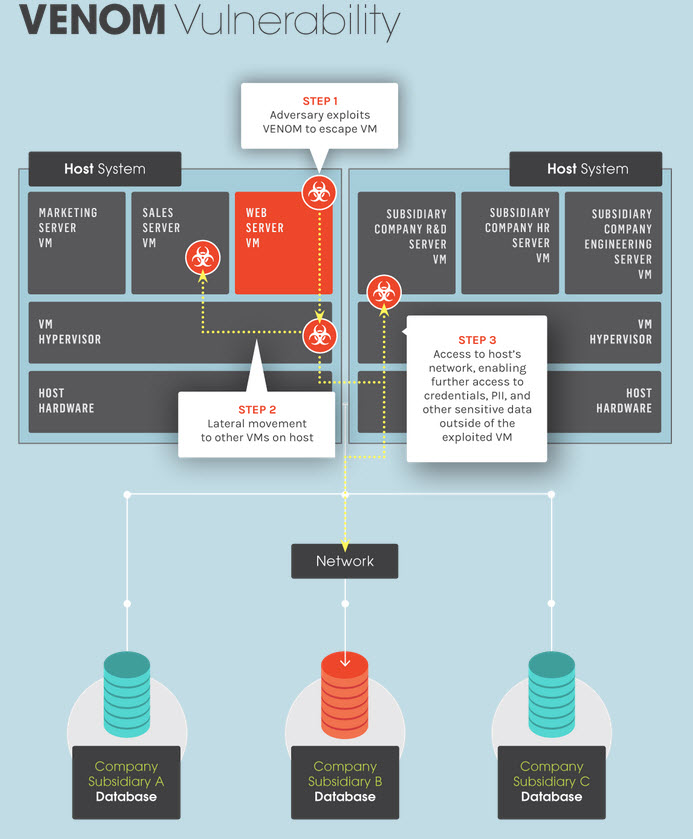
The bug itself is quite dangerous as it allows the owner of a virtual machine to execute code in the host machine and from there move on to the network.

In other words, Venom takes advantage from a vulnerability in the virtual floppy drive controller to enter the system and obtain root privileges, as high as possible, not only of that machine in particular but also for all those connected to the same network.

The chart published in the web page created to gather information about Venom explains it very well.

venom vulnerability

The greater risk is that this vulnerability enables the cybercriminal to access the host system through his virtual machine. Once he is inside the physical machine, he will be able to access any virtual machine running in this system.

If you want to prevent Venom, you can download the already published patches here.

We will keep you updated!

The post Venom: the security vulnerability in your floppy drive appeared first on MediaCenter Panda Security.
The Chief Financial Officer as the new guarantor of corporate cybersecurity

cfo

Technology has for a long time been out of the laboratories and has held, in its own right, a position in the companies’ executive committees. The transformation that ‘digital technology’ is injecting into all types of organizations requires that the top-level executives understand the basis of this new era.  According to Gartner’s report “2014 Gartner Financial Executives International Technology CFO Study”, CFOs must be prepared for this trend as they have an increasingly important role in IT decision-making. It also stated that 30 percent of the CFOs interviewed (almost 40 percent if we talk about SMBs) claimed they took these decisions, compared with 24 percent in 2013.  If there is an area where they should pay special attention, this is without doubt that of information security.

No, cybersecurity is no longer the sole responsibility of IT managers. Nor is it that of the security managers, who often report to the former. CFOs also play a key role in defining the organization’s strategy regarding this subject.  Until now their only duty in the ICT area was to control the department’s budget and assess, together with the CIO, in which security solution they should invest and whether they should increase this in one sense or another. And above all, they must know how to act to protect their organization against the ever increasing risks appearing in the market, ranging from an infection caused by one of the multiple existing malwares, now operating in any platform, to an advanced persistent threat, amongst others. For this reason it is essential that the CFO works closely with the CIO on the development of a security plan which integrates perfectly into the company’s business model and its operations, as well as into its relationship with its employees and shareholders, and that it safeguards the brand and the corporate reputation.

From cost controller to evangelist

How should the XXI Century CFO act?  Experts recommend someone capable of analyzing along with the CIO, the value and vulnerabilities which come with the use of IT and who knows how the company should act when attacked, because it is now practically impossible to prevent ever more sophisticated security incidents. What one needs to know is how to minimize their impact.

On the other hand, the Chief Financial Officer must realize that these types of attacks directly impact on the company’s business and its market value.  This is pointed out in the report “The Value Killers Revisited: A risk management study” by Deloitte, which states that the issues that ‘kill’ this value are not only limited to factors such as the recent credit and euro crisis experienced by the market or M&A transactions, but also include others like cyberattacks, which nowadays are unfortunately very common, as has been seen with recent notorious cases (the Sony Pictures case is only one of many).

Therefore the inclusion of cybersecurity with the issues to be addressed in the risk committees and audits in which they participate is an obligation for CFO’s today, and they should bear in mind which of the company’s assets need the greatest protection in order to guarantee the continuity of the business.  Additionally they must participate in the development of a contingency plan for a possible cybersecurity incident and be certain that they know what to do, as should the CIO and the other members of the Executive Committee.  It is advisable that companies organize simulated attacks to ensure that everyone responsible is prepared should a high range cyberattack really occur.

The Chief Financial Officer should also explain to the managers the risks implicit within the new digital scenario pointing out the most dangerous players, and also assess which methods, technology and human resources are the  most appropriate to combat them. According to experts, one area on which they should concentrate is to have monitoring systems which facilitate the rapid identification of attacks in real time in order to respond with greater agility. It is necessary to anticipate these situations as much as possible. Today, for instance, it is unthinkable that customers are the ones who have to report a possible fraud related to the services offered by the company. The company must act as quickly as possible and be proactive rather than reactive if a security breach occurs, and have their communication and performance strategy already prepared for customers and third parties who may be affected.

Obviously all the above does not mean that from now on the CFO has to lead exclusively the cybersecurity initiatives in his organization. But he does have to start participating more actively and evangelizing about the importance of data security and about the policies to protect them within the Executive Committee. In short, companies (and also society) are now so digital that is simply impossible for its top executives, including the CFO, to ignore the risks and threats which the new scenario entails and which steps are the most appropriate to solve the problem.

The post The Chief Financial Officer as the new guarantor of corporate cybersecurity appeared first on MediaCenter Panda Security.

Security challenges in the digital era

security

The boom in information technology has led to a transformation which has been increasing in recent years due to the widespread adoption of Internet and mobile devices. Individuals and companies are all are imbued with ‘digital life’, which now defines the way we act, buy, work… the way we live. This reality has also marked a before and after in another sector:  that of information security which is becoming more complex every day.

According to IDC, companies are becoming increasingly aware of the risks in the market – from an infection caused by one of the many existing malwares, now spread to any platform and device, to a persistent advanced threat – and almost 50 percent of the companies in Europe (45 percent to be exact) increased their security budgets in 2014. In fact, Spain is the third country in Europe where more companies have increased their investment in this area, just behind the United Kingdom and Germany. Moreover, according to Gartner, another major IT consultant, the fear of suffering targeted cyber-attacks is what is encouraging 40 percent of the largest companies to make far-reaching plans for 2018 to defend themselves against these risks. Plans which they currently lack and which go far beyond preventive controls such as firewalls, traditional antivirus and vulnerability management, and which follow a more global and integrated control of all security areas.

In this context, the way of buying and selling security has also changed radically. According to independent analysts in the ICT sector, companies no longer sell only security, which is just the necessary lever to sell anything related to technology: cloud, big data, Internet of Things, mobility… Let’s say security has become a ‘building block’ for almost every aspect. In fact, these macrotrends carry the most sophisticated formulas for information security. For example, big data and analytics allow behaviors to be modeled in order to prevent attacks.

More sophisticated and intelligent solutions offered as a service

In general, the market trend is to offer as a service the most sophisticated and intelligent security solutions.  Advanced security services, managed and based on the cloud system, are on the rise. As it is no longer possible to put up walls as in the past, we now have to protect companies from below, from the processor itself to the highest levels. In this new approach security must be seen as a more global concept which includes more aspects from communications to storage, passing through many more elements. The key to this more complex world is, on the one hand, that security is immersed in a complete cloud solution, and on the other, that it includes different capacities in order to provide a more comprehensive service.

The price of being safe

 With this more complex scenario with “the ‘baddies’ becoming increasingly ‘badder’ and smarter”, with the proliferation of more sophisticated attacks with different formats making them more difficult to stop, will companies have to invest more money to be safe? The answer is ‘no’. In fact prices have dropped in recent years, especially since the boom of the cloud based system. What happens is that now companies have to protect themselves against more threats. There is a new range of risks and this is why investments in security are becoming increasingly higher.

Obviously, the investment made by large corporations is still higher than that made by the smaller companies.  But at least, it seems that they are all starting to be aware that an attack can cost them a lot of money and can damage their image.  How they deal with it is another matter, but the awareness is there, and also at the highest level within the companies. Moreover, news about security is one of the few subjects in the IT world which makes the headlines in newspapers around the world. Still, as we said, SMB’s are the most vulnerable.  Unfortunately they are generally the least prepared and the main victims of many attacks.

With the Internet of Things the risks can be limitless

Another major risk looming on the horizon in this new digital scenario derives from the so-called ‘Internet of Things’. Given the growing proliferation of all kinds of sensors and gadgets such as the popular wearables, devices which we will all wear in the near future like watches or smart glasses  (many people already do this), and the unstoppable advance of the smartphone, the risks will constantly increase. The Internet of Things means bringing the digital into the physical world, and this will lead to endless security risks. Undoubtedly, with this trend there are many challenges ahead to overcome, not only with regard to safety, but also privacy, complying with the regulations, etc. Therefore, the Internet of Things makes the current situation even more complex, opening up at the same time interesting business opportunities which we should all exploit to the full.

The post Security challenges in the digital era appeared first on MediaCenter Panda Security.

A JPEG may jeopardize your company’s network

smartphone taking picture

We daily capture them on our phones. We have dozens of them stored on our computers. We share them on social networks and we love to see those of others. We are talking about the images in JPEG format, the most used one because when compressed the pictures don’t lose much quality. Indispensables, and yet, could be the tool used by a cybercriminal to access any corporate or institution network.

This was proven by security expert Marcus Murray, who researched a new way a cyber-attacker could exploit a malicious JPEG to compromise Windows servers and access any company’s sensitive information.

The researcher demonstrated how someone could performed this attack during the RSA Conference in San Francisco, an event that gathers dozens of experts in computer security every year. Murray implemented a ‘demo’ to compromise a similar security network to any US government agency network.

upload picture

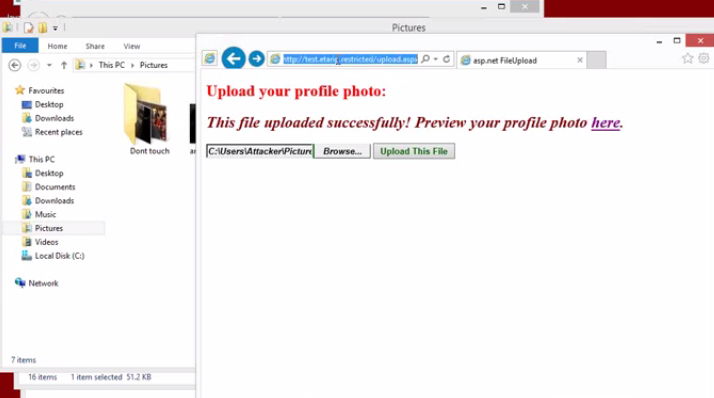
Murray changed the attributes or metadata that any JPEG file stores including in it a malicious code. Then he got this image to infect the corporate network. How did he do it? By a form that allowed users to upload a profile picture to the alleged government agency web page. Once inside, the file became a gateway for the attacker.

Thanks to the malicious JPEG, the cyber-criminal’s administration permissions over the network grew more and more, reaching a point at which he could steal sensitive information or even take control over the network.

The rest of the process is simpler: the criminal only has to exploit his advantage to install malicious software that infects the computers to spy the corporation or steal confidential information. According to Murray, this attack can be performed in “even mixed environments” with Windows and Linux.

secure pc

On the conference in San Francisco, he showed how to introduce a remotely accessed Trojan he created using Metasploit, the popular open source project that allows trying different kinds of attacks as part of a ‘pentest’ (penetration test).

That’s how he prove that only with a picture you can access any company’s network and steal their confidential information, without the employees realizing the damage a file so seemingly harmless could make.

The post A JPEG may jeopardize your company’s network appeared first on MediaCenter Panda Security.
An Insider’s Look at the History of Cybersecurity

Vinton Cerf, often known as one of the “Fathers of the Internet”, was featured in a talk presented by The City Arts and Lectures, held in San Francisco on April 29.

For those who don’t know, Cerf was the co-designer, with Robert Kahn, of the TCP/IP protocols that founded the essential architecture of the Internet. He worked on building what would become Internet protocols as a graduate student. He now has the role of Chief Internet Evangelist for Google.

Cerf was brilliant and charming.  The audience listened intently to his anecdotes and stories about what grew to become the Internet – and so much a part of our daily lives. His talk was supposed to be focused on the Internet of Things, but ended up being wide-ranging and provided a lot of food for thought.

As we celebrate nearly 26 years of the Internet, Cerf’s shared that early Internet security considerations were hampered because work on public key cryptography systems remained top secret.

As Cerf noted in a video interview here:

“I worked with the National Security Agency on the design of a secured version of the Internet but we used classified security technology at the time and I couldn’t share that with my colleagues… If I could start over again I would have introduced a lot more strong authentication and cryptography into the system.”

Specifically in terms of the Internet of Things, Cerf said, it has a great capacity to reduce waste and costs in our everyday lives, but he also noted it definitely has security issues.

Cerf also detailed the fine line between the accessibility of digital data and the right to privacy. This is something he has obviously considered for a long time.

He chose healthcare as one example, where a patient’s heartbeat and temperature can be digitized, and that it is a great tool for medical professionals, but as Cerf said it “wields both ways,” as a hacker or crook would love to know the state of your health or when you’re going to be in the hospital.

Hearing the talk made me wonder what better security and encryption would have meant from the get-go for the Internet. Theoretically, it could have saved us many of the cybersecurity issues we face today.

Interestingly, as a backdrop, Cerf’s talk came on the heels of news of the White House being hacked. The White House had a data breach where Russian hackers apparently gained access to its unclassified computer system. This was reported back in October, but lightly, and now new details are emerging.

The good news is this hack didn’t include classified emails and information. The bad news: The hackers reportedly first breached the State Department system –via a phishing scam –and from there gained access to the White House network. You can read more in The New York Times article.

As they say, hindsight is 20/20, and the Internet is all about moving forward.

We all know cybersecurity issues will only become more important with IoT. If we are to change the course of cybercrime, it will require great minds like Vint Cerf along with champions for cybersecurity in both the private and public sector, more vigilance by businesses and better educated consumers who proactively take responsibility for their own cyber security. We’re certainly committed to doing our part.

You can hear Vint Cerf’s Internet of Things interview broadcast on City Arts & Lectures on Public Radio in the U.S. on May 24.

Title image courtesy of The Guardian

Your likes in Facebook can be the passwords of the future

smartphone keyboard

Do you remember, who was the last person you spoke on the phone with? And the first one you sent a WhatsApp message this morning? If the answer is yes, you might want to change your usual passwords for the answers to this questions.

Do you imagine your passwords changing depending on your last ‘Like’ in Facebook? Anything you have done with your smartphone or your computer during the last few hours can be used as a password by ActivPass. A system developed by researchers of the universities of Illinois and Texas and the Indian Institute of Technology Kharagpur, in India.

These researchers have developed a new method of authentication to unlock applications for which users had to answer correctly questions about recently completed actions. Something that it has proven to be possible, despite of what our absent minds might think. In fact, those who took part in this study answer correctly 95 percent of the questions.

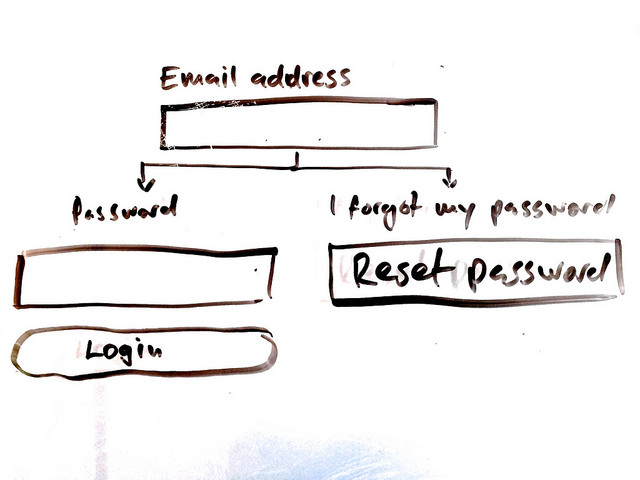
ActivPass could be a possible solution to the many times a user forgets his password and clicks on “forgot your password”. In fact, they hope to reduce the amount of passwords we have to remember thanks to their tool, as the questions will be about recent topics and will change overnight.

forgot-password

They first thought of it as an evolution to the questions about our past which are already used as security measures in many platforms. Questions like: “What was your first pet’s name?” or “What was the first name of your favorite teacher?”

“Whenever there’s something you and your phone share and no one else knows, that’s a secret, and that can be used as a key” says professor Choudhury, University of Illinois. However, this new security method is not foolproof yet. Still raises some unknowns, like what would happen if a long period of time passes and the user can’t remember what he did last time.

Researchers are working to improve it, but for now they just conceive it as a part of a user’s authentication on a platform. Also, during the firsts test they found other disadvantages. Those who volunteered to take part in the tests not only had a high percentage of success in the questions about their own activities, but also were able to answer question about other people less than 6 percent of the time, which is quite disturbing.

forgot password

As the research conducted by Jason Hong, a professor at Carnegie Mellon University, demonstrated the percentage of users correctly answering questions about other people is low.

So, despite of having to fix some details, it doesn’t seem far away when we will use a system like ActivPass instead of standard passwords. An option that is gaining popularity among platforms where you can share content with our friends and family. If, for example, you were to be subscribed to Wuaki.tv, you can give access to your cousin one night without having to worry about changing the password the next day. The password will change depending on what we have done that day, something our cousin would not know, unless you told him.

Passwords that change every day. A method of discouraging those who want to access others accounts, but also a challenge to the absentminded. Would we be able to remember the first thing we did with our phone?

The post Your likes in Facebook can be the passwords of the future appeared first on MediaCenter Panda Security.
Heartbleed. Why do the vast majority of companies remain vulnerable?

heartbleedWhen you visit a webpage, your computer actually accesses the server where the files displayed on your screen are located. If you enter a password on this site, it will also go to the server, where it will be stored. Companies use secure protocols, like the popular OpenSSL, which encrypt communications of computers connected to the network.

So when in April 2014 a serious vulnerability in the software package of OpenSSL was published, companies all around the world held their breath. Since 2012, the open source SSL protocol version was not complying with its protection duty.

The ultimate responsible for the finding was Google’s engineer Neel Mehta, who found it after thoroughly reviewing the tool’s open source code. Mehta along with team members of Codenomicon gave CVE-2014-0160 a simplest name: Heartbleed. With a logo of a bleeding heart to expose the severity of the fault.

The vulnerability allowed cybercriminals to access users information (passwords, bank accounts, and other sensitive information) stored on the Internet servers using OpenSSL.

The news kept on edge thousands of companies that used this system to encrypt communications in their webpages or between internal servers. Even ‘routers’ use the SSL system. One of the affected organizations was the Community Health System (CHS) in the United States: compromising the data of 4.5 million patients until the authorities fixed the error.

keyboard

Fortunately, as with any other security breach, a fix was found. OpenSSL team developed a software update which made it disappear. Professionals had only to follow a few steps to safeguard their communications again.

However, a recent report carried out by a group of security experts revealed that 74% of the largest companies in the world are still at risk. The reason being that those companies have not yet gotten rid of the malware. In addition to installing the new version (1.0.1g or higher) they had to cancel and change the encryption keys and the library certificates. This process requires some computer skills and, in many cases, contact with the digital certificates’ suppliers. Something many of them left half done.

Although some experts doubted the test results, the fact is that Heartbleed is not a regular ‘bug’. When vulnerabilities affect only one program they can be quickly fixed but during its two years of life the OpenSSL breach infected 66% of the active pages on the Internet, according to Netcraft. Even Yahoo! or Flickr were affected and had to fix the problem.

The cryptographic library is one of the companies most used software, from an online shop to a simple user identification on a corporate platform. OpenSSL is often used to protect mail servers, chats and virtual private networks.

Internet users couldn’t do anything about it, just trust that the people responsible for their most visited websites had solved the security breach. Companies did have homework to do in order to solve the problem. We just hope that, at least, the report results make the stragglers get down to work.

 More | Heartbleed, how bad was it?

The post Heartbleed. Why do the vast majority of companies remain vulnerable? appeared first on MediaCenter Panda Security.

This is how Facebook, Twitter or LinkedIn fight to protect your security

social networks

Probably when you were reading about the privacy policy on Facebook or Twitter, you skipped the part of ‘how to protect yourself from cyber attackers’. Each time you download a new application you agree to its terms and conditions, and we are sure that you don’t stop to read them and never worry about how the applications manage your sensitive information.

Social networks strive to inform you on how they protect your information and what can you do to contribute to this task. That’s why they offer the information in the most understandable possible way.

Facebook the most complete

Facebook just had its guide to security redesigned and in the ‘How to Keep Your Account Secure’ section offers new recommendations on how to prevent cyber-attacks through interactive graphics. And to assure everyone can read these tips, they are available in 40 languages and you can share them on your profile.

The recommendations “focus on the tools we make available to help you secure your account, the steps we take to keep your information secure, and the ways you can recognize and avoid attempts to compromise your information” explained Melissa Luu-Van, product manager at Facebook. Van-Luu added in the same post that already millions of people have read the new privacy settings launched last November.

like facebook

Click on ‘help’ if you think your account might have been taken over by someone else, explain you that you have to log out if you are not using your habitual computer or inform you that you can report suspicious profiles and posts are some of the features included in the new security collection.

The guide also warns you of the possibility of a phishing attack. Facebook will never send you an email asking for your password, so if you ever receive an ‘email’ requesting this information could come from a cyber-attacker who created a fake web site to steal your information.

LinkedIn the less organized

Facebook isn’t the only social network which has improved its security information recently. LinkedIn has also a new ‘Security Blog’ with helpful guidelines. “We’ll use this site to share some of our security research, whitepapers on how we handle data and the security features and diligence we’ve built into our products. If you are responsible for information security at an enterprise that uses LinkedIn’s products” says Cory Scott, LinkedIn’s Information Security Director.

This professional network explains how your information is used and protected. For example, inform that they can hire third party companies to provide their services with limited access to your information. In addition its support center offers advice on how to better protect your account: changing your password regularly, check the privacy settings or activate the two-step verification to prevent phishing attacks, that many users have suffered in the last few months.  Nevertheless, this information is less organized than in Facebook, so you will have to dive deeper to find what you want.

Twitter the one that offers personal tips

Twitter also wants to show you its way of protecting your information. If you are interested to know more details, in their help center there is a wide security and protection section, you can access it from the tab of ‘help and support’ in your profile.

twitter

Here you can find out some tips on how to maintain secure account (similar to other social networks), or how to inform Twitter if you find your account has been violated. The company pays special attention to cyberbullying and includes custom security tips for teens, parents and teachers.

What about Google?

But not only social networks detail their security policy; google has been doing it for a while. A complete manual is included in the web ‘How to stay safe and secure online’ where explains how to prevent cyber-attacks protecting your passwords, checking your Gmail’s settings or verifying the emails’ sender if you think it might be a scam.

You can also dig through all the security and privacy tools offered, like two-step verification or who to browse through Chrome without your computer recording it in your browsing history.

So, if you ever wonder how the services you trust every day protect your information against cyber-attacks now you have no excuse, the answer is here!

The post This is how Facebook, Twitter or LinkedIn fight to protect your security appeared first on MediaCenter Panda Security.
InboxScan: the service that checks if you have saved your passwords in your email

inbox scan

Passwords are the unfinished business of Internet users. We have all had the same problem. After carefully picking the perfect password with capital letters, numbers, special characters and which is finally long enough, we have to sing up for another service. Whether it is to open bank account, a new profile on Instagram or to access our telephone bills via the Web we have to remember yet another password.

Although some platforms help us with this task by sending us a password to enable us to enter the account and which can be modified later, we end up learning it by heart instead of changing it.

That email with our password is then forgotten and ends up at the bottom of our inbox.

inbox scan

We already warned you when more than five million Gmail passwords were leaked on a file and security experts have demonstrated with various safety studies that this is an upward trend. If we look back to that forgotten email among other hundreds, you can figure out that its very existence poses a risk, because its content is at the mercy of the cybercriminals who are always ready to steal the information.

If you, like most people, suffer from ‘digital Diogenes syndrome’ it will be difficult to rescue all those emails with sensitive information and to prevent their theft. And to remember all the online services you have signed up for and for which you have kept the original password.

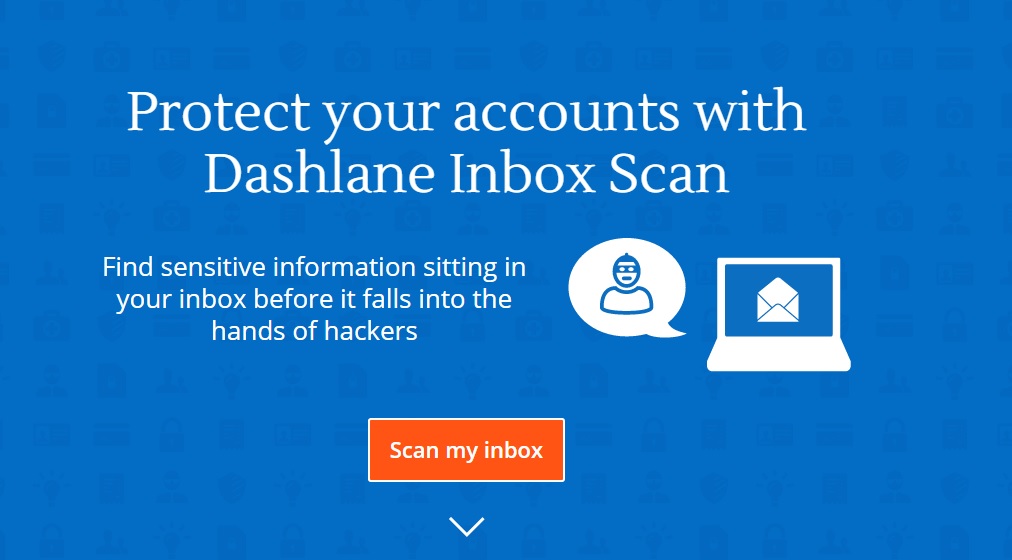
Whatever the case we recommend a useful and simple option called Scan Inbox. A tool which detects forgotten private information in your inbox and deletes it permanently. You don’t even have to download the service. It is available ‘online’.

The program works in Gmail, Hotmail, Yahoo or AOL and searches for and locates sensitive information such as automated emails with passwords or bank account numbers which you think are secure.

To use this tool you only have to indicate your mail server and it will automatically access and scan your email.  Dashlane, the company owning the service, ensures that this intrusion is temporary and no personal information is stored.

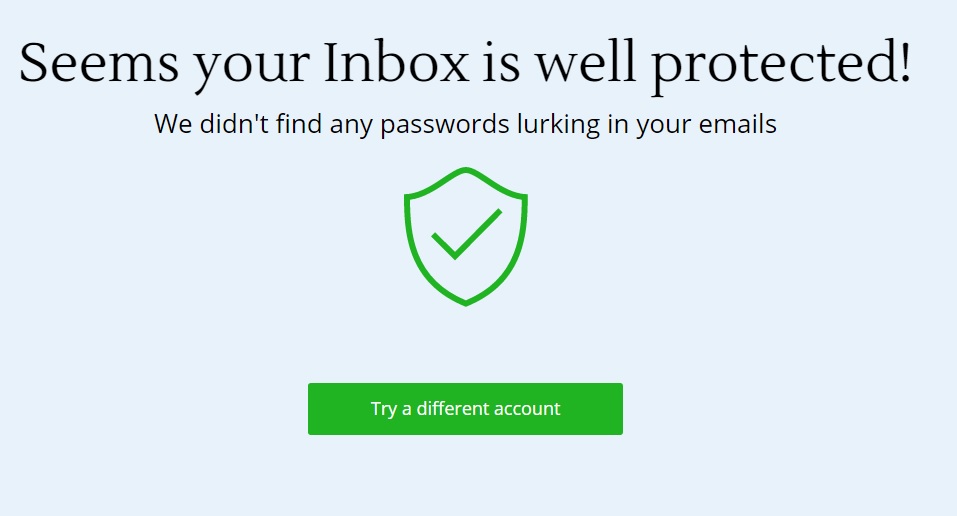
inbox scan protected

Once the analysis is executed and completed, Inbox Scan gives you a full report on the inbox’s ‘health’ with regard to security. The report includes details like the number of passwords and the number of new accounts created, those which might have been affected by a security breach and which passwords have been reused.

All the information is presented in a visual way: a lower bar indicates the time and above it a series of bubbles arranged chronologically. Each of these represents one of the accounts you have created. The bigger the bubble the more important it is, and the color red indicates whether this tool has found a password associated with the account in question.

If the display is not enough for you and you wish to study the report in depth you can download it in PDF. From there on, you just have to change the compromised passwords and delete all the sensitive emails.

An alternative for you to store your passwords safely

If you wish to have all your passwords stored in one place, you can use the password manager of our antivirus software Panda Global Protection.

If you use this you will only have to remember one master password to access all your Web services. In this way, you will never forget another password again!

The post InboxScan: the service that checks if you have saved your passwords in your email appeared first on MediaCenter Panda Security.