Tag Archives: News

Curb Your ‘App’-etite: These Top 10 Apps Stifle Your Phone’s Performance

We all know that excited feeling when you take your new Android phone out of the box for the first time. The possibilities seem infinite – the battery will last forever, your phone will operate at lightning speed and you’ve never had more space for all your photos and music. But, how long until that hopeful feeling fades? Well, just wait until you’ve installed all your favorite apps. You may see your smartphone or tablet slow down to a virtual crawl in no time at all.

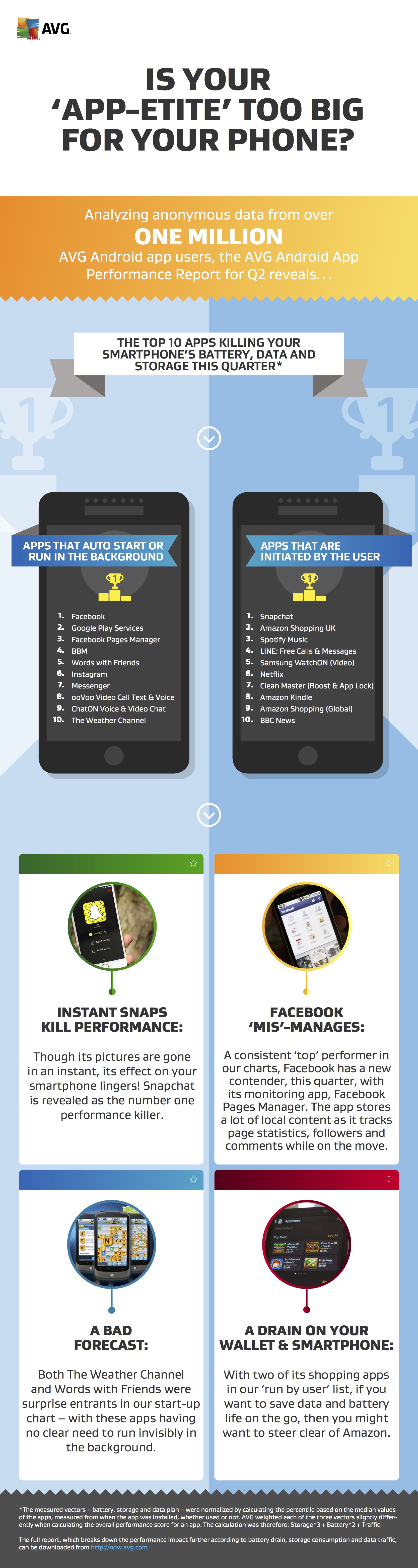
Keen to prevent this? In our global AVG Android App Report (Q2 2015), we’ve again, identified the top 10 apps that drain your battery, clog your storage and use up most of your mobile data. 
AVG App Reprort Infographic Q2 2015

What are the top app sinners? 

  • Snapchat! Oh Snap! Forget Facebook, Spotify, or any of the preinstalled apps: In Q2 2015, Snapchat dethroned them all as the app which had the highest, overall performance drain. Did you know that while it runs, it makes use of the camera, Wi-Fi/mobile data and GPS functionality, simultaneously? This explains the high battery life and traffic consumption.
  • Samsung Updates! The top, hidden battery-drainer this quarter was a service innocuously named “com.sec.android.fwupgrade,” which is responsible for delivering periodic Samsung updates to your device via Wi-Fi. As with the similarly update-heavy Samsung Security Policy Update (KNOX) and Google Play apps, the service has a massive impact on the battery life of your device.
  • Your Browser’s a True Hoarder! Joining more obvious entrants on the top ten list this quarter, such as Spotify and Amazon Kindle, Google Chrome emerged as the second highest, storage-consuming app, thanks to its collection of your browsing data over time. Our advice here: Clean up your browser from the settings menu or use a thorough cleaner product.
  • Facebook ’mis’-manages: A consistent ‘top’ performer in our charts, Facebook entered a new contender this quarter, with its monitoring app, Facebook Pages Manager. The app stores a lot of local content as it tracks page statistics, followers and comments while on the move
  • A bad forecast: Both The Weather Channel and Words with Friends were surprise entrants in our start-up chart – with the apps seemingly having no clear need to run invisibly in the background
  • A drain on your wallet and smartphone: With two of its shopping apps in our top ten ‘run by user’ list, if you want to save data and battery life on the go, you might want to steer clear of Amazon.

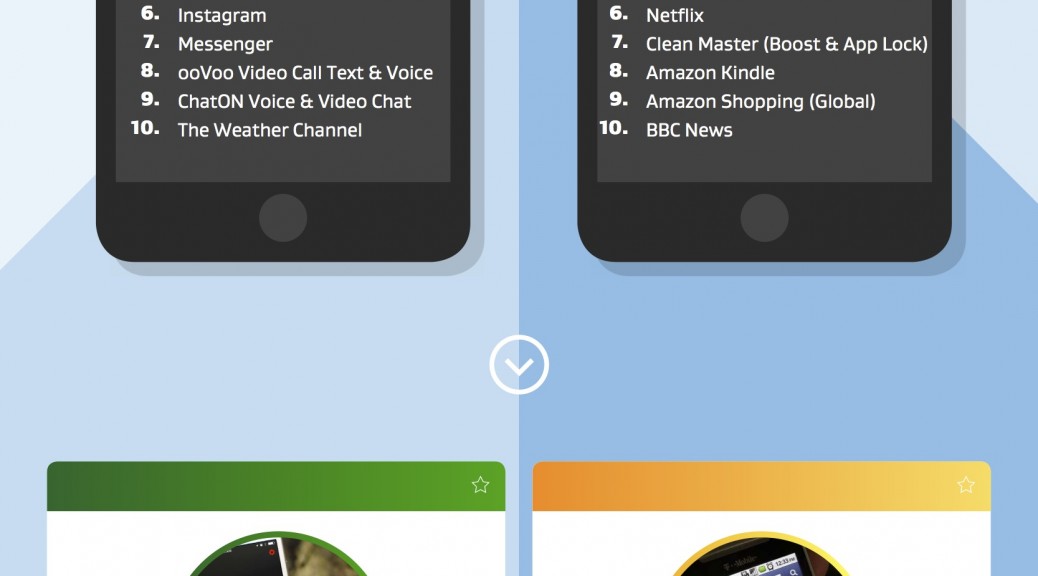
These were just some of the highlights that stood out to us. Our top 10 resource-draining apps should give you even more insight into what apps make your phone or tablet slow to a crawl. We’ve divided our top list into apps that you run by yourself, and those that run quietly in the background, which you may not even know about:

App report q2


Read the entire App Report here.

So what can you do about it?

Now that you know about the top apps, what’s left for you to do? Stay tuned for our next blog on the top tips to optimize your smartphone and tablet.

Is your ‘app-etite’ too big for your phone?

AMSTERDAM – October 20, 2015 – Although its pictures and videos are gone in an instant, its effect on your smartphone lingers, as Snapchat the image-sharing app has been crowned as the number one smartphone performance killer in the latest AVG Android App Performance Report. Compiled by AVG® Technologies N.V. (NYSE: AVG), the online security company™ for more than 200 million monthly active users, the report saw Snapchat dethrone previous top-spot holders, Facebook and Spotify, thanks to its simultaneous use of your device’s camera, Wi-Fi, mobile data and GPS functionality.

Also climbing to the top of the report is the social and blogging platform Tumblr, which has emerged as the highest, traffic-consuming app for the period. Despite the relatively low-level content viewed on the platform – primarily news, short video clips, blogs and some pictures – Tumblr used more data than Netflix and Spotify combined.

Additional findings from the report include:

  • There is a costly quest for updates: Topping the list of hidden, battery-draining services this quarter is the innocuously named “com.sec.android.fwupgrade,” which is responsible for delivering periodic Samsung updates to Android devices via Wi-Fi. As with the similarly update-heavy Samsung Security Policy Update (KNOX) and Google Play apps, the service has a massive impact on the battery life of your device
  • Your browser ‘hoards’ data: Google Chrome emerged as the second-highest storage-consuming app this quarter thanks to its collection of user browsing data over time, joining more obvious apps, such as Spotify and Amazon Kindle
  • Facebook ‘mis’-manages: A consistent ‘top’ performer in our charts, Facebook has a new contender, this quarter, with its monitoring app, Facebook Pages Manager. The app stores a lot of local content as it tracks page statistics, followers and comments while on the move

Though many users make a conscious choice to download and run high-impact apps on their smartphones, AVG’s research has found a host of apps which silently drain smartphone resources in the background without the users’ knowledge or action. These apps are differentiated in the report as those that run at start-up, versus those that are run by the user. The following apps consumed the most, overall battery drain, storage usage and mobile data combined.
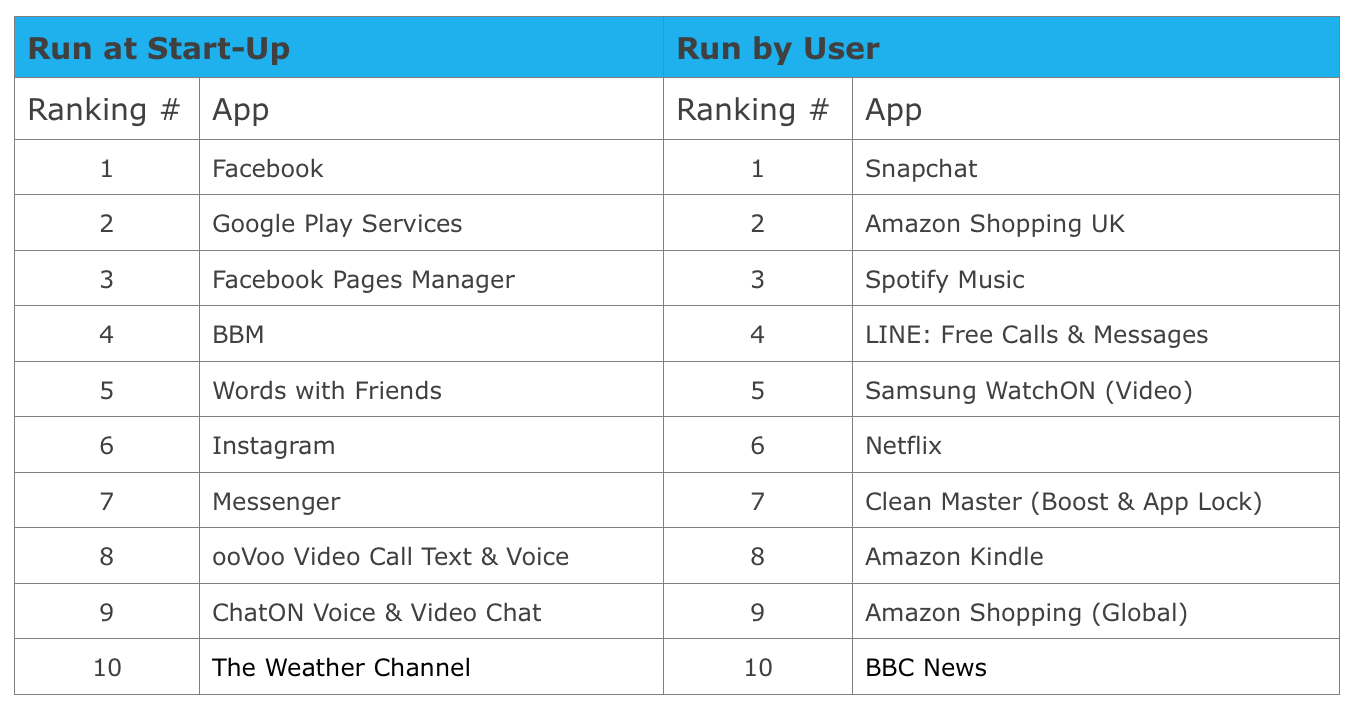
AVG App report

  • A bad forecast: Both The Weather Channel and Words with Friends were surprise entrants in our start-up chart – with the apps seemingly having no clear need to run invisibly in the background
  • A drain on your wallet and smartphone: With two of its shopping apps in our top 10 ‘run by user’ list, if you want to save data and battery life on the go, you might want to steer clear of Amazon

“The goal of these reports is not to alarm smartphone users, but rather to enable them to make informed choices about the apps they run on a daily basis,” said Tony Anscombe, Senior Security Evangelist, at AVG Technologies. “Apps are meant to enhance, not to detract from your smartphone experience, but with so many options, we are in danger of overloading our devices. If you are one of the people who feels like they are fighting a constant battle with their device’s battery, or never have enough storage to save your favorite clips and images, then we want to help you take back control.”

Analyzing aggregated, anonymous data from over one million AVG Android app users, the quarterly AVG Android App Performance Report aims to reveal the top performance-affecting apps worldwide – analyzing their overall impact and performance against three key categories – battery drain, storage consumption, and data traffic use.

The full report can be downloaded from http://now.avg.com/android-app-performance-report-q2-2015


About AVG Technologies (NYSE: AVG)

AVG is the online security company providing leading software and services to secure devices, data and people. AVG’s award-winning technology is delivered to over 200 million monthly active users worldwide. AVG’s Consumer portfolio includes internet security, performance optimization, and personal privacy and identity protection for mobile devices and desktops. The AVG Business portfolio – delivered by managed service providers, VARs and resellers – offers IT administration, control and reporting, integrated security, and mobile device management that simplify and protect businesses.

All trademarks are the property of their respective owners.

www.avg.com


Contacts:

North America:
Deanna Contreras
Tel: +1 415 371 2001
Email: [email protected]

Rest of World:
Zena Martin
Tel: +44 7496 638 342
Email: [email protected]

Press information: http://now.avg.com


Kemoge: Google Play faces new app attack

Android users will be well aware of the fact that the Google Play store, and their Android device, are constantly under the watchful eye of cybercriminals. Thanks to the wide usage of the Android operating system, these criminals use this in the favor and use the Google Play store to help spread their malware to unsuspecting victims.

android malware

The latest case is called Kemoge and, similar to another recent malware that affected iOS users, has its roots in China. This follows Google removing many apps from the online store that disguised themselves as legitimate applications but actually began to push out adware and, eventually, more malicious things. Some of the popular apps that were disguised as Kemoge include Smart Touch, Calculator, Talking Tom, Light Browser, Privacy Lock, Easy Locker and others including adult apps. The malware then collects information from the infected device and starts sending ads in an aggressive manner. The eight root exploits are more worrisome because the attackers can use them to download, install and launch apps on the infected device.

Once the campaign was discovered, Google set about deleting the infected applications from its online store and issued warnings to users. The infection covered a large spectrum of devices, but the root exploits are not one-to-one mapping. Furthermore, some of the root exploits are device oriented, like motochopper which targets Motorola devices, but some others are general root, like the put_user exploit, which can root unpatched devices from Samsung, HTC or Motorola.

Once the device is infected, Kemoge beings to install different components which help it gain root access. It, for example, registers MyReceiver in the AndroidManifest which invokes another component called MyService, both of which are disguised as legitimate Google code because they include Google’s com.google component prefix. This means that the device is under constant control without the victim realizing it.

As always, the best way to avoid being the victim of malware, regardless of what device you are using, is to be protected with an antivirus for Android. As we have seen before, there are many different ways that you could have your or your loved ones’ privacy or information compromised, and prevention is the best form of protection.

The post Kemoge: Google Play faces new app attack appeared first on MediaCenter Panda Security.

Dridex malware crippled by the FBI

On Tuesday, October 13, The United States Department of Justice announced that they had taken down and seized multiple command-and-control (C&C) servers that were part of a network used by the Dridex trojan to upload stolen information and distribute malware.

U.S. Attorney Hickton said, “Through a technical disruption and criminal indictment we have struck a blow to one of the most pernicious malware threats in the world.”

Dridex, also known as ‘Bugat’ and ‘Cridex’, is a malicious trojan used by criminals to steal bank login credentials from an infected PC, in order to gain access to a victim’s bank account—it’s been quite successful too, with losses in the UK estimated at £20 million and in the US at $10 million.

Dridex is commonly distributed in the form of a phishing email, and often contains an infected Word doc attachment. When a victim opens the Word document they unknowingly infect their PC, thereby allowing attackers to eavesdrop on their computer’s activity and automate the theft of data.

Head of Operations at the National Crime Agency’s National Cyber Crime Unit (NCCU), Mike Hulett, said: “This is a particularly virulent form of malware and we have been working with our international law enforcement partners, as well as key partners from industry, to mitigate the damage it causes. Our investigation is ongoing and we expect further arrests to be made.”

While the FBI and other international agencies continue their investigations, UK’s National Crime Agency (NCA) is still warning UK internet users to be aware of and protect themselves against Dridex.

Even though the distribution network has been crippled, the actual malware still exists and can be used by other criminals.

Mike Hulett goes on to provide sound advice for everyone, “We urge all internet users to take action and update your operating system. Ensure you have up to date security software and think twice before clicking on links or attachments in unsolicited emails”.

If you don’t already have a suitable antivirus solution in place, we recommend you install one today. Download our award-winning AVG Protection for your PC to help prevent malware and viruses.


If you or anybody you know has been affected by cybercrime fraud you can report it to:

US
Federal Bureau of Investigation, Internet Crime Complaints Center
http://www.ic3.gov/default.aspx

UK
ActionFruad – National Fraud & Cyber Crime Reporting Centre
http://www.actionfraud.police.uk

AUS
ACORN – Australian Cybercrime Online Reporting Network
https://report.acorn.gov.au