Gentoo Linux Security Advisory 201506-2 – Multiple vulnerabilities have been found in OpenSSL that can result in either Denial of Service or information disclosure. Versions less than 1.0.1o are affected.
Monthly Archives: June 2015
Polish LOT Aeroplanes Grounded By Computer Hack
US And British Spies Targeted Antivirus Companies
How OPM Hackers Tapped The Mother Lode Of Espionage Data
North America Hosts One In Five Of The World's Botnets
Accomplishments and Awards: Kaspersky Lab Q1 Independent Test Digest
CEBA-2015:1131 CentOS 7 paps FASTTRACK BugFixUpdate
CentOS Errata and Bugfix Advisory 2015:1131

Upstream details at : https://rhn.redhat.com/errata/RHBA-2015-1131.html

The following updated files have been uploaded and are currently
syncing to the mirrors: ( sha256sum Filename )

x86_64:
24b3bf897337e5c2f78711db4df73cc5d9265db50d8d84480b418cf381269835  paps-0.6.8-28.el7.1.x86_64.rpm
811665608f8897bd2c6f77849951ba8f9768c6297b9acada1b8a7d48420cae39  paps-devel-0.6.8-28.el7.1.i686.rpm
8c68912593558e68d5c38b01c845ed3339fe06b21682e2005e2929c93b241424  paps-devel-0.6.8-28.el7.1.x86_64.rpm
b5e53dc9cab2c14243ada528433f09244fc42dfc87dea9433531655cc9379375  paps-libs-0.6.8-28.el7.1.i686.rpm
ca2e1da1f5ffdc62f85c037c507ac96554046f2abb46bdfaaa3fb8eedc9e367c  paps-libs-0.6.8-28.el7.1.x86_64.rpm

Source:
01955f5f405288f98ef2f299886e7478220d1c4bc59053cb8b7cd4ef7e41bf6f  paps-0.6.8-28.el7.1.src.rpm
Looking back at WWDC 2015
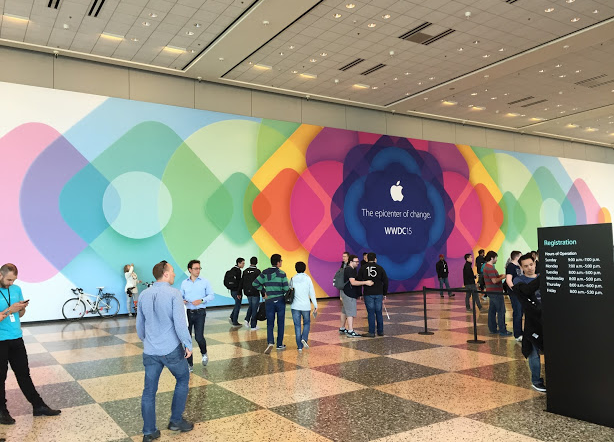
Apple’s Worldwide Developers Conference kicked off June 8 at San Francisco’s Moscone West.
Earlier this month, I was lucky enough to attend Apple’s Worldwide Developers Conference (WWDC) in San Francisco, where mobile developers from far and wide came together to learn about the future of iOS and OS X systems. Along with being the first time I was able to participate in this sought-after conference, it was also my first time visiting San Francisco.
Once you get past its glitz and the glamour, the majority of the event revolves around waiting in a series of queues — the day before the actual event began, the line for the event’s keynote lectures had formed around an entire city block. Although I wasn’t one of the first people to camp out there, I did arrive around 5:30 a.m. on Monday to stake out my spot. While the masses of people at WWDC can be a bit overwhelming, there really isn’t a better place to meet thousands of like-minded developers with whom one can strike up an interesting conversation discussing the ins and outs of of iOS development.
This year, Apple hosted 5,000 developers from 70 different countries, the vast majority of whom were present at WWDC for the first time. The WWDC Scholarship Program awarded 350 scholarships to recipients, the youngest of whom was Kiera Cawley, a 12-year-old app developer who has been coding since the age of nine. Apple CEO Tim Cook made a guest appearance at the conference’s special orientation session, mingling with the recipients and even taking selfies with some of them.
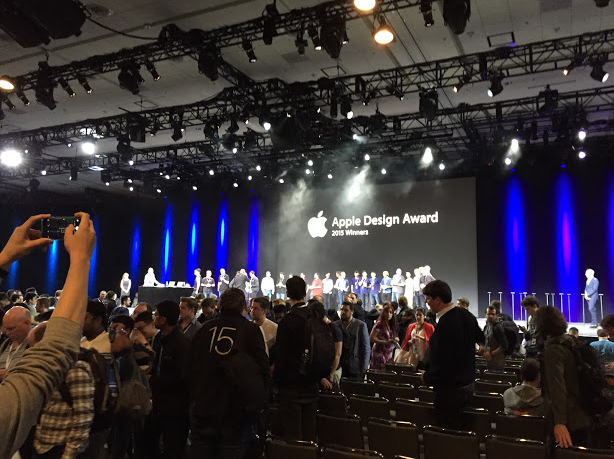
WWDC 2015
OS X EL CAPITAN — what a name! At first, I thought it had to be another joke from Craig Federighi, but I was wrong. A noteworthy new feature in El Capitan is the split view mode, which allows us to work on two apps simultaneously. Apple claims that there has been a 1.4x time increase in app launch times and 2x improvement in app switching speeds. In general, Apple has been quite busy and has made huge improvements for developers. The most exciting news is that Apple will be making Swift open source later this year — a big step forward for the developer community.
The recent release of iOS 9 makes the entire system smarter and more secure. Now, users can run two apps at once on an iPad, side by side in split view (the same feature present in OS X). This will be challenging for developers who still don’t prefer Auto Layout. For the rest of us, though, it works quite well. It’s also possible to make activities and documents within your app searchable using Spotlight or to include special links on your site that launch your app at a specific view. And yes, it’s still necessary to support iPhone 4s on iOS 9. However, it should be more optimized now more than ever before.
Jennifer Bailey announced release of Apple Pay in the UK next month. This was a bad piece of news for the developer sitting right next to me. He was working as a freelancer for a company that provides mobile payments in the UK via iOS. “My company is screwed and I should start looking for a new job,” he said in response to Bailey’s announcement. Apple Pay’s imminent launch is, unfortunately, not the best update for people whose jobs revolve around mobile payments.
During the rest of the week, Apple featured 100 sessions and labs, and over 1000 Apple engineers were present and ready to give me advice. UI Design Lab was the most popular workshop at the conference, and you could count on the fact that there’d be a huge line every day. After trying to get into the session every morning, I was finally able to make an appointment on Friday. In the end, it was worth the wait. 
All in all, WWDC was a great opportunity to meet an impressive collection of talented developers and to discuss the vast amount of progress Apple has been making within the mobile sphere. See you next year, Apple!

Time to Hang Up? Parents Should Look into Latest Smartphone Studies
Our children are spending more and more time with smartphones, and with good reason. They give parents a line of contact, and give kids access to loads of great games and apps.
But a recent study from the London School of Economics suggests that you may want to limit or delay your child’s access to smartphones. It shows a clear link from schools that ban students from carrying phones to an improvement in their test scores.
So what’s the gist of the study? It turns out that having a smartphone – or barring one—has a real and measurable impact on education.
“We found the impact of banning phones for these students equivalent to an additional hour a week in school, or to increasing the school year by five days,” researchers Richard Murphy and Louis-Philippe Beland stated. The study, released this May, is called Ill Communication: Technology, Distraction & Student Performance. It also found that following a ban on phone use, the schools’ test scores improved by 6.4%. The impact on underachieving students was much more significant — their average test scores rose by 14%. The results noted that they could focus regardless of the presence of a smartphone.
The authors looked at how phone policies at 91 schools in England have changed since 2001, and compared that data with results achieved in national exams taken at the age of 16. The study covered 130,000 pupils. (See link to the full study here.)
It’s an interesting conundrum. Many of us think that technology is a driving force for improvement and development. I think that having the great wealth of education on the Internet can only be a boon. But the authors of the study draw awareness to the contrast. “Technological advancements are commonly viewed as leading to increased productivity. Numerous studies document the benefits of technology on productivity in the workplace and on human capital accumulation. There are, however, potential drawbacks to new technologies, as they may provide distractions and reduce productivity.”
Here in the US, these new studies may change a few minds and tilt a few policies. For example, Mayor Bill de Blasio of New York City just revoked a decades old ban on cell phones, leaving it up to individual principals, in consultation with parents and teachers. I wonder now if he might re-think his decision?
Other research underscores the concerns raised. A major educational study by the Pew Research Institute found 87% of teachers surveyed said that Internet and digital devices are creating an “easily distracted generation with short attention spans” and 64% said today’s digital technologies “do more to distract students than to help them academically.”
The crux of the matter is this: Kids are using their phones to text and chat when they should be paying attention in class and interacting with others personally and not digitally.
Meanwhile, yet another recent study outlines additional risks of smartphone behavior: They don’t allow us to think for ourselves.
A study from researchers at the University of Waterloo (Canada) published in the journal Computers in Human Behavior, says that “Smartphone users who are intuitive thinkers — more prone to relying on gut feelings and instincts when making decisions — frequently use their device’s search engine rather than their own brainpower. Smartphones allow them to be even lazier than they would otherwise be.”
“They may look up information that they actually know or could easily learn, but are unwilling to make the effort to actually think about it,” said Gordon Pennycook, co-lead author of the study.
“Decades of research has revealed that humans are eager to avoid expending effort when problem-solving and it seems likely that people will increasingly use their smartphones as an extended mind,” noted Nathaniel Barr, the other lead author of the paper.
I think it is great to have so many tech educational resources at our fingertips. But I too worry about is the next generation. Thinking about things, focusing, contemplating, and making decisions are a crucial part of a young person’s life – as is imagination.
We’ve also done a lot of research on children, Internet safety and the mobile world. AVG Digital Diaries research findings last year showed 42% of the parents polled by AVG said that they are concerned that their child spends too much time on devices, and a similar number (43%) said they were worried their child didn’t spend enough time outside.
So what does this all add up to, in the big picture?
If you have kids, it’s important to take control and limit use of smartphones by setting up guidelines. At AVG, we offer parental controls to limit and guide smartphone usage through our Location Labs products.
After all, even Steve Jobs famously limited how much technology his kids used at home.


CEBA-2015:1128 CentOS 6 selinux-policy BugFixUpdate
CentOS Errata and Bugfix Advisory 2015:1128

Upstream details at : https://rhn.redhat.com/errata/RHBA-2015-1128.html

The following updated files have been uploaded and are currently
syncing to the mirrors: ( sha256sum Filename )

i386:
c34b15ba6f550ee470feeee3a1293da33163bd6ee541619e26951a9fc5b60138  selinux-policy-3.7.19-260.el6_6.5.noarch.rpm
4cc82766e9dd5ca42debc5454fb54ec05b445220a111917c2be0011d64c2e309  selinux-policy-doc-3.7.19-260.el6_6.5.noarch.rpm
98403e1609639cd41bbcbb9c4044b87aa23c0a758e29d06a904fe1e10768b3aa  selinux-policy-minimum-3.7.19-260.el6_6.5.noarch.rpm
c4b9a85a62c7fca806261b827491a7b5f29e5e7494ffae7b497f54ae456a2f7f  selinux-policy-mls-3.7.19-260.el6_6.5.noarch.rpm
291844b1db889754a9d0b8526c054d9392de84c6f97c940b32924d80533dd5d8  selinux-policy-targeted-3.7.19-260.el6_6.5.noarch.rpm

x86_64:
c34b15ba6f550ee470feeee3a1293da33163bd6ee541619e26951a9fc5b60138  selinux-policy-3.7.19-260.el6_6.5.noarch.rpm
4cc82766e9dd5ca42debc5454fb54ec05b445220a111917c2be0011d64c2e309  selinux-policy-doc-3.7.19-260.el6_6.5.noarch.rpm
98403e1609639cd41bbcbb9c4044b87aa23c0a758e29d06a904fe1e10768b3aa  selinux-policy-minimum-3.7.19-260.el6_6.5.noarch.rpm
c4b9a85a62c7fca806261b827491a7b5f29e5e7494ffae7b497f54ae456a2f7f  selinux-policy-mls-3.7.19-260.el6_6.5.noarch.rpm
291844b1db889754a9d0b8526c054d9392de84c6f97c940b32924d80533dd5d8  selinux-policy-targeted-3.7.19-260.el6_6.5.noarch.rpm

Source:
fcecdcdc7fdda1c16c965bc4bf54de300b71a9ec4299556e853f3c202c7ace2c  selinux-policy-3.7.19-260.el6_6.5.src.rpm