Category Archives: AVG

AVG

Managed Services: Der Kick fürs Business

Düsseldorf, 7. September 2015 – AVG (NYSE: AVG), der Online Security Anbieter für mehr als 200 Millionen aktive Nutzer, ist Hauptsponsor der Veranstaltung “Managed Services: Der Kick fürs Business“. Gemeinsam mit den Unternehmen Epson sowie dem Reseller-Experten und Chefredakteur von ChannelPartner, Dr. Ronald Wiltscheck diskutiert der Anbieter die Zukunft und die Chancen des Channels. An insgesamt fünf Stationen in Deutschland und der Schweiz erfahren IT-Service-Anbieter und solche, die es werden wollen, wie sie ihr Geschäft mit Service-Angeboten effektiv ausbauen können.

“Wir sehen deutlich, dass sich das Geschäftsmodell unserer Partner ändert – und sich auch ändern muss”, erläutert François Tschachtli, Sales Director DACH & Benelux, AVG Business. “Die Zeiten, in denen Fachhändler und Systemhäuser einfach nur Produkte aus dem Regal verkaufen konnten sind endgültig vorbei. Ohne ein Service-Angebot geht heute nichts mehr. Auf diesem Weg wollen wir unsere Partner begleiten und sie dabei unterstützen, ihr Geschäft noch weiter voranzutreiben.”

Auf der Agenda der Veranstaltungen stehen u.a. folgenden Themen und Sprecher:

  • Dr. Ronald Wiltschek, ChannelPartner: “Trends und Chancen für Systemhäuser – neueste Studie und Prognose von ChannelPartner”
  • Oliver Wegner, evolutionplan: “Erfolgreich verkaufen  Marketing- und Vertriebsstrategien für Systemhäuser”
  • Vertreter lokaler Systemhäuser berichten über die Erfahrungen, die Sie mit Managed Services gemacht haben

Darüber hinaus stellen AVG Vertreter die unternehmenseigenen Lösungen für das Remote Monitoring und Management anhand einer Live-Demo vor und erklären, wie sich damit die Profitabilität eines Unternehmens steigern lässt. Zwischen den einzelnen Programmpunkten ist Zeit für Rückfragen, Diskussionen und Networking.

Lokationen und Termine:
Hamburg, 22.09.15: Millerntor Stadion
Düsseldorf, 23.09.15: Esprit Arena
München, 13.10.15, Allianz-Arena
Stuttgart, 14.10.15, Mercedes-Benz Arena

IT-Service-Anbieter und Reseller haben so die Gelegenheit, sich mit den Experten der AVG Business und deren Partnern über die neuesten Trends und Geschäftschancen im Channel auszutauschen. Anmeldungen können ab sofort entweder online unter www.your-business-kick.com oder telefonisch +49 211 586 99 200 erfolgen.

Hinweis für Pressevertreter: Gern vereinbaren wir ein Interview mit einem der Sprecher. Für eine Terminvereinbarung wenden Sie sich an [email protected] oder +49 89 17 959 18-0.

Ansprechpartner für die Presse:
Martina Krelaus
Akima +49 89 17959 18-0
[email protected]

The future of work-life balance and tech

Many of us question the impact of technology on work-life balance, as our lives play out in the always on, always connected 24×7 workplace.

Now, in the heat of the late summer, the topic has become a hot one in the tech industry itself – from a controversial new New York Times expose that examines Amazon’s purported workplace culture to the highly-reported news of increased parental leave programs by key companies and, finally, a release of some annual  “top” ranked company lists.

First, a look at the expanded parental leave offerings unveiled this summer:

  • Netflix announced it is offering a year’s paid maternity or paternity leave to its employees.  Specifically, Netflix has put in place “an unlimited leave policy for new moms and dads that allow them to take off as much time as they want during the first year after a child’s birth or adoption.”
  • Microsoft said it would offer 20 weeks of paid leave to new mothers, up from its current 12 weeks paid and eight weeks of unpaid leave. New fathers will get 12 paid weeks, instead of four paid and eight unpaid.
  • Adobe said it would offer parents who are the primary caregivers 16 weeks of paid leave after the birth or adoption of a child – in addition to 10 weeks of paid medical leave following childbirth. That means a new mother could take a total of 26 weeks off — up from the current nine weeks.

Among offerings of other tech giants already in place: Google raised its paid maternity leave from 12 to 18 weeks in 2007. Facebook’s new parents receive four months of paid leave, as well as $4,000 in “baby cash.”

Analysts say the underlying goal of the newly updated parental leave programs is not totally altruistic,but are efforts for the companies to stay competitive in the super competitive Silicon Valley tech job market. They also expect that outside of the tech sector, little will change… particularly for startups and smaller businesses that cannot afford to provide equally rich programs.

While the new parental-leave policies of tech powerhouses are innovative, the U.S. is still playing catch-up when it comes to other nations. For example, the U.S. is the only developed country that does not mandate any paid leave for new mothers. (See Pew research on the topic from 2013 here.)  BTW, in most countries that offer paid time for mothers (a median of 5-6 months), their government picks up the tab and paternity leave is more limited (offered by only 25 of the 38 nations).

U.S. Sen. Kirsten Gillibrand of New York and U.S. Congresswoman Rosa DeLauro of Connecticut are pushing for a new law that would provide 12 weeks, but not unlimited leave, in the U.S. under their bill, employees and employers would make small contributions and pool them so that workers can draw a significant portion of their pay while caring for a newborn or for other serious personal or family illness.

To be sure, advances that are taking place toward work/life balance in the U.S. aren’t only in the domain of Silicon Valley. In its examination of the 25 companies that have “the best” work/life balance in the U.S, Forbes Magazine cited more exemplary non-tech companies than tech examples.  Forbes’ criteria went beyond time-off to other considerations.

According to the Forbes list, the best company for work/life balance for the third year in a row, is non-tech giant Colgate/Palmolive. Among tech companies to rank on the list were Google, Nokia, Philips, Motorola, and Intel… You can access the list here. (The Forbes survey, conducted in concert with the job search engine Indeed, ranked companies with least 100 employees which hire primarily full-time workers. The list does not include government or military organizations, colleges and universities, nonprofits, or staffing agencies.)

The Forbes survey also notes that in 2015 work/life balance, flexibility is fast rising up the ranks in importance. Though the number one consideration for people is still pay, number two is location and number three is flexibility – even ahead of benefits.

In the end, though it may be a culprit when it comes to taking away from our work/life balance, technology is also a driving factor in helping make the balance possible…

And there lies a conundrum that we in the tech industry and all companies must all continue to work on.

Will your kids ever have privacy?

A study carried out by the Global Privacy Enforcement Network (GPEN), involved over 29 privacy enforcement authorities in 21 countries. It found that only a third of websites had effective control of the information collected on our kids.

Understanding what happens to the personal information of your children needs to be high on the agenda of all parents. I’m not sure it’s understood due to the covert way that the data is being collected. Have you ever tried reading the privacy policy that accompanies websites and apps? if you haven’t then I am fairly certain your kids haven’t.

Imagine someone knocking on your door and asking for your child’s email address and access to their friends contact details. You would be shocked at the audacity of the request and send them away with nothing. When our kids go online or use apps, this very information is being given up without thought about what happens to it.

When something is free, such as an app or web service, it’s not because the company developing it is just being nice. Companies need to make money so that they can fund innovation that will keep us functional and entertained. One of the ways they can do that is by using our data. As consumers, especially when it’s our kids, we need to understand the trade off between free and acceptable data collection and use.

In a recent BBC article about the GPEN findings, Mr Adam Stevens, head of the UK’s Information Commissioner’s Office, said: “The most common concern domestically was a lack of information being provided about how their information would be used.”

The study identified concerns with 41% of the websites examined and that a minority of sites had an accessible way to allow families to delete data.

It’s important that we engage with our kids and teach them the value of their data. They need to understand how apps and services they’re accessing are using their personal data, and we need to guide them on what is acceptable usage.

Data breaches are now common place, and with vast amounts of personal data being collected and stored the consequences for our kids could be significant.

While I would not encourage kids to tell untruths, I might encourage them to have a modified set of data for use online, for example: their place of birth could be anywhere and the day of their birth does not need to be the real one, however their year and month of birth should not differ from reality as the reputable websites and apps deliver content that is age appropriate.

I personally have multiple email addresses: one for my serious stuff like banking and family communication, and an account that I can burn if it becomes compromised or I start getting too much spam. While this maybe a complicated thing for our kids to do, the principal behind this is something worth educating kids about.

Follow me on Twitter @TonyatAVG

‘InstaPolicing’: Police departments are monitoring social media

The golden rule of social media is ‘think before you post.’ In the age of Instagram and living in the moment online, people sometimes forget how that one digital moment can now and forever be captured.

It happens to the best of us – and it is also happening to the worst of us, sometimes with real consequences.

In terms of the latter, social media has become a tool for law enforcement to fight crime almost since its inception. Now, Instagram photos have become a popular mechanism for helping police to track criminals who, you might say, are ‘selfie-incriminating’ themselves on social media.

The San Francisco Police Department, for example, has dedicated resources for monitoring Instagrams to track individuals of interest, and the program has yielded results.  Officer Eduard Ochoa, who has been SFPD’s “Instagram Officer” for a number of years, has monitored and tracked individuals who were on probation and observed them doing things in violation of their probation. In one case, a minor on probation posted photos of himself in possession of a firearm. The Instagram spottings allowed officers to perform a probation search, and in the course of the investigation firearms were found.

Recently, an appeals court ruled that those Instagram photos of the incident were admissible even though no one who was present when the photographs were taken testified. (You can read the court ruling here.) The individuals involved were also wearing the same clothes as they were in the Instagram photos when police arrived, which no doubt helped seal the deal.

The SF Police Officers Association’s newsletter singled out Ochoa and other officers for performing “an extremely intensive investigation using the most modern techniques provided by our new electronic age” to locate the suspect in a shooting.

“If the criminals are getting smarter and more tech savvy, so should the police department,” SFPD spokesman Officer Albie Esparza told a reporter for Marketwatch.

The Instagram officer is only one example of police using social media to fight criminals. Many departments across the country now use Facebook, YouTube and Twitter in police work. According to a 2013 social media survey from the International Association of Chiefs of Police, 96% of police departments were using social media in their policing, and more than 80% said it was helping solve crimes. (Of course, it works both ways, and the defense can find evidence of alibis on social media as well.)

Indeed, while social media usage is now commonplace in law enforcement, one item of concern is that guidelines and procedures to govern it may be lagging. According to a November 2014 study by LexisNexis, “Social Media Used in Law Enforcement,” 52% of the law enforcement agencies surveyed lacked procedures governing social media use. Further, Government Technology research found there is little training when it comes to social media usage by law enforcement departments.

Policies and guidelines for law enforcement using social media seem critical. As Police Chief Magazine reported in a 2013,  “Written policies will ensure that agency executives know what their employees are doing and why they are doing it, as well as protect citizens’ privacy and civil rights and liberties…Many agencies already have policies to protect civil rights and civil liberties. Agencies should include references to agency privacy protections when drafting social media policies to collect intelligence and investigate crimes.”

In Minnesota, where police used Instagram photos to make indictments in a weapons-for-sale scheme, ACLU executive director Chuck Samuelson noted: “The law has not caught up with social media and other technology used to share and gather personal information and even law-abiding citizens should be aware that their personal information is being collected by all sorts of organizations and can be used against them.”

It would seem, as in many aspects of our digital lives, vigilance and ongoing work needs to be done to keep pace with the technology innovation, in order protect us all – our rights, our privacy and our security.

(Note to Hollywood: There’s plenty of material here to create a new series, CSI InstaPolice.)

A London NHS clinic leaks 780 patients’ details.

The 56 Dean Street clinic in London accidentally released the names and email addresses of 780 patients who have attended HIV clinics.

In a statement released on their website, a spokesperson for Chelsea and Westminster Hospital NHS Foundation Trust stated:

“We can confirm that due to an administrative error, a newsletter about services at 56 Dean Street was sent to an email group rather than individual recipients.

“We have immediately contacted all the email recipients to inform them of the error and apologise. Any concerned patients can call  020 3315 9555 and 020 3315 9594.”

In an interview with BBC Dr. Alan McOwan has said that, “Not everybody on the list is HIV positive.”

This data breach comes on the heels of a similar incident that occurred earlier last month to UK based holiday company Thomson. The 56 Dean Street clinic data breach, while unfortunate, again underscores the importance of having appropriate data security policies and procedures in place, as well as the need for employee training on the handling and protection of sensitive data.

The cost of a data breach can affect more than your bottom line, it can affect lives too. So if you’re in doubt about the security of your own IT infrastructure, download AVG’s Small Business IT Security Guide or take the AVG Small Business IT Security Health Check now to find out what you can do to help prevent security and data breaches.

If you need comprehensive protection against online threats for your business PCs, network and email, take a look at AVG Internet Security Business Edition.

Physical safety is becoming digital security

Imagine rows of people hunched over soldering irons, carefully crafting systems designed to hack wireless devices and networks. Welcome to Defcon 23, a mash-up of talks, small vendor displays and hands-on hacking challenges/competitions dedicated to all things security—and how to break through it.

While browsing through booths of physical hacking paraphernalia, I ran across lock-picking tools from Toool. Scattered across the table were lock-picking sets as well as heaps of sample locks, so you could refine your technique.

lockpick

Picking analog locks is a lot of fun, but I would have expected to see more digital hacking tools, for electronic door locks for example. At AVG we’ve been studying how physical security systems are evolving to become more digital and the security challenges that emerge from this evolution.

Your home door lock will become digital soon (here are some examples), and those skilled with wireless hacking will replace those with lock-picking expertise. Your digital lock will have more functionality than your old analog one. For example, it will probably have a camera, and allow you to let the plumber in even though you are at the office.  It is easy to imagine the incremental security concerns that this opens up. While it may take years for this to occur, but it’s not too speculative to imagine that houses with high-value contents will become digital faster than others and provide an attractive target for theft.

Digitizing old technologies, like the door-lock, is just another part of the IoT trend. Next year at Defcon we might see an analog+digital hacking kit, combining lock picks and hacker hardware to open your door. This is something we’re keeping a close eye on as we also develop tools that help monitor and manage your security.

Vote for Todd Simpson’s upcoming talk at SXSW


Vote for my proposed session at the SXSW (South by Southwest) 2016 Interactive Festival.  If you care about privacy, here are sme important questions that I aim to answer:

  • How are physical tracking mechanisms and traditional online mechanisms converging?
  • What does that mean for your privacy?
  • Why is privacy an important fundamental human right that we should all be protecting?


Click here now to vote for Todd


If you vote for my session, I’ll also introduce a breakthrough technology that can help tell the world when you’re not willing to be tracked called ‘Do Not Snap’.

Thank you for voting for me, and I to hope to see you at SXSW 2016.

Windows 10 vs. 150 Programs vs. AVG PC TuneUp!

To understand the effect of 3rd party programs, such as iTunes or Adobe Creative Suite, on your typical home computer, we installed 150 of the most popular programs of 2015 from sources such as Download.com, Softpedia, Top 10-20 lists etc.) on two devices, the HP Spectre x360 (Core i5 2.5 GHz) and the Asus UX-501 (Core i7 3.6 GHz), and measured performance on both without the optimization of AVG PC TuneUp and after, with it enabled.

Experiment complete: This is how our desktop and taskbar looked after the installation of 150+ popular programs. It was beyond slow! Can AVG PC TuneUp help with this mess?

150 apps

Once we installed AVG PC TuneUp, we literally went through every single tool that helps improve performance, such as AVG Program Deactivator, Turbo Mode, Startup Manager, Registry Defrag or Startup Optimizer

The results….


1. PC Startup Time: Windows

For “boot time” tests, we used Microsoft’s “Windows® Performance Toolkit”: It’s used by software and hardware makers to test the impact of battery life and performance of their products on typical machines and I consider it one of the most accurate testing tools out there.

Under the load of more than 150 applications, even the more powerful Asus UX-501 suffered as countless startup items, services, drivers and scheduled tasks were loaded which made the machine barely usable in the first couple of minutes.

It’s worth noting that the Windows desktop, the taskbar and all icons were visible within one minute on all devices, but weren’t usable: That’s why we measured total boot time until the very last program was loaded and the PCs or laptops were actually usable.

After we optimized the PC using all the various performance tools included in the 2016 release of AVG PC TuneUp, boot up time dropped between 32-77%.
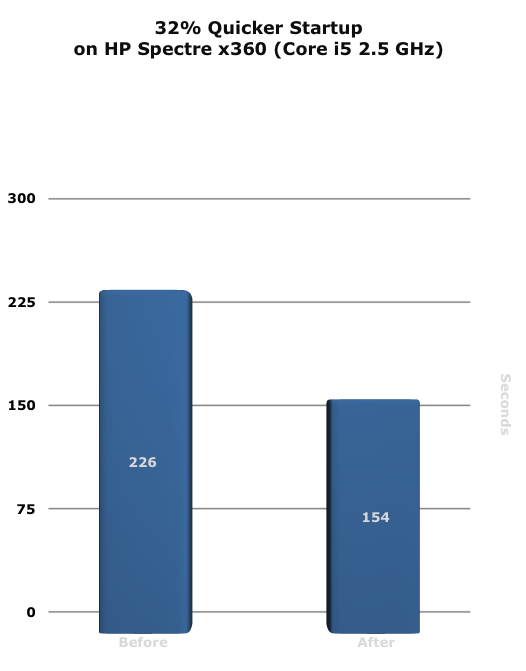
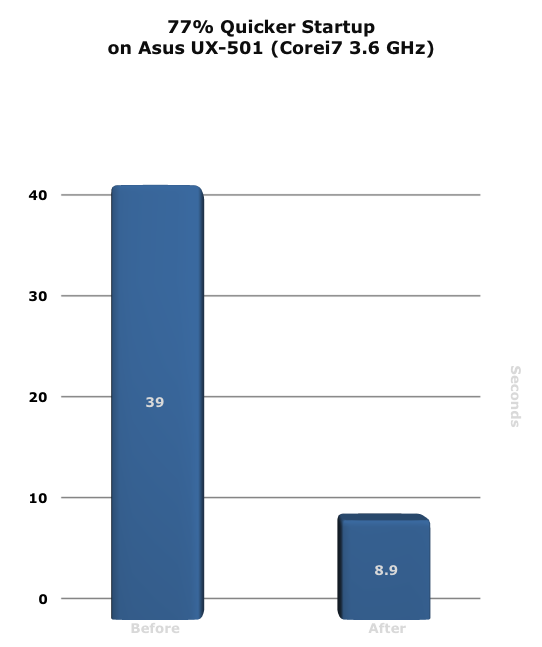


However, this theoretical number doesn’t reflect how the machine actually “feels”: In the case of the Asus UX-501, the Windows Assessment Console also showed the actual time to desktop. In all cases, the web, games or office applications were instantly usable after the boot.


2. Internet Explorer Startup Time

Again, to measure how long it takes to achieve a simple task such as loading a program, I used Windows Assessment Toolkit. I wanted to see how much of an impact the load of 150 programs has on load time of a simple browser:
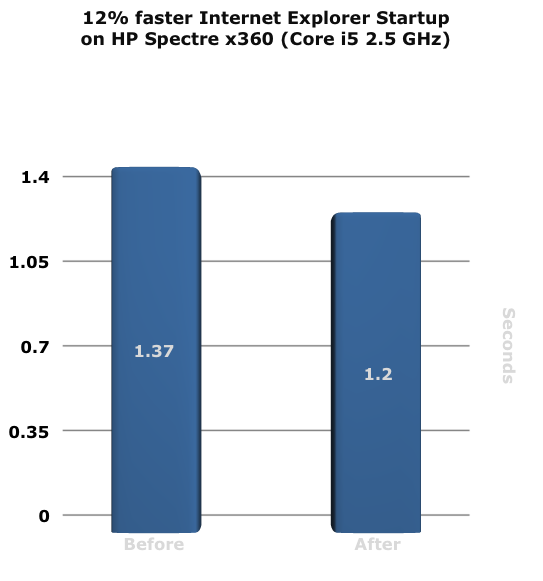
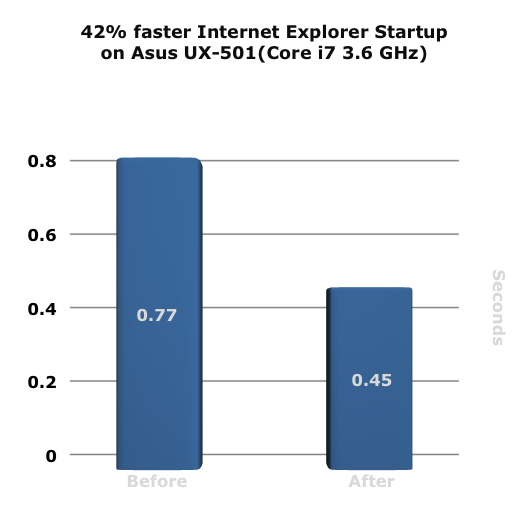
 

Internet Explorer 10 launched within 1,37 seconds on both devices, mostly due to their fast Solid State Disks. However, even on these faster devices these times went down to 0,45 and 1,2 seconds after the optimization with AVG PC TuneUp.


3. Performance while playing GTA V

Let’s see how much of an impact 150 programs and the optimization using AVG PC TuneUp has on the more fun tasks, such as gaming. In this example I used one of the top hits of 2015, Grand Theft Auto V, which includes a built-in benchmarking tool.

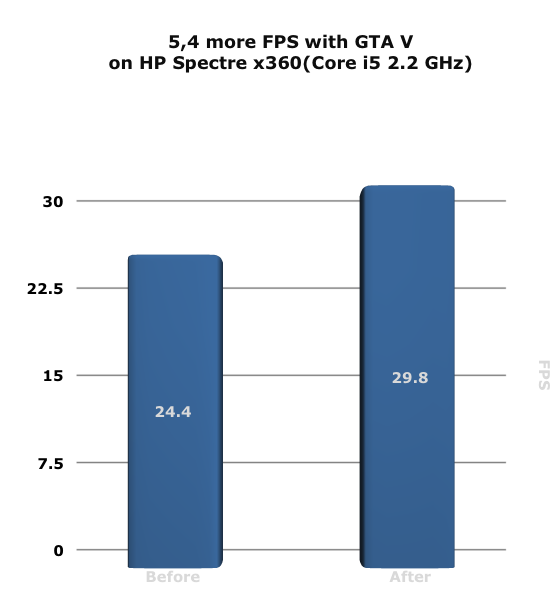
Unfortunately, having installed the 150 programs on the Asus UX-501, the benchmark frequently crashed so I could only look at the performance on the HP Spectre x360. it achieved only 24,4 fps under the load, but once I optimized the laptop using AVG PC TuneUp, frame-rates crawled to over 30 fps in some scenarios and averaged at around 29,9 which is considered smooth gameplay.


4. Performance while gaming

The de-factor standard for measuring gaming performance, Futuremark 3DMark, is my next test to measure how games in general perform on a specific device.

Once I got rid of all the extra load on these PCs, I saw quite some improvements in the final 3DMark score:
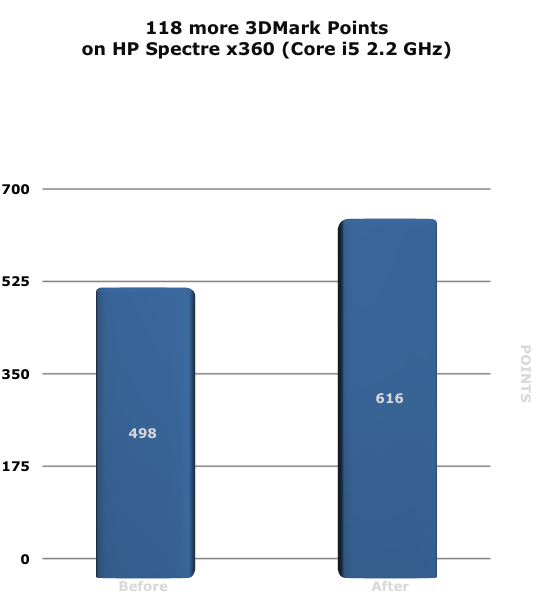

 

the HP Spectre managed to achieve 118 more points, whereas the much faster UX-501 (with its 960M) got 279 additional points back once all the optimization using AVG PC TuneUp was complete. Some gamers buy new hardware or overclock their devices just for this kind of improvement.


5. Writing, Web Browsing and Video Chat Performance

The next test involved the benchmarking tool PCMark 8 which uses real-life scenarios such as browsing the web, Office 2013, Adobe Creative Suite and other tools to recreate a typical home and business scenario.
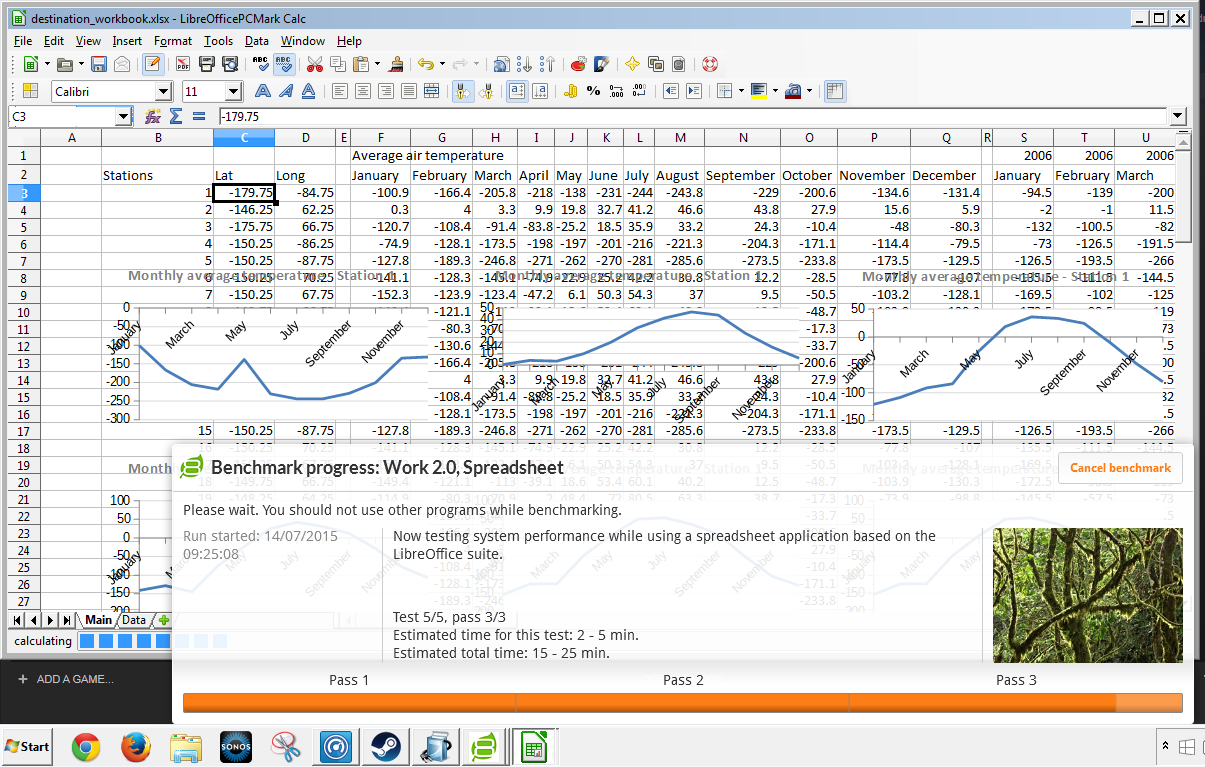
It measures the exact time it takes to complete tasks down to the millisecond:
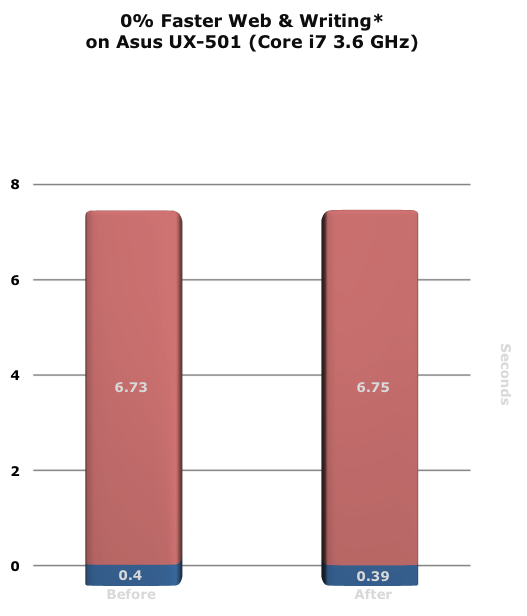
 

*Results in Seconds
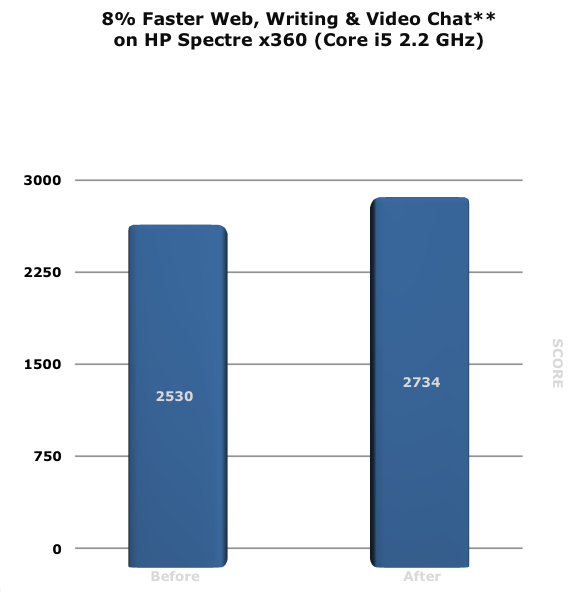
 

**Results in points

Note: The numbers you see in the graphs for the Asus UX-501 represent the time it took to complete the browsing benchmarks. That’s because the 150 programs interrupted some additional benchmarks (which we didn’t take into account) and thus PCMark couldn’t spit out a final score. The differences were ultimately the same, though. On the HP Spectre x360, however, the benchmarks ran through just fine and showed an increase of 8%. Nice!


6. Office 2013 Performance

The next test involved PCMark running automated actions in Word, PowerPoint and Excel to measure performance, such as converting and calculating a huge Excel file:
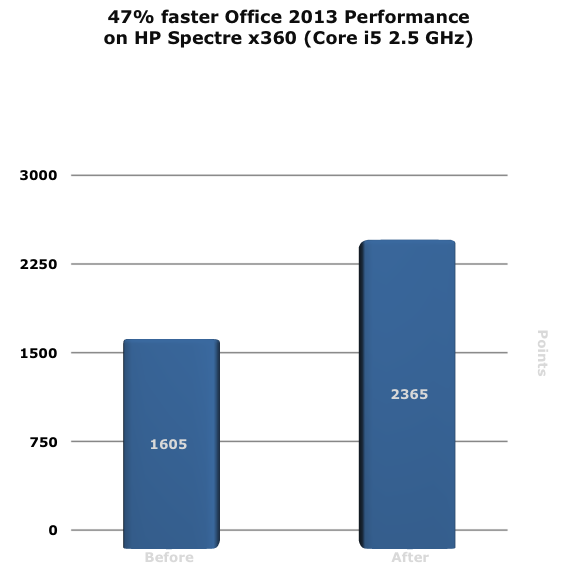
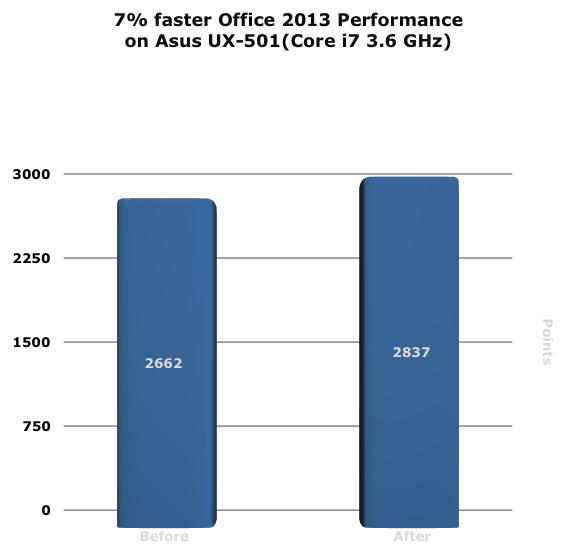
 

An almost 50% increase while performing complex animations in PowerPoint, calculations in Excel or documents in word is a noticeable improvement. It also goes to show that the impact of 150+ popular applications can, in some cases, have quite an impact on speed.


7. Adobe Creative Suite Performance

Many professionals can’t live without Adobes Creative Suite which includes tools like PhotoShop, InDesign or Illustrator. Given that you’re working with a lot of heavy files, your PC needs to focus all of its resources on the task:

Again, my trusty benchmarking tool PCMark helps out here: it automatically performs complex tasks such as applying a filter to a huge PhotoShop file or putting together an InDesign document and measures the time it took to complete the tasks.

In the end, I again got a score for the performance under the load of 150 programs – and once I optimized it using AVG PC TuneUp:
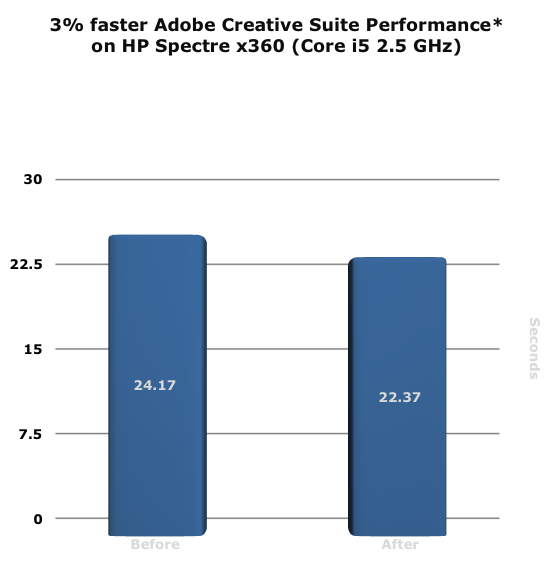
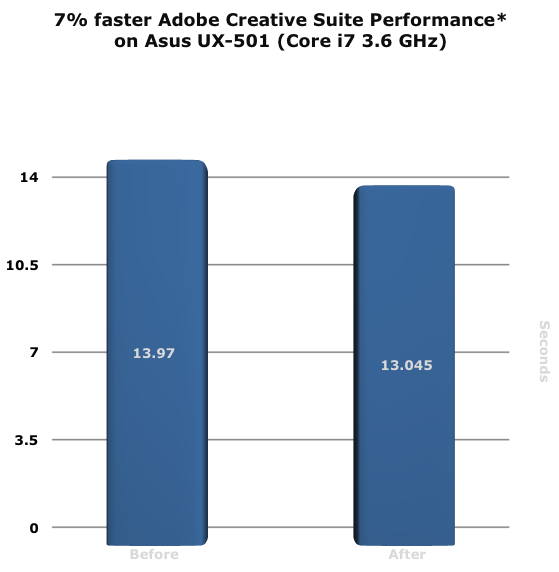
Not a huge improvement, but definitely a nice boost for anyone working with Adobe Creative Suite.


8. Battery Life while watching a movie

When you’re on a long flight or train ride, you really need your battery to keep up with you while you’re binge-watching TV shows or movies. Unfortunately, the additional background load and Windows 10’s default power management settings had quite some effect on one of my devices:
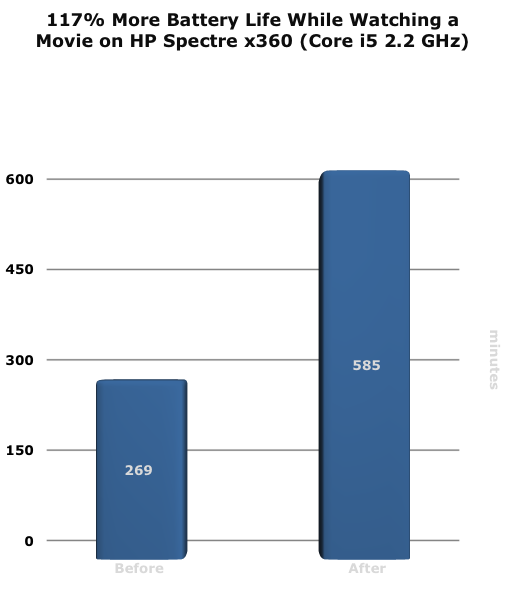
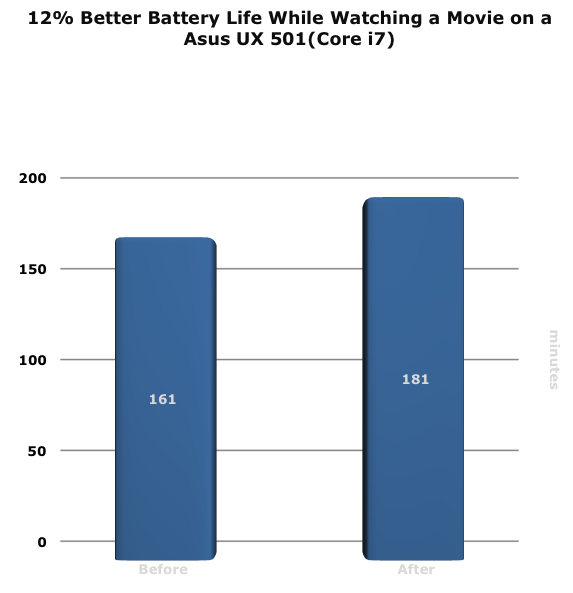
Under load, the HP Spectre gave in after 4 ½ hours. Once I tuned the device to its maximum, freed it from all the resource hogs and activated Economy Mode and Flight Mode, battery life went up to almost 10 hours. That’s crazy. Even on the Asus UX-501 I managed to get an additional 20 minutes.


9. Disk Cleaning Tests

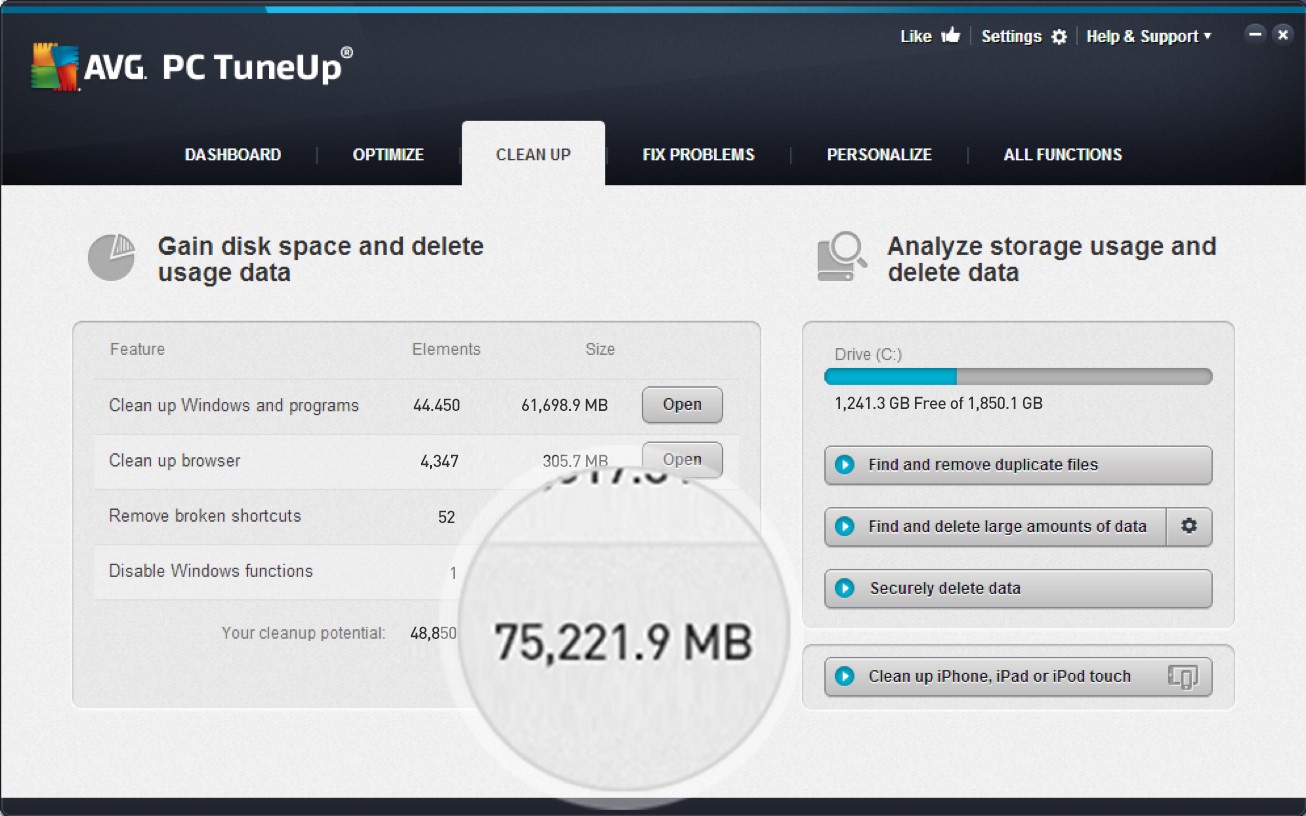
Performance and battery life isn’t all when measuring the performance of a computer: over time, Windows, applications and browsers accumulate Gigabytes of data. Case in point: even on the newly purchased mobile workstation (Asus UX-501), the installation of 150+ programs and the upgrade from Windows 8.1 to 10 accumulated to roughly 38,5 Gigabytes of unnecessary files

The HP Spectre had only about 2.7 GB, but that accumulated over the time of only a few days following a clean install of Windows 10.
Verdict

Windows 10 is arguably Microsoft’s best operating system. It has improved in some scenarios when compared to Windows 8.1 and is a highly stable and smooth-running OS. However, it still suffered under the the load of 150 programs.

Once we fired all of AVG PC TuneUp’s performance guns at it, performance improved.

One of the key benefits of AVG PC TuneUp is that it helps alleviate performance load by using a feature called Program Deactivator which temporarily turns off programs that you don’t use, and enables them on the fly again when you need them, leaving you with a usable system!

Have you tried AVG PC TuneUp for Windows 10? Click here to give it a try.

Back to school: Are you prepared?

Parents everywhere have been preparing for the back to school rush. It’s a ritual of making sure that the children are equipped with new backpacks, new binders, sports gear and uniforms and so on. For some parents, there is the complexity of purchasing a new laptop or tablet and having to decide which one to buy.

If you are still in the depths of deciding which device to purchase, my earlier blog may help you and can be found here:  7 tips for picking the right back to school device.

I sent my son off to school with the same laptop he had last year. If you’re doing the same, I recommend you take the time to ensure it’s working as expected and in a clean state – just like you would with the backpacks and other gear.

As part of being a responsible parent, it’s important to have visibility to what our kids are doing on those laptops and tablets, especially on hand-held devices such as a smartphone.  While we don’t want to be intrusive, we do want to ensure our kids are being safe online and are using these connected devices in a responsible and mature way.

I feel that what kids do online is ultimately the parent’s responsibility. Just like children are taught to cross the road safely, guidance is needed in the online world.  Some schools have even supported this notion by requiring parents to sign school acceptable usage policy, which makes them responsible. See my previous blog on this:  Parents, have you signed a school digital policy?

AVG recently commissioned a Harris Poll which asked parents in the United States about their monitoring habits. First, 85% of parents said that their 3-17 year old does indeed have their own device – and most of them got that device by the 7th grade (or age 11)! I’d be willing to bet that the remaining 15% are in the younger age group because when we’re talking about older children, I believe it’s really closer to 100%.

Are parents looking and monitoring those gadgets? 88% of U.S. parents say they do check their child’s activity online with more than 60% checking at least once a week.  However, about 1 in 10 never check their child’s text messages, emails, social media, etc. Some say because they believe it’s an invasion of privacy. When my son was younger, he always used devices in a public setting in the home like the living room or the kitchen and as a minor; we didn’t consider his online use needing to be private.  Now that he’s older, I give him a lot more space.

More than half don’t know the password of their kid’s device. I think in reality though, parents may think they know the password but when placing the device in front of them and asked to unlock it, many probably couldn’t.

In my family environment we encourage dialogue about being online and it is understood to be a privilege to have devices. And its understood that if I want to have a look then I can. We also have other rules that mean no devices after 9pm, not in bedrooms and never at the meal table. Every family will have different rules but keeping some family time without devices is a good thing, especially if all the adults participate.

As your child heads of to school in the coming weeks remember that the devices the are carrying are a learning tool in the same way their text books and notebooks need to be in good order, so do their technology.  Making sure they are performing well and running securely is a parent’s responsibility, we have some free software that will assist you – AVG Antivirus FREE & AVG Antivirus for Android will do a quick cleanup.  To keep those devices working at their optimum, download a trial of AVG PC TuneUp and run the recommended maintenance items.

Good luck with the new school year.

Follow me on Twitter @TonyatAVG

AVG Helps Secure Obi Worldphone Smartphones

SAN FRANCISCO– August 31, 2015 – AVG® Technologies N.V. (NYSE: AVG), the online security company™ for more than 200 million monthly active users, announced today a new global partnership with smartphone manufacturer Obi Worldphone to provide mobile security across its new range of SF1 and SJ1.5 smartphones. Launched in numerous countries worldwide and unveiled at a special event in San Francisco, the devices will come pre-installed with AVG’s flagship AVG AntiVirus PRO for Android™ app, giving Obi Worldphone customers the peace of mind that they can use their devices safely and securely straight out of the box.

“With mobile the primary source of Internet connectivity for many smartphone users in emerging markets, security is becoming an increasing concern for device manufacturers looking to deliver the best experience to their customers,” said David Ferguson, Senior Vice President, Revenue & Business Operations, AVG Technologies. “This partnership enables AVG to further our expansion into some of the markets where we are seeing an increase in mobile phone use, ensuring that we continue to secure and protect people, devices and data across the globe.”

Under the terms of the partnership, Obi Worldphone customers will receive a free, 30-day trial of the AVG AntiVirus PRO for Android™ app. After the trial, customers can either choose to keep the enhanced features by purchasing the annual subscription or use AVG AntiVirus FREE for Android™, which equips their smartphone or tablet with core protection.

“We have partnered with the best in the industry in bringing this new range of devices to market, and AVG is a prime example,” said Neeraj Chauhan, CEO, Obi Mobile, maker of the Obi Worldphone. “With smartphone users increasingly relying on their devices for a whole range of online activities such as gaming, shopping and even more sensitive transactions such as online banking, we are committed to providing safe, secure mobile connectivity for our customers from the outset.”

About AVG Technologies (NYSE: AVG)

AVG is the online security company providing leading software and services to secure devices, data and people. AVG’s award-winning technology is delivered to over 200 million monthly active users worldwide. AVG’s Consumer portfolio includes internet security, performance optimization, and personal privacy and identity protection for mobile devices and desktops. The AVG Business portfolio – delivered by managed service providers, VARs and resellers – offers IT administration, control and reporting, integrated security, and mobile device management that simplify and protect businesses.

All trademarks are the property of their respective owners.

www.avg.com


Media Relations:

US: Deanna Contreras
Tel: +1 415 371 2001
Email: [email protected]

Rest of World: Zena Martin
Tel: +44 7496 638 342
Email: [email protected]
Press information: http://now.avg.com