Category Archives: Antivirus Vendors

Antivirus Vendors

SXSW 2015: The Challenges Facing Women in Tech

Recent events have shown that the technology industry is starting to address the gender gap, but what can women do to get ahead in one of the most competitive business environments?

This year at SXSW 2015, Judith Bitterli will be giving expert advice to women looking to forge a career in technology.

Whether a building career roadmap, mentoring advice or hard lessons learned, Judith will share her experiences and answer questions.

Video

The Challenges Facing Women in Tech?


If you are planning to attend SXSW this year, we’d love for you to come by and share your views.

See Judith Bitterli at SXSW 2015

Why you should celebrate Data Protection Day 2015

So what is Data Protection Day? It’s a holiday proclaimed by the Council of Europe on January 28, 2007. The goal is to raise awareness and promote privacy and data protection best practices.

It is globally celebrated and in the U.S. often referred to as Data Privacy and Protection Day, but it’s still a holiday! So tell your boss, and take a day to yourself. In the words of Madonna, rather the spirit, perhaps we should “Celebrate.”

If we took a data day, took some time to celebrate,
Just one data out of life
It would be, it would be so nice

Everybody spread the word… We’re gonna have a celebration
All across the world, In every nation

It’s time for the good data practices… Forget about the bad, oh yeah…
We need a holiday…


On this anniversary of Data Protection Day, the promise is matched only by the tension. In the past year, we’ve seen unprecedented data hacks, continued instances of government surveillance, and an ongoing tide of commercial data collection and use practices that don’t always bode well for consumers.

Data Protection Day 2015


This is amplified by real concerns for people’s safety, life, and liberty. Criminal enterprises continue to engage in identity theft and financial fraud.  Terrorist attacks, like those recently in France, further fuel our fears and heighten the impulse to use more invasive state surveillance techniques.

Add to this the sea-change in the landscape created by mobile devices, which will look like nothing compared to the changes ushered in by the Internet of Things. We have more data, more collection points, more providers, more sensitive information, and growing commercial and state appetites to use the data that define our lives.

So why celebrate? Well, a set of forces seems to be converging that indicates a corresponding change in attitude to better protect consumers and change the pH of the ecosystem so it’s more habitable for businesses and users alike.

The FTC released a thoughtful report on IoT that gives us a framework to get ahead of the changes. President Obama recently proposed new cyber-security and data breach legislation that is promising, provided the voices of civil society advocates like CDT and the EFF remain engaged.

The EU continues to work on updating the data protection act to address both the technological and societal changes that have occurred since it was first drafted. More importantly though, the heat in this space has been turned up. There is more debate.  More industry leaders are devoting increasingly more mind share.  Notions of choice, transparency, control, and reasonable defaults – the very threads that weave the fabric of trust that we depend upon – are no longer dirty words.

While these may seem like concepts beyond your desktop, there is a lot each of us can do to take back some of our privacy. Today, I actively managed my privacy settings in iOS. I disabled location services for all those apps where it didn’t make sense.  Why for example do the camera or ADP (payroll) apps need to use my location in the background when I’m not using them? Something doesn’t seem right.

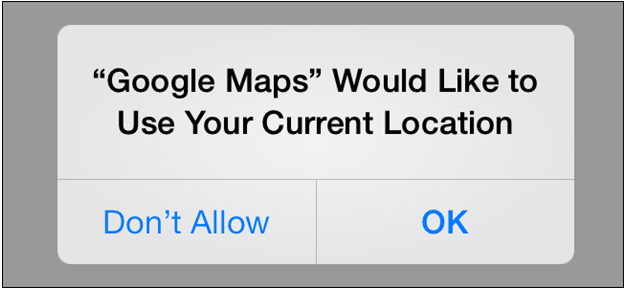
Google Maps Sharing


Some apps, I was pleasantly surprised to find, like Google Maps and ESPN’s SportsCenter, do give me the option to turn location services on only “while using.” This makes sense to me and is an example of privacy forward design that gives users better and more refined choices.  The fact that the interface exists at all is an example of transparency that didn’t exist in earlier versions of iOS, and a good sign that things are changing.

All this is to say – the tide is shifting. In this transition, there is more opportunity than we can imagine. We don’t believe that users have to trade privacy and security to benefit from the wealth of data-enabled services available now and soon to come.

Today there is growing interest in shaping a future that is more people-centric than device-centric, and that properly reflects the human rights that we expect. I am optimistic that there is more future than there is past. That’s something to celebrate.

20 million dating site profiles targeted by hacker

20 million usernames and email addresses for a popular Russian dating website have been leaked, according to Bloomberg. Techworld highlights the targeted website as Topface, which has 91.5 million users. Anti-fraud firm Easy Solutions claimed that of the leaked users, 50 percent were Russian citizens, and 40 percent from the EU. Seven million of the logins

The post 20 million dating site profiles targeted by hacker appeared first on We Live Security.

Now we are simplexity!

Making complex things simple. That’s the meaning of simplexity, and the basis of the transformation Panda has undergone.

An internal and external transformation of the way we do things, and which signals the beginning of an ambitious five-year strategic plan based on growth, technology and international expansion.

This is the new Panda

panda logo

Our new corporate identity coincides with the company’s 25th anniversary and is the result of the participation of all Panda’s offices around the world.

The worldwide presentation of our new strategic plan took place yesterday in Madrid. This event, which was attended by numerous Panda employees as well as the media, gave us the opportunity to explain the company’s core values among many other things: non-conformist, people-centric and innovative.

Here are some pictures from the event!

panda security simplexity


diego navarrete panda security

Diego Navarrete, Panda Security CEO, during the event


Paula Quiros Panda Security

Paula Quirós, our CMO


Felipe Mejias Panda Security

#PandaSimplexity by Felipe Mejías


simplexity panda security

After almost a year of hard work we are finally proud to present to you the new Panda. What do you think? Will you join #PandaSimplexity?

The post Now we are simplexity! appeared first on MediaCenter Panda Security.

Online privacy protection in the EU

It’s European #‎DataProtection day! Every day we visit websites and willingly hand over our name, address, and credit card number. Have you ever thought about what happens to that data or what your rights are?
European ‪#‎DataProtection‬ day

Avast keeps your personal data private.


Members of the European Union (EU) enjoy a high standard of protection of their personal data. The Digital Agenda for Europe lays it all out for you on their website. Here’s a summary:

The burden to protect you is on organizations

The EU Data Protection Directive ensures that personal data can only be gathered under strict conditions and for legitimate purposes. Organizations that collect and manage your personal information must also protect it from misuse and respect certain rights. One of the objectives is that organizations notify their customers, in plain language, what information is collected and how it is used as well as get permission before using any personal information.

One of the stumbling blocks has been the so-called one-stop-shop for businesses and citizens in each member state in which authorities will handle citizens’ complaints about any breach of the rules. There are just as many ideas on how to run it as there are EU member states.

You must be notified of cookies and data breaches

The Directive on Privacy and Electronic communications (ePrivacy Directive) ensures that all communications over public networks maintain a high level of privacy. For example, this directive requires website owners marketing online to EU citizens to obtain consent from users, via some kind of opt-in, before implementing cookies or other technologies to capture online visitor information. (See below for information on managing your cookies.)

If your data is stolen, the ePrivacy Directive states that you should be notified. That’s good because data theft can result in identity theft or fraud, damage to your reputation, loss of control over your personal data or a loss of confidentiality.

However, this fall, the rules changed slightly and now businesses don’t have to notify consumers that their personal data has been lost or stolen if the data has been encrypted. The ministers figure that the business has “appropriate technological protection measures” to protect the data that has been lost or stolen from being accessed by people not authorized to see it.

Viewing and managing your cookies

For those of you not familiar with the term, cookies are small files stored in your browser that contain information about your visit to a web page. They help tailor your online shopping experiences by doing things such as recording items in your shopping cart, they also recommend products based on your interests, allow auto-log in and compile browsing histories.

In most modern browsers, you can control cookie settings. The options include viewing stored cookies, controlling which sites you accept cookies from, and setting how long they may be stored and used.

Chrome

  1. 1. Open the drop-down menu in the top right corner of the Chrome browser, select Settings.
  2. 2. At the bottom of the page, click Show advanced settings.
  3. 3. In the Privacy section, open the button that says Content settings.
  4. 4. Under Cookies, you check or uncheck the options to manage the settings.
  5. 5. To see individual cookies, click All cookies and site data.
  6. 6. To remove cookies, hover the mouse over the entry. Click the X to delete.
  7. 7. To delete all cookies, click Remove all.

Firefox

For instructions to clear cookies in Firefox, please visit Mozilla’s support page.

Chrome

For instructions on clearing and managing cookies in Internet Explorer, please search Microsoft help for your version of IE. Here’s general information.