Category Archives: Antivirus Vendors

Antivirus Vendors

Thoughts from CES: The physical world is becoming digital

As a long-time attendee of CES, I tend to look forward to it with both excitement and trepidation. As it gets bigger each year, it steadily becomes busier and more difficult to physically get around and take it all in.

This year, I walked away from the show thinking we finally have reached a point where smart digital tech doesn’t just sit within a specific market or category any more. Instead, it’s finally become ubiquitous and is now being embedded throughout our everyday lives.  It was evident at the show that we are truly in the “smart” and “Internet of Things” era.

IoT

Image courtesy of GigaOm


Shawn DuBravac, chief economist for the Consumer Electronics Association (CEA), identified this phenomenon as the ‘digitization of physical space”, “permeation of logic” and the “Internet of Me”.

Regardless of what you call it, CES 2015 showed me that innovation in connected technology is now everywhere – from baby pacifiers to dog bowls, home appliances to, of course, the self-driving car.

As always, we must remember that  as fascinating as they are, many of the products at CES are in the prototype phase –and many will never reach the wider market. But nonetheless, it’s always interesting to observe and try to gauge what we may have in store a few years down the line.

This year I was fortunate enough to also be exhibiting at CES as part of the Lifelong Tech and Family Tech Summits. AVG exhibited many of our family-focused products (including our Location Labs, Privacy Fix, and Zen products) in the Sands Expo Hall.

We were surrounded by all things smart and wearable for health, fitness, education and families. It was a fascinating and highly trafficked place to be where the digitization of everything and the Internet of Things was on display in full force.

Where it will all go from here in the year ahead, will be, not doubt, rooted in practicality. For example, let’s take that baby pacifier I mentioned.

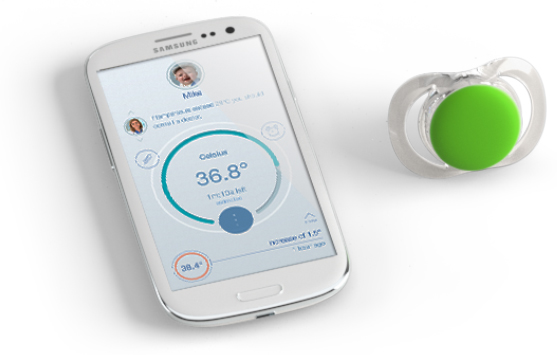
The Pacif-i, a “smart” baby pacifier designed by U.K.-based Blue Maestro was a big hit. This product connects to parents’ smartphones via Bluetooth, and alters them to situations such as as when their baby is running a fever. In this instance, smart devices are creating very useful and valuable information to help parents.

Then at the other end of the spectrum were many fun, novelty and me-too items (names I’ll withhold) whose value will need to be proven…

It’s an exciting new world that we’re embarking upon. But it also reminds us that our privacy and security is increasingly paramount. That’s why we at AVG are continually looking at the trends and what we can do to help you guard and defend your data, devices and “digital” selves.


Title image courtesy of gospelherald

Internationalization and the Internet

The Internet is a child of the United States of America, so it does not come as a surprise that only Latin letters and some scientific characters were used when the systems and the software (then called ARPANET) were designed. In today’s world, where roughly half the global population, with its different letters and alphabets uses the Internet, things look different.

The Need for Internationalization

You might have seen a so-called IDN before. IDN stands for internationalized domain name and all it boils down to, is a web address with special characters. This can be of great help for Internet users that live in regions where the primary alphabet in use is not Latin-based or is extended with special characters. Take Swedish for instance: the letters ä, ö and å augment the standard Latin alphabet. Without the support of IDNs, you would have to agree on a different (Latin) character for domains – like a or aa instead of å. Instead of visiting the website of your favorite Swedish bakery with www.pågen.se, you would have to go to www.pagen.se. This is okay until another company with the name Pagen appears and wants to claim that domain name. It becomes confusing very quickly for the visitors.

Wait…IDN what?

The Domain Name Service (short: DNS), which is used to translate a web address to something the computer understands, only accepts Latin characters. To make internationalized domains work, a system called punycode is used. A complete explanation of the algorithm is way out of scope for this article, but here is a short one. Whenever you enter an address like pågen.se, punycode prepends xn--, skips all non-Latin characters of the domain (å) and appends a dash to the remaining characters (pgen). So far, the result is xn--pgen-. Now, some black magic (finite state machines and generalized variable length integers) is used to represent the location and the identity of the skipped characters. In the end, the result looks like xn--pgen-qoa.se. This is the domain that your browser will access. You, as a user, will not feel any difference as this is done transparently by your browser. Arguably the first internationalized domain (rather subdomain in this case) was http://räksmörgås.josefsson.org.

How it affects you?

There are alphabets which contain letters similar to the ones in other alphabets. Take the Cyrillic script for instance: the Cyrillic letter а resembles the Latin character a. In a so-called IDN homograph attack, a cyber-criminal uses exactly this resemblance to mimic trusted websites. Imagine the domain in the following pictures.

Internationalized version of a domain. The first a is Cyrillic, not Latin

Internationalized version of a domain. The first a is Cyrillic, not Latin

From the looks of it, it is paypal.com. You would almost have to be psychic to note that the first a is a Cyrillic letter. Now the attacker only needs to design a page that looks exactly like PayPal’s and send the login credentials to his or her email address – Mission accomplished.

If the domain is considered suspicious, modern browsers will show the punycoded variant

If the domain is considered suspicious, modern browsers will show the punycoded variant

Not all is lost

Fortunately, it is not that simple to deceive unsuspecting users anymore. Modern day browsers indicate that you are browsing an internationalized website as the image below shows.

Internationalization feature of Internet Explorer: shows a small icon in the address bar

Internationalization feature of Internet Explorer: shows a small icon in the address bar

In contrast to typosquatted URLs, where you might be able to spot phishy URLs by looking at them twice, IDNs can pose a real problem. You have to rely even more on a strong Web protection. It shows that common sense does not protect you from everything on the Internet and that it is crucial to have an up-to-date antimalware solution on all your devices.

Recommended Reading & Resources

Internationalized Domain Name
Punycode
Internet Usage Statistics
Internet
Homograph Attack
DNS

The post Internationalization and the Internet appeared first on Avira Blog.

Digital Invasion: 3 things we learned from CES 2015

Ever lost a kid somewhere? Not anymore if the gadget vendors have anything to say about it. Now you can digitally strap your kid to your tablet and keep track of them. Kids not running enough to stay trim? There’s an app for that that works the same way. Got high blood sugar? You can keep track of that too using the sensor-du-jour highlighted at CES 2015 in Las Vegas.

The post Digital Invasion: 3 things we learned from CES 2015 appeared first on We Live Security.

Facebook privacy – why statements about copyright don’t do anything

Facebook users around the world have reported the return of the network’s longer-lasting hoaxes – a legal disclaimer which allows users to regain copyright over their images and other content. Here’s why it doesn’t work.

The post Facebook privacy – why statements about copyright don’t do anything appeared first on We Live Security.

Posting a privacy notice on Facebook is useless

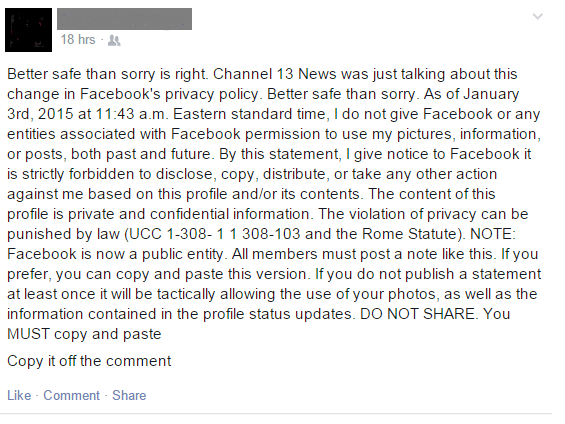
An old hoax has been resurrected after Facebook made a recent announcement about its updated privacy policy. The copyright message claims to protect users’ pictures, information, and posts under UCC 1-308- 1 1 308-103 and the Rome Statute. It’s seems so official; it just must be true, right? Here is an example that I saw on my newsfeed this morning.

Facebook privacy permission statement is useless

Other variations have come through in the past few days with legal-sounding statements, like this:

“In response to the new Facebook guidelines, I hereby declare that my copyright is attached to all of my personal details, illustrations, comics, paintings, professional photos and videos, etc. (as a result of the Berner Convention)….”

The good news is that Facebook users are becoming more aware of privacy issues, and they seek a way to control their own shared media. The bad news is that this notification has no legal standing at all, you are bound to the terms and conditions that you agreed to when you signed up with Facebook, and you are annoying your friends.

The truth is that YOU own all of the content and information you post on Facebook, and YOU can control how it is shared through your privacy and application settings. If you neglect to look at those settings, you grant Facebook a non-exclusive, transferable, sub-licensable, royalty-free, worldwide license to use any content that you post on or in connection with Facebook.

In tomorrow’s blog, we will share the top 3 areas in Facebook where you need to make sure the privacy is set to your liking.