Category Archives: Antivirus Vendors
Antivirus Vendors
Apple Pay and security – what you need to know
Mobile payments look set to be one of the defining technologies of 2015, as the launch of Apple Pay catalyses a boom in cardless payments – both from Apple’s own system, and rivals playing catch-up.
The post Apple Pay and security – what you need to know appeared first on We Live Security.

Dark Web drug trade site Silk Road 2.0 shut down
A year ago, Silk Road 2 appeared on the dark web, after the original Silk Road site’s illegal drug trade was shut down by the FBI. Now, Wired reports Silk Road 2 has met a similar fate to its predecessor.
The post Dark Web drug trade site Silk Road 2.0 shut down appeared first on We Live Security.

Panda Antivirus for Mac, compatible with Yosemite

Some days ago, Apple announced the launch of the new version of OS X: Yosemite, available for free from the Mac App Store.
As always, at Panda we have strived to fulfill our aim of providing protection for Mac users and today we can announce that Panda Antivirus for Mac is compatible with Yosemite.
Yosemite has been presented as one of the most significant changes to the Apple OS in years, perhaps even ever.
We recommend you update your antivirus before updating to OS X Yosemite. To do this, you can use NetUpdate, which is launched from the Panda Antivirus for Mac menu or from the “System Preferences” section in the application.

Panda Antivirus for Mac
Our antivirus for Mac blocks Mac OS X viruses, as well as malware created for Windows, so as to protect Mac users that share files with PC users.
It also scans files and messages, quarantines infected files and offers two types of scan:
- One in real time that continually scans Mac files.
- An on-demand scanner to scan files manually.
If you also have iPhone, iPad or iPod touch, you can use Panda Antivirus for Mac to scan these devices for viruses.
Have you updated your Mac to Yosemite? We advise you to do it as soon as possible!
The post Panda Antivirus for Mac, compatible with Yosemite appeared first on MediaCenter Panda Security.
Why I’m supporting AVG’s sponsorship of The Pitch
My name is Lee Chappell and I am managing director of Total Computers, a business that I started up in 1995 when I left school aged just 16. In those days the IT services industry was still in its infancy so I guess you could say that by today’s standards I was something of an entrepreneur myself.
Not long after I started my IT services company there was a boom in PCs and we found ourselves providing support services to many smaller businesses where the PC was their first ever IT purchase.  Over the years our knowledge and expertise has tracked developments in the industry from resolving customers’ PC and server issues in the ‘90s and early 2000s to managing their Cloud-based software applications as we do today.
One of the reasons I decided to get involved with AVG in its support of The Pitch is that I remember how tough it is when starting out. I’ve seen plenty of start-ups in my time some have succeeded but more often than not they fail. I feel strongly about giving something back to the business community, to help someone else succeed in life. I know I and many others would have loved the kind of support and mentoring opportunities – through government schemes and small business competitions like The Pitch – that are available to start-ups today. The more help you can get, the more you can focus your energies on something more productive.
As part of its commitment to support AVG’s lead sponsorship of The Pitch 2014, Total Computers has agreed to install and maintain AVG’s prize to the competition winner of a suite of AVG CloudCare Cloud security services including AVG CloudCare AntiVirus, Content Filtering, Email Security and Online Backup.  We have also agreed to be point of contact for any issues and provide 5 free remote fixes per month over a two year period.
When we begin working with a new start-up we understand that their IT needs to be running at all times. They simply don’t have the resources or finance of a large business so it just needs to work reliably at all times. Most of our customers are other local businesses. A lot of our new business comes from companies whose existing IT supplier is more than three hours away and has been unable to provide them with timely support. We think the local touch is important and try to get out to the customer regularly. Not to fix their systems, but to review with them what we have been doing on their behalf. This gives them confidence that we are looking after them and have everything covered.
Since working with AVG CloudCare we have found it has allowed us to take our support to a whole new level. Only last week, we had a customer whose PC got a virus. AVG CloudCare automatically sent us an email to inform us of the situation. We rang the customer and sorted the problem out. The customer loved the fact that we had contacted them before they even knew of the problem.
Finally, we obviously hope our relationship with the winner of The Pitch will be a long lasting one and they will want us to continue as their primary IT solution provider long after the initial two year period has ended.


How to turn on WiFi encryption in your router settings
Eavesdropping is a major concern when we talk about the security of home WiFi networks. People around you, your neighbors in the next apartment, or even your own government, can discover anything flowing through your Internet traffic. Your personal data, like passwords and log in credentials, your credit card numbers, and  your photos and videos, are at risk.
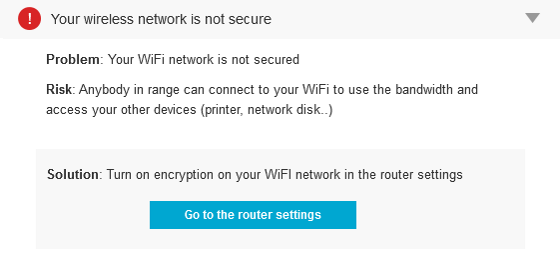
Your WiFi network is not secured
We have written a lot about how to protect our communications using a VPN. To summarize, a Virtual Private Network, or VPN, is an encrypted tunnel where your data travels from your computer to a secure server on the Internet. Avast SecureLine is a VPN that you can use when outside of your home; at cafes, hotels, or airports.
Get your home network secure
But now, it’s time to bring your attention to your home network security. Your router should be correctly set to achieve the highest level of protection. Until you secure your router, you’re vulnerable to people accessing information on your computer, using your Internet service for free, and potentially using your network to commit cybercrimes.
There are basically three levels of security on a home router. These come in types of encryption. They are WEP, WPA and WPA2. These strange acronyms refer to different wireless encryption protocols which protect – in fact, encrypt – the information you send and receive over a wireless network.
WEP (Wired Equivalent Privacy) was the first protocol used in late 90s. It should not be used nowadays as it has serious security weaknesses which are easily hackable by even the most novice hacker. So, the first wise thing to do is move away from WEP. Your router must be quite old if you can’t do that, and you should consider purchasing an updated one, or ordering a new one from your ISP.
WPA (WiFi Protected Access) replaced WEP, but very soon after that, WPA2 replaced WPA. WPA2 implements the latest security standards, especially for data encryption with AES (Advanced Encryption Standard), a strong encryption algorithm.
Using WPA or, better, the WPA2 protocol, means that when any device tries to establish a connection to your wireless network, it will be prompted to enter the security key or password to connect.
Most wireless routers allow you to select WPA2 during the setup process. Unfortunately, the default in many wireless devices is WEP or, even worse – nothing -Â which means anybody in range can connect to your WiFi to use the bandwidth and access your other devices (printer, network disk, etc.).
What to do at home
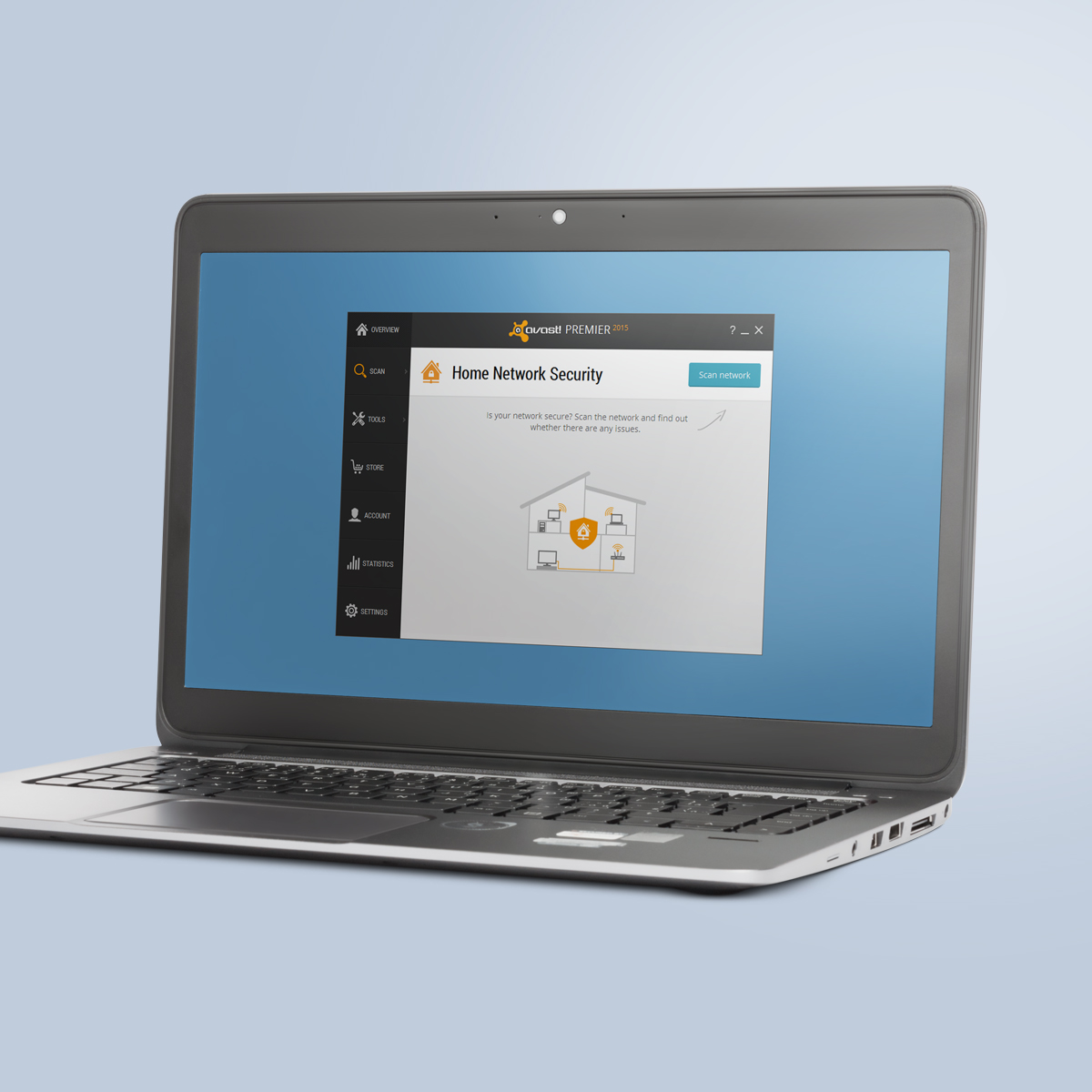
Avast Home Network Security scans for vulnerabilties.
Verify your wireless network router (or other access point) supports WPA2. If necessary, go to your router manufacturer site and search for the latest firmware to be downloaded and applied according to its instructions. Apply compatible WPA2 settings on each WiFi device, choosing the WPA2 encryption and the correct authentication info.
Although encrypting your traffic won’t protect you from rogues, denial-of-service (DNS) attacks or interference, it will ensure secure wireless communication.
Also, change the default password. Make sure the one you use is long and strong, using a mix of numbers, letters and symbols.
Avast 2015 includes a Home Network Security scanner that can help you determine what needs to be done, explain why, and can direct you to the router manufacturer’s website. Read more about it on our blog, Your home network is at risk of cybersecurity attacks.
Avast Software’s security applications for PC, Mac, and Android are trusted by more than 200-million people and businesses. Please follow us on Facebook, Twitter and Google+.
Â
Google security – how to lock down your Google account
If you use Gmail as your ‘main’ email account – or rely on Google services such as Drive for work – it’s well worth revisiting Google’s Settings menus to give your Google security a boost.
The post Google security – how to lock down your Google account appeared first on We Live Security.

Government requests for private Facebook data up 24%
Government requests for private Facebook data have increased by nearly 25% since the second half of 2013, the social networking giant has reported.
The post Government requests for private Facebook data up 24% appeared first on We Live Security.

WireLurker: new malware targets Apple users
A new malware has been discovered that targets both Apple Mac computers and iPhones, Neowin reports. It is the first known malware that can infect iPhones that have not been jailbroken.
The post WireLurker: new malware targets Apple users appeared first on We Live Security.

Tuning in to Cybercrime
The BBC has begun airing a six-part series, presented by British technologist, writer and “futurist†Ben Hammersley.
Called “Cybercrimes with Ben Hammersley,†the series was produced in partnership with The Open University. It looks at the range of cybercrime – from the scam emails that fill up our inboxes to drugs and guns that can be bought anonymously on what is called the shadowy business of “darknet,†and even governments spying on their own citizens.
Hammersley emphasizes that 2013 was a very bad year for cybercrime in businesses. He notes: “In February, $45 million was stolen from ATMs around the world after cyber criminals hacked credit cards and gave them unlimited withdrawal limits. Then, in November, 40 million credit card numbers were removed from the point-of-sale terminals of US retailer Target.â€
Video
Cybercrimes with Ben Hammersley
We’ve chronicled other recent major breeches here. The fact is, major data breaches are occurring at a regular pace now, and are having an impact on our most standard, or reliable, institutions.
The global annual cost of cybercrime has been estimated at several hundred billion dollars. PwC’s 2014 Global Economic Crime Survey found that 7% of US organizations lost $1 million or more due to cybercrime incidents in 2013; furthermore, 19% of US entities reported financial losses of $50,000 to $1 million.
As Hammersly points out, ” Cybercrime affects each and every one of us. Every aspect of our lives is vulnerable to the criminal abuse of our networked world…â€
It’s good to see the issue of cybercrime getting more in-depth attention in mainstream venues such as the BBC… I’m hoping there will be a large audience tuning in for what promises to be a very interesting and educational series. The more educated people are, the better equipped we all will be to protect ourselves online.
Of course, cybercrime is a major issue to us at AVG: Our mission is to secure devices, data and people – and we are always working to give people and businesses the tools and information they need to better protect themselves online. We haven’t talked about it a lot, but AVG Innovations Lab monitors current trends and develops software and apps to meet the needs of today’s consumer – as well as looks to future vulnerabilities to meet those needs too. In fact, we will be showcasing some of the work of our labs –including solutions to growing threats in mobile and the Internet of Things– during a press-only event we are calling “AVG Experiential Lab,†in San Francisco on Sept. 18.

