The HTTPS landscape is changing. Now, tech giants, like Google and Mozilla, have decided that each and every website must adopt this security protocol. But this isn’t always a good thing.
Tag Archives: News
New range of Panda Antivirus: Security for all your devices
Multiplatform security, management ease and light resource usage are some of the main benefits of the latest product range from Panda Security.

QuadRooter vulnerabilities leaves 900 million Android devices at risk of attack
Over 900 million Android smartphones and tablets are vulnerable to cyberattacks, as they contain a set of four vulnerabilities dubbed QuadRooter.
The post QuadRooter vulnerabilities leaves 900 million Android devices at risk of attack appeared first on We Live Security.

5 Smartphone & App Trends That Will Blow Your Mind
Our latest AVG App & Trends Report unearthed surprising trends, about apps’ rise and fall—and their troubling tendency to suck phone life. Here we are pulling back the curtain …
For the full report, check out our AVG App Performance & Trends Report (H1 2016).
I live in my own tech bubble. I work in the performance division of a world class online security firm, so most of my colleagues get the latest apps, phones, and PCs. Many of my friends are also tech enthusiasts, always trying the newest and shiniest devices.
But step outside those spheres, and things change. There is a whole other reality out there. My family and wider circle of friends, people on the streets and trains, and people in other countries often don’t care about owning the latest tech or the newest app. That’s the real world. And I have once again been blown away by our AVG App Report and what people really do on their phones …
Without further ado, here’s the top trends that made me raise an eyebrow and mutter “Fascinating!”
Number 1: No, not everyone owns a Samsung Galaxy S7
Sure, I don’t expect everyone on earth to have the most expensive and up-to-date Android on the market. But finding out that phones from 2012 and 2013 are still alive and kicking is startling.
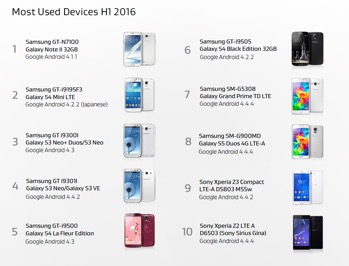
Number one on the list is the Galaxy Note II, a phone that came out in September of 2012 – almost four years ago. Then came the S4 Mini, a still super popular phone from early 2013 that apparently just won’t die off. With limited storage, old Android 4.x versions, and slowly dying batteries, their owners must be feeling the age when going about their daily tasks and using newer apps.
Though Samsung obviously completely dominates the Android smartphone space, it is not alone. Sony nabbed two spots in the top ten (The Xperia Z3 Compact and Z2 LTE A) and more than 10% of the roughly 20 million devices we logged anonymously that quarter.
Number 2: The Top 50 Most Commonly Used Android Apps are from Google
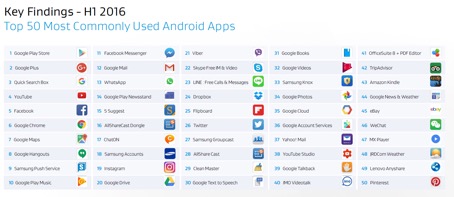
Google dominates the mobile OS world. No doubt about that. But Google also dominates its own world. The top most used apps on Android are Google Play Store, Google Plus, Google Quick Search Box, YouTube (yup, that’s Google), Google Chrome, Google Maps, and Google Hangouts. Only Facebook and the pre-installed Samsung Push Service made it into the top 10.
Number 3: Many Apps Are Just Websites-turned-into-apps
The top 50 also includes a lot of websites-turned-into-apps, like Facebook, Tripadvisor, and eBay. The trend is double-edged unfortunately: It’s app makers continuing to push users to their mobile app, sometimes very aggressively in the case of Tripadvisor, as almost every step on their mobile website www.tripadvisor.com leads to a “recommendation” to use their apps.
On the one hand, these apps generally offer a more pleasant experience, with nicer animations, more features, and often a better look and feel. On the other hand, many of them also register themselves as startup applications and constantly check for updates and notifications in the background. This drains power and bandwidth.
If your phone doesn’t make it to the end of the day, try one thing: Uninstall all these apps and try opening up www.facebook.com, ebay.com, tripadvisor.com (and all the other apps that you’ve got that are available online) on your mobile browser. The ‘manual’ approach is likely going to save you a lot of battery life going forward.

Number 4: Mighty No. 33
Another example of the “real world” bursting my tech bubble: I thought everyone except myself downloads and uses hundreds of apps. It appears both the real world and myself have something in common. I only have a total of 29 apps on my phone that I use more or less regularly, which is slightly less than average. Our anonymized data shows that users have an average of 33 apps installed. (I guess I should up my game as an enthusiast)
Number 5: Miitomo predicting Pokémon Go’s future?
Just recently, Nintendo had to announce that it’s massive Pokémon Go success will only have a limited impact on their revenue numbers, as most of the cash flow goes to Niantic, the company behind Pokemon (Nintendo owns only 13% of the Pokémon Go app). So while they don’t get as much as you might think they do get a boost.
But will it last? Is Pokémon just another typical app fad that goes wild and dies off? (Anyone still playing Angry Birds?)
Nintendo was in a similar situation with its first real app, Nintendo Miitomo, which let you chat with friends as Mii characters using a cool, fun environment. After launch, it died off quickly, as we anonymously logged over 127.000 installs in March – to only 17k in May. So Nintendo can’t just rely upon Pokémon Go to secure their future, but might need something that belongs to them and that reinvigorates the gaming market long-term….


NIST: It’s time move on from SMS 2FA
According to the National Institute of Standards and Technology (NIST) at the US Department of Commerce, it is time to move on from SMS 2FA.
The post NIST: It’s time move on from SMS 2FA appeared first on We Live Security.

PosCardStealer and Large-scale Attacks Jeopardize PoS Systems
Point of Sale terminals are one of the cybercriminal’s most desired objectives. Protect yourself from PosCardStealer!
“For the first time, we can get ahead of their movements and predict anomalous behaviors before they even happenâ€
Did you know that the majority of attacks begin inside the company? Read more details in this Interview with the CEO of Panda Security, Fernando Garcia Checa.
One Hardcore Gamer’s Take on Pokemon Go
An inside look into how Nintendo’s popular mobile game is bridging generational gaps and keeping you outside through the lens of one avid gamer. This piece originally appeared on GamesBeat.
All technical woes aside, Pokémon Go—which I’ve been playing nonstop since its release now—is a lot of fun. While it may not offer the complex gameplay, storytelling, or character development the past decade of Hollywood-standard video games has delivered, it’s engrossing — and its astronomic growth is a phenomenon.
Which got me thinking … what does account for the appeal? As a way to come up with an answer, I’ve made these four observations, which are as much about human nature as they are about gaming culture.
1. It’s just like that one Star Trek: The Next Generation episode
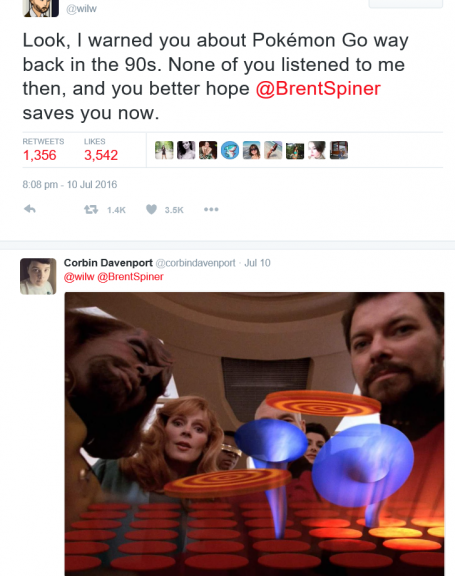
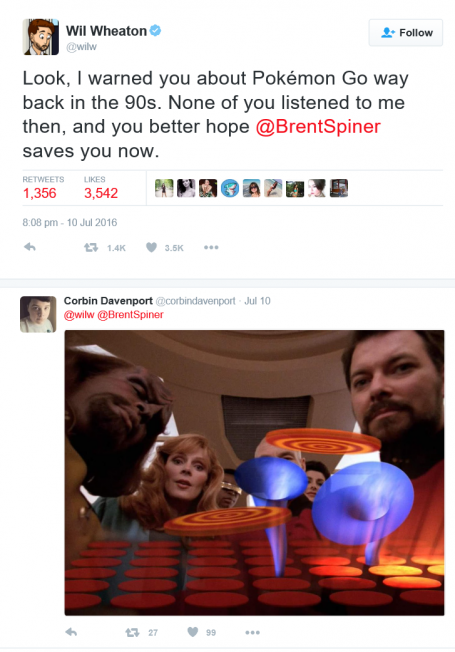
Pokémon Go has been compared to The Matrix, Ready Player One, and just about every other dystopia where technology controls humans. But while Pokémon Go arguably is an addictive worldwide phenomenon whose ultimate reach is yet to be determined … wait, am I talking myself out of my own conclusion that it’s not actually dangerous to society? OK, it’s not, seriously. It does, however, remind me to an eerie degree of “The Game” episode of the Star Trek: The Next Generation TV series. In “The Game,” the crew of the Enterprise became obsessed with an augmented reality game in which the object is to throw a flat plate (Pokéball, anyone?) into a cone (Do I hear Pokémon?) in order to score and move to the next level.
Apparently I’m in good company, because Wil Wheaton, who played Wesley Crusher in that episode and later saved the Enterprise, even Tweeted about it.
The verdict: While Pokémon Go doesn’t (yet) seem to psychologically manipulate people, it is, for better or worse, mesmerizing. And people love to be mesmerized.
2. I want it to keep getting better
Nintendo was once known for stellar gameplay and mechanics, but it’s been struggling to keep up with Sony and Microsoft in the marketplace. Niantic’s Pokémon Go is the first hit associated with the Nintendo brand in quite a while. As someone who grew up with Nintendo games, I hope they can turn this into a comeback and that the excitement around Pokémon Go can catapult them back to their former glory. Nintendo needs to take Niantic’s start and increase the depth, interaction, and engagement. Right now it’s simple—catch, level, feed, fight, train. Lather, rinse, repeat. Even casual gamers need more.
The Verdict: I guarantee I’m not alone in hoping Pokémon Go sticks around and gets more challenging, which just shows that people love a success story, especially when whoever’s being successful is somewhat of an underdog.
3. It bridges generation gaps

I never expected that playing Pokémon Go would bring me closer to generations I must admit I barely knew—or thought I could know.
Pokémon Go has connected me with people—while grocery shopping, going for my morning run, or just walking down the street. Within the first three days I was stopped by kids less than half my age and a couple more than twice my age.
On day 2, I noticed several tweens in the grocery store pointing at me, whispering, “Look at him. …” I turned to them, held up my phone, and asked, “Pokémon?” Nods, and big smiles. Nearly 30 minutes later, while hanging out at the cheese counter where they’d caught a monster, we’d talked about smartphones, gaming, school, grades, friends, sports … and I got an all-too-rare glimpse into what it’s like to be a kid in 2016.
Day 3 brought me face-to-face with an elderly couple who wondered, as they saw me stop and hold up my phone during a run through the forest, what I was taking a photo of. I told them what I was up to, and they were in awe of today’s technology. This, too, became a conversation about how maybe they needed phones, about where they’d grown up, their family, their work, their life.
All the scary stories about people being injured or lured to harm by strangers while playing Pokémon Go, while true, likely don’t happen nearly as often as the sort of positive experiences I had with people in my own community—people I probably never would have talked to, were it not for Pokémon Go.
The verdict: People want to connect, and it’s amazing how the shared experience of a cultural phenomenon like a game—or a movie, or a book, or a TV show—can forge common ground among people who otherwise couldn’t be more different. And the more we have these experiences, the more open we are to recreating them.
4. It makes you go outside
Truth be told, this aspect of Pokémon Go does make me feel a bit uneasy: while the game’s become mainstream in a very short time and is all over the news, you can’t expect every last person on earth to know what it is or how it’s played. Which could explain the suspicious looks I’ve gotten while wandering around my quiet family neighborhood. While nothing bad came of any neighbors’ quizzical looks, I’m sure there were moments of confused uneasiness, and if you’re going to play, you’re wise to consider your surroundings and be conscious of people’s privacy. And if you get “those” looks, explain it (or invite them to play, it could turn out well!—see observation 3).
But you can’t discount the really wonderful opportunity to explore areas near your home, work, or school that you may never have seen. I took it on my morning run (which usually follows the same route) and ended up going down beautiful forests paths I’d never seen and through neighborhoods I’d never been to. You’re essentially combining exercise, exploration, and gaming—which until now never really went together that well.
The verdict: While I am a bit torn about the overall benefits of Pokémon Go’s ability to bring you together with new people and new aspects of your everyday world (see: potentially freaking out the neighbors), there’s no doubt that its forcing players to go beyond routine is a big part of its appeal. People love adventure.
My verdict
Pokémon Go promotes exercise and getting outdoors … but it makes you look at your phone even more than you probably already do. And some of the things that account for its appeal—the fact that it’s somewhat mesmerizing—also have a flip side, in this case overly repetitive gameplay. You should play it, too, see for yourself, see if the appeal is well-founded, see if its current cult status is likely to last.
While I’ve noticed my interest waning (I spent hours on end in week 1 catching dozens of Pokémons and now use it only 15-30 minutes a day in week 2), I’m not sure yet if I’m getting tired of it overall, or if there’s going to be a “second wave” of excitement.
What’s your verdict?


Big spike in card fraud in Europe
There was a notable spike in card fraud in Europe last year, with the UK the worst hit, according to new data from FICO.
The post Big spike in card fraud in Europe appeared first on We Live Security.

What is Multigrain? Learn what makes this PoS malware different.
This is a technical analysis of a powerful PoS malware: Multigrain. Save your credit cards and information!