Red Hat Enterprise Linux: Updated iputils packages that fix one bug are now available for Red Hat
Enterprise Linux 7.
Monthly Archives: June 2015
RHBA-2015:1143-1: gnutls bug fix update
Red Hat Enterprise Linux: Updated gnutls packages that fix one bug are now available for Red Hat
Enterprise Linux 7.
RHBA-2015:1142-1: pcs bug fix update
Red Hat Enterprise Linux: Updated pcs packages that fix one bug are available for Red Hat Enterprise Linux
7.
RHBA-2015:1140-1: selinux-policy bug fix update
Red Hat Enterprise Linux: An updated selinux-policy package that fixes several bugs is now available for
Red Hat Enterprise Linux 7.
Screen Time: Adults need to lead by example
I think it reveals some pretty interesting insights about the digital family. Among them, the nagging worry about our kids’ screen time and, likewise, their worry about their moms’ and dads’ obsession with mobile devices – and the impact it’s having on the quality of our parent/child interactions.
As AVG senior evangelist Tony Anscombe points out ,, it’s really important that we set good habits within the home.
Unfortunately, almost a third of parents in our survey conceded that they actually aren’t setting very good examples.
As a case in point, on Father’s Day, I sat in a fine-dining restaurant and watched the dynamics of some digital families play out during the holiday Sunday brunch.
Across the room from my table, a father and son sat. Dad was on his smartphone. Junior, a grade schooler, was on his iPad…Not a word was being exchanged between the pair during the entire meal. They sat isolated from each other, with either of them barely looking away from their device, except to give and receive their food orders.
The sight of the non-communicating father and son saddened me. It not only illustrated a failure to lead by example, but one of the worst digital lifestyle habits – using mobile devices during a meal, and a time when we should be paying attention to each other. (The latter was also called out as a key issue in the Digital Diaries study).
Closer by, at the table directly next to me on Sunday, was another digital family –this one definitely more engaged with each other and animated. Mom, Dad and teen daughter were merrily talking. Their digital devices only came out when Mom and the teen daughter posed the family for a few selfies. After attempting to do it themselves –and keep the self in Selfie—several times and not getting the desired shot, the Mom handed the smartphone to the waiter and arranged the family for a better angle. Snap. Photo taken and immediately posted on social media.
We often hear stories about children having an unhealthy relationship with technology, but it’s important to remember that it’s our role as parents, grandparents, uncles and aunts to set a good example. It’s up to us to engage them beyond the screen and perhaps examine our own device usage.
The latest Digital Diaries research has spurred me on to spend more time in person with my family and to indulge in the occasional digital detox. I hope you do too.


Kids Competing with Mobile Phones for Parents’ Attention
AMSTERDAM – June 24, 2015 – Mobile phones are gaining an increasing share in the battle for parental attention, with a third of children, surveyed for a recent study, saying their parents spent equal or less time with them, than on their devices. The research, conducted by AVG® Technologies N.V. (NYSE: AVG), the online security company™ for more than 200 million monthly active users, examined children’s perceptions of their parents’ mobile device use, and uncovered some worrying trends.
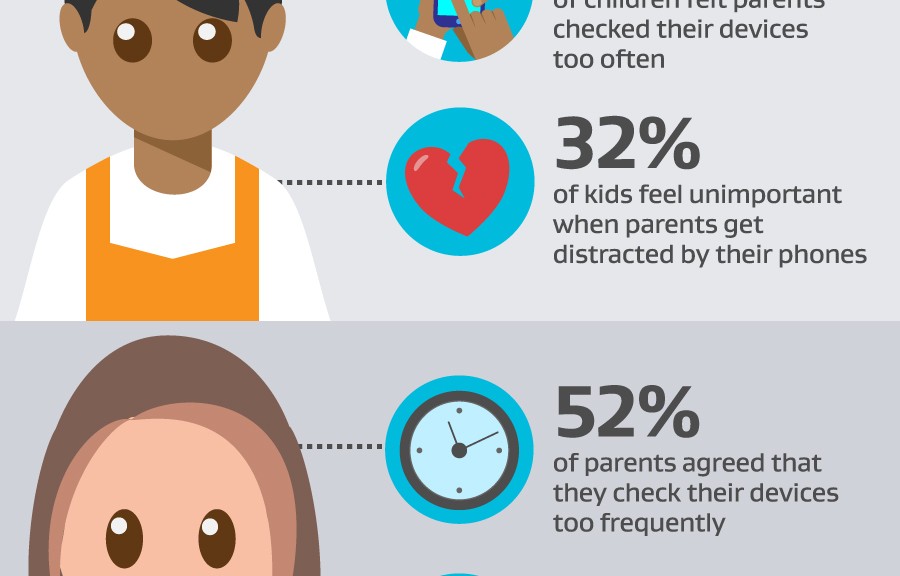
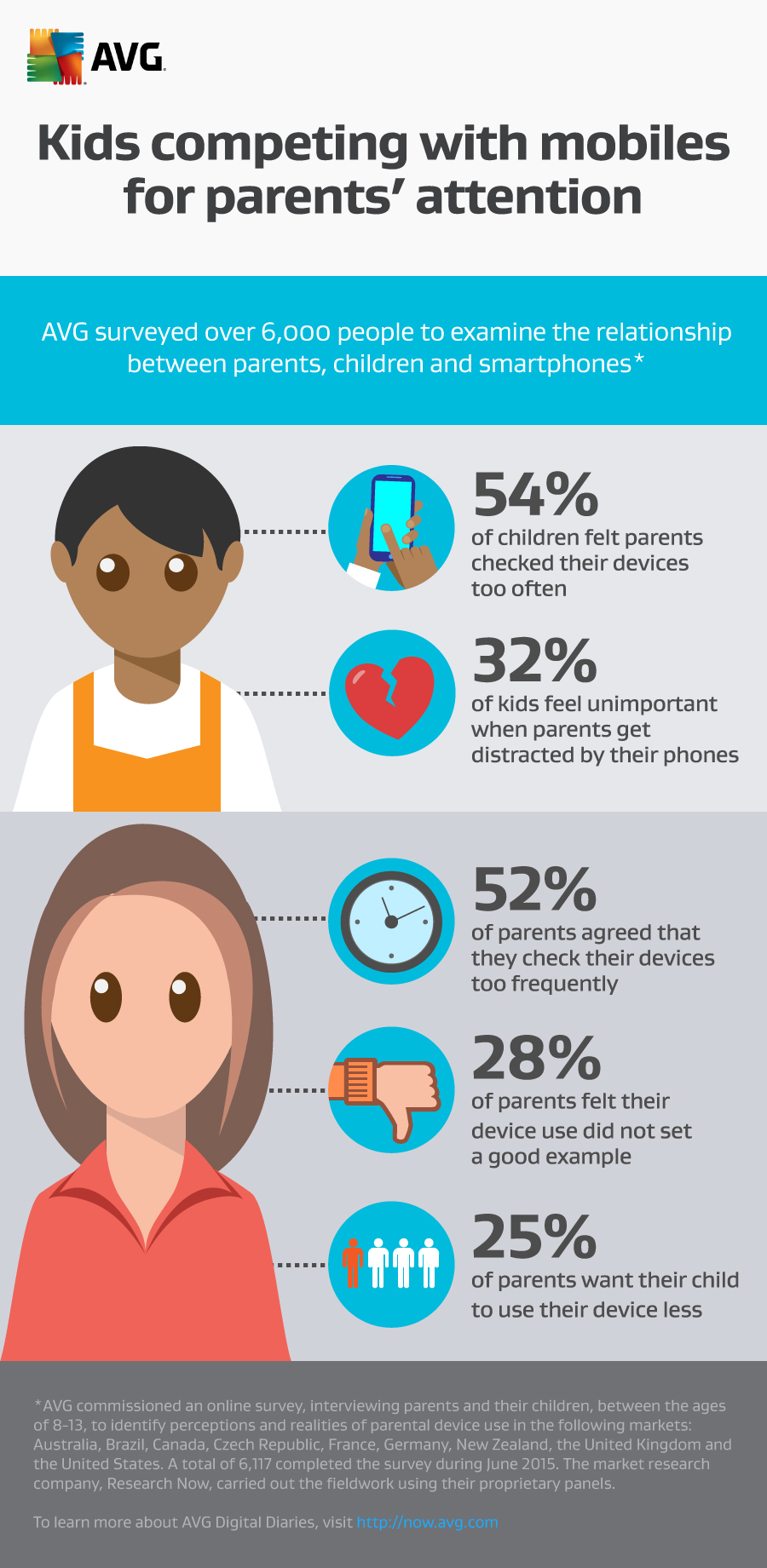
Hinting at ongoing digital intrusion upon family life, over 50 percent of the children questioned, felt that their parents checked their devices too often (54 percent); and their biggest grievance, when given a list of possible, bad device habits, was that their parents allowed themselves to be distracted by their device during conversations (36 percent) – something that made a third of the complainants feel unimportant (32 percent).
When asked about their device use, half of all parents agreed that it was too frequent (52 percent), and many also worried about how this looked to the younger generation. Almost a third (28 percent) felt that they didn’t set a good example for their children with their device use.
“With our kids picking up mobile devices at an increasingly younger age, it is really important that we set good habits within the home, early on,” said Tony Anscombe, Senior Security Evangelist at AVG Technologies. “Children take their cues from us for everything else, so it is only natural that they should do the same with device use. It can be hard to step away from your device at home; but with a quarter of parents telling us that they wished their child used their device less (25 percent), they need to lead by example and consider how their behavior might be making their child feel.”
In a country by country comparison, Brazilian parents topped the survey for device use, with 87 percent of children stating their parents used mobile devices too much. More worryingly, 59 percent of Brazilian parents admitted to using the phone while driving – interestingly, 56 percent of children in Brazil also said they would confiscate a parent’s device, if they could.
Methodology:
AVG commissioned an online survey, interviewing parents and their children, between the ages of 8-13, to identify perceptions and realities of parental device use in the following markets: Australia, Brazil, Canada, Czech Republic, France, Germany, New Zealand, the United Kingdom and the United States. A total of 6,117 completed the survey during June 2015. The market research company, Research Now, carried out the fieldwork using their proprietary panels.


We’re all guilty of checking our devices too often
For over four years now, we have been researching the use of technology by families, specifically how our kids use technology to learn and communicate. Our latest research looks at how much time we, the adults, and our kids spend using devices and the effects that this has on family life.
Are adults checking their devices too often? The simple answer is yes. Both kids and adults are in agreement with this as 54% of children say this and 52% of adults. At the same time, both kids and adults agree that it’s the kids that spend more time on their devices, 46% and 49%.
It would appear that the parent’s have some bad habits too, nearly one in four admit they answer their phone during meal times and one in three while watching TV with their kids. This makes our kids feel unimportant, at least that what 32% said in our survey.
Technology is changing our world, whether interactive education, TV on demand or communicating with our friends and family. Its important though that we distinguish between family time and device time and give each other the time and attention that we deserve.
In my family, we have ‘the basket’. The basket lives in the kitchen and during meal times and at 9pm all our devices are relegated to the basket. This means for those precious moments of our day that we sit opposite each other; we communicate with out distractions and swap our news.
The challenge is clear that we, as the parents, need to set the example to our kids that the devices are super useful, engaging and give us great pleasure, but we need to show them that there is a time to put them down and spend quality time with each other.
Amusingly, I am writing this blog sitting in an RV in Yellowstone National Park, where there is no phone signal, yet both my son and wife are sitting playing a game on their phones competing to see who can get the highest score. It’s a great example of the addictiveness. As soon as I finish writing they will have them confiscated! Tomorrow we’ll go hiking and have a device free day.
I challenge you to set the example and get a phone basket!


Digital Diaries: The Battle for Our Attention
Press Release
Kids competing with mobiles for parents’ attention
Executive Summary
Blog Posts:
Screen Time: Adults need to lead by example
We’re all guilty of checking our devices too often
Video
Infographic


Agahi 1.6 Cross Site Scripting / SQL Injection
Agahi version 1.6 suffers from cross site scripting and remote SQL injection vulnerabilities.
CEBA-2015:1161 CentOS 7 golang BugFix Update
CentOS Errata and Bugfix Advisory 2015:1161

Upstream details at : https://rhn.redhat.com/errata/RHBA-2015-1161.html

The following updated files have been uploaded and are currently
syncing to the mirrors: ( sha256sum Filename )

x86_64:
26eae688b6566ba557c493605242f219c0a30a300d9ef5954638bd68be109000  golang-1.4.2-4.el7_1.x86_64.rpm
a5ddd3652c7e4abb2332594cb8b98e54907497576dc0c8b4421b54f2b42757be  golang-pkg-bin-linux-amd64-1.4.2-4.el7_1.x86_64.rpm
7e6060b953931a170fca2f8e5f4cb3ec1cf6194c969fc4e7368476e08e39f3d7  golang-pkg-darwin-386-1.4.2-4.el7_1.noarch.rpm
1350e7f8c720edb51a2c1fe594a63b5122c577944f7ded63b47b7f261d23baa1  golang-pkg-darwin-amd64-1.4.2-4.el7_1.noarch.rpm
25189254a9dce6b164948a86f80e4f7be5b96fa07b35e1c4017d969addbed019  golang-pkg-freebsd-386-1.4.2-4.el7_1.noarch.rpm
946621098de3d2f6cc332039b6cdbb139836e163a29d995ce631babe87fceb5d  golang-pkg-freebsd-amd64-1.4.2-4.el7_1.noarch.rpm
62f7982857c8067d89ea4d471d7e4a2ae74330cb8da38a96bdae814413d63253  golang-pkg-freebsd-arm-1.4.2-4.el7_1.noarch.rpm
1fb66fb58b8c3506f99c673609f1595fa53525737940dd60374e7c301bd22db7  golang-pkg-linux-386-1.4.2-4.el7_1.noarch.rpm
484004fe2e320d5309b91efb86cbb5693484c42748f0b4868746b4231d8e28c7  golang-pkg-linux-amd64-1.4.2-4.el7_1.noarch.rpm
e41ab0e39ec1609f63c3180dd1217f5b6fd3bb57ae86ecabbe6cf0a6ca8787b1  golang-pkg-linux-arm-1.4.2-4.el7_1.noarch.rpm
25185e43eb9da858460f6ff54db38b16b361dc33cce8bb44ba65b2a7dd180dda  golang-pkg-netbsd-386-1.4.2-4.el7_1.noarch.rpm
d696b3ce4b3ea2e2f5380d91e55a14b780633270af5daa788293715f198a9ada  golang-pkg-netbsd-amd64-1.4.2-4.el7_1.noarch.rpm
4cb9a7c18ae74187fcb108d143baeb6c7a53536518a6e98a613522044b1166ad  golang-pkg-netbsd-arm-1.4.2-4.el7_1.noarch.rpm
b0630fe3e751c00a2a16e6f03a4cc62744accf926c5797f044def33765bf21d3  golang-pkg-openbsd-386-1.4.2-4.el7_1.noarch.rpm
d58bcc58914c5512aef15084f72c234c63c16df6c07949bbe76ad22a755ce7e4  golang-pkg-openbsd-amd64-1.4.2-4.el7_1.noarch.rpm
6d7047262920d84093995a4ff3974ef576c1137ab8182416ac30cbe6e7b2dcec  golang-pkg-plan9-386-1.4.2-4.el7_1.noarch.rpm
a4b4e573933b3f59ef9629cef8d003598248e42ddd96e2816283f54ee6f6e3e3  golang-pkg-plan9-amd64-1.4.2-4.el7_1.noarch.rpm
49664659d4c15f01964bf21c8bf887a4cdb18240680b434f0df2db20da1de64a  golang-pkg-windows-386-1.4.2-4.el7_1.noarch.rpm
2c41512953d93c14b150fffe3402d60f1923b4d4716f9e1770112038576f754b  golang-pkg-windows-amd64-1.4.2-4.el7_1.noarch.rpm
9144fad1e38fee49f9889a8ab3b78df42bb624a29d81ed64a05d5020a83e7020  golang-src-1.4.2-4.el7_1.noarch.rpm

Source:
11f2308d5283e066a8daa5c01f632f6355808907f07c8e6aea6d29a09518b557  golang-1.4.2-4.el7_1.src.rpm