Category Archives: AVG

AVG

IoT – The Biggest Security Threat to Everything

I’ve seen seven platform shifts in my lifetime, including the shift from mainframe to PC and the shift from desktop to mobile. With every shift, technology is getting closer to our skin—literally, given the wearables gracing many of our wrists. We are sharing information that is more personal and valuable—such as sleep patterns, health data, driving data, shopping habits and location—which companies are piecing together to create a mosaic of our individual lives. And they are doing so in the name of more personalized advertising.

At some point, people will balk at this loss of privacy, and that point is arriving quickly. In our latest MEF Global Consumer Trust Report, we learned that 36% of respondents reported online privacy and security concerns; 27% said privacy and security concerns prevent them from using apps; and 47% said they’d pay extra for a privacy-friendly app that guaranteed the data it collected would not be shared.

Contrast this sentiment of consumer concern with the Wild West atmosphere of the IoT. Companies are engaged in a massive, frenetic land grab in which access to the IoT and freedom to innovate are the prevailing values. In the Wild West, there was no principle of “privacy,” and even the idea of “security” as a human right was barely supported, depending on the whims of the local sheriff.

The IoT is similar, with speed, freedom and access as the chief values prioritized among hardware manufacturers and software companies. Everyone wants a piece of the IoT, but few are looking beyond their own homestead, to see what’s happening across the industry and to seek ways to ensure that the IoT remains a viable platform to deliver goods and services.

Now we’re faced with two roads—speed and trust—and they diverge. The road of speed is what we’ve been on—fast-paced innovation and growth in the IoT, which in itself has produced some pretty exciting technology. However, on this road we also find a lot of potholes and bad guys—ranging from legitimate commercial concerns that are inadvertently weakening the security of the IoT to learn more about consumers to full-fledged criminals who hack into systems to fulfil their desire for money and power.

In addition to direct breaches to secure credit card information, these criminals buy and sell intellectual property and private information—for example, information exploited from the Ashley Madison attack that can be used to blackmail targets. Health data is the next major target.

On the road of trust, it’s slower-going. Building the IoT sustainably requires industrywide participation and agreement upon standards. Companies will need to realize that they’re only as strong as the ecosystem they’re a part of, and that’s a tough mindset to adopt when you’re eagerly seeking a competitive advantage over everyone who crosses your path.

This week I addressed an audience at CES’s first-ever Cybersecurity Forum on this very topic. If attendees got only one thing from that talk, I hope it was that it’s up to us, the industry, to make the Internet of Things private and secure, and that will require a level of inquiry and accountability that we’re not accustomed to.

If you’re a device manufacturer or a software provider, think bigger and broader. Participate in standards groups; help define policies and start being part of a smart framework of the next-gen IoT.

As we go in to 2016, let’s tackle this challenge together. And in fact, there is no other way to tackle it. Hopefully, I’ll be standing in front of the crowd at next year’s CES celebrating our progress.

What is a VPN and why should you use one?

A Virtual Private Network (VPN) encrypts and transmits data via a connection to remote servers over the Internet — this enables your data to remain secure and private while it travels from one place to the other.

It’s one of the simplest and most effective ways to help maintain your data security and privacy when online, but if that’s not enough, here are some other great reasons why should consider using one:

  1. Shop and bank online in safety
    Thanks to the encryption used on VPNs your data is secured against any unauthorised access from scammers and hackers, which means you can access financial services and shop online with peace of mind.
  2. Protect your privacy and data on unsecured networks
    If you’re regularly connecting to multiple wireless networks, especially free public Wi-Fi, then you’ll have no way of knowing who’s monitoring or logging the data that passes through it. A VPN will ensure that all your confidential data is kept as it should be — confidential.
  3. Access services in other geographic locations
    If you travel abroad, you might encounter regional restrictions to internet content or services that you would normally be able to access in your own country. A VPN masks your actual IP address, which would otherwise reveal your geographic location, and instead uses the VPN server IP address — especially useful if you rely on specific content and services for doing business or staying in touch with family while travelling.

If you’re not already using VPN and care about your data privacy and security as much as we do, download AVG Safe Surf.

When Will Our Data Be Secure?

As CES gets underway, it’s even more apparent that 2016 is projected to be the year of the “reluctant sharer”. The overwhelming common denominator of the conference seems to be cybersecurity, whether regarding drones, autonomous sport cars, or wearables; practically every device announced at CES has some type of Internet connection, adding to the already-reluctant sharer’s worries.

The latest MEF Global Consumer Trust Report 2016, in partnership with AVG, addresses digital citizenship – consumers’ responsibility to secure their online data and privacy. As an industry, are we sufficiently holding up our end of the deal, our responsibility to the consumers? One of the most striking findings in this year’s report, is the rise of the “reluctant sharer,” a growing 41% who don’t want to give up their personal information but know they need to in order to use an app. While consumers recognize more than ever how vital it is to protect themselves online, they feel caught. In just a single year, 20% more consumers shared personal information they would rather not have, just to be able to use apps and services.

With innovation in the connected world happening at an incredible pace, is resignation really the feeling we want customers to have at the beginning of our relationship with them? Year over year, this report has revealed a decrease in consumer trust, and in 2015, more people than ever (36%) said that lack of trust is the number one reason they decided against using software or apps. As an industry we can do better.

We needn’t look far to see how this might play out. Consumer distrust, leading to complete intolerance, has irrevocably disrupted the business model of digital publishing, in regards to ad blockers. While controversy surrounding the phenomenon is nothing new, Apple’s recent decision to allow ad-blocking apps has tipped the issue into mainstream consciousness and forced an entire industry to re-evaluate how it operates; and, perhaps most important, the value it offers to the people who make it all possible: their readers (consumers).

I predict that as high-profile hacks, like those on Talk Talk, Ashley Madison, the US Office of Personnel Management, and even the FBI, continue to dominate mainstream media conversations, fewer and fewer consumers will be willing to take this ‘devil’s bargain’ of privacy in exchange for services. And who can blame them? In fact, nearly half (47%) of everyone surveyed for this year’s report said they’d be willing to pay for an app that guaranteed not to share any collected data. That number is surely on the rise as consumers at large become more aware of the risks.

Given all this, I think the real question is not whether 2016 will signal a tipping point for consumers, but whether it will be the tipping point for us, the industry.

We, in mobile, have to decide if we want more than simply to avoid digital publishing’s troubles. We must put our customers first, and go beyond being only “good enough” at protecting them. Transparency and education need to go hand-in-hand with an industry-wide commitment to set, adhere to, and hold each other accountable for honorable, human-centered behavior principles. It is no longer enough to show consumers the “what” of data collection and sharing—we need to explain the purpose and consumer benefit of doing so, without spin, in real-life terms.

Who will step up to the challenge?

Ultimately, people should not have to trade privacy and security to benefit from the wealth of data-enabled services that are available now and on the horizon. Our customers are speaking loud and clear. Will we listen?

AVG Unveils New Smart Photo Cleaner

AMSTERDAM – January 5, 2016 – AVG® Technologies N.V. (NYSE: AVG), the online security company™ for devices, data and people, today introduced Smart Photo Cleaner, a new feature within the AVG Cleaner™ for Android™ application. Perfect for consumers with a serious photo addiction, but who rarely delete blurry, duplicate or similar images, the new Smart Photo Cleaner helps users regain lost mobile storage by identifying and removing unwanted photos.

Additional updates to the latest version of AVG Cleaner, AVG’s flagship mobile performance app, include a new, one-click dashboard overview that analyzes the device’s status and initiates a one-tap clean-up of hidden files, storage and battery-draining apps.

“On average, we each carry 2GB of unnecessary photos on our smart devices,” said Ron Levy, Senior Product Manager at AVG Technologies. “These files slow mobile performance and take up valuable space that people would rather use for more memorable pictures, useful apps or new games. But manually editing your photo collection can be tedious and time-consuming. Smart Photo Cleaner does the dirty work for you, automatically finding photos you can do without, saving you time and improving your smartphone’s performance.”

AVG Cleaner for Android now includes

  • Smart Photo Cleaner: Automatically identifies duplicate, similar and poor quality photos, so users can remove them from the device and free storage
  • One-Click Dashboard Overview: Provides one-tap analysis of device performance, battery life and storage, helping users easily—and from a single screen—fix, clean and remove top resource hogs, bad photos, unnecessary files
  • Cache Cleaner: Identifies and cleans hidden and unused files to free space
  • History Cleaner: Earmarks browser history and old call logs for deletion
  • App Manager: Flags resource-hungry apps (as detailed in AVG’s latest App Performance & Trends Report) and helps users stop or delete them to free device storage, increase battery life
  • Battery Manager: Helps users optimize battery life by automatically turning off power-sapping features and creating “Battery Profiles,” which adjust battery usage based on location (i.e. at home, at work, in the car)


About AVG Technologies N.V. (NYSE: AVG)

AVG is the online security company™ for devices, data and people. AVG’s award-winning consumer portfolio includes internet security, performance optimization, location services, data controls and insights, and privacy and identity protection, for mobile devices and desktops. The AVG Business portfolio, delivered through a global partner network, provides cloud security and remote monitoring and management (RMM) solutions that protect small and medium businesses around the world. For more information visit www.avg.com.

Detox Your Messy Photo Gallery with AVG Cleaner for Android

It’s the start of a New Year, and it’s time to Detox! Try this now: Pick up your phone, open up your photos app, swipe through your gallery and look at how many bad or duplicated photos of your daily lunches, sunsets or the cat sticking its tongue out, you’ve been hoarding over the months, or even years. Surprised by how many there are?

Well, you’ll likely be as shocked at my results: 27 poor selfies; 230 nearly identical shots; 81 blurry images. That’s a total of 3 GB wasted in just 6 months of using my Galaxy S6. And if you’re as lazy as I am about sorting out a messy photo collection on a weekly basis, here’s something for you.

New AVG Cleaner for Android 3.0 with Smart Photo Cleaner

Our own AVG Cleaner for Android has helped millions of users clean up browser traces, hidden temporary app files, forgotten downloads, among other performance tools. But today, we’ve taken a massive leap to focus on one of – if not the – single most storage-hungry type of data: your photos.

Upgrade now to get Smart Photo Cleaner, which scans your entire photo gallery and allows you to identify & clean:

    • Similar photos: Since the dawn of digital photography, the practice of carefully framing and taking pictures are long gone. Now we take 5 photos of our lunch, but only post one to social media or send to our friends. Smart Photo Cleaner doesn’t just identify similar-looking photos, but also figures out the best ones from the group – and allows you to get rid of the rest!
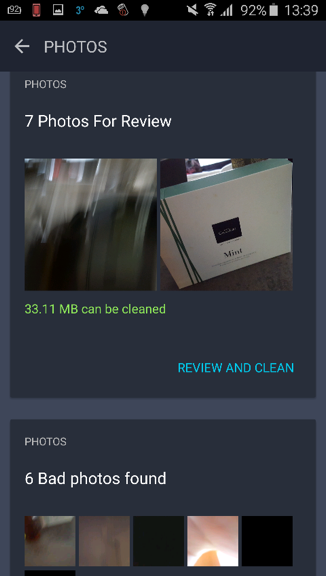
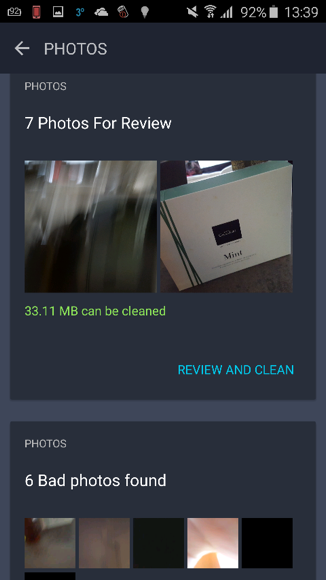
    • Bad photos: AVG Cleaner for Android also knows which photos are under- or over-exposed and blurry, giving you an instant way to de-clutter your photo gallery. It analyzes various aspects of a photo, such as sharpness, color, and lighting, and gives you the choice of what to keep and what to get rid of.

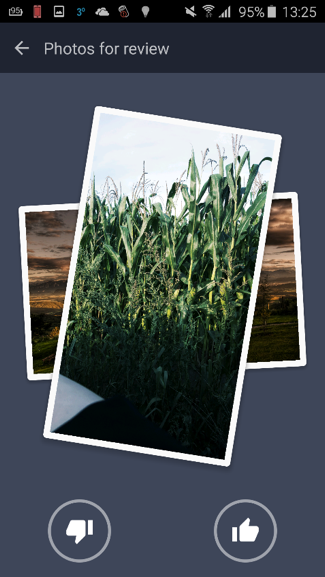
  • Review photos: If our Smart Photo Cleaner isn’t 100% sure about a bad photo, it lets you review it. Swipe to the left to delete; swipe right to keep it!

Best of all, Smart Photo Cleaner gets smarter about your choices and will give you more personalized suggestions on which photos to keep or clean up. Keep an eye out for an upcoming post soon, explaining how Smart Photo Cleaner works and how to use it. And that’s not all…

One-Stop-View to Fix and Clean

AVG Cleaner has received a major redesign, a term which probably doesn’t do it justice. Let me explain:

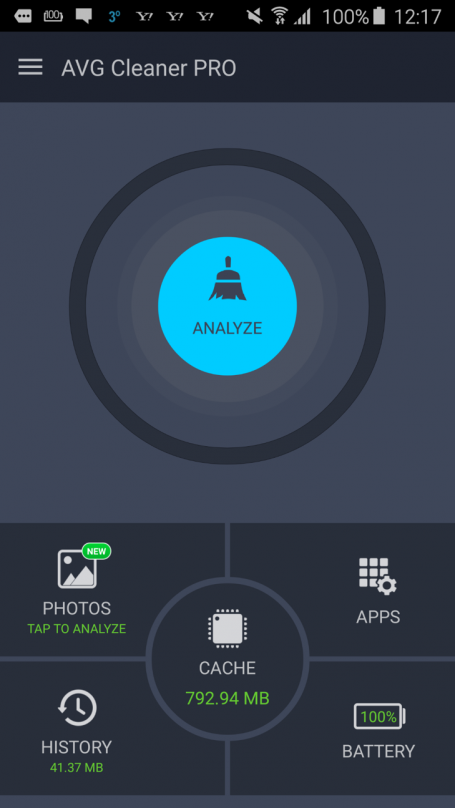
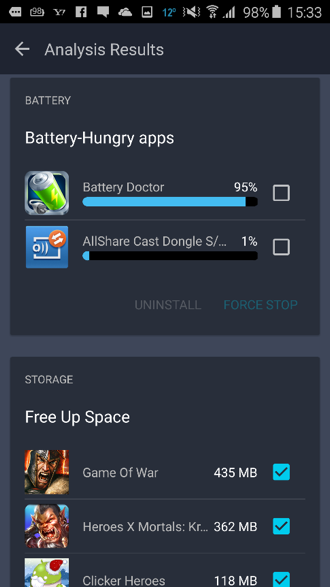
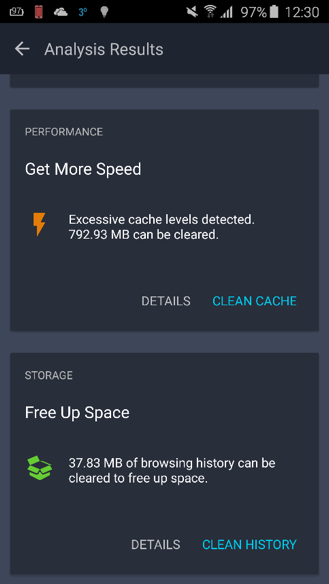
See the big fat ANALYZE button in the middle? Hard to miss. One tap on it, and AVG Cleaner will identify all the top resource-draining apps, bad photos, wasteful junk files and battery-draining settings, on one, simple screen – and helps you instantly fix it all. Basically, you get all of AVG Cleaner’s key features on one screen; and as you scroll down, you see all the issues with your device, such as Cache files, history leftovers, low-battery warnings, bad photos or battery-hungry apps:

Tap on one tile to fix these issues. Here’s what’s behind them:

  • Cache Cleaner: Identifies and cleans hidden, unused files to free up lost space
  • History Cleaner: Identifies browser history and old call logs that can be deleted to get rid of users’ traces
  • App Manager: Identifies ‘resource hungry’ apps (as detailed in AVG’s latest App Performance & Trends Report) and helps users stop or delete them:
    • Running Apps: Shows running apps and how much RAM they’re consuming
    • Unused Apps: Identifies apps that you haven’t used in a long time
    • Data Usage, Battery Usage and Storage: Helps you spot the largest apps and the ones with the most battery and mobile traffic drain
  • Battery Manager: Helps you optimize battery life with one tap, or allows your phone to automatically turn off power-sapping features and settings based on where you are, such as at home, at work or in their car (“Battery Profiles”)
  • NEW Smart Photo Cleaner: As above, automatically identifies all of the poor quality and similar photos on the device and enables users to ‘clean’ them easily, to free up device storage
  • NEW One-Click Dashboard Overview: Provides a one-tap-analysis of the device’s status across performance, battery life and storage, helping users easily fix and clean top resource hogs, bad photos, and temporary files, all on one screen

If you’re looking for a quick clean-up of all of your unwanted photos, check out our newly re-launched Cleaner today for free!

Is free Wi-Fi Safe?

Public networks are so convenient, they’ve popped up everywhere: cafes, airports, shopping centers. They’re almost everywhere.

But be warned: since your data is traveling through the air—sometimes completely unprotected—hackers could be listening in.

Bad guys could:

  • Eavesdrop on what you are doing
  • Steal your passwords
  • Intercept your communications and alter them, aka a Man-in-the-middle attack

When you’re connecting to an unknown Wi-Fi or network, ask yourself these questions:

  • Who owns the network?
  • Who else is on the network?

If you don’t know the answers to those questions, don’t do sensitive things like shop or bank online. Wait until you’re home or on a network you trust.

If you absolutely must access your bank accounts or shop for things, use a VPN like AVG Safe Surf to stay protected.


Santa’s Security Secrets

We all think we know Santa – where he lives (to the nearest Pole!), what he likes to wear (on one day of the year!) – but what do we really know about this mysterious character? What does he do during the rest of the year, what are his hobbies, where does he work on the other 364 days of the year,  what is his ‘real’ name, and more importantly – who is on his naughty list?! None of these personal details have ever been revealed, and even in today’s connected world, Santa has managed to keep his identity a closely guarded secret – but how, and what best practices can we learn from our favorite festive character?

 He wears the AVG Invisibility glasses
Santa saw AVG’s Invisibility Glasses in February and sent us a letter saying “Dear AVG, those Invisibility Glasses are just what I need to keep me invisible during the year. I have been a good Santa, and I hope you can help me out.”

The glasses make it difficult for cameras or other facial recognition technologies to get a clear view of Santa’s identity, so Facebook can’t automatically tag him in that embarrassing picture under the mistletoe, for example! We, of course, agreed to provide a pair, enabling Santa to travel the world without being tracked, seeing sights that would have been difficult to visit due to the number of people taking pictures to post online. Santa has provided us some pictures from his travels that we can share with you here…XXXX.
Cameron, Obama and Santa

Bono and Santa

Taj Mahal and Santa

Eiffel Tower and Santa

While not generally available yet, unless you’re Santa, the concept serves as a reminder to protect your privacy online. There are, of course, many other methods Santa uses to stay private – he has shared a few of them with us in this exclusive interview!

He stays away from social media
“There are hundreds of Santa impersonators on Facebook, but I – the real Santa – am nowhere to be found,” says Santa. Staying away from social media completely might be a challenge for the rest of us, but it’s worth thinking about the information we share via these channels at this time of year. Make sure to check your security and privacy settings to ensure you’re not exposing any information you’d rather not be. “You may want to think twice about posting those pictures of the latest high-tech gadgets you’ve been gifted too – you never know who might be looking!”

He still uses a POLARoid camera
“I never take selfies,” says Santa, “they may get leaked online and that could be awkward.” But with most of us now using our smartphones to take pictures, there are privacy issues you may not have considered. Aside from pictures getting into the wrong hands – the recent VTech hack which may have enabled hackers to steal children’s photos is an example – you might not know that smartphone photos are also oftengeotagged’, meaning that others can find out exactly where your pictures were taken.

His sleigh is Wi-Fi free and disconnected
“Checking out if you have been good or bad is now even easier with people posting so much of their lives on their online profiles. I avoid being located, tracked or leaving things to chance by using an encrypted Virtual Private Network (VPN) when using the Internet,” says Santa. But It would be impractical for most of us to avoid the Internet completely. There are ways to make sure you’re surfing securely and privately though.

Secure your home Wi-Fi with encryption using a strong password. Also avoid public Wi-Fi hotspots when transferring personal details online during bank transfers for example, or follow Santa’s example and use a VPN. Phishing emails also tend to spike around the festive season as cybercriminals try to tempt us with too good to be true deals. If at any point you think the email is spam and fraudulent then do not open or click on any links, just delete the email!

He pays for everything with toys
Santa told us that his “route and present list is a closely guarded secret. I use very strong passwords and a reindeer for two-factor authentication”. If you’re doing last minute shopping online this year, it’s worth taking to time to remember good password practice – to save time, and a potential headache, later! This means using strong passwords that are different for each account, along with additional security codes or the ‘two-factor authentication’ Santa refers to where available.

So now you know a bit more about Santa and his security secrets – hopefully they’ll also help you to stay safe and secure this Christmas. Happy Holidays!


Image sources:
The British Foreign and Commonwealth OfficeErik (HASH) HersmanTANAKA Juuyoh (田中十洋)Sreejith KBrian Burk


Bluecom Buys Big from AVG Business

2015 has been a big year for AVG Business. Our worldwide community of partners has been supporting businesses in cities across the globe, giving their customers the reassurance that their applications and data are protected on any device, anytime, anywhere.

I’m excited to welcome a new partner, Bluecom, to our AVG Business network. Stockholm-based Bluecom, a rapidly-growing IT service provider, has recently chosen AVG Managed Workplace to manage network monitoring, control and automation for its small and medium business customers throughout Sweden.

This represents the largest order of the year for AVG Business in the Nordics region.

According to Bluecom CEO Robert Sjöholm, after conducting tests with several solutions on the market, AVG Business was selected because our product had the breadth Bluecom needed, “AVG Managed Workplace has all of the major functionality, while being more user-friendly than other products on the market we tried.”

Bluecom has already seen a positive effect on its sales since it started using AVG Managed Workplace, with Sjöholm noting that, “The reports we get from Managed Workplace are so good that we can often see flaws in customer systems that are unknown to them.”

AVG Business solutions like AVG Managed Workplace are a great example of how we are listening to our partners and responding with powerful security solutions to help partners proactively manage and monitor their customers’ networks and automatically deploy and update critical security tools.

With Managed Workplace 9.2, released in September, we move one step closer to a complete, end-to-end IT and managed security solution. The Managed Workplace platform streamlines IT management for our partners, providing ease of use, security and control of the entire IT infrastructure (devices, applications and networks) from a “single-pane” of glass. With premium remote control integrated at no additional cost to the remote monitoring and management platform, partners also gain cost savings as well as reporting tools to streamline billing and demonstrate client ROI.

Visit http://www.avg.com/partners to find out more about our AVG Business solutions and how we can help your business.  We look forward to sharing new products and services with you in 2016.

Happy holidays and best wishes for the new year!

4 Tips for Successful Online Sales over the Holiday Season

Christmas is nearly upon us, but is your website ready to make the most of it? In fact, let’s go one step further: are is your website, social media and IT systems all singing the same song?

Preparation and a co-ordinated set up is essential if you’re going to make the most out of any uplift in customer attention and desire to buy from small businesses instead of the big brands.

You can have a killer website but if your social media channels aren’t up-to-date too then you’ll look behind the times and disorganised.  If your IT systems that enable you to take, process, and dispatch orders aren’t up to scratch, then any online sales you do make might go to waste.

The web is available 24/7/365 – this is as level a playing field as it gets for small business, especially when advertising and marketing budgets don’t match those of the large and well established brands.

Customers can be fickle and have short attention spans too, hopping from website to website in a matter of seconds if they don’t see what they’re looking for. This is the same for all businesses, but it underlines the importance of having everything ready, up to date and aligned.

Here are four things you can do to make the most of the holiday season for your small business online:

1. Have a dedicated webpage and keep it live all year round
Have a dedicated web page on your site for popular sales events like Small Business Saturday, Black Friday and Cyber Monday… and keep it live all year round! That might sound counter-intuitive when we’re only talking about one day in the year, but there’s a very good reason you should do this. Once a web page is live it’s far easier to manage: the basic structure can stay the same even if the copy and imagery change. Plus, people don’t always follow the rules when it comes to searching for offers and deals online – they’ll start searching for them whenever the mood takes them, wherever they happen to be. As recent research reveals, when people start looking for information about a purchase, they could be doing it using a mobile on the train, a desktop PC at work, or a tablet when they’re snuggled up in bed.

For example, If they start searching for details about Small Business Saturday in September and October – as Google search data shows – then having your web page already live will allow people to find you. Currys use this tactic with their Black Friday web page.

If you take down your page after the event, then search engines won’t be able to show it to customers whenever they start searching for it next year. They’ll draw a blank and you’ll be starting from square one all over again. Why shoot yourself in the foot? Competition for online orders is tough enough as it is.


2. Facebook is a great starting point for a conversation
“Like” it or not, Facebook is a force to be reckoned with. 84% of internet users between the age of 35-44 are on at least one Facebook service, meaning Facebook, Facebook Messenger, Instagram or WhatsApp. That figure goes up to a whopping 90% for 16-24 year-olds. This is where your customers – existing and future – are likely to be spending a lot of their social media time, so if you’re not on there, they won’t see you.

Make sure you’ve set up a Facebook business page. They won’t want to see a constant stream of sales related messages though. Imagine your business page to be a little bit like your personal Facebook page: it should express the everyday goings on and personality of your business. And in between those posts, you can publish business event or sales related messages. If you’re short on ideas, have a look at how other small businesses have used Facebook to grow their business.


3. Make sure your IT system is safe and secure
If it’s the one day in the year you definitely don’t want to be hacked it’s when you’ve just taken a large number of online orders. We can all remember the Ashley Madison scandal and countless other big brands being hacked and losing customer data over the years. A survey of UK businesses conducted this year also reveals nearly nine out of 10 large businesses said they had suffered some form of information security breach in the last year. Don’t be fooled into thinking it can’t happen to a small business. Hackers – and the viruses they release into the world – will target anyone they think might have weak website security.


4. Ask the experts
If you are concerned your ecommerce and supporting IT system aren’t as secure or co-ordinated as they could be, ask for help. There’s a whole host of free resources for small businesses all over the web to help you understand how healthy and secure your IT system is. For example, AVG’s free IT Security Health Check is a good place to start if you’re not an expert with little time on your hands. It’s short and sweet and offers straightforward tips for how to improve your IT security. The UK government is also offering Innovation Vouchers worth £5,000. These can be used to pay for advice which will help protect and grow your business by having good cyber security in place.


At the end of the day

Gearing up your website, social media and IT systems to make the most out of the holidays is only half the battle. Making sure they stay safe and secure, and continue to serve you and your customers well, is the other half.

The Connected Car: Your Smartphone’s Biggest Accessory and Security Threat

Over the last few years, technology’s merger with the auto industry has materialized in the form of advanced digital dashboards and mobile OS integration. While adoption has been slow, car manufacturers have been attempting to fill dashboards with Silicon Valley-grade technology, including Apple’s CarPlay and Google’s Android Auto.

Defying the status quo, Tesla has continuously outperformed traditional automakers since its inception. The fully electric sedan comes standard with a gigantic screen on the car’s console, resembling the cockpit of commercial airliners. Additionally, and perhaps most similar to the mobile OS’s consumers have grown accustomed to, the Tesla performs over-the-air software updates. Most recently, Tesla rolled out (and rescinded parts of) its ‘Autopilot’ feature in Model S sedans. The feature allows drivers to sit back and watch as the car drives itself using various sensor and GPS technologies.

Tesla isn’t the only company integrating this technology, among others, into their cars. Even before they released the ‘Autopilot’ feature, Google unleashed a squadron of driverless cars that can be seen testing their abilities (and getting pulled over for going too slow) around Silicon Valley. Apple has owned technology headlines for months as rumors of car development continue to surface for the first time since Walter Isaacson’s biography on late CEO Steve Jobs hit the shelves back in 2011. But it’s not only Silicon Valley giants like Tesla, Apple and Google that are developing technology and cars for the driverless era as automakers like Volvo and Ford have also thrown their names into the ring.

Other IoT features continue to make their way into consumers’ driveways. Many cars in the new Chevrolet lineup offer 4G connectivity on the road. Third-party dashboard accessory makers like Pioneer, Kenwood, and Alpine are developing add-ons for older cars wishing they had access to Apple’s Carplay and Google’s Android Auto. And several automotive giants are capitalizing on new device categories like smartwatches to provide a more simple and technological experience for their car-owners.

With the addition of connectivity in cars, drivers and passengers alike need to think about their physical safety and digital safety. As we’ve seen in the news recently, namely in a July Wired article, certain cars can be hacked and completely controlled remotely. Scary, yes, but that covers just the surface of security threats. Like every other IoT device, the data a connected car will produce is vulnerable to cybercrime. Picture driving down Main St. and passing your favorite pizza shop on your way to work in the morning, the same route you take every day. It’s Thursday, which means Pizza Night for the family. As you drive by, a coupon for two free extra toppings and a 2-litre soda bottle with any large pizza order appears on your dashboard or windshield, valid only tonight. Seemingly magically, based on past patterns, your IoT car knew to offer you a coupon for this pizza parlor on the night you’d need it.

A connected car has the potential to be your smartphone’s biggest and greatest accessory, but it also inherently comes with major security vulnerabilities, like the rest of the IoT, that need to be addressed.  Currently, traditional car companies are researching and developing their own self-driving/connected cars. Technology companies like Apple and Google, along with other rumored giants, are following suit. But a recent poll out of WEF and Boston Consulting Group, showed that 69 percent of consumers (6,000 polled from 10 different countries) want automakers and tech giants to work together to create the next big thing in automobiles. As awareness of the IoT, its vulnerabilities and connected cars grows, I see this number rising. What’s important is that the integration of security also grows, so we can help usher in the future we all want, as safe as it can be.