Category Archives: AVG

AVG

The truth about Android updates

If you are using an Android-powered smartphone, you may have found yourself wondering about updating your operating system. With names such as Lollipop, Kit Kat and Jelly Bean, it’s not always clear which is the latest version and what are the benefits of updating your device.


Why is it importIant to update?

Beyond their cute sounding names, each Android update brings new features, improvements and most importantly, security fixes.

It’s this last bit that matters most, as even basic activities like emails hold an enormous amount of valuable information about you. The latest versions of Android fix vulnerabilities that can help keep your data safe.

As of writing, the latest version of Android is 5.1, codenamed “Lollipop”. You can check which version your phone has by going into your settings, and into “About Phone”. (Tap on the Android Version section a few times for a surprise.) If you want to check if there’s an update available for you, you’ll find a Software update tab in this menu.

Most likely, there won’t be.

Why aren’t you receiving the update?

According to Google’s own stats, you’re most likely running  an old version of Android. In fact, most of us are running Jelly Bean (Android 4.1, 4.2, 4.3) or Kit Kat (Android 4.4).
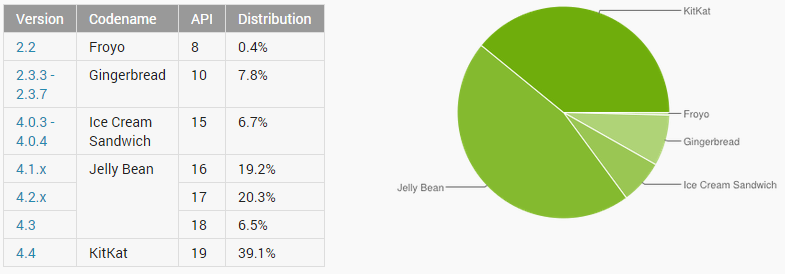
Android versions

This is because Google doesn’t push updates directly to you. Instead, they are generally sent to phone manufacturers like Samsung, Sony and HTC. Manufacturers then make their own changes to the software, adding features to improve compatibility with their devices or differentiate themselves from their competition. If you got your phone through a carrier like Verizon, Vodafone or Orange, they will also certainly make additional changes to the update. This process can sometimes take over a year, so don’t hold your breath.

Often the whole process is so complicated and time consuming, that many manufacturers may not even issue an Android update more than once per phone. This encourages customers to purchase new handsets to get the latest updates.


What can you do to stay safe without an update?

While it’s possible to install up-to-date versions of Android yourself, the methods can be quite technical, risky and will certainly void your warranty. For most people this is not an option, and so updates are unobtainable, short of buying a new phone.

However, this should not stop you taking steps to protect your device.

That’s where having a strong antivirus app like AVG AntiVirus for Android becomes a must have. It will help keep you safe by keeping an eye on what happens in your phone, even if your phone is not updated. So stay protected!

Three reasons to be excited about: 3D printing

The fledgling industry has grown rapidly and is estimated to be valued around $16 billion by 2018. Now it seems that almost anything is possible. Here are some of the three great uses of 3D printing technology emerging today.


Clinical testing

Cosmetics company L’Oreal has started developing 3D printed skin to help them test cosmetics without the need for animals or real human skin. Working in collaboration with bio engineering company organovo, L’Oreal said “Our partnership will not only bring about new advances in vitro methods for evaluating product safety and performance, but the potential for where this new field of technology and research can take us is boundless.”

This is clearly a big step forward for a whole range of cosmetics and can help build a future less dependent on animal testing.

3D Skin

Image courtesy of BBC


Fashion and textiles

While it most fashion conscious people may take some convincing before they agree to don a garment made out of 3D printed fabrics, the emerging industry shows a lot of promise and potential.

The opportunity to create custom pieces, built to specific physical dimensions could potentially give clothes of the future a convenience and suitability rarely found in traditional clothes.

It doesn’t stop there though, when you consider the market for fashion bags and accessories, the possibilities for customization and personalization are as broad as they are deep.

Video

3D Printed Fashion Accessories


Body Parts

Perhaps the biggest success story for 3D printing thus far has been in the area of prosthetic limbs and body parts. Recently, a seven year old California girl received a new 3D printed prosthetic hand that was created for only $50.

Video

3D Printed Prosthetics

Clearly this is one of the most inspiring and uplifting ways that 3D printing technology can touch lives for the better, but it’s not just for humans.

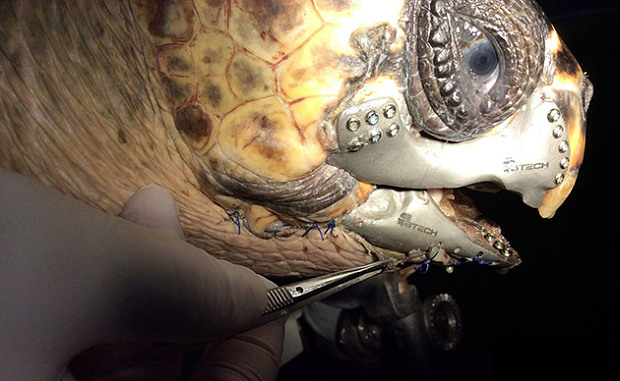
In the last few days, a loggerhead turtle that was gravely wounded in an accident with a boat propeller received a brand new 3D printed jaw. Without its brand new 3D printed titanium jaw, the turtle would have had to spend a lifetime in captivity, unable to fend for itself in the wild.

3D Turtle Jaw

Photo: BTech Innovation


What most excites you about 3D printing. I’d love to hear from you on Twitter or Facebook.

Title image courtesy of CNN.com

Three reasons to be excited about: 3D printing

The fledgling industry has grown rapidly and is estimated to be valued around $16 billion by 2018. Now it seems that almost anything is possible. Here are some of the three great uses of 3D printing technology emerging today.


Clinical testing

Cosmetics company L’Oreal has started developing 3D printed skin to help them test cosmetics without the need for animals or real human skin. Working in collaboration with bio engineering company organovo, L’Oreal said “Our partnership will not only bring about new advances in vitro methods for evaluating product safety and performance, but the potential for where this new field of technology and research can take us is boundless.”

This is clearly a big step forward for a whole range of cosmetics and can help build a future less dependent on animal testing.

3D Skin

Image courtesy of BBC


Fashion and textiles

While it most fashion conscious people may take some convincing before they agree to don a garment made out of 3D printed fabrics, the emerging industry shows a lot of promise and potential.

The opportunity to create custom pieces, built to specific physical dimensions could potentially give clothes of the future a convenience and suitability rarely found in traditional clothes.

It doesn’t stop there though, when you consider the market for fashion bags and accessories, the possibilities for customization and personalization are as broad as they are deep.

Video

3D Printed Fashion Accessories


Body Parts

Perhaps the biggest success story for 3D printing thus far has been in the area of prosthetic limbs and body parts. Recently, a seven year old California girl received a new 3D printed prosthetic hand that was created for only $50.

Video

3D Printed Prosthetics

Clearly this is one of the most inspiring and uplifting ways that 3D printing technology can touch lives for the better, but it’s not just for humans.

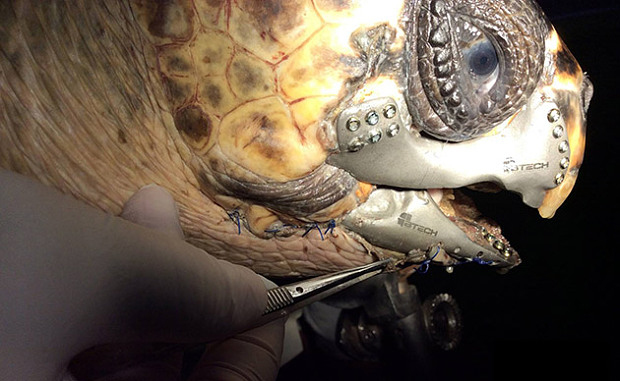
In the last few days, a loggerhead turtle that was gravely wounded in an accident with a boat propeller received a brand new 3D printed jaw. Without its brand new 3D printed titanium jaw, the turtle would have had to spend a lifetime in captivity, unable to fend for itself in the wild.

3D Turtle Jaw

Photo: BTech Innovation


What most excites you about 3D printing. I’d love to hear from you on Twitter or Facebook.

Title image courtesy of CNN.com

Distracted Drivers Pose a Greater Challenge on our Roads than Driverless Cars

Google announced last Friday that a prototype of its own self-driving car will hit the streets in its hometown of Mountain View, CA in a pilot test.  Each car will be equipped with a human ready to take over the wheel, if needed, and the car speed will be capped at 25 mph.

Google also revealed its track record for autonomous vehicle safety with impressive results thus far. In the 1.7 million miles of the manual and autonomous driving Google has logged in the past six years, there have only been 11 minor accidents—all of which were caused by other drivers—and none resulting in injuries.

Google’s Chris Urmson, director of its driverless car program, said in a statement: “…not once was the self-driving car the cause of the accident.”

These early numbers are impressive, especially since these driverless cars have been on the road for 10,000 miles a week and in some crazy driving conditions.

About those accidents, Urmson noted: “Rear-end crashes are the most frequent accidents in America, and often there’s little the driver in front can do to avoid getting hit; we’ve been hit from behind seven times, mainly at traffic lights but also on the freeway. We’ve also been side-swiped a couple of times and hit by a car rolling through a stop sign.”

You can see a detailed report by Urmson in his article on Medium.

Video

Ready for the road

Though some continue to question the safety of testing driverless vehicles on public highways, and we have a ways to go before autonomous driving hits prime time… it’s also good to keep in perspective the impact of human error (the cause of 94% of accidents) and the risk of distracted drivers.

Lot’s of people aren’t paying attention on our roadways, which Google’s driverless cars have experienced.

People are eating, drinking, smoking, talking on cell phones, adjusting their entertainment consoles, navigating via digital maps, or you name it.  On any given day, Distracted.gov estimates over 660,000 vehicles are being driven by someone using a hand-held cell phone… And it has been shown that a lot of our distraction has to do with drivers using smartphone technology while behind the wheel.

In fact, AT&T this week released an alarming new survey that shows that motorists have expanded their behind-the-wheel activities from just talking and texting to use of Facebook, Twitter, taking selfies and even videos.

Here are a few of AT&T’s salient numbers of smartphone activities undertaken while driving:

  • 70% people engage in smartphone activities while driving
  • 61% text
  • Nearly 40% use social media
  • About 30% surf the net and/or use Facebook
  • 17% snap selfies
  • 14% use Twitter, Integra
  • Around 10%-plus use video chat and Snap Chat


AT&T revealed the research along with its launch of its expanded “It Can Wait” ad campaign, moving its focus from just texting while driving to include other smartphone driving distractions.

Other recent studies indicate that anything that takes your attention away from the road for just two seconds or longer can increase the risk of an accident from four to 24 times…Sending or reading a text takes your eyes off the road for 5 seconds, according to info collected by Distracted.gov. Imagine the seconds devoted to viewing real-time social media feeds, or framing a selfie?

People very well should be concerned about bumps in the road for fully autonomous cars, which are a lot more than smartphones on wheels. But the usage of smartphone technology inside our autos poses another and very real safety challenge and far bigger threat today that we need to be more focused on and deal with!

I applaud AT&Ts effort and those of others to educate the public on the problem of technology-induced distracted driving – although a lot more than education needs to be done.

And I also applaud Google’s goal to have smart self-driving cars in the future to at least share the burden of driving with humans. It may not solve all of our roadway safety problems in the future – but it sure may help!

In the meantime, it’s incumbent upon all of us in technology industry who are contributing to our increasingly connected mobile future, to be vigilant about all aspects of our products’ safety, security, and privacy.

Title image courtesy of Google.

Distracted Drivers Pose a Greater Challenge on our Roads than Driverless Cars

Google announced last Friday that a prototype of its own self-driving car will hit the streets in its hometown of Mountain View, CA in a pilot test.  Each car will be equipped with a human ready to take over the wheel, if needed, and the car speed will be capped at 25 mph.

Google also revealed its track record for autonomous vehicle safety with impressive results thus far. In the 1.7 million miles of the manual and autonomous driving Google has logged in the past six years, there have only been 11 minor accidents—all of which were caused by other drivers—and none resulting in injuries.

Google’s Chris Urmson, director of its driverless car program, said in a statement: “…not once was the self-driving car the cause of the accident.”

These early numbers are impressive, especially since these driverless cars have been on the road for 10,000 miles a week and in some crazy driving conditions.

About those accidents, Urmson noted: “Rear-end crashes are the most frequent accidents in America, and often there’s little the driver in front can do to avoid getting hit; we’ve been hit from behind seven times, mainly at traffic lights but also on the freeway. We’ve also been side-swiped a couple of times and hit by a car rolling through a stop sign.”

You can see a detailed report by Urmson in his article on Medium.

Video

Ready for the road

Though some continue to question the safety of testing driverless vehicles on public highways, and we have a ways to go before autonomous driving hits prime time… it’s also good to keep in perspective the impact of human error (the cause of 94% of accidents) and the risk of distracted drivers.

Lot’s of people aren’t paying attention on our roadways, which Google’s driverless cars have experienced.

People are eating, drinking, smoking, talking on cell phones, adjusting their entertainment consoles, navigating via digital maps, or you name it.  On any given day, Distracted.gov estimates over 660,000 vehicles are being driven by someone using a hand-held cell phone… And it has been shown that a lot of our distraction has to do with drivers using smartphone technology while behind the wheel.

In fact, AT&T this week released an alarming new survey that shows that motorists have expanded their behind-the-wheel activities from just talking and texting to use of Facebook, Twitter, taking selfies and even videos.

Here are a few of AT&T’s salient numbers of smartphone activities undertaken while driving:

  • 70% people engage in smartphone activities while driving
  • 61% text
  • Nearly 40% use social media
  • About 30% surf the net and/or use Facebook
  • 17% snap selfies
  • 14% use Twitter, Integra
  • Around 10%-plus use video chat and Snap Chat


AT&T revealed the research along with its launch of its expanded “It Can Wait” ad campaign, moving its focus from just texting while driving to include other smartphone driving distractions.

Other recent studies indicate that anything that takes your attention away from the road for just two seconds or longer can increase the risk of an accident from four to 24 times…Sending or reading a text takes your eyes off the road for 5 seconds, according to info collected by Distracted.gov. Imagine the seconds devoted to viewing real-time social media feeds, or framing a selfie?

People very well should be concerned about bumps in the road for fully autonomous cars, which are a lot more than smartphones on wheels. But the usage of smartphone technology inside our autos poses another and very real safety challenge and far bigger threat today that we need to be more focused on and deal with!

I applaud AT&Ts effort and those of others to educate the public on the problem of technology-induced distracted driving – although a lot more than education needs to be done.

And I also applaud Google’s goal to have smart self-driving cars in the future to at least share the burden of driving with humans. It may not solve all of our roadway safety problems in the future – but it sure may help!

In the meantime, it’s incumbent upon all of us in technology industry who are contributing to our increasingly connected mobile future, to be vigilant about all aspects of our products’ safety, security, and privacy.

Title image courtesy of Google.

Google introduce new Chrome extension rules to help protect users

Google has just introduced new rules for Chrome extensions to help crack down on unwanted and malicious extensions by only making Chrome extensions available via the official Chrome Store.

According to their blog post announcement, Google’s test phase for the rule saw a 75% drop in users complaining about unwanted extensions. Google wrote:

“We originally did not enforce this policy on the Windows developer channel in order to allow developers to opt out. Unfortunately, we’ve since observed malicious software forcing users into the developer channel in order to install unwanted off-store extensions. Affected users are left with malicious extensions running on a Chrome channel they did not choose.”

The move to a centralized marketplace for extensions is a great way for Google to establish quality control for Chrome extensions, just as it and Apple have with their respective app stores.

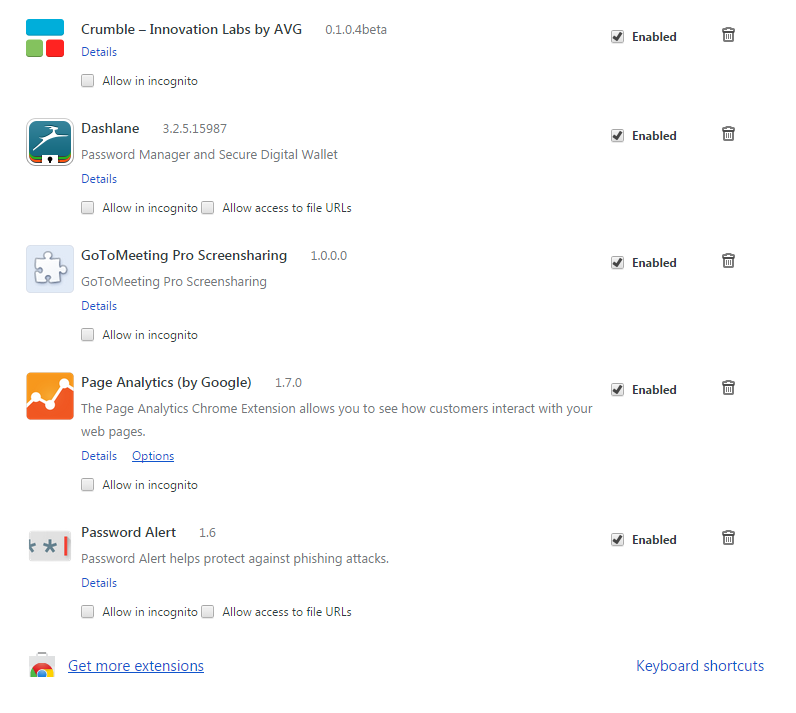
Chrome extensions are a great way to customize and optimize your browsing experience. For example AVG’s Crumble extension blocks online trackers and cookies allowing you to surf without surveillance.

You can install the extension for free from here: Crumble Chrome extension.

Checking which extensions you are using is very easy to do.

How to check which extensions you are running

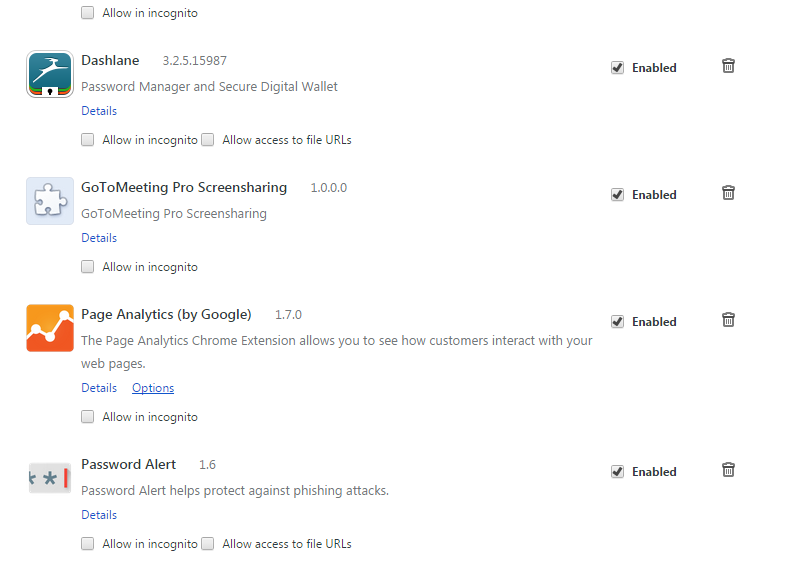
Checking which Chrome extensions are active is quick and easy. Within Chrome, open the menu in the top right and select More Tools. Select Extensions from the menu.

Here you can view which extensions are currently running, add and remove extensions.

Chrome Extensions


Google introduce new Chrome extension rules to help protect users

Google has just introduced new rules for Chrome extensions to help crack down on unwanted and malicious extensions by only making Chrome extensions available via the official Chrome Store.

According to their blog post announcement, Google’s test phase for the rule saw a 75% drop in users complaining about unwanted extensions. Google wrote:

“We originally did not enforce this policy on the Windows developer channel in order to allow developers to opt out. Unfortunately, we’ve since observed malicious software forcing users into the developer channel in order to install unwanted off-store extensions. Affected users are left with malicious extensions running on a Chrome channel they did not choose.”

The move to a centralized marketplace for extensions is a great way for Google to establish quality control for Chrome extensions, just as it and Apple have with their respective app stores.

Chrome extensions are a great way to customize and optimize your browsing experience. For example AVG’s Crumble extension blocks online trackers and cookies allowing you to surf without surveillance.

You can install the extension for free from here: Crumble Chrome extension.

Checking which extensions you are using is very easy to do.

How to check which extensions you are running

Checking which Chrome extensions are active is quick and easy. Within Chrome, open the menu in the top right and select More Tools. Select Extensions from the menu.

Here you can view which extensions are currently running, add and remove extensions.

Chrome Extensions


Help protect your family with AVG’s new VPN from Privax

As a father of three, I understand the difficulty of raising children in an increasingly online world. This first-hand experience made it even more pleasing to stand in the offices of AVG’s newest acquisition, a privacy and protection technology company called Privax, and to welcome all their employees officially to AVG.

Privax is behind a fantastic service called HMA! Pro which is a virtual private network (VPN) product that allows consumers to connect their mobile and desktop devices to the Internet securely and privately. It’s a great tool to ensure that personal data remains just that – personal data. VPNs give people more control over what information about themselves they are comfortable sharing and what they would prefer to keep to themselves when communicating, purchasing or searching online.

AVG understands that you are concerned about your privacy and this acquisition is part of our continued commitment to offering the best protection and privacy products available. It’s our goal to give you peace of mind when you go online on your mobile as well as your desktop devices. You’ve told us that you value choice when managing your own privacy settings, and for those with families, this is even more important as you look to protect your children online.

Research we carried out earlier this year with the Mobile Ecosystem Forum showed that 49% of people surveyed in 10 countries said trust prevented them from downloading or buying online, or using some or all apps from their mobile device. We also found that 72% were not happy sharing personal data with apps – compared with 65% last year.

Therefore, at Mobile World Congress earlier this year, our CEO, Gary Kovacs, made a public commitment to provide smart tools to help our customers reassert their privacy. This acquisition takes us one step further towards fulfilling this promise.

Video

Gary Kovacs Keynote at MWC 2015


Customers can already use our existing privacy services including AVG PrivacyFix and the Do Not Track feature of our secure search. Privax’s HMA! Pro will give you another option by helping you enjoy your favorite online activities in a safe and private environment that you can tailor to your personal sharing preferences and without compromising your privacy.

Has a plane been hacked mid-flight?

The FBI is investigating Chris Roberts, a security researcher, who claims to have taken control of an aircraft in midflight and made it drift sideways by controlling one of the engines. All this from a passenger seat and a connection through the entertainment system located under a seat.

Chris Roberts, who has demonstrated hacking many devices at Blackhat conferences, denies the claim and has tweeted


The FBI is reported to have interviewed Roberts a number of times in a recently published article on APTN, a Canadian news outlet. According to the article Roberts claimed he took control of an aircraft

Just one month ago, a GAO report warned of a vulnerability on aircraft where they claim that the avionics could be accessed through the entertainment system as they are connected through a common infrastructure. The GAO report was widely disputed by many industry experts as I detailed in a previous blog post.

This second incident has made me revisit the topic and makes me question whether or not I will be safe on my next flight. Once again, my conclusion is that I am. Here’s why:

  • The original conclusion that the two networks are not connected was based on expert commentary from Dr. Phil Postra a qualified pilot and professor of digital forensics at Bloomsburg University.
  • There is speculation that newer aircraft, specifically the Boeing 787 DreamLiner may have a single onboard network but experts say that even on these aircraft the flow of data is one way from the cockpit to the passenger network and that no traffic can fly in the opposite direction. This has been a speculative issue for the last 7 years, see this Fox news story.
  • The aircraft that Roberts reportedly hacked was ‘older’ and had the standard of separate networks for Avionics and Entertainment, which would imply that the hack may not have happened at all and may have just been a bit of bragging.
  • Since this story took to the mainstream press last month, I am certain that manufacturers of aircraft have tested and re-tested the security of the avionics systems and if necessary made the necessary changes. In fact, Roberts may have made the systems even more secure with just the rumor of a hack.
  • Lastly, aircraft are fitted with the ability for the pilot to take manual control and fly by wire, this is done through a disconnect switch in the cockpit. In the remote possibility someone did manage to mess with the avionics then I would trust one of the pilots to take control.


While there maybe doubt, speculation and differing views, there are many other systems that could potentially be hacked to disrupt a flight such as air traffic control systems or satellite positioning systems. These could be attacked from the ground and not require a hacker to be on board. It seems far more likely to me, that these would be the target of a person with malicious intent.

Will I be boarding an aircraft soon? Yes, next week. If the person sitting next to me gets out a screw driver and starts taking his seat apart to access networks cables I will call the crew over  and ask them to inform the pilot, I trust you will do the same.

AVG Business: Volles Haus beim Auftakt der Roadshow 2015

Basel und Düsseldorf, 18. Mai 2015AVG (NYSE: AVG), der Online Security Anbieter für mehr als 200 Millionen aktive Nutzer, präsentiert seine neuen Produkte für Business-Anwender in Deutschland und in der Schweiz. Bei den Auftaktveranstaltungen seiner Partner-Roadshow 2015 in München, Stuttgart und Frankfurt am Main mit mehr als 100 Teilnehmern verzeichnete der Hersteller ein hohes Interesse an seinen Lösungen zum Remote Monitoring und Management. Für die kommenden Termine in Düsseldorf, Zürich und Basel sind noch wenige Plätze für kurzentschlossene Interessenten verfügbar.


Francois Tschachtli

Francois Tschachtli, Sales Director AVG Business DACH & Benelux (Quelle: AVG).

AVG Partner-Roadshow 2015 im Überblick
AVG Business zeigt auf seiner Roadshow Bestandspartnern und solchen die es werden möchten, wie sie mit den neuen Managed Services Mehrwert im Unternehmen schaffen können. Zudem steht eine Präsentation inklusive Live-Demonstration der Produkte aus dem Business-Portfolio auf dem Programm.

Deutschland

  • Mi, 20.05.2015 – Düsseldorf

Anmeldung online, telefonisch unter +49 211 586 99 200 oder per Mail an [email protected]

Schweiz

  • Di, 19.05.2015 – Zürich
  • Do, 21.05.2015 – Basel

Anmeldung online, telefonisch unter +41 61 317 25 25 oder per Mail an [email protected]

Über AVG
AVG ist ein Online Security Anbieter, der Software und Services für die Sicherheit von Geräten, Daten und Menschen herstellt. AVG hat mehr als 200 Millionen aktive Nutzer als Kunden. Die AVG-Produkte und Services für Endkunden bieten Internetsicherheit, Leistungsoptimierung, persönliche Privatsphäre und Identitätsschutz für den PC und mobile Endgeräte. Das AVG Business Portfolio für Sicherheit und einfachere Prozesse im Unternehmen ist über Managed Service Provider, Value Added Reseller und Händler erhältlich und enthält Lösungen zur IT-Administration, Überwachung und Reporting, integrierte Sicherheit und Mobile Device Management.

Alle Marken sind Eigentum ihrer jeweiligen Besitzer.

Ansprechpartner für die Presse:

Martina Krelaus
Akima Media
+49 89 17959 18-0
[email protected]