Category Archives: AVG

AVG

Let’s ‘Make It Happen’ for Women in Tech

The first International Women’s Day was held in 1911. The day is actually celebrated worldwide, and not just on one day, but from late February through March and beyond.

This year, thousands of events are occurring to mark and encourage the economic, political and social achievements of women. Organizations, governments, charities, educational institutions, women’s groups, corporations and the media celebrate the day. The activities span the realm of possibilities for women, including women in tech.
Make it happen

There were more than 340 events scheduled to take place in the United Kingdom alone to celebrate International Women’s Day. For example, an event on March 6, focused on women’s work in creative and technology industries was scheduled in London’s tech hub.  And in a variation of Girls Who Code, in Luxembourg they were holding “Mums and Girls Code”– a fun introductory workshop in coding for mothers and their daughters.

Here in the USA, 186+ events were scheduled for International Women’s Day.  You can see a complete list here. The list of events is inspiring, promoting awareness, culture, and learning for women and girls across the nation. Many of the IWD events are also online, including webinars, for people who don’t have time to visit a particular event.

Later this March, I’m personally very excited to be speaking at SXSW Interactive on the subject of furthering women’s roles in technology.   My session at 3:30 p.m. March 14 (JW Marriott Room 407), “Boardroom or Baby: The Choices Women Have in Tech” will address closing the gaps in opportunities for women in technology and achieving work/life balance. If you can’t join in person, you can join the conversation at @judyatavg  #techwomen #SXSW.

Video

Boardroom or Baby?


It’s actually very encouraging to see that there are many conversations on the topic of women in technology scheduled for SXSW Interactive 2015: Among them:  “End To Brogramming” with Re/code and Elle.com, which takes place from 5-6 p.m. on March 13;  “Geek Girls Are Chic!” on March 15 by Girls Who Code and IBM, and “#OurTimeToLead: Why Tech Needs More Women” by the Anita Borg Institute on March 17. You can see the SXSW schedule here.

We’ve all done the math. But women in tech (or the lack of such) is not just a pipeline issue, it’s a retention issue and a culture issue as well. It’s encouraging to see major tech companies are recognizing this. It is for everyone’s own good: we need a smart tech workforce and can’t dismiss half the population, and on the consumer side, women represent significant adopters when it comes to technology.

So progress is happening. Good moves are being made. Though more must happen. I think International Women’s Day is a great day to see how far we have come, and serve a fantastic spark to light and then pass the torch to following generations to empower all women, our sisters and daughters.

Speak_IA

Our journey to over 100 million mobile downloads

Every company, big, small or start-up faces the question of what will be big four years from now. While there is no way of knowing for sure, we can learn a lot from what happened four years back.

The smartphone platform was coming to life but was fragmented across a number of platforms. How could we find out which of the platforms would grow to be the biggest?

At the end of 2009, beginning of 2010, we identified Android as the platform of the future despite a market share of only 4%. Needless to say, it was hard to explain to our finance and marketing departments.

It’s no secret that the market can give you signals about what the future may hold, you just need to know where to look.

When we watched vendors like HP, BlackBerry and Nokia dip in 2010, we noticed that Android and iOS were heading in the opposite direction. In Nov 2010, we knew we had to take action. We decided to step into the mobile market and announced acquisition of a small team of five people providing Android security. This is where our journey started.

But a bigger company acquiring a start-up does not mean the problem solved. We knew that Google ranked apps in the store via keywords so we knew that we needed to get to the top of the list. If you search for antivirus on Google, we are at the top.

A year later, we to noticed another important method to improve rankings – user ratings.  If you want to achieve a number of downloads to really affect your business, you need a user rating of at least 4.4. So we invested in a team to ensure we could maintain this rating.

Today 137 apps have passed the 50 and 100m download milestones. Keywords and review ratings are no longer enough. We are a consumer company but we know our consumers needed to engage with our products.

Understanding user behaviour helps extend the lifetime of an app so we researched what functionality people wanted from an app. The result was a new app – Cleaner. Although the functionality was already in the antivirus app, downloads started to increase. We did the same for privacy and it also grew.

My advice would be “don’t stick to one app”. Add additional services and functionality to maintain growth.

We looked at adding value – could users register when they download? Terrible idea – we had a 40% drop when we introduced this because we failed to understand the consumer.

Before you ask for value from the user, make sure you can deliver value.

Of course, we removed this and returned to the original format.

These tactics helped us reach 100m downloads but that’s only half the story. Revenue is also crucial. In December 2014, we were ranked among the top 10 developers for generating app revenue (excluding games). In February, we reached number 5.

On our last earnings call, we announced 101m downloads. Keeping them is the next challenge.  Now our whole roadmap of our company is around mobile.

Picture a connected home where each device has its own app. It would be impossible to manage such a large number of individual applications. That’s why we introduced AVG Zen.

In conclusion, if you want to know what is going to be the big thing, don’t look just at the newspapers but look at stock. Search for big shifts. They don’t happen very often but they are there.

Also, don’t just stick to data. It can help you to optimize, but really, the “next big thing” can be only be found in one place your imagination. You won’t find that in the data.

My employer is stalking me online!

Would you know if your employer is stalking you online? Fortunately, I do.

There’s nothing shady going on though. I agreed to be the subject of an experiment conducted by AVG CEO Gary Kovacs for his keynote speech at Mobile World Congress 2015.

In the keynote he highlighted the growing need for consumers to understand the great wealth of their personal data that is available online.

I offered to be the victim of this experiment as I consider myself a fairly private person online. I rarely use Facebook and Instagram and when I do, the accounts are very much set to friends only.

Other than my very public profile and work for AVG, there should not be a huge amount of information on me as I’m very conscious of not sharing too much.

The team set about looking for me and sure enough, old articles from the print era and other public sources gave them a good picture of who I am, where I have lived, how much my house is worth, and a whole lot more.

Much of this data is a matter of public record. For example, my property in the UK is listed on the electoral register and a scan of Companies House shows I have held company directorships.

Once these little snippets are discovered, they can be used to search with more specific terms that meant relevant articles started to appear at the top of search results.

Before long, the team had built out a profile of me including pictures, data, family, assets, arrests (fortunately none for me) and many other personal details that we generally consider private or safe from public view.

So what can you do to help keep your data private and under control?

In today’s world, there is little chance of us avoiding a digital footprint short of disconnecting and living in the woods. But what we can do is better understand what is being shared and how we can control what appears in public.

Here are FIVE simple tips that you can follow to help you ensure your data doesn’t appear where it shouldn’t:


Check your privacy settings

Much of the information found online about us as individuals is found on social network. Photos, posts, groups and comments can be a great way to find out more about a person so make sure that your privacy settings are set so that only the activity you want shared is made public.

Set Up a Google Alert

Google Alerts are a great way to stay on top of any sites or news that may mention your name (or any other term). Setting one up is very simple and you can learn how in this video.

Video

How to set up a Google Alert

Pick your usernames carefully

When setting up an online account or email address, carefully consider whether it should include parts of your real name. Having an email address with your full name such as [email protected] makes it much easier for snoopers to build out a profile of your details. The same goes for account names on web services.

If you can, remove old accounts

When we stop using old web accounts, a forum for example, see if there is a way to disable or delete your account. While you may not be using the service any more, the data will remain there almost indefinitely and can be discovered with just a simple search.

Tick the box

When giving out your personal details be sure to understand what the company or organization collecting them may do with them. Where possible tick the box (or uncheck in some instances) to keep your data private and do not allow personal data to be shared with third parties.

Gary Kovacs’ Keynote Speech at Mobile World Congress

In the address, Gary outlined AVG’s vision of a safer Internet for everyone. To achieve that, we must understand how digital technology, especially mobile, has impacted the ideas of identity and privacy.

The modern Internet has given rise to an economy based on collecting and monetizing user information.

As a result, the lives of consumers are more exposed now than ever before in history. Their actions online are being watched, even scrutinized, and not necessarily towards benevolent ends

Consumer data shows that more and more people are demanding trust, actively considering it when they choose whether or not to adopt a technology.

If we want to facilitate further development of technology and digital economy, we need to challenge our thinking again. It’s time for another revolution, a Trust Revolution.


AVG reaches 200 million active users!

Today I’m proud to announce that AVG now has more than 200 million active users globally.

To put that into perspective, if AVG were a country, it would be the sixth largest behind Brazil.

This is a very significant milestone for AVG and one that not many companies ever achieve. The last 18 months have been the fastest period of growth in the company’s history and we expect this rate to continue.

None of this would be possible without your incredible support.

Thank you and we are looking forward to the next 200 million!


AVG Surpasses 200 Million Users Worldwide

MOBILE WORLD CONGRESS, BARCELONA – March, 4, 2015 – AVG® Technologies N.V. (NYSE: AVG), the online security company™ announced today that it has passed the significant milestone of 200 million active users worldwide including over 100 million on mobile. Over 50 million new customers have joined the AVG family over the last 18 months alone, using one or more of AVG’s consumer and business products for mobile and desktop platforms, including Android, iOS, Windows and Apple Mac.

“This is a very significant milestone for AVG and one that not many companies ever achieve. Not only have we reached the 200 million user mark, but more than half of these users are mobile customers. This highlights the successful evolution our company has made from a PC heritage to a strong mobile future,” said Gary Kovacs, Chief Executive Officer, AVG Technologies. “The last 18 months have been the fastest period of growth in the company’s history and we expect this rate to continue going forward. This also gives us an important and growing base of customers in over 200 countries who trust AVG with their digital safety, and to whom we can offer over time our enhanced services to increase the value and protection we provide.”

AVG announced the all-new version of AVG Zen™ this week during Mobile World Congress, showcasing its wide range of security features including important family safety services, support for industry partner applications and services, and support for the Internet of Things, all from one place.

Kovacs continued, “At AVG, we believe that everyone in the world has the inalienable right to security and privacy online. We are committed to enabling the next three billion people coming on line to explore the Internet with peace of mind and security.”


###


About AVG Technologies (NYSE: AVG)

AVG is the online security company providing simple, integrated software and services to secure devices, data and people. Over 200 million active users and businesses use AVG’s products and services worldwide.

All trademarks are the property of their respective owners.

www.avg.com


Contacts:

US

Katie Han

Waggener Edstrom for AVG

[email protected]

+ 1 (212) 551 4807

UK

Samantha Woodman

Waggener Edstrom for AVG

[email protected]

+ 44 (0)20 7632 3840

From Nottingham to Barcelona in 17 Years

In my talk I spoke about how, 17 years ago, I started as a shop owner in Nottingham selling software and networking tools to small businesses. All those years later, I am General Manager of AVG Business and presenting at the world’s leading mobile show.

Of course, things have changed rapidly in this period, but one thing remains the same – my vision, which is the same as the AVG Business vision, namely to help businesspeople do what they do best – run their businesses.

Back in my Nottingham days, security meant four walls and a locked door. However, we all know that this has changed. Phenomena such as Bring Your Own Device and the so-called Consumerization of IT have changed everything.

Cloud apps and services made this happen. Businesspeople expect the connectivity and flexibility that the cloud delivers. In turn, cloud brings about security challenges. Staff handle business-critical and confidential data on an increasing number of devices, both company provided and their own.  My old-fashioned four walls and a locked door no longer applies. How can this connectivity and flexibility be controlled and secured?

I said on stage that Bring Your Own Device (BYOD) is no longer a debate – it’s a responsibility. We are now at the point where BYOD has become “YOD.” Thanks to cloud computing, staff no longer need to bring devices into an office in order to access business data. The workplace is now everywhere, we live in an age of business without walls. Telling staff not to use their own smartphone for work purposes is not an option. Digital natives demand it.

Cloud is here, but it has made control and security harder – business owners are demanding solutions from their IT partners and providers, and this is where we come in.

I was delighted to be joined on stage by Shreyas Sadalgi, SVP Business Development at Centrify, market leader in Single Sign On technology. Together we unveiled a simple, affordable way for small businesses to help keep company confidential data safe, private and within their control even when shared with employee-owned mobile devices (such as smartphones and tablets) and externally hosted cloud services.

We’re making it simple for businesses. Through Secure Sign On, a new employee can have access to any of their employer’s apps through any device. When an employee leaves, access is removed very quickly. This simple solution solves the YOD question and puts control and security back in the hands of the business, as quickly as physically taking a key and locking a door.

It’s amazing how far you can go in 17 years!

Why IoT should stand for “Illusion of Trust”

Our always on, always connected world has fundamentally changed how businesses operate. Communicating with customers and employees will never be the same again.

Cloud solutions bring many benefits by making things easier for businesses, and it’s happening whether we like it or not.

But many businesses trust the cloud blindly without proper consideration for the challenges and deeper issues at hand.

The added convenience of cloud applications also comes with a potential downside, such as potential security threats and surrender of control.

Many people are familiar with the acronym “IoT”, and we understand it to mean the Internet of Things. This is a catch-all term for our world of cloud based information and smart connected devices.

I believe there’s another meaning for these three letters – “Illusion of Trust”.

I call it the Illusion of Trust because business owners don’t realise that cloud security is an issue.

The reality is that, through their T’s and C’s, cloud providers are limiting their responsibility for the data they create and manage. This means that interruptions to service or changes of policy can leave businesses in trouble. As we hand the control, we need to consider the trust – just as we do we with employees.

No so long ago, Facebook experienced a software flaw due to a seemingly simple error that cascaded into a much larger problem causing an major outage that lasted five hours.

I personally know a number of businesses impacted by this outage.  It was unplanned, unscheduled and hugely inconvenient for the many thousands that rely on Facebook as a business tool.

Businesses around the globe trust Facebook to deliver – all the time. The same goes for other cloud-based services that millions of businesses rely on.

The following line is from the terms and conditions of a well-known cloud storage provider:

“We may add or remove functionalities or features, and we may suspend or stop a Service altogether”.

These T’s and C’s are not unusual. There are thousands of providers out there and many do not take any responsibility for losing data, for changing or suspending service, or for any outages that may occur.

Traditionally, if your employees suddenly decided to take five unscheduled hours off you’d be able to take action, wouldn’t you?  This is within your control.

But when you adopt cloud solutions, you forgo that control in return for added convenience and cost efficiencies.

Businesses are still too eager to hand over their vital services and data to cloud providers. They are placing blind trust in a system that is not entirely reliable. Instead, I believe that cloud providers should have to win the trust of businesses before they take control over important business elements.

After all, who we trust with our data and our livelihood is now one of the most important business decisions we can make as businesspeople.

I hope, over the next few years, that we witness an evolution in cloud services that focuses on transparency, flexibility and reliability.

Trust is something that should be earned and not granted unconditionally at the onset.

AVG Launches Secure Sign-On for Service Providers and Small Businesses

AMSTERDAM and SAN FRANCISCO – March 3, 2015 – AVG Technologies N.V. (NYSE: AVG), the online security company for 197 million active users, today announced the immediate availability of AVG Business Secure Sign-On (SSO). Underpinned by technology from identity management leader, Centrify, AVG Business SSO works to provide AVG partners and business owners with a simple way to control company data on employees’ mobile devices and cloud applications.

“AVG Business SSO allows AVG partners to offer much needed help to those small business customers who are struggling with the issues of bring your own device (BYOD) and password management,” said Lee Frankham, director of Simpology, an AVG Business partner in the UK. “Now, we can roll out services that give our customers simple, secure management of their users’ mobile device data and applications in a matter of a few clicks.”

“Mass ownership of personal mobile devices, the adoption of popular consumer cloud services like Skype and Dropbox for business purposes and the impact of the Internet of Things have been the catalysts for true ‘business without walls’,” said Mike Foreman, General Manager, AVG Business. “Business in a fully connected environment puts smaller firms at risk of data breaches. AVG Business SSO for the first time makes it simple for businesses without big budgets or in-house IT staff to keep company confidential data safe, private and within their control, even while it is shared with employee-owned mobile devices and externally hosted cloud services.”

Key features of AVG Business SSO are:

  • Centralized control of cloud and mobile apps/data for one-click authentication of end-user mobile devices – single secure sign-on with multi-factor authentication (MFA) for any device unifies identity and mobile device management to give simplified control of mobile data
  • Affordable identity policy, verification and mobile device management service – including via Active Directory
  • Efficient password management – eliminates risk from easy-to-remember, reused and/or improperly managed passwords, improves end user productivity by eliminating the need to remember multiple passwords and reduces volume of helpdesk calls resulting from forgotten passwords
  • Large range of business applications – support for more than 2,500 of the most popular Cloud-based business apps including Office 365, Salesforce, Webex, Facebook, LinkedIn and many more helping IT providers monetize mobile and cloud management services.

###


About Centrify

Centrify provides unified identity management across cloud, mobile and data center environments that delivers single sign-on (SSO) for users and a simplified identity infrastructure for IT. Centrify’s unified identity management software and cloud-based Identity-as-a-Service (IDaaS) solutions leverage an organization’s existing identity infrastructure to enable single sign-on, multi-factor authentication, privileged identity management, auditing for compliance and enterprise mobility management.  Centrify customers can typically reduce their total cost of identity management and compliance by more than 50 percent, while improving business agility and overall security.  Centrify is used by more than 5,000 customers worldwide, including nearly half of the Fortune 50 and more than 60 Federal agencies.  For more information, please visit http://www.centrify.com/.


About AVG Technologies

AVG is the online security company providing leading software and services to secure devices, data and people. Over 197 million active users, as of December 31, 2014, use AVG´s products and services. AVG’s Consumer portfolio includes internet security, performance optimization, and personal privacy and identity protection for mobile devices and desktops. The AVG Business portfolio – delivered by managed service providers, VARs and resellers – offers IT administration, control and reporting, integrated security, and mobile device management that simplify and protect businesses.

All trademarks are the property of their respective owners.

www.avg.com


Media Contacts:

US

Holly Luka

Waggener Edstrom for AVG

[email protected]

+ 1 (415) 547 7054


UK

Paul Shlackman

PR Manager, SMB & Channel

[email protected]

+44 (0)7792 121510


Note to Editors:

AVG Business sells and markets a comprehensive, integrated set of cloud security and remote monitoring and management (RMM) software applications that are  designed from the ground up to simplify the lives of IT providers, Managed Service Providers (MSPs) and their small-to-medium sized business customers.

The portfolio comprises AVG Business CloudCare, a cloud-based administration platform offering resellers a simple way to implement and manage services such as antivirus, content filtering, online backup and email security services for their customers; AVG Business Managed Workplace, an open eco-system Remote Monitoring & Management tool; and AVG Business Secure Sign-On, a cloud-based identity policy, verification and mobile device management service.

Supported by a worldwide network of more than 10,000 partners, AVG’s strong IT security heritage complements its proven strength as an RMM provider and partner to help smaller IT companies and MSPs transition and flourish as fully-fledged managed services businesses.

Mobile World Congress In Pictures

Sunday

AVG revealed a pair of concept “Invisibility Glasses” at Pepcom the night before Mobile World Congress.

AVG Invisibility Glasses


Monday

HTC announced the release of the HTC M9 on the first day of the conference

HTC M9


Smartwatches are present in all shapes and sizes this year


AVG is showcasing how AVG Zen can work across wearable devices

AVG Zen


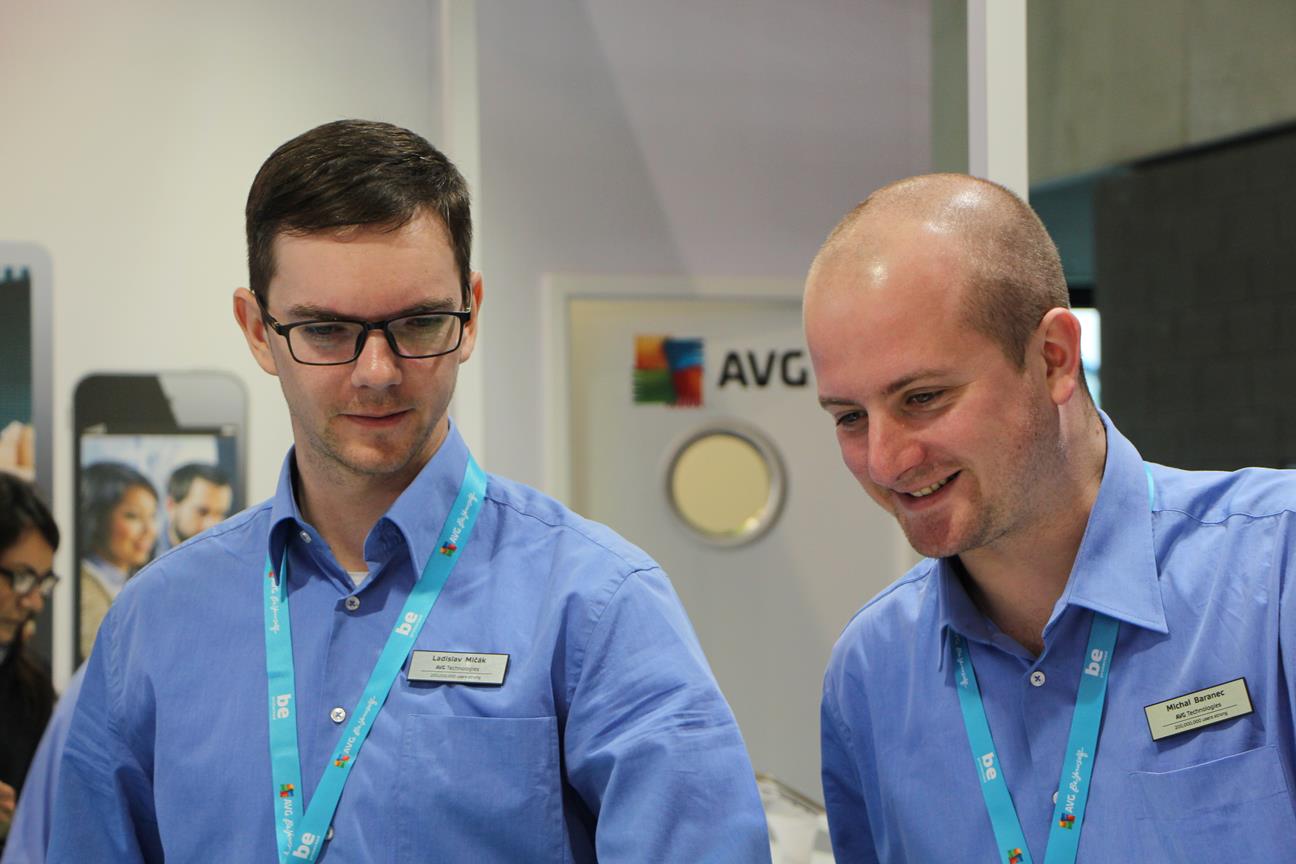
AVG experts are on hand to give visitors details on AVG products.

AVG Support Staff


More to follow!