Category Archives: Antivirus Vendors

Antivirus Vendors

Phish Allergy – Recognizing Phishing Messages

While phishing-related malware is still mostly Windows targeting, attacks that rely purely on social engineering and fake web sites might be delivered by any platform, including smartphones and tablets. The more cautious you are, the better informed you are, and the more you think before you click, the more chance you have of leaving phishing craft stranded.

The post Phish Allergy – Recognizing Phishing Messages appeared first on We Live Security.

Who are the Guardians of Peace? A new hacker group is on the loose

Are you familiar with the name ‘Guardians of Peace’? This is a new hacker group that has been gaining notoriety over the last few weeks.

Everything began when the hacking group sent Sony a disturbing message threatening the company with leaking large amounts of confidential data unless a series of requests were met.
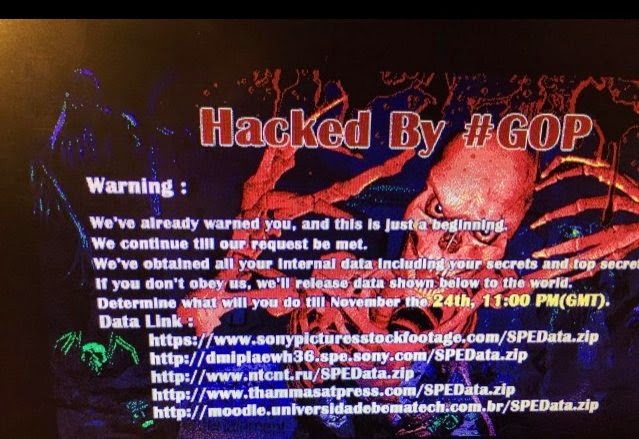
guardians of peace

Shortly after this, the Guardians of Peace started publishing all sorts of documents, files and confidential data belonging to Sony. Unreleased movies, information about executive salaries, emails from the company’s lawyers, employee workplace complaints, movie scripts and even the phone numbers of Hollywood celebrities were among the nearly 100 terabytes of data stolen by the hacker collective through a piece of malware called Destover.

The mystery has since grown larger…  Who is behind the Sony attack? Who are the so-called Guardians of Peace and what’s their reason for attacking Sony?

North Korea, prime suspect of the attack

US authorities believe the attacks originated from North Korea. One of the group’s demands was the cancellation of the planned release of the film ‘The Interview‘, a comedy about a plot to assassinate North Korean leader Kim Jong-un.

However, North Korea has repeatedly denied any involvement in the hack attack, and the Guardians of Peace have posted new messages mocking the FBI’s investigation.

Various theories are emerging surrounding the attack. Despite North Korea is still the prime suspect, there is also speculation linking the attack to a possible Sony insider, a group of disgruntled former employees or even a marketing campaign orchestrated by Sony itself to promote ‘The Interview’.

the-interview

Some theories even claim that this is nothing but a campaign designed by the US government to find itself a new enemy and thus justify the mass spy operations carried out through agencies such as the NSA

Incidents like this, combined with the alleged hack of the Play Station and Xbox online services during Christmas, and the constant rumors of Internet leaks, certainly make you wonder if we are not really in the middle of a cyber-war between powers…

Despite the mystery surrounding the attack, the truth is that Sony decided to cancel the premiere of ‘The Interview’ for security reasons (after receiving threats against the company’s employees and their families), and the cyber-attacks have exposed the frailties of the security measures implemented by one of the largest entertainment companies in the world.

The post Who are the Guardians of Peace? A new hacker group is on the loose appeared first on MediaCenter Panda Security.

Scammers trying to steal Netflix passwords, and more

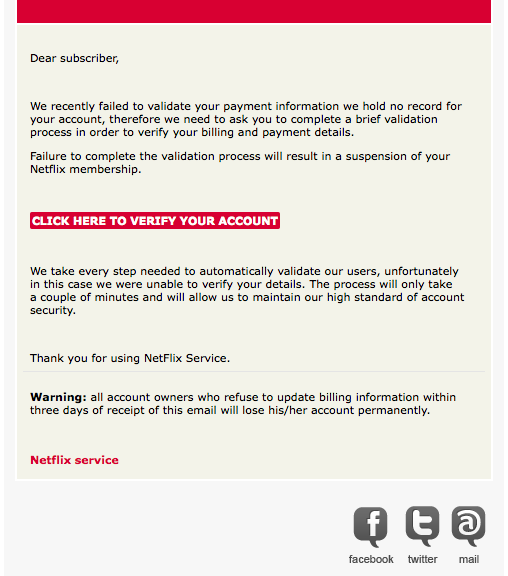
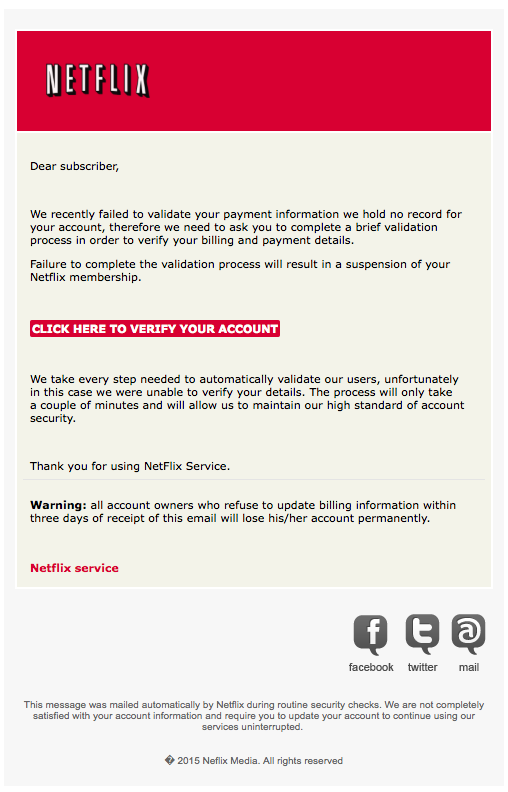
A flurry of news concerning Netflix in recent days has presumably motivated this recent phishing attempt, as scammers continue to pursue current events and breaking news stories to attract victims.

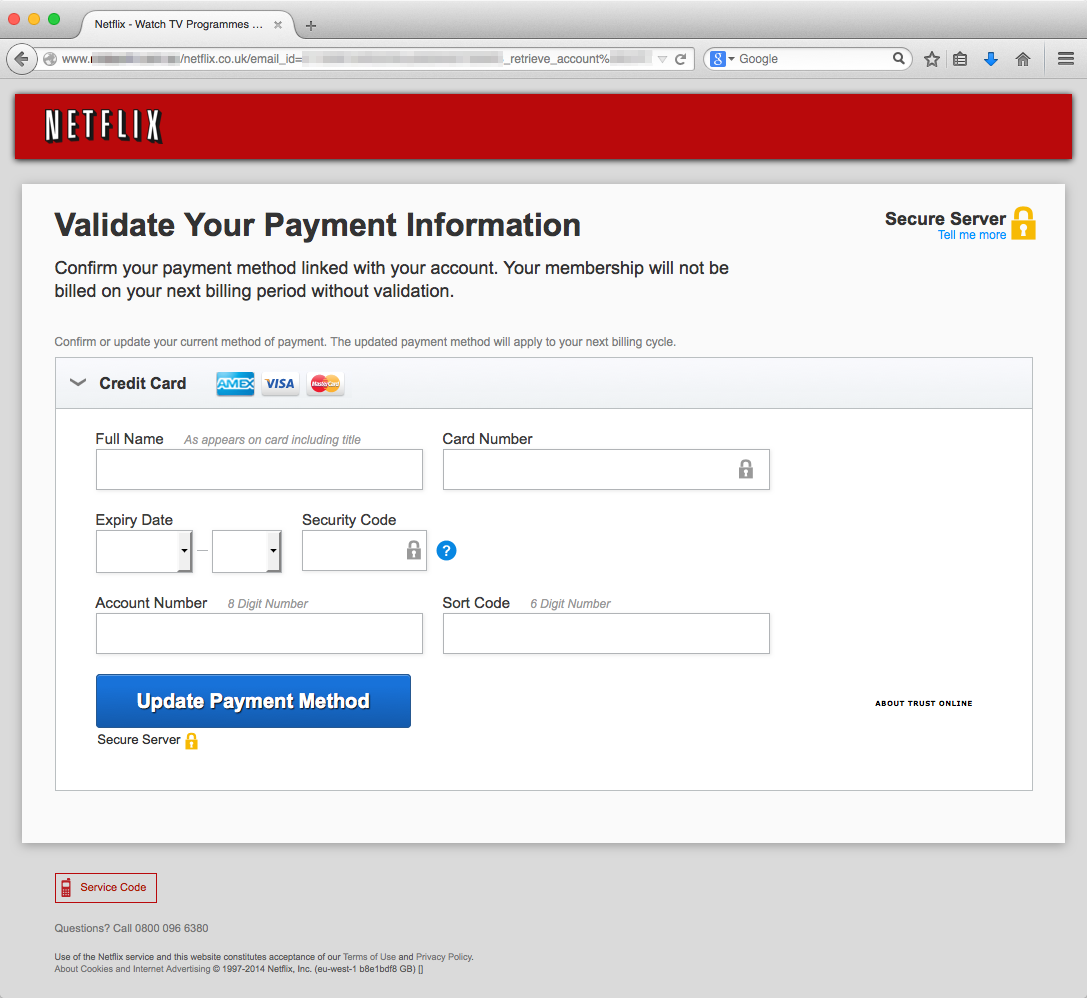
In the email is a red button “CLICK HERE TO VERIFY YOUR ACCOUNT” that leads directly to a replica Netflix login page, as well as pages that ask for personal details including Credit Card information.


Unsuspecting Netflix customers who are tricked into this process will not only divulge their account password (which they may have used elsewhere), but may also have their credit card details stolen and used for fraudulent purchases.


If you do receive a Netflix phishing email you should report it officially to Netflix by forwarding the message to [email protected]. Further information about keeping your Netflix account secure can be found here.

Until next time, stay safe out there.


iOS users facing new storage challenges

News emerged recently that Apple has been challenged about storage on their iOS devices.

According to news sources, Apple has come under fire for the size of their latest operating system iOS8 which can apparently occupy up to 23.1% of the devices total storage.

On top of this, the upgrade from iOS 7 to iOS 8 alone can take up more than 1.3 Gigabytes of storage space.

While the storage statistics for iOS 8 might be surprising, it’s important that iPhone and iPad users realize that often their storage can be taken up by multiple unnecessary files and not just operating system files.

Operating systems are not the only files that bloat and grow over time; in fact it’s quite common for updates to systematically increase an app’s footprint on our devices as new features and enhancements are added

That’s why it’s very important to regularly clean out your mobile device, get rid of unwanted or unneeded files and apps and create space for the things you really want.

To help you do this, AVG has developed iOS Cleaner as part of the AVG PC TuneUp performance suite. iOS Cleaner can help you reclaim back valuable storage space on your iPhone or iPad devices by locating and removing duplicate files and unnecessary clutter and temporary files.

We’ve also prepared this easy to follow guide to help you get started.

Title image courtesy of engadget

The Privacy Fear Factor: How Tech Is Failing To Serve the 50+

As Ann Karpf, the British journalist and sociologist reported in her January 4, 2015 New York Times Op-Ed piece on “The Liberation of Growing Old”: “Ageism has been described as prejudice against one’s future self. It tells us that age is our defining characteristic and that, as midnight strikes on a milestone birthday, we will become nothing but old — emptied of our passions, abilities and experience, infused instead with frailty and decline.”

Well said. But sadly, this is a construct that, while wrong, pretty much rings true when we look at how tech companies market to Boomers and Seniors – aka, those aged 50+ — at present.

Indeed, two in five Boomers and Seniors think tech companies patronize them according to our survey of 50+ as part of our most recent edition of the AVG Digital Diaries consumer research series.

However, the majority of 50+ that we surveyed do NOT consider themselves novice users. Most of us consider ourselves “average” tech users (76%); 10% think of ourselves as experts –and only 16% describe themselves as novice.

Digital Diaries Boomers


Earlier this week, I highlighted these findings at the Lifelong Tech Summit as part of the 2015 Consumer Electronics Show in Las Vegas.

I was honored and delighted to address the assemblage on the topic because I believe the tech industry in general overlooks – if not neglects – the 50+ consumer segment.

Equally important, my talk on “The Privacy Fear Factor,” focused on what the tech industry needs to do to better serve the needs of the 50+ market – around the issues of data protection and online privacy. This has become an everyday issue and question of fundamental human rights for all of us at any age.

This is especially true for those 50+. We fiercely believe at AVG that regardless of age, people need to know that they don’t have to give up their privacy every time they go online.

But the nagging question remains: why are Boomers and Seniors being undervalued and/or patronized by our industry when they represent a $3 trillion opportunity (U.S. dollars in disposable income).

“why are Boomers and Seniors so undervalued when they represent a $3 trillion opportunity?”.

A basic tenet of marketing is that you have to first understand a market’s dynamics before you can address a market.  And therein lays the heart of the issue.

In my view, the industry needs an attitude adjustment regarding the 50+ market. And I look forward to continuing dialogue on this topic – and in addressing this important demographic.

I’ll close with more of Karpf ‘s eloquent take on aging:

“How to enable the growing numbers of old people to live comfortable, meaningful lives is a fundamental issue of equality, with benefits for all. If we make the world better for old people, we make it better for everyone, from stroller pushers to wheelchair-users.”

5 reasons not to “hack back”

Are hacking victims “hacking back”? That question was recently posed in headlines like this one from Bloomberg: FBI Investigating Whether Companies Are Engaged in Revenge Hacking. The Marketplace reporter, Ben Johnson, speculated that 2015 might be the year of “hacking back” when he asked me about revenge hacking. As I told Ben, there are several good

The post 5 reasons not to “hack back” appeared first on We Live Security.