Kaspersky Lab today announced the results of its quarterly IT threat evolution report, which found the number of Internet users that encountered encrypting ransomware more than doubled in Q3 2016, reaching 821,865 people.
Category Archives: Antivirus Vendors
Antivirus Vendors
Has anyone hacked my IoT?

Forget about those big attacks, what about little me?
The post Has anyone hacked my IoT? appeared first on Avira Blog.

Hacking an election is more than breaking into a machine


Flashback Tuesday: The Morris Worm
On November 2nd 1988, the Morris Worm was released, bringing the internet to an effective standstill. It was a seminal moment in internet history.
The post Flashback Tuesday: The Morris Worm appeared first on WeLiveSecurity.

Linux/Moose: Still breathing
For the past year, ESET and the security firm GoSecure combined their skills in order to research Linux/Moose further. Here’s some of what was uncovered.
The post Linux/Moose: Still breathing appeared first on WeLiveSecurity.


Are (IoT) Smart Homes of the Future As Smart As They Say?

With great power comes great responsibility. Powerful words. We’re not talking about a web-slinging superhero though, but a different type of web altogether -the World Wide Web- and with the ongoing expansion of the Internet of Things, its increasing connection to the physical world is inspiring awe and wonder, but also a growing necessity for out-of-the-box thinking and creative risk assessment from cyber security experts the world over.
Here at Panda Security, we have gathered a few of our ideas on ways that hackers could get unprecedented access to your daily lives through the app-integrated devices you keep at home.
Ways hackers could get unprecedented access to your daily lives
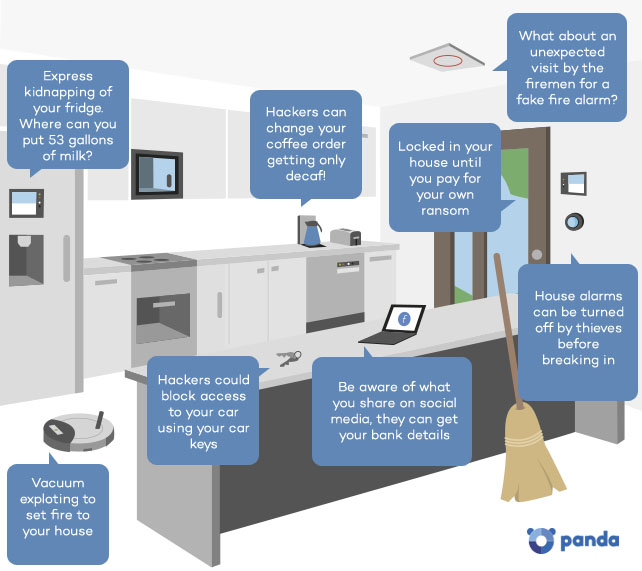
A Doorway Ransom?
As the Internet of Things continues to integrate seemingly inane and unrelated objects, an entire comprehensive home operating system seems increasingly likely. While this will turn your house into a streamlined living space completely catered to your comfort, it could also put you at greater risk of falling victim to a cyber attack in your own home.
Central to any future smart home’s security would surely be its locking system.
Recent investigation, though, has shown that smart locks are alarmingly easy to hack, making them embarrassingly unable to guarantee the function they are there to provide in the first place.
Current systems simply make it too easy for a cyber hacker to actually physically enter your home.
We’ve thought further ahead though; what if a hacker were to completely invert their use of this technological weak spot in the future? If a smart lock can be compromised in order to open it, maybe hackers will find a way to keep your doorway completely shut.
The future’s equivalent of a home invasion could be completely silent, a hacker controlling events from a distance, perhaps asking for a sizeable ransom before letting you out of your own home.
It may make a terrible idea for a film script (Home Very Alone) but it’s a terrifying thought nonetheless. If all of your security devices are interlinked, cyber attackers could potentially also have access to your house alarm and even your car keys.
Smoke Screen Smoke Alarm
One safety feature that is already incorporated into some smart smoke detectors available on the market is the ability to let a smart house pull information from, and manipulate, other smart devices so that they can react accordingly in case of an emergency. This feature is implemented for the user’s safety, allowing a house that detects a fire, for example, to unlock all the doors in the house in aid of a speedy exit.
That is a great example of the way IoT businesses are working to seamlessly integrate and interconnect devices within smart homes. However, there is one strong reservation; if this technology is breached by a cyber attacker, there is the potential for setting off a chain reaction that could greatly reduce the safety of a smart home.
Another way that a hacker could potentially intrude from afar is by setting off a false smoke alarm that will send for the fire services. The chaotic scene could act as a smoke screen, making you a soft target for other potentially malicious cyber attacks.
The Hoover of Death
One of our wilder ideas perhaps, but with all the furor about exploding mobile phones at the moment, we’re aware that IoT is increasingly putting us in the position of giving hackers access to potentially explosive devices!
Could this be manipulated in a cyber attack? Attackers typically work en masse, such as in distributed denial of service attacks (DDOS), where thousands of emails or requests are sent to a server to slow down or crash the intended target’s servers.
If that’s the case we could face a future in which hackers try to send as many machines into overdrive as possible in the hope that some will malfunction. A terrifying prospect, and perhaps part of the reason for which government agencies have been liaising on the potential dangers of IoT related cyber attacks.
Beware the Fridge
Remember that Simpsons episode in which Marge falls for a Pierce Brosnan voiced AI house operating system that does the cooking and is secretly planning to “get rid” of the rest of the family? As bemusing as it may seem we may only be a few small technological leaps away from mirroring the events of that hilarious, yet horrifying, HAL parody.
Ok, granted your fridge isn’t about to have an intelligent conversation with you, and much less hatch a murderous scheme against your family. However, as far back as two years ago, the CIA were highlighting the threat of smart refrigerators in people’s homes.
The Central Intelligence Agency were alarmed when a refrigerator was used as part of a “zombie” network to perform a DDOS attack. All of this unbeknownst to its owners, who had no idea their fridge had taken on a, quite devilish, new purpose aside from keeping tomorrow’s lunch cool.
What’s next?
As these devices become smarter, tracking your shopping habits and ordering deliveries for the home, could a hacker gain access to your bank details or disrupt your order? All we know is that AI and fridges are best left as a spooky cartoon vision for now!
The post Are (IoT) Smart Homes of the Future As Smart As They Say? appeared first on Panda Security Mediacenter.

97% of Large Companies are Victims of Mass Data Breaches
 Ashley Madison, Dropbox and Yahoo have something in common—they are all victims of mass data breaches where user log-in credentials were stolen. Sadly, this type of tactic has become more common over the last year. What’s even worse is that it seems like this will continue to be an objective for cybercriminals—after all, why wouldn’t they want access to millions of users’ data? The greater the risk, the bigger the reward.
Large corporations cannot escape these attacks. Although you might think that regular internet users are the targets of these attacks, most cybercriminals are after large corporations. Despite the security solutions that companies can implement, a recent study has revealed that 97% of the thousand largest companies in the world have been victims of data breaches.
The 97% of the thousand largest companies in the world have been victims of data breaches.
Many users choose to use their corporate email when signing up for one of these online services which, over time, will be victims of some type of attack. If a business’s employees always use the same password to access different platforms, regardless if they use their work email or a personal one, the situation becomes much riskier.
Following a recent investigation, out of all the mass leaks that have affected large corporations, LinkedIn suffered a massive data breach during the attacks last May. Adobe was a victim of a similar attack during 2013. It’s no wonder these two companies were hit: both services are accessed by professionals who use their corporate emails to log-in.
However, the LinkedIn and Adobe cases are not the only multinational companies who have been victims. In fact, the study also reveals one of the most famous data breaches, the Ashley Madison attack that endangered thousands of corporate emails linked to large corporations.
Large economic consequences
The danger these data breaches have on corporate accounts is much greater than simply affecting the company’s reputation. In fact, according to a recent report by the Ponemon Institute , these data breaches cost companies an average of 4 million dollars, that’s more than 3.5 million euros. With that said, make sure your employees are educated on the matter—While signing up for one of these services, they shouldn’t use corporate information like business emails, and they should make sure they use different usernames with several complex passwords.
The post 97% of Large Companies are Victims of Mass Data Breaches appeared first on Panda Security Mediacenter.
Parents Lack Visibility and Control over Kids’ Online Activity, Kaspersky Lab Study Shows
Today Kaspersky Lab announced that its latest consumer survey report revealed only 26 percent of participants use parental control software to help restrict their kids’ activity online.
Kaspersky Lab Releases its Second Corporate Social Responsibility Report
Kaspersky Lab today released its second annual Corporate Social Responsibility Report, profiling the company’s technological, educational, and charitable initiatives which help communities grow stronger.
Cyberattacks ‘no longer the stuff of spy thrillers’
Cyberattacks are “no longer the stuff of spy thrillers” – they are now a very serious threat to individuals, organizations and economies.
The post Cyberattacks ‘no longer the stuff of spy thrillers’ appeared first on WeLiveSecurity.
