
Category Archives: Panda Security

Panda Security

“Securing a business involves so much more than plugging in various pieces of computer technology”, Simon Edwards

guest article panda

I met Simon Edwards in January 2007 at the first AMTSO meeting in Bilbao. For many years, Simon dedicated himself to testing security products for Dennis Publishing and, at the time, he was also the technical director of Dennis Technology Labs. The prestige gained over the years has made him a recognized authority in this sector.  Less than a year ago he began a new career path when he started his own business, SE Labs.

1 – Since your time as the editor of the Computer Shopper magazine, your life has been linked with computer security. What has your experience been like in such a changing and innovative industry?

simon-edwards-mediumres

Simon Edwards, founder of SE Labs

I have always approached the security business from an ethical position because we genuinely want to make a bad situation better. We do much more than testing anti-malware products. We provide threat intelligence to very large companies and, in the UK, the insurance industry uses our information to make important decisions. That is a new diversion from testing, but we do still test security products and that feeds back into the threat intelligence information we provide. We didn’t set out to create a security testing business from day one, though.

When I was first asked to write an anti-virus group test I thought about how to do it, but without any input from other testers or even the companies that made anti-virus programs. In complete isolation from the experts I came up with a method of testing and found that some well-known threats could bypass anti-virus, particularly those that were more like Trojans and hacking attacks rather than standard self-replicating ‘viruses’. That was interesting.

The response from the readers was fantastic and every time we published such a test we sold more magazines than in a usual month. The anti-virus industry was less pleased and I received aggressive phone calls from some people who, today, I actually count as very good friends. We just had to get to know each other and develop trust.

I think that the default position the security industries take, when confronted by challenging results from a new face, is to attack. “We don’t know this guy and he’s saying our product sucks? He must be an idiot, or corrupt!” Nothing much has changed on that front. At least now people know SE Labs creates useful tests and works ethically. Well, most people do. There are some companies, particularly new ones, who are still working out what’s what. They assume that if you don’t support their marketing message then you are an enemy with a biased agenda.

The default position the security industries take, when confronted by challenging results from a new face, is to attack.

One big change is that vendors are starting to see the usefulness of testers really attacking systems, rather than just scanning regular malware that exists on the general internet. We were running hacking attacks in tests back in the days of Back Orifice 2000  and we also used other tools that the bad guys had access to. At the time that was extremely controversial, as the industry had a general view that creating threats was taboo. Many still feel that way, but we’ve been crafting targeted attacks for testing purposes ever since, and it seems fair considering how many products claim to prevent such things.

2- What is like to be an entrepreneur? Are you still able to perform the tests yourself or has management become the main part of your day-to-day?

I personally review every set of data that powers the tests that we publish, and I also develop the test methodologies used by the talented testers who actually sit in front of the systems and put the products through their paces. The ongoing testing and general office tasks are managed by the SE Labs team in London. Once a test is up and running I trust the team and spend most of my time doing one of a million other things. What’s really cool about setting up a company from scratch is that there are so many creative tasks to carry out. But, as we’ll see, there’s also a load of nonsense to contend with too.

When you are running a company on your own you make decisions about literally everything. One day I would be negotiating six-figure finance deals and then I’d be fielding questions about teaspoons. I spent literally half a day in Ikea arguing with colleagues about which cutlery sets to buy.

There is a lot of emotion and some immaturity in this emerging ‘next-gen’ industry.

Back to testing, I have spent a large amount of time trying to work with the newer companies in the industry. Some of them can be reluctant and I understand why. Startups are vulnerable and a poor result could kill a business before it even starts. That said, some of the aggressive marketing we’ve seen very much invites testing to challenge quite extraordinary claims. There is a lot of emotion and some immaturity in this emerging ‘next-gen’ industry. That needs to stop, because it does not serve the customers.

3- As Director of SE Labs, does your work continue to surprise you on a daily basis? Do you have to adapt your tests to the type of attacks that appear frequently? 

A fundamental part of what we do is to seek out and use prevalent threats. Theoretically every product should score 100 per cent in our tests because we’re not using threats from the edges of the internet or zero day threats. So it’s always been quite surprising to me that most vendors don’t score 100 per cent. It’s well-known in the security world that a test in which everyone scores 100 per cent is useless. I don’t think that’s true, as long as the test comes with a good explanation of what it’s trying to achieve.

But regardless, if I throw 100 well-known threats at the leading anti-malware products I know there will be compromises. And that still surprises me. We work with many vendors to help them fix these issues.

4- In addition to traditional security solutions, in the past few years several new solutions have appeared on the market with names like “Next Gen AV” that use a different approach to protect businesses. Have you had the opportunity to try one of these solutions? What has your experience been like?

We have managed to gain access to some so-called ‘next-gen’ products and I know what you’re expecting me to say! But they are not the snake oil that their crazy marketing suggests. They are proving to be competent solutions. I don’t think I’d want to run many on my systems without some other form of anti-malware, but they are not the ‘smoke and mirrors’ fake solution I think many people assume. They are not perfect but neither are they rubbish.

It’s always been quite surprising to me that most vendors don’t score 100 per cent.

5- There are also solutions from “traditional” manufacturers within the EDR category (Endpoint Detection and Response). Have you had the opportunity to try out any of them? 

Indeed we have, and we even run one on these products alongside so-called ‘traditional’ AV on our own systems. Being able to track a breach if/when it happens could be useful. Although we’re a relatively small company, it would be naïve to think that no-one would ever mess with us. We take security seriously, especially considering the nature of some of our clients (we don’t just test anti-malware products, but also provide security advice to some of the largest companies in the world). Our influence extends beyond the basic ‘AV test’ world and, as such, we need to be very careful.

6- You have been involved in AMTSO since the very beginning, and in fact you are currently a member of the Board of Director. In your opinion, what are the major accomplishments AMTSO has achieved since its inception?

The relationship between testers of anti-malware products and the developers of those products is a million times better today than it was. This is important because a good relationship means a productive development cycle of the software that we all use to protect our computers. Once it was the case that vendors hated testers and treated their results as something to work around, rather than use to improve products. I think that AMTSO has largely fixed that problem.

7- What are the challenges that AMTSO has to face in the near future in the testing landscape?

The next-generation companies are opposed to testing. They might claim otherwise, but in my opinion they don’t want to be challenged. Their focus is investment and growth. AMTSO needs to bring these companies into the fold and help them understand that there is something more important than just raising investment funding. Customers count and they need to be protected. Testing actually plays a crucial part in that. They can’t expect to succeed if they operate in a vacuum.

8- In your opinion, what is the biggest challenge that institutions and corporations are up against today in regards to cybersecurity? Does that time lag really exist between adopting new technologies in businesses and applying the proper security measures?

I think the biggest challenge is that securing a business involves so much more than plugging in various pieces of computer technology. Users are potentially the strongest link in the chain, whereas often they are accused of being the weakest. Training can help a lot here. Going back to fundamentals and really understanding what security is would help. It’s easier to spend a few millions on some new types of firewalls, but that’s not going to do the job. CISOs need to understand that.


The post “Securing a business involves so much more than plugging in various pieces of computer technology”, Simon Edwards appeared first on Panda Security Mediacenter.


Are you willing to gamble your company’s security with the new iPhone 7?

iphone panda security

Apple has taken the world by storm once again with the release of the latest version of its top-of-the-range smartphone. Two new iPhones, the 7 and the 7 Plus, are on the Smartphone market with some standout novelties: the absence of the classic headphone Jack and the addition of two new and improved cameras. Unfortunately, the topic of cybersecurity was absent from the keynote presentation, in fact, Tim Cook and his team did not devote a single minute to this important issue.

This isn’t to say that the lack of conversation regarding security in the brand new iPhones makes them a danger to your business or your employees. In fact, if businesses decide to use it as a corporate phone, users could actually benefit in regards to security thanks to some of its new standout characteristics and changes.

Novelties in Apple Mobile Security

The new Home button, for example, is not a button at all.  On the new version the Home button is actually a touchpad with a Haptic system that permits users to perform various functions—from exiting applications to using the multitasking function—while some of the other features were designed specifically for user convenience, security and privacy such as the Apple Pay or Touch ID.

Unlike the original iPhone button, the new Haptic button is designed to last over time.

iphone panda securityIn addition to the physical iPhones, a new operating system is also added to the new 7. The iOS 10 is presumed to be more robust in terms of cybersecurity (this is great news, especially after discovering various faults in the beta operating system).

It also permits users to respond to messages without introducing a security code or having to use Touch ID to unblock the device.

In conclusion, although Apple has given little or no attention to cybersecurity in their keynote, the combination of the iPhone 7 with the new operating system continues to be an excellent option for preventing IT risks in the corporate mobile sphere. If these devices become a growing danger for your company, make sure to combine them with the best advanced security solution.

The post Are you willing to gamble your company’s security with the new iPhone 7? appeared first on Panda Security Mediacenter.

Top 5 things you are revealing to the world when downloading torrents

Top 5 things you are revealing to the world when downloading torrents

Downloading torrents is certainly not as popular as it used to be but people still do it. The fact you may be able to watch a movie free of charge before it is even available in your town’s movie theatre may sound appealing, we wanted to highlight that this is illegal and your actions will have consequences.
In this blog post we are not going to focus on the consequences, we are sure you already know what happens to the bad guys. We want to stress on the type of information you are sharing with the world while downloading torrents;

Username and Password

Very often torrent websites require you to create a profile before you are able to download a torrent. Therefore you are forced to come up with a username and password. Having in mind people don’t enjoy using multiple passwords some folks end up literally giving their username and password without a fight. Imagine what hackers who crack software for fun could do with your personal information. It feels like getting a wolf pack to guard your sheep.

IP Address

You are sharing your IP address with both seeders and leechers. Almost every torrent client has the option to see details about the peers you are connecting with. Sharing your personal IP address with complete strangers is not the safest thing. Not all peers are there to help you, hackers masked as seeders/leechers are lurking around harvesting IP addresses.

ISP – Internet Service Providers

Your ISP knows what you are doing. Even though it is NOT in their interest, sometimes they are forced to share information with the law enforcement. Your ISP provider will not hesitate to share information about you when pressured by the authorities. After all torrents can be heavy and ISP providers are certainly not very happy when they see you abusing the unlimited data stream they offer you.

Traffic Information

Getting to download an actual torrent is not an easy task. You have to go through a whole bunch of shady websites so you can get to the point where you will download the torrent you want. There are a whole lot of ‘download’ buttons that download everything else to your device but the desired torrent. Even if the content you want to download may not be illegal, you share all your traffic information with the website admins. Remember what we discussed about the wolf packs.

Social Media channels

Torrent websites sometimes offer you perks when following them on social media. This immediately gives an idea to everyone interested about the type of people that support those websites. Even if you are not downloading or distributing any illegal content, engaging with them on social media channels and being active on torrent forums may drag you towards a group of people you don’t want to be in.
Peer to peer file sharing is not always illegal but you have to keep in mind that very often cheap things end up being expensive. You should be fully aware about what you exposing to the world on your journey to the next episode of the Big Bang Theory.

If you are in store you don’t just go and grab a DVD and walk out, you pay for it. The reason why you don’t steal is not only because you are a good person but also because you are afraid that your action may ruin your life. Nowadays, being on internet is similar to walking on the street or in the store, your actions are being monitored – let’s make sure you don’t embarrass yourself before the whole world.

The post Top 5 things you are revealing to the world when downloading torrents appeared first on Panda Security Mediacenter.

Links that endanger your cyber-security

panda security

On any given day, employees at your company click a multitude of links and many of them come from unknown sources. But clicking these mysterious URLs endangers more than your security, it can also threaten your business.

Curiosity can cost you. The sole purpose of these links is to transfer malware onto your system. What’s worse is that, as demonstrated in a recent study, the majority of internet users click these unknown links.

Zinaida Benenson, a professor from the University of Erlangen-Núremberg, and her team of investigators sent 1,700 students messages (from both Facebook and email) containing a shortened link in order to access a photo album. To do this they created fake accounts and profiles to see if the students trusted and clicked the unknown sources.

But, of course, a photo album did not appear when the link was clicked. Luckily for the study’s participants, there was only an error page that allowed for the investigators to count how many of them clicked the bait. The study’s results speak for themselves: 56% of those that received the link via email and 38% via Facebook clicked the links.

More than half of internet users click links without thinking.

Later on all of the study’s participants received a questionnaire. Once again, one of the conclusions drawn from the study was the most surprising: The number of those who clicked the unknown links totaled 78%. Why? For most participants, curiosity was to blame.

It is extremely important that employees are aware of the risks when clicking a link from an unknown source: this mistake can endanger all of the private data stored on company systems, including information stored in the Cloud.

However, if you see that curiosity takes flight, the best advice you can adopt is to begin using a solid protection service such as Panda Solutions for Companies, the only way to protect ourselves against these type of cyberattacks.

The post Links that endanger your cyber-security appeared first on Panda Security Mediacenter.

Webcams, Routers and Other Risks to your IT Security

panda security

The fleet of computers in your business may be protected but that does not mean that your corporate information is safe. Beyond tablets, there are a number of devices such as mobile phones and smart watches that have joined the list of gadgets that every enterprise must control and protect to prevent IT risks. Every office contains a number of vulnerable devices that can pose a danger to confidential data.

Although we do not usually pay attention to webcams, they pose a danger to corporate privacy and security—even the founder and CEO of Facebook, Mark Zuckerberg, shared a photo on the social media site where we can see that the laptop’s camera is covered for security purposes.

Covering webcams at your office when they aren’t being used could help keep your corporate information private.  An example of this occurred two years ago when it was discovered that a Russian website issued a direct signal to more than 70,000 private webcams that were hacked.

Printers, routers and USB

However, there is more work to be done than just covering webcams. Every office has routers that are not generally given the proper attention. Without the proper security measures (like simply changing the standard password that comes with your computer), a router can easily be taken advantage of by cybercriminals. They can easily take over your bandwidth and build a network of malicious bots, or worse, link it with a DDoS attack on another website.

There’s more. Corporate printers can be one of the biggest cybersecurity problems in your corporate environment. Every document that is sent out to print has to travel through a network that can be attacked. It is worrisome to think what could happen to this private information on the way to the printer. As you can see, the security of these devices are just as important as any other computer in the office.

Any device with USB storage in the office could put the entire corporate structure at risk. Malware on pen drives can be transmitted using USB ports on computers or can be used as a storage device to steal information.

As you can see, beyond covering webcams and changing router passwords, it is important to have reliable anti-malware  protection for your business, devices and networks in your workplace.


The post Webcams, Routers and Other Risks to your IT Security appeared first on Panda Security Mediacenter.

Yahoo Data Breach: Top 5 things you should do immediately

pandasecurity-yahoo-accounts-hacked

Yahoo’s biggest nightmare was confirmed yesterday – back in late 2014, a copy of certain user account information has been stolen from Yahoo’s network. The story started developing in early August when a hacker named “Peace” was openly trying to sell personal information of more than 500 million Yahoo account users on the dark web.

According to Yahoo, the account information may have included names, email addresses, telephone numbers, dates of birth, hashed passwords and, in some cases, encrypted or unencrypted security questions and answers.

Even though the breach happened two years ago it is not too late to take action, especially if you haven’t changed your password in a while.

Top 5 things you should do immediately

Change your password now!

It is as simple as that. Change not only your Yahoo password on your Yahoo account, but also review all your online accounts on which you’ve used the same or similar information. The sooner you do it, the better!

Turn on the two-step authentication that Yahoo offers.

Two-step verification uses both your password and an extra security code to verify your identity whenever you sign in to your account. If someone else tries to access your account, even if they can guess your password, they still won’t be able to get in without using two-step verification.

Pick better passwords.

We cannot stress more on the fact that using the same passwords for many accounts is not recommended. As you remember Yahoo are not the only one who’ve had similar issues. Back in 2014 eBay asked 145 million of their users to change passwords after a data breach. Changing your passwords often must be a habit!

Update your security questions immediately.

Yahoo says about 1 billion people globally engage with one of its properties each month. The chances your password is in the wrong hands are not minimal and the risk is real. Take action and don’t wait anymore, time is key here.

Go through old emails and remove sensitive content.

If your Yahoo account information is indeed for sale on the dark web, someone can hack into your email at any minute. There is tons of document scans, tax returns, credit card details and invoices that may be laying around your inbox. All these documents contain information you want to keep for yourself.

Remain vigilant! After Yahoo admitted the data breach you may be approached by fraudsters pretending to be someone they are not. It is important for you to not engage with online fee-based, toll-free-number services. Even though the incident happened nearly 2 years ago and you may be off the hook, we advise you to remain cautious and spend some time making sure you are fully protected.

The post Yahoo Data Breach: Top 5 things you should do immediately appeared first on Panda Security Mediacenter.

Worldwide “Crysis” Through Remote Desktop Protocol

Tales from Ransomwhere Two weeks ago we saw a ransomware attack in a server belonging to a French company. It was a Crysis variant, a ransomware family that appeared earlier this year. We witness thousands of infection attempts by ransomware on a daily basis, but this one caught our attention as the file somehow showed up in the computer when no one was supposed to be using it and in fact, there were no email clients or Internet browsers running there.

How did it get into the computer?

Why did the security measures in place allow this file into the server? That’s what we wanted to find out, and so we began an investigation. It turns out that this server is running Remote Desktop Protocol (RDP) and these cybercriminals used a brute force attack until they could guess the credentials to obtain remote access.

Back to the story—as most users do not have 2FA enabled and the passwords are not that complex nor random, it is pretty easy to get into a server using this kind of brute-force attack, a good dictionary or with the most common combinations. This is not a new technique. More than a year ago, I remember one wave that hit Spanish companies with ransomware using the exact same technique. Cybercriminals usually perform these attacks at night or during weekends, when there are few people in the office, or none at all.

Cybercriminals get into a server using this kind of brute force attack, a good dictionary or with the most common combinations. 

In this case, the attack to the server started on May 16th, where they performed 700 login attempts. These were performed automatically, usually for a period of two hours approximately. Most of these attacks have been happening from 1am to 3am, or from 3am to 5am. Each and every day. The number of login attempts changes, for example on May 18th there were 1,976 while on July 1st there were 1,342.

After almost four months and more than 100,000 login attempts, the attackers were finally able to get into the server and drop the Crysis ransomware.

This is a Worldwide Crysis

This week our colleagues from Trend Micro published an article that warned us about similar attacks happening in Australia and New Zealand that deploy Crysis variants. Unfortunately, we can say that those are not the only countries—this is happening at a worldwide level (at least since May).

Assuming you need to have RDP running and connected to the Internet, apart from monitoring connection attempts so you can learn that you are under attack, you should also enforce complex passwords. The best approach would be to implement 2FA, such as SMS passcode, so guessing passwords becomes useless.

We’ll continue to keep you informed with our Tales from Ransomwhere series!


The post Worldwide “Crysis” Through Remote Desktop Protocol appeared first on Panda Security Mediacenter.

Panda Security Protects Privacy in Public Administration

Header-EN

There have been thousands of top secret documents leaked, confidential information pertaining to individuals has been stolen, cyber espionage between powerful governments has occurred, and attacks have been performed by personnel with privileged access. These are all examples that confirm that propagandistic pursuit and economic gain drive cybercriminals, and they target those who are willing to pay for the retrieval of their valuable information, such as institutions in the public sector.

PandaLabs, Panda Security’s anti-malware laboratory, presents the “Privacy in Public Administrationwhitepaper; detailing numerous cyber-attacks on countries that could almost have come from a science fiction story.

Legislative Developments in Cybersecurity

The technological revolution in the public sector, the digitalization and storage of information, and the boom in online services to simplify administration for the public have led to an exponential growth  in the generation, storage and processing of confidential data; data which must be treated with the utmost care. Consequently, the public sector now faces a new series of demands in risk prevention, security and legal compliance.

Politically-motivated attacks

During the past decade, crimes including cyber-terrorism, cyber-espionage and hacktivism have been on the rise, threatening the privacy of Public Administrations, businesses and nations:

Manning-EN 2010: Bradley Manning, a US soldier, copied 700,000 confidential documents and used WikiLeaks to publish the data. In total almost half a million records from the Iraq and Afghanistan conflicts, and more than 250,000 secret U.S. diplomatic cables.

2013: EdSnowden-ENward Snowden, a former employee of the CIA and NSA, published top secret documents through the Guardian and the Washington Post concerning various NSA programs, including the mass surveillance programs PRISM and xkeyscore.

2016: A total of 19,252 emails (including attachments) from 8,034 servers of the US Democratic National Committee sent between January 2015 and May 2016 were revealed on WikiLeaks this July. The security company contracted by the Democratic National Committee has claimed that the hack was the work of at least two different groups of hackers linked to a Russian government agency in an action designed to favor Republican candidate Donald Trump.

Now, three months before the US elections, the FBI has confirmed the hacking of at least two electoral databases by foreign hackers who have extracted voter information from at least one of them. There is an ongoing investigation and IPs have been traced back once again to Russian hacking forums. Coincidence?

Elections-EN

The solution for adapting to the change.

The emergence of new players from different backgrounds and with varying motivations combined with their ability to act in any security dimension, hinders the identification of aggressors and decreases the ability of countries to adequately respond. Current legislation is not adapted to the new cyber-crime dynamic or to new technological or data management demands.

To prevent new attacks on public agencies, a common regulatory and legislative framework is needed, with responsibilities shared between states. One such example is the new regulatory framework passed in the EU in 2016.

For public institutions, success in ensuring cyber-security lies with meeting certain requirements:

  • Having real-time information about incidents and security holes related to data security, such as the accidental or illegal destruction, loss, alteration, unauthorized disclosure or remote transference of data.
  • Compliance with Article 35 of the “General Data Protection Regulation” on data protection with regular and systematic monitoring of data on a large scale.
  • Reporting all possible transfers of data files to foreign countries.
  • Improving individual rights, including the right to be forgotten, and data portability across all shared data files.
  • Safeguarding delegation to other processors of data deletion, reporting and notification requirements, and the maintenance of file transfer activities.

To this effect, the implementation of advanced technologies such as Adaptive Defense 360, as a complement to traditional antivirus solutions or perimeter security, enables compliance with guidelines and the technical requirements outlined above, since Adaptive Defense offers guaranteed security against threats and advanced targeted attacks on companies.

Download the Infographic here.

Download the Whitepaper:

International Edition
Edición América Latina Edición México
Edição Portugal Ausgabe Schweiz
UK Edition US Edition

The post Panda Security Protects Privacy in Public Administration appeared first on Panda Security Mediacenter.

Improved Efficiency and Centralized Management with the Latest Version of Panda Systems Management

Systems management

Computer systems have become part of every aspect of our lives. As digital transformation continues to grow in the corporate environment and the number of devices connected to the network is on the rise, the issues associated with this topic are becoming increasingly complex.

For this reason, Panda Security has presented the latest version of Panda Systems Management: the most powerful, scalable and easy-to-use RMM administration tool on the market. Systems Management is capable of combating all inefficiencies in the IT environment, allowing businesses to save time and money.

The Problem

This new hyper-connected context means that new challenges may arise while trying to increase your company’s productivity. Some of the challenges that have added to the already complex IT environment include: the increasing and varied number of devices connected to the network, the growing number of remote users, and the need to fix problems with greater flexibility (anytime, anywhere).

The mixture of tools used everyday in the workplace provoke incidents and interrupt work. Consequently, as these inefficiencies multiply, they add to the IT department’s workload, and other important details that affect business management and security can be overlooked.

The Solution: Greater Automation and Maximum Performance

Systems Management remotely monitors and manages devices from the Cloud so that every IT department can offer a professional service with minimal impact on employee work.

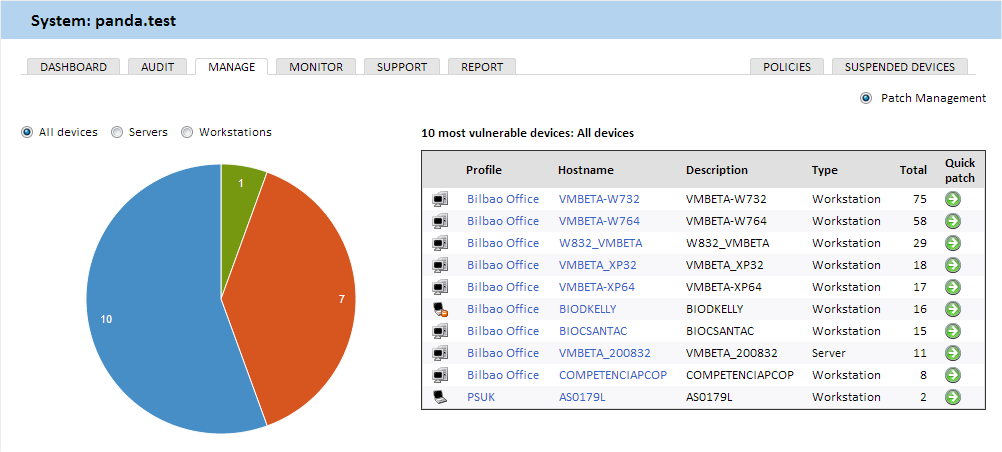
Patch Management - manual n

What does the new version offer?

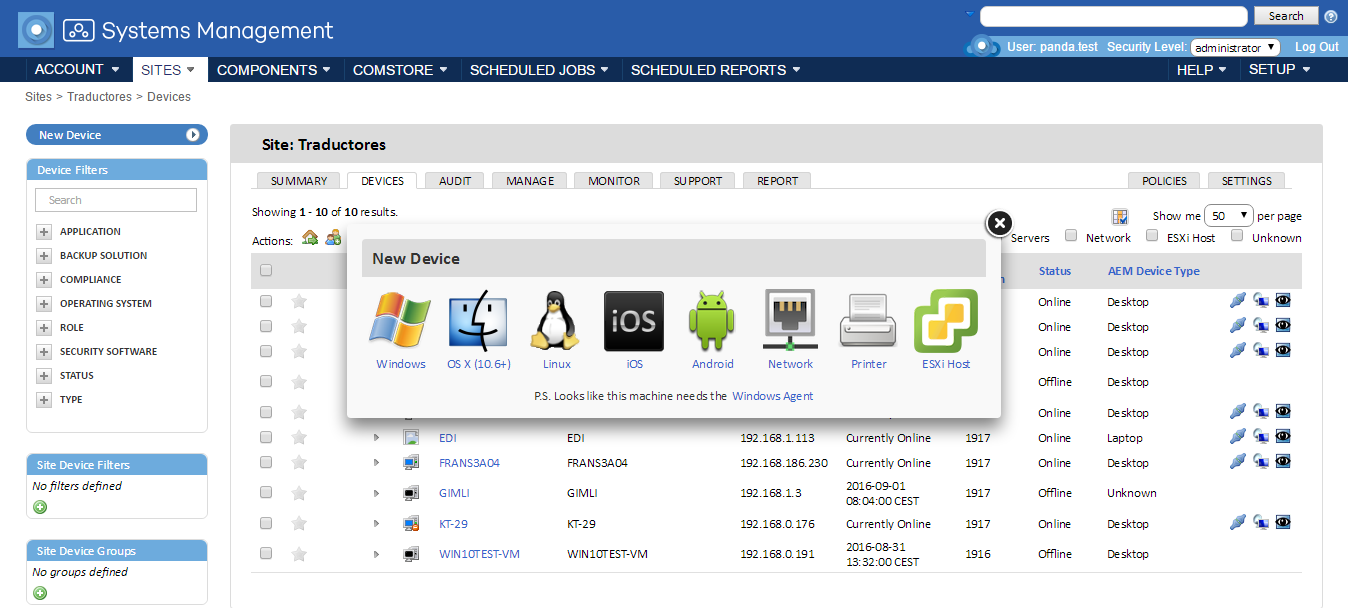
The new version of Systems Management gives you maximum performance ’out of the box’. To increase efficiency and grow business for our clients and partners, the Systems Management manager facilitates five pillars (asset inventory, device monitoring, remote device management, resolution tool support that is not intrusive, and generated reports) with the following functions:

device_new_mRecommended monitoring policies based on the best practices of our clients.


  • New filters improve management systems: instant visualization of the IT Park so you can see what you need.
  • New reports for server performance, CPU, memory, and disk performance for the last 30 days, including general averages.
  • Integrates with Microsoft Hyper-V and the new hardware monitors added for VMware ESXi.
  • New maintenance Windows- now alerts can be programmed and silenced.


The post Improved Efficiency and Centralized Management with the Latest Version of Panda Systems Management appeared first on Panda Security Mediacenter.

Panda Security Achieves 100% Detection Rate

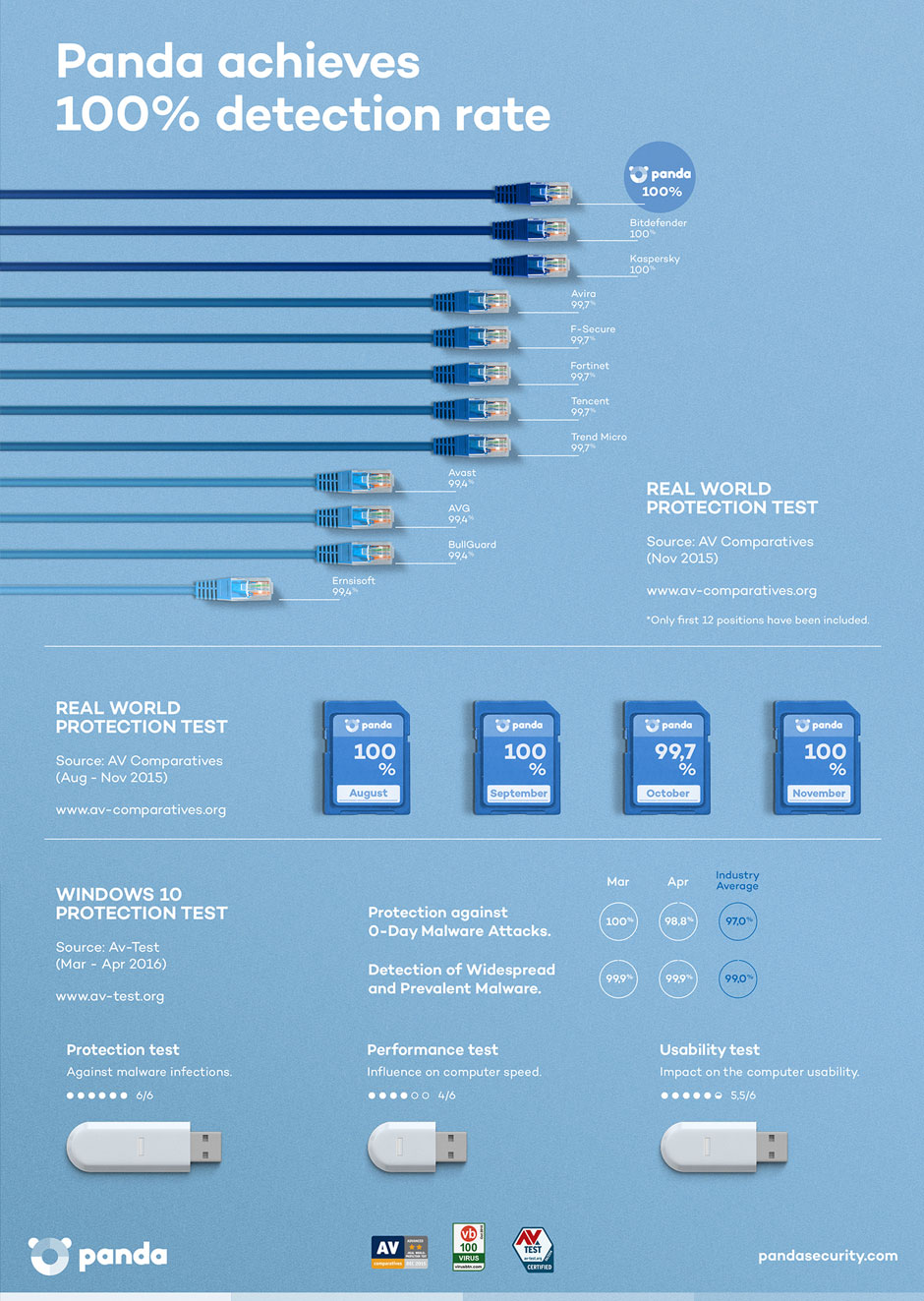
awards-pandaPanda Security  solutions were recently recognized by Virus Bulletin, one of the world leaders in testing security for the prevention, detection and elimination of malicious software and spam.

With more than two decades of experience, Virus Bulletin regularly analyzes the latest viruses then evaluates the current anti-malware products on the market in their publication. This year, Virus Bulletin has honored Panda with a VB100 certificate in their most recent comparative test.

Here you can see the complete report with all of the results of the 2016 study: https://www.virusbulletin.com/testing/results/latest/vb100-antimalware

A History that Guarantees 100% Detection

This is not the first time that Panda Security’s cybersecurity solutions have received a high grade from a demanding approving agency.

Halfway through this year, the independent organization AV-TEST, named Panda as the best antivirus software for Windows End Users. On this occasion, Panda was also given a certification that recognized their software as the highest protection against 0-Day attacks, and the Panda products additionally had the highest ratio of detection for the most extended and frequent malware. The lightness of the software on the system load and its impact on PC use were also key factors included in the test results.

Additionally, at the end of 2015 Panda was recognized in the Real World Protection Test for the proper functioning and efficiency of our solutions. So, have you enjoyed the benefits of the Panda guarantee?

panda-security-solutions-tests

The post Panda Security Achieves 100% Detection Rate appeared first on Panda Security Mediacenter.