
Tag Archives: Malware

POS and Credit Cards: In the Line of Fire with “PunkeyPOS”

pandasecurity-punkeypos-principal.png

PandaLabs, Panda Security’s anti-malware laboratory, has been working on an in-depth investigation since May related to Point of Sale terminals (POS) in restaurants across the United States. A new malware sample was discovered during this investigation called PunkeyPOS, a malware variant that is able to access credit card data. PandaLabs left this information at the disposal of American law enforcement so they can take the appropriate actions. Let’s see what this is and how it operates.

How can they steal your card without touching your wallet?

PunkeyPOS runs seamlessly in all Windows operating systems. The cyber-criminal’s plan is to install the malware in POS terminals in order to steal sensitive information such as account numbers, magnetic strip contents (tracks) from bank cards, etc.

PunkeyPOS seems simple:

It installs a keylogger that is responsible for monitoring keystrokes, then it installs a RAM-scraper that is responsible for reading the memory of all processes running on the system.

Based on the information it captures, the malware performs a series of controls to determine what is valid and what isn’t. Regarding the keystrokes, PunkeyPOS ignores all information other than credit card data. It is mostly interested in tracks1/2 from the process memory that is obtained from RAM-scraping. The POS terminals read this information from the bank cards’ magnetic strips and then can use this data to clone the cards at a later time.

Once the relevant information has been obtained, it is encrypted and forwarded to a remote web server which is also the command and control (C&C) server. In order to avoid the detection of the card information in case somebody is scanning the network traffic, it is encrypted before it is sent using the AES algorithm.

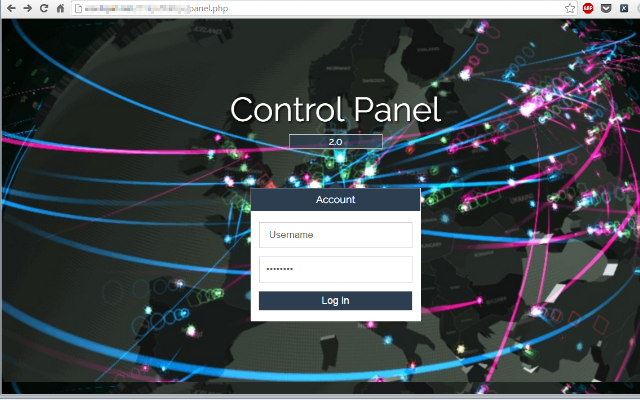
The command and control (C&C) server address can be easily obtained based on this malware sample through reverse engineering or analyzing their communications. This is the main page of the control panel; it requires a username and password to get access:
pandasecurity-punkeypos-1

Follow the Trail to the Digital Pickpocketers

The cyber-criminals behind this attack haven’t been very careful. Since the server was not configured correctly, PandaLabs was able to access it without credentials.

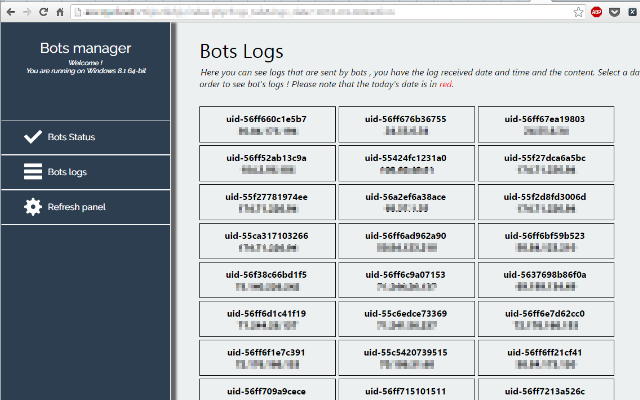
Because of their neglect, PandaLabs was able to see where PunkeyPOS sends the stolen information. In addition to being in front of a panel that is used to access the stolen data, from this panel cybercriminals can reinfect or update current clients (POS bots).
pandasecurity-punkeypos-2

The version of the analyzed PunkeyPOS sample is hardcoded: “2016-04-01”. If we compare this sample with older versions, some from 2014, we can barely see any difference in the way it operates (in the References section of this article you can find links that will go further into detail about how it works.)

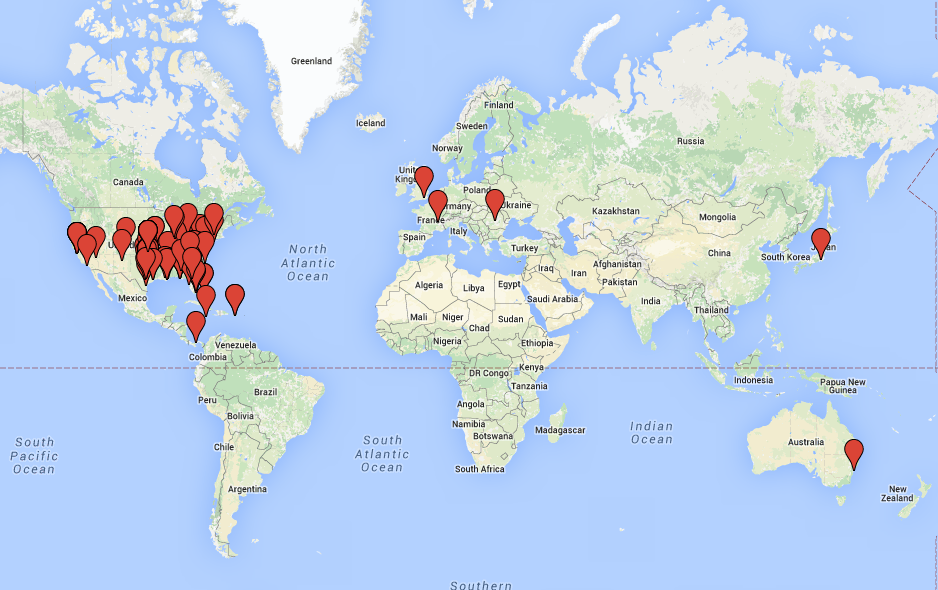
PandaLabs has been able to gain access to the control panel of PunkeyPOS, and has geolocated around 200 Point of Sale terminals that were compromised by this specific malware variant. We can see that virtually all the victims are in the United States:
pandasecurity-punkeypos-3

Taking into account how easy it is to sell this information on the black market, and how convenient it is to compromise these POS terminals anonymously through the internet, we are certain that cyber-criminals will be increasingly drawn to these terminals.

Protect your devices proactively from these types of attacks with an advanced cyber-security solution like Adaptive Defense. Real-time control of all inappropriate user operations is in your hands.

References:

http://krebsonsecurity.com/2016/06/slicing-into-a-point-of-sale-botnet/

https://www.trustwave.com/Resources/SpiderLabs-Blog/New-POS-Malware-Emerges—Punkey/


The post POS and Credit Cards: In the Line of Fire with “PunkeyPOS” appeared first on Panda Security Mediacenter.

North Korean Hackers Steal thousands of Military files from S. Korea

Hackers aligned with North Korea have always been accused of attacking and targeting South Korean organizations, financial institutions, banks and media outlets.

Recent reports indicate that North Korean hackers have hacked into more than 140,000 computers of at least 160 South Korean government agencies and companies, and allegedly injected malware in the systems.

The cyber attack was

Beware of Online Invoices! A Newly Discovered Threat Has Already Crossed Borders

endesa 4

Just a few days ago we received an alert from Endesa, a Spanish electricity company, warning us of a new online scam targeting victims through fraudulent emails. The cyber-criminals send out fake invoices to Spanish users, using the Endesa name, and then the attack hits soon after. Unfortunately, the cyber-criminals were successful in their first attack and have expanded to other countries. It is very difficult to estimate the number of people who have received the email and who have fallen victim to this scheme.

In the past few hours, a similar attack has arisen. The state-owned electric company in Poland, PGE, has fallen into this cyber-criminal network, amplifying this attack-method to an international level. Just like the incidents in Spain, important and sensitive information, belonging to both companies and individuals, have been infected after opening an infected file with the supposed electricity bill (which is really high, by the way).

We are facing a massive fraud that has transcended borders with a very lucrative goal: forcing you to pay a ransom to reclaim your personal files.

In both cases, the campaign has worked in a very similar way: by sending false invoices using the name of an electricity company, while infecting the computers of naïve victims with a locky computer virus. Although the malware has only reached Spain and Poland, it’s quickly growing and your country could be hit next.  Here are some tips to help you combat this threat:

The Online Invoice Scam, Step-by-Step.

  1. In both of the analyzed cases, the email in question reaches the spam mailbox and in the subject box is the name of an electricity company that corresponds to the country.
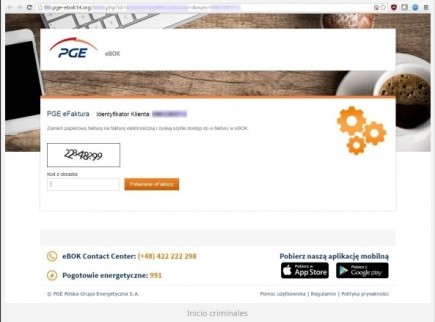
  2. It appears as though the fake invoice is the same in both countries. After carefully analyzing the PGE situation, we see that the message may appear somewhat messy, with Polish characters inserted into the text at random.
  3. When the user wants to learn more about the factitious bill, they will click on the button with the text “See Your Invoice and Consumption” that appears below the energy consumption summary. But by then, it is too late. After clicking the fake button, the ransomware that is contained inside the Zip file is executed and a malicious Java code script begins to run on the system.
  4. In this case, the schemers continue to trick their target by asking them to complete a Captcha to gain access to the Zip folder. This makes users think that they are carrying out a safe action, but in reality, their cyber-security is being controlled by a very powerful ransomware.
  5. Once the malicious program has been executed, the user will be blocked from accessing personal files. Locky is an aggressive kidnapper and will only return the personal information once a ransom has been paid.

Endesa 3

Don’t fall into a Scam That Is Tailor-Made for You

Each time, there are more detailed and customized attacks. Their creators are getting away with their wrong-doings using the names of prestigious companies, making it easy to fall into this trap.

One thing is clear: if you are not protected against this type of ransomware, your personal and company files are at risk of being abducted.

Avoiding this situation will free you from paying a ransom and will prevent giving up important information and time to the internet’s predators. There is one solution on the market that is able to control any and all types of threats, including Cryptolocker: Adaptive Defense 360.

When you receive an electric bill, you should only worry about how much energy you have consumed. Here at Panda, we will continue on our mission to detect and neutralize all threats and protect all of our customers.


The post Beware of Online Invoices! A Newly Discovered Threat Has Already Crossed Borders appeared first on Panda Security Mediacenter.