Tag Archives: News

California governor vetoes drone bill

In the wake of increasing drone incidents, including the most recent highly-publicized crashes at the U.S. Open tennis tournament and the opening game of a newly renovated college football stadium in Kentucky, drones got a somewhat surprising defender last week: California Governor Jerry Brown.

Governor Brown last week vetoed a bill that would have barred drones from flying within 350 feet above a property without “express permission” of the property owners. Despite easily passing the state legislature, the bill was widely reported to have opposition by tech industry companies and trade organizations.

Brown said in his veto message that the measure went too far in its restrictions. The bill, which is SB142 by Santa Barbara Democratic Sen. Hannah-Beth Jackson, would have created a trespassing crime for operating drones within 350 feet above private property without the consent of the property owner.

In his official statement about the veto, Brown noted, “Drone technology certainly raises novel issues that merit careful examination,” and should be looked at “more carefully.” But in his measured response, he suggested the act would be a crime “whether or not anyone’s privacy was violated by the flight.”

Said the Governor, “This bill, however, while well-intentioned, could expose the occasional hobbyist and the FAA-approved commercial user alike to burdensome litigation and new causes of action.”

As industry observer news website Re/Code reported, one of the tech industry’s leading associations, The Consumer Electronics Association, was a vocal opponent of the legislation. Among CEA members are Amazon and Google, both of which are planning drone delivery services. And among other influential participants, Re/Code also reported that GoPro, which recently announced plans for a drone, was in opposition.

“Safe, responsible drone use will transform the way we do business — allowing these devices to assist in search and rescue and disaster relief missions, improve crop production and efficiency, and create safer work environments for infrastructure maintenance.” Gary Shapiro, the CEA president and CEO, said in his statement to Re/Code.

Drones are (literally) at the intersection of technology, security, and privacy. Unfortunately, some bad players have colored the drone issue to date. But there are benefits to be derived from drone technology: They can speed delivery of emergency supplies, they can provide great benefits to agriculture, and they can literally save lives. For example, in natural and/or manmade disasters, drones can be positioned to survey damage, locate lost hikers or disaster victims, and improve efficiency and safety of rescue teams.

There will no doubt be more legal decisions and bills involved. As Re/Code also noted:  46 different states have considered 156 different bills about drones this year. And as American Civil Liberties Union (ACLU) policy analyst Jay Stanley recently said about drone policing,” It’s still a bit of a Wild West.”

But as Capt. Chesley B. “Sully” Sullenberger, the now-retired US Airways pilot that in 2009 managed to safely land his Airbus A320 passenger jet in the Hudson River, saving all 155 persons aboard, emphasizes: we need better risk management, better regulation of the recreational drone industry, and more enforcement of those regulations when drone operators do what he describes as “stupid, reckless, dangerous things.”

Panda Security achieves a 100% detection rate yet again, according to AV-Comparatives!

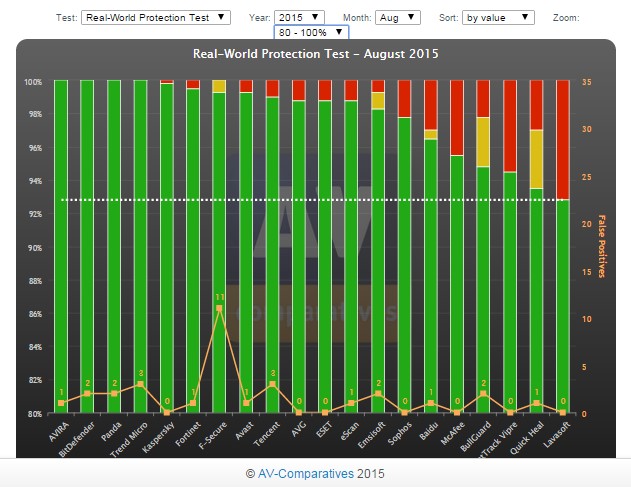
It’s happened again! Our free antivirus, Panda Free Antivirus, has obtained a 100% rate of detection according to the monthly report that was carried out in August by AV-Comparatives.

This is another success for our XMT motor, which is the basis for all of our consumer solutions.

av comparatives august

That’s not all, though! We scored the same result in the Real World Protection Test that was carried out during the last three months. This test recreates real-life conditions in which it analyzes and subjects different protection solutions to various tests. Here are Panda’s results:

comparatives
You can see all of the information in this infographic, which explains it all for you. Congratulations, everyone!

The post Panda Security achieves a 100% detection rate yet again, according to AV-Comparatives! appeared first on MediaCenter Panda Security.

AVG Business responds to evolving channel needs with enhanced Managed Workplace platform

Since we launched our flagship AVG Business Managed Workplace 9.1 in April 2015, the ongoing dialogue and feedback from our channel partners has been crucial. Managed Workplace 9.2 – the latest version of the platform, available today, addresses the needs our partners have raised. We are confident that the additional capabilities we have included in the expanded platform align to MSPs’ business objectives more closely than ever before.

An important feature in Managed Workplace 9.2 is the Premium Remote Control capability, through our partnership with enterprise remote desktop software provider, ISL Online, that has enabled us to integrate a premium Remote Control capability into our platform for the first time. By building in the remote control at no further cost to our partners, we are able to reduce not only the need for MSPs to work across disparate systems, but also the need to purchase additional, expensive, third-party tools. Offering greater control and visibility to resolve issues and deliver support more quickly, the Premium Remote Control enables MSPs to quickly and easily access remote computers, transfer files, chat, record sessions and perform administrative tasks for their clients, without switching interfaces.

Those of you who attended our Cloud Summit last October will remember discussing remote controls in detail – it’s a great example of you telling us what you wanted, and us listening and responding.

We want to help small enterprises and our MSP partners feel that they are doing everything they can to protect their data. At the same time, we recognize that monitoring so many different systems requires a streamlined workflow. Managed Workplace 9.2 now includes integrated Backup and Disaster Recovery, so that MSPs can easily control workstation backups, capture Bare-Metal-Recovery images for servers, as well as monitor and manage devices from one central dashboard.

Further details on the key features of the Managed Workplace 9.2 platform, including AVG Device Manager for Mac OS X and integrated AntiVirus enhancements can be found here.

With Managed Workplace 9.2, we move one step closer to a complete, managed IT solution – one which provides ease of use, security and control of the entire IT infrastructure (devices, applications and networks) from a “single-pane” of glass. We understand that our channel partners’ technology needs are always evolving and we are committed to doing all we can to streamline the experience while delivering the best services possible.

We are listening. Thank you for your ongoing feedback and please keep sending it our way.

PandaLabs detected more than 21 million new threats during the second quarter of 2015, an increase of 43% compared to the same period in 2014

PandaLabs, the laboratory set up by Panda Security, has published its quarterly report where it shows the latest statistics on malware and cyberattacks that have been at the forefront of this year’s second quarter. The creation of new malware samples have broken records in this timeframe.

The world of cybersecurity doesn’t take a moment’s rest and cybercriminals are a constant threat. The number of malware examples continues increasing and shows no sign of stopping, so here we’ll share with you the most important details of this report.

Malware can’t be contained

The creation of new types of malware continues to grow, reaching an average of 230,000 new examples every day during the second quarter of 2015. This represents an increase of 2% compared to the first quarter of the year. The figure is alarming and more than 21 million new threats have been generated during these three months. Compared to the same period last year, where there were 160,000 samples, this shows an increase of 43%.

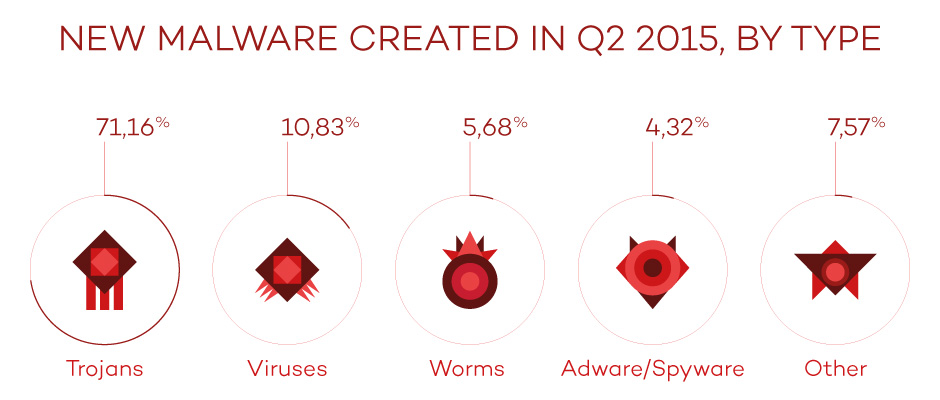
Of the new malware created this quarter, the most popular has been the Trojan, which accounted for 71.16%. This was followed by traditional viruses which made up 10.83%.

new malware

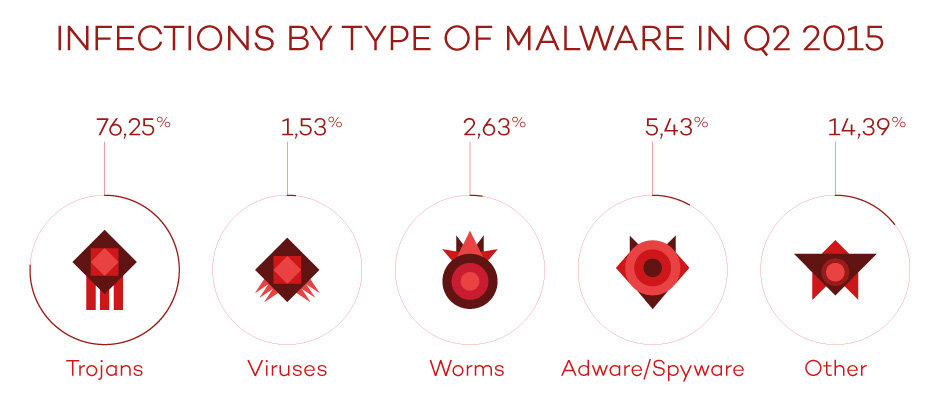
If we analyze the infection by type of malware we can see that, logically, the figures are the same as those for newly created malware, except for the category marked others, whose percentage is higher by a significant margin. Trojans continue to be the main cause of infection, with 76.25% of all users infected by them.

type of infections

Asia and Latin America show a higher rate of infection

China, once again, sits at the top of the chart with 47.53% of all computers infected. It is followed by Peru (43.11%) and Turkey (41.97%), respectively.

On the other hand, the countries with the lowest infection rates were Sweden (21.57%), Norway (22.22%), and Japan (23.57%). It is important to highlight Europe as the region with the lowest rate of infection worldwide, with nine countries on this ranking. As regards Spain, the rate of infection was (36.37%), which places it above the worldwide average.

Cybercrime is the order of the day

Among the main threats that were collected in the study, the use of Cryptolocker was highlighted as being used to infect both private users and businesses.

In the case of private users, cybercriminals have begun to reuse an old technique that was first used over 20 years ago. It consists of infecting the victim via the macros in Office documents, mainly Word. One such example which was discovered by PandaLabs was a Word document containing a blurred image. At the top of the document in bold capital letters there was a message that indicated that the image was blurred for security reasons. If the user wanted access to the information then they had to enable the macros, with an arrow pointing to the button to be pressed. Once enabled, it showed you the clear image while simultaneously infecting you with a type of Cryptolocker.

In this quarter we have seen some of these notable cyberattacks on businesses:

  • Ryanair, the well-known low-cost airline, was the victim of an attack which led to the loss of 5 million dollars.
  • CareFirst BlueCross BlueShield, an American medical insurer, suffered an attack which saw the theft of information relating to over a million clients.
  • AdultFriendFinder, an online dating site, suffered an attack which saw the theft of private user information. The attackers offered the stolen information to the first one to pay them 70 bitcoins, equivalent to $17,000 at the time. Not long after, the complete database was published online.
  • LastPass, a leading password management company, was another victim of information theft.
  • The well-known group Syrian Electronic Army managed to infiltrate the website of the US Navy, publishing propaganda promoting Bashar Al-Assad and his regime in Syria.
  • Ben Rhodes, Assistant to the President of the United States and Deputy National Security Advisor for Strategic Communications and Speechwriting, stated that the White House had fallen victim to an IT attack.

In the second quarter, attacks focused on mobile devices were popular among hackers. WhatsApp is a popular way to attract and try to infect users with a trick called WhatsApp Trendy Blue. It passes itself off as a “new version” of the application with extra features when, in reality, the only thing it does is sign the user up to an expensive billing service.

These are just some of the important cases that we have seen this quarter. More than ever, businesses need to be prepared for this massive avalanche of information theft. They need to reinforce their systems and security solutions, and understand that a simple antivirus is no longer enough to safely protect themselves from an attack. Preventing attacks is the best way to combat them, as the costs associated with an attack put the stability and existence of businesses at risk.

The complete report is available here.

The post PandaLabs detected more than 21 million new threats during the second quarter of 2015, an increase of 43% compared to the same period in 2014 appeared first on MediaCenter Panda Security.

Why Every Company Should Have a One-Page Privacy Policy

Most companies know you won’t read their 45-page privacy policy before downloading their app. I suspect they also know that their privacy policy needs to change. The problem is, when you gloss over a privacy policy, you could be giving software makers access to your personal information. Once you click the “I accept” button, your data could be theirs.

When my daughter was 10 years old, she asked to download a single-player, non-web connected game on her mobile device. Aimed at 8-12 year old children, the game required the user to accept an agreement that was illegible on a mobile phone. Looking more closely, I discovered that the app claimed the right to collect information including but not limited to my daughter’s name, profile, photos, telephone numbers, email address, contacts, GPS location, browser history and chat or messaging activity, without clearly explaining what the company did with that information or who it might share it with.

As you can imagine, I said “no” to downloading the game. However, that experience was my motivation to launch a campaign to simplify these privacy policies. At Mobile World Congress in March, I announced that AVG would produce a one-page privacy policy that is simple and transparent, and I challenged other companies to do the same. This week, out of our commitment to make the Internet safer for everyone, AVG has fulfilled on this promise with our latest privacy policy.

What’s a one-page privacy policy?

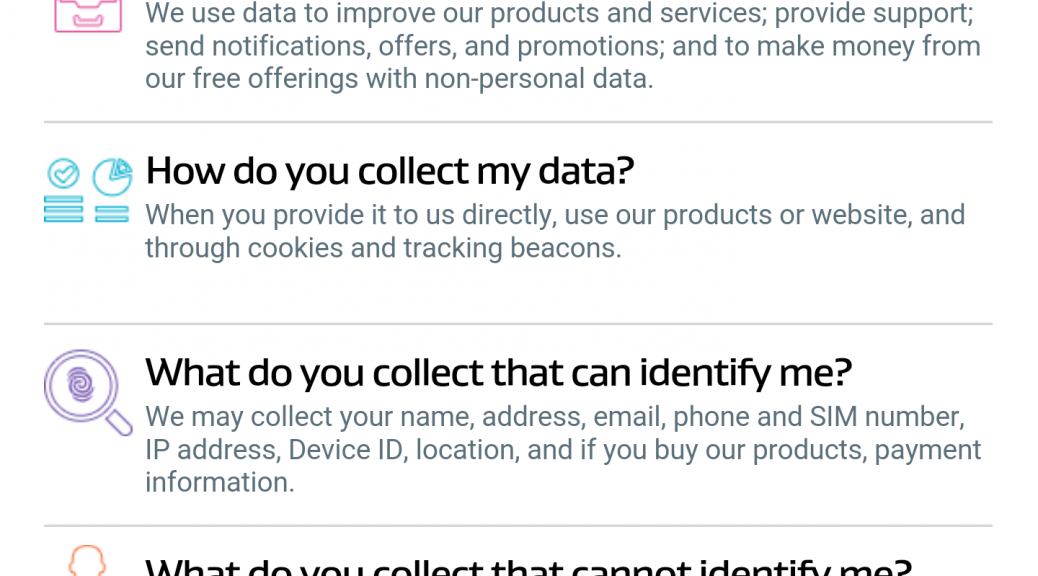
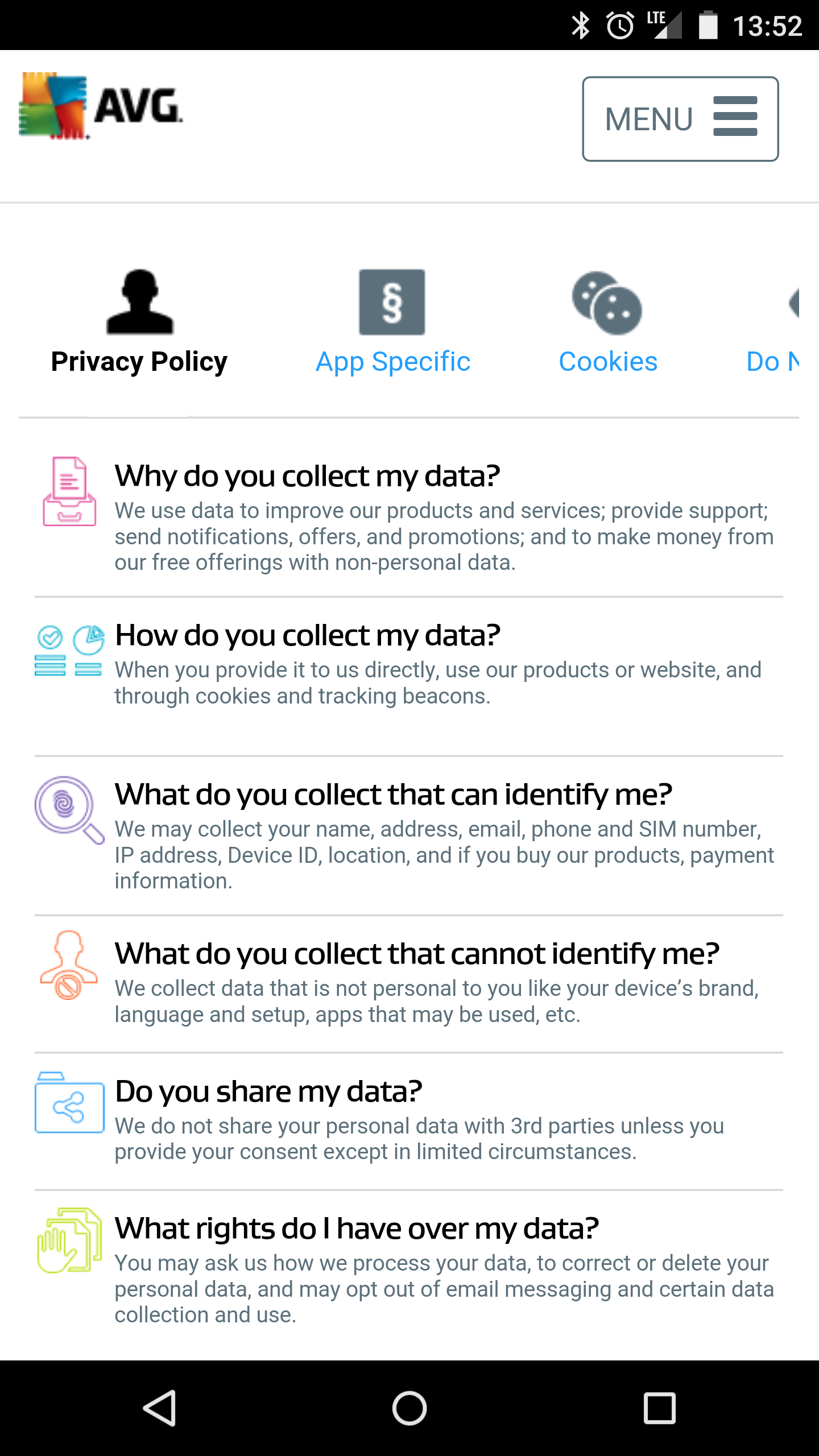
AVG’s one-page privacy policy is an at-a-glance summary of which data our company will collect or won’t collect and an explanation of how and why the data may be shared. We believe our users have the right to understand how and where their information will be used.

AVG’s users are important to us, and we want to earn and keep their trust. A simple and transparent privacy policy helps strengthen this relationship with our customers. A recent study shows that almost half of respondents (49 percent) report that lack of trust prevented them from downloading apps or using them once installed. Over a third (34 percent) said lack of trust stopped them from buying any mobile apps and services. I believe that the more consumers are clearly told the full extent to which companies collect their personal information, the less likely they will be to download new apps or software.

We see the world around us beginning to change: devices now capture new kinds of sensitive information, including health data through wearables and biometric devices and information from smart-home devices. Users must understand what companies will do with their personal information before they hit the “I agree” button.  And, they should understand this clearly and at a glance, not having to read pages and pages of a privacy policy. Users have a right to control their own information, and companies have the obligation to be transparent about their company’s use of this information. Here at AVG, we’ve created a simple, one-page, graphical summary for our users of what we will and won’t do with data.  I continue to challenge other companies to do the same. Let us know what you think.


one-page privacy policy