Category Archives: AVG

AVG

Is the blockchain the next big thing in banking?

Late last year, it emerged  that that two major Dutch banks ABN Amro and ING were running trials of blockchain technology on their trading desks.  The move follows reports that international banking group Santander was testing the viability of moving their international payments infrastructure to the blockchain.

The move to the blockchain, which Santander estimated could save banks as much as $20 billion a year in infrastructural costs, would be a landmark endorsement of the technology behind cryptocurrencies such as Bitcoin.

While it seems that the move may now not go ahead, it is still a significant step for financial institutions that have gone largely unchanged in decades.  What we are witnessing is the first large scale reaction from a bank in the face of new technology that threatens their industry, Bitcoin has revealed how outdated the existing financial infrastructure is, and banks realize this.

What is the blockchain?

Many people confuse blockchain with Bitcoin. While Bitcoin is a cryptocurrency, blockchain is the ledger system that tracks and manages every transaction made. The blockchain is mostly known for being the ledger system used by Bitcoin.

The blockchain is essentially a record of all Bitcoin transactions in history. They are recorded live and stored chronologically in “blocks” so that if you followed the chain through to the end, it would return to the first ever Bitcoin transaction.

You can see the blockchain in action here, with a live scrolling list of all transactions made in Bitcoin shown in real time.

https://blockchain.info/new-transactions


Why move to the blockchain?

What’s interesting about the blockchain is that it is entirely transparent. The sender and recipient of every transaction is known. But the blockchain also grants pseudo anonymity, while the details of the transactions are shown, there is no way to trace the identity of the account holders.

As well as improved privacy, the blockchain allows end users to save money on international financial transactions, move money around instantly and securely.

Security is another important benefit of the blockchain. While a traditional bank has a small number of servers processing transactions, when using the blockchain, the legwork is split between thousands of computers around the world.

Naturally, having such a large bank of computers do the processing makes the blockchain incredibly secure. With each computer managing only a tiny fraction of the transactions, in order to successfully hack the ledger, hundreds, if not thousands, of computers would need to be successfully breached. On top of this, it means that banks no longer need to foot the bill for server maintenance and security.


What does this mean for Bitcoin?

With blockchain technology on the brink of mainstream adoption, where does that leave Bitcoin? Unfortunately for fans of the cryptocurrency, the traded volumes are still too small to really support its case as a viable alternative to traditional currency.

However, volumes are growing slowly over time and while early adopters such as Silkroad have brought negative press associations, they are also paving a way for legitimate business use – a proof of concept.

While we may have to wait some time to see either blockchain or Bitcoin adopted by mainstream industry and finance, the news that major corporations are investigating the applications of blockchain technology is a very positive sign.

I believe that in a few years’ time, blockchain will be the de-facto method for ledgering transactions and that businesses and banks will no longer ‘own’ how their clients move money but instead battle to be the platform of choice for blockchain transactions.


Will your next password be an emoji?

Emoji’s such as smiley faces and others pictographs used commonly by many people nowadays have been put forward as a possible replacement to the humble password or PIN by a British start-up called Intelligent Environments.

As reported in The Guardian recently, the concept lends itself to our natural ability to remember pictures much more vividly than standard characters like letters and numbers.

Add to that research that shows 64% of millennials are using Emoji’s almost exclusively in their communication, and one wonders if this trend just might have some merit in the future.

The method proposed is that instead of entering your password or PIN, instead you would select a sequence of 4 Emoji pictures from a possible set of 44.  The math behind this says that an Emoji “password” would therefore be one out of a possible 3,748,096 combinations.

However, the question of whether this would be more secure over the standard password, and in particular a 4-digit PIN is open for debate.

While technically your 4-digit PIN is only one from a combination of 10,000 choices, the implementation on your mobile device tends to be much more secure, by the fact that incorrect attempts will result in gradually increasing timeouts – making it much more difficult and impractical to crack easily.

And consider that, just as with passwords, it is possible that people will select Emoji sequences that are quite predictable.  For example, selecting Emoji’s that tell a common story, like a Man, a love heart, a Woman, and a bunch of flowers; it’s quite possible people will end up selecting popular Emoji versions of the 1234 PIN equivalent.

On the positive side, think of how hard writing down your Emjoi “password” is going to be for those of us who aren’t artistically gifted.

If you are concerned about only using a 4-digit PIN on your mobile device, however, there are options you can change:

  • For Android users, depending on the version you have, you can select from PIN, Password, and also Smart Lock features. Using the Pattern option (where you draw a pattern on the screen) is not recommended as the smudge marks you leave on the screen can be enough to give it away!

For more information keeping your mobile device safe, check out the video below 6 Tips to Secure your Android Phone video.

Video

6 Tips to Secure Your Android Phone


Until next time, stay safe out there.

Tablet AntiVirus Security FREE scoops award

We are happy to announce that AVG’s Tablet AntiVirus Security FREE has been voted as the best tablet security app in a Czech and Slovak app award.

The awards, organized by Czech company Tuesday Business Network, are designed to celebrate the very best of Czech and Slovak app development industry.

A shortlist of products was drawn up by public nominations and an expert panel selected the winners.

AVG Tablet AntiVirus Security FREE has many powerful protection and anti-theft features that can help you keep your device safe as well as protecting the data stored on it.

These include:

  • App scanning
  • Remote locating/locking/wiping if it gets lost or stolen.
  • Task killer to help you improve the speed of your device
  • Secure web browser to protect you from malicious links and phishing attacks
  • Battery, storage and data package usage monitors
  • And many more


Download AVG Tablet AntiVirus Security FREE from Google Play today.

Screen Time: Adults need to lead by example

I think it reveals some pretty interesting insights about the digital family. Among them, the nagging worry about our kids’ screen time and, likewise, their worry about their moms’ and dads’ obsession with mobile devices – and the impact it’s having on the quality of our parent/child interactions.

As AVG senior evangelist Tony Anscombe points out ,, it’s really important that we set good habits within the home.

Unfortunately, almost a third of parents in our survey conceded that they actually aren’t setting very good examples.

As a case in point, on Father’s Day, I sat in a fine-dining restaurant and watched the dynamics of some digital families play out during the holiday Sunday brunch.

Across the room from my table, a father and son sat. Dad was on his smartphone.  Junior, a grade schooler, was on his iPad…Not a word was being exchanged between the pair during the entire meal. They sat isolated from each other, with either of them barely looking away from their device, except to give and receive their food orders.

The sight of the non-communicating father and son saddened me. It not only illustrated a failure to lead by example, but one of the worst digital lifestyle habits – using mobile devices during a meal, and a time when we should be paying attention to each other. (The latter was also called out as a key issue in the Digital Diaries study).

Closer by, at the table directly next to me on Sunday, was another digital family –this one definitely more engaged with each other and animated. Mom, Dad and teen daughter were merrily talking. Their digital devices only came out when Mom and the teen daughter posed the family for a few selfies. After attempting to do it themselves –and keep the self in Selfie—several times and not getting the desired shot, the Mom handed the smartphone to the waiter and arranged the family for a better angle. Snap. Photo taken and immediately posted on social media.

We often hear stories about children having an unhealthy relationship with technology, but it’s important to remember that it’s our role as parents, grandparents, uncles and aunts to set a good example. It’s up to us to engage them beyond the screen and perhaps examine our own device usage.

The latest Digital Diaries research has spurred me on to spend more time in person with my family and to indulge in the occasional digital detox. I hope you do too.

We’re all guilty of checking our devices too often

For over four years now, we have been researching the use of technology by families, specifically how our kids use technology to learn and communicate. Our latest research looks at how much time we, the adults, and our kids spend using devices and the effects that this has on family life.

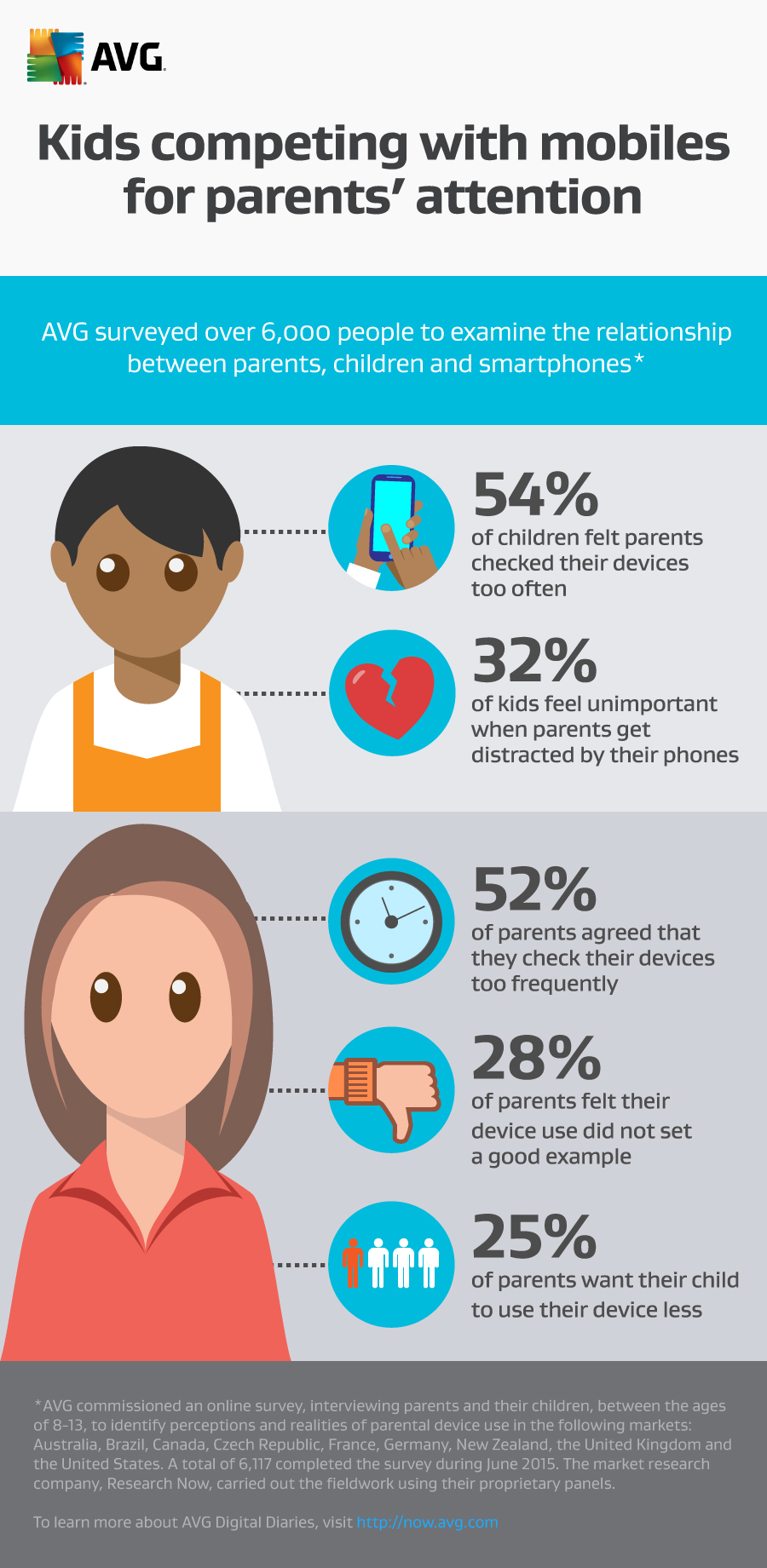
Are adults checking their devices too often? The simple answer is yes. Both kids and adults are in agreement with this as 54% of children say this and 52% of adults. At the same time, both kids and adults agree that it’s the kids that spend more time on their devices, 46% and 49%.

It would appear that the parent’s have some bad habits too, nearly one in four admit they answer their phone during meal times and one in three while watching TV with their kids. This makes our kids feel unimportant, at least that what 32% said in our survey.

Digital Diaries Infographic

Technology is changing our world, whether interactive education, TV on demand or communicating with our friends and family. Its important though that we distinguish between family time and device time and give each other the time and attention that we deserve.

In my family, we have ‘the basket’.  The basket lives in the kitchen and during meal times and at 9pm all our devices are relegated to the basket. This means for those precious moments of our day that we sit opposite each other; we communicate with out distractions and swap our news.

The challenge is clear that we, as the parents, need to set the example to our kids that the devices are super useful, engaging and give us great pleasure, but we need to show them that there is a time to put them down and spend quality time with each other.

Amusingly, I am writing this blog sitting in an RV in Yellowstone National Park, where there is no phone signal, yet both my son and wife are sitting playing a game on their phones competing to see who can get the highest score. It’s a great example of the addictiveness. As soon as I finish writing they will have them confiscated! Tomorrow we’ll go hiking and have a device free day.

I challenge you to set the example and get a phone basket!

Kids Competing with Mobile Phones for Parents’ Attention

AMSTERDAM – June 24, 2015 – Mobile phones are gaining an increasing share in the battle for parental attention, with a third of children, surveyed for a recent study, saying their parents spent equal or less time with them, than on their devices. The research, conducted by AVG® Technologies N.V. (NYSE: AVG), the online security company™ for more than 200 million monthly active users, examined children’s perceptions of their parents’ mobile device use, and uncovered some worrying trends.

Hinting at ongoing digital intrusion upon family life, over 50 percent of the children questioned, felt that their parents checked their devices too often (54 percent); and their biggest grievance, when given a list of possible, bad device habits, was that their parents allowed themselves to be distracted by their device during conversations (36 percent) – something that made a third of the complainants feel unimportant (32 percent).

When asked about their device use, half of all parents agreed that it was too frequent (52 percent), and many also worried about how this looked to the younger generation. Almost a third (28 percent) felt that they didn’t set a good example for their children with their device use.

“With our kids picking up mobile devices at an increasingly younger age, it is really important that we set good habits within the home, early on,” said Tony Anscombe, Senior Security Evangelist at AVG Technologies. “Children take their cues from us for everything else, so it is only natural that they should do the same with device use. It can be hard to step away from your device at home; but with a quarter of parents telling us that they wished their child used their device less (25 percent), they need to lead by example and consider how their behavior might be making their child feel.”

In a country by country comparison, Brazilian parents topped the survey for device use, with 87 percent of children stating their parents used mobile devices too much. More worryingly, 59 percent of Brazilian parents admitted to using the phone while driving – interestingly, 56 percent of children in Brazil also said they would confiscate a parent’s device, if they could.

Digital Diaries Infographic


Methodology:

AVG commissioned an online survey, interviewing parents and their children, between the ages of 8-13, to identify perceptions and realities of parental device use in the following markets: Australia, Brazil, Canada, Czech Republic, France, Germany, New Zealand, the United Kingdom and the United States. A total of 6,117 completed the survey during June 2015. The market research company, Research Now, carried out the fieldwork using their proprietary panels.

Time to Hang Up? Parents Should Look into Latest Smartphone Studies

Our children are spending more and more time with smartphones, and with good reason. They give parents a line of contact, and give kids access to loads of great games and apps.

But a recent study from the London School of Economics suggests that you may want to limit or delay your child’s access to smartphones. It shows a clear link from schools that ban students from carrying phones to an improvement in their test scores.

So what’s the gist of the study? It turns out that having a smartphone – or barring one—has a real and measurable impact on education.

“We found the impact of banning phones for these students equivalent to an additional hour a week in school, or to increasing the school year by five days,” researchers Richard Murphy and Louis-Philippe Beland stated. The study, released this May, is called Ill Communication: Technology, Distraction & Student Performance. It also found that following a ban on phone use, the schools’ test scores improved by 6.4%. The impact on underachieving students was much more significant — their average test scores rose by 14%.  The results noted that they could focus regardless of the presence of a smartphone.

The authors looked at how phone policies at 91 schools in England have changed since 2001, and compared that data with results achieved in national exams taken at the age of 16. The study covered 130,000 pupils. (See link to the full study here.)

It’s an interesting conundrum. Many of us think that technology is a driving force for improvement and development. I think that having the great wealth of education on the Internet can only be a boon. But the authors of the study draw awareness to the contrast. “Technological advancements are commonly viewed as leading to increased productivity. Numerous studies document the benefits of technology on productivity in the workplace and on human capital accumulation. There are, however, potential drawbacks to new technologies, as they may provide distractions and reduce productivity.”

Here in the US, these new studies may change a few minds and tilt a few policies. For example, Mayor Bill de Blasio of New York City just revoked a decades old ban on cell phones, leaving it up to individual principals, in consultation with parents and teachers. I wonder now if he might re-think his decision?

Other research underscores the concerns raised. A major educational study by the Pew Research Institute  found 87% of teachers surveyed said that Internet and digital devices are creating an “easily distracted generation with short attention spans” and 64% said today’s digital technologies “do more to distract students than to help them academically.”

The crux of the matter is this: Kids are using their phones to text and chat when they should be paying attention in class and interacting with others personally and not digitally.

Meanwhile, yet another recent study outlines additional risks of smartphone behavior: They don’t allow us to think for ourselves.

A study from researchers at the University of Waterloo (Canada) published in the journal Computers in Human Behavior, says that “Smartphone users who are intuitive thinkers — more prone to relying on gut feelings and instincts when making decisions — frequently use their device’s search engine rather than their own brainpower. Smartphones allow them to be even lazier than they would otherwise be.”

“They may look up information that they actually know or could easily learn, but are unwilling to make the effort to actually think about it,” said Gordon Pennycook, co-lead author of the study.

“Decades of research has revealed that humans are eager to avoid expending effort when problem-solving and it seems likely that people will increasingly use their smartphones as an extended mind,” noted Nathaniel Barr, the other lead author of the paper.

I think it is great to have so many tech educational resources at our fingertips.  But I too worry about is the next generation. Thinking about things, focusing, contemplating, and making decisions are a crucial part of a young person’s life – as is imagination.

We’ve also done a lot of research on children, Internet safety and the mobile world. AVG Digital Diaries research findings last year showed 42% of the parents polled by AVG said that they are concerned that their child spends too much time on devices, and a similar number (43%) said they were worried their child didn’t spend enough time outside.

So what does this all add up to, in the big picture?

If you have kids, it’s important to take control and limit use of smartphones by setting up guidelines.  At AVG, we offer parental controls to limit and guide smartphone usage through our Location Labs products.

After all, even Steve Jobs famously limited how much technology his kids used at home.

Personal data is becoming a primary target at every level

I recently published a blog about the data breach at the Office of Personal Management (OPM) and the Interior Department which is being blamed on China.

In the last week, there have been a number of experts giving more detail on the depth of the stolen data. The concern is about Standard Form 86 which is used to collect data on potential federal employees applying for positions in National Security.

As you can imagine, this form probes into areas of someone’s background, family and friends that not even those close to the person may know. There are 127 pages of the form and the collection of information includes citizenship, passport, residence schools, military service, employment, financial records, alcohol and drug use, criminal records, psychological and emotional health, groups that may have been associated with, foreign travel, associates including relatives and friends.

The data is extremely valuable to any foreign government or intelligence agency, knowing your enemy in this much detail is a definite advantage. Some observers are suggesting that the data may even be used to blackmail people.  While there is of course this possibility, I doubt anyone who successfully got a position in the NSA would be susceptible to blackmail…

However, there is the risk of an unsuccessful applicant being blackmailed with the data on their Standard Form 86. Naturally, this is bad news for them and they need protection as they are not in positions of national security.

Any breach that affects the people responsible for our security is extremely serious and there needs be a robust plan to assist current and past employees, and even those who simply filled out the form.

Personal data is becoming the primary target for many cyber criminals, foreign powers and governments and the holders of the data need to take precautions to secure it. We are all potential victims of data theft and it’s our responsibility to understand the dangers of handing over our data.

While in this case there is no alternative for national security employees, in many of the data breach cases recently there are ways that we can limit our exposure by sharing less.