Category Archives: AVG

AVG

Three reasons to be excited about: Mobile Payments

While paying through a mobile device, wearable or digital card may seem like a high-tech near future, the reality is that mobile payments are already soaring around the globe.

Earlier in April, GSMA Mobile Money for the Unbanked (MMU) released its 2014 State of the Industry Report on mobile financial services.  The report indicates that there are already 255 mobile money services in operation across 89 countries and in over 60% of developing markets.

The arrival of major tech and finance players such as Apple, VISA and Samsung have brought the mobile payments into the spotlight and into the mainstream.

Here we look at three of the most interesting developments in recent months:


Digital Credit Cards

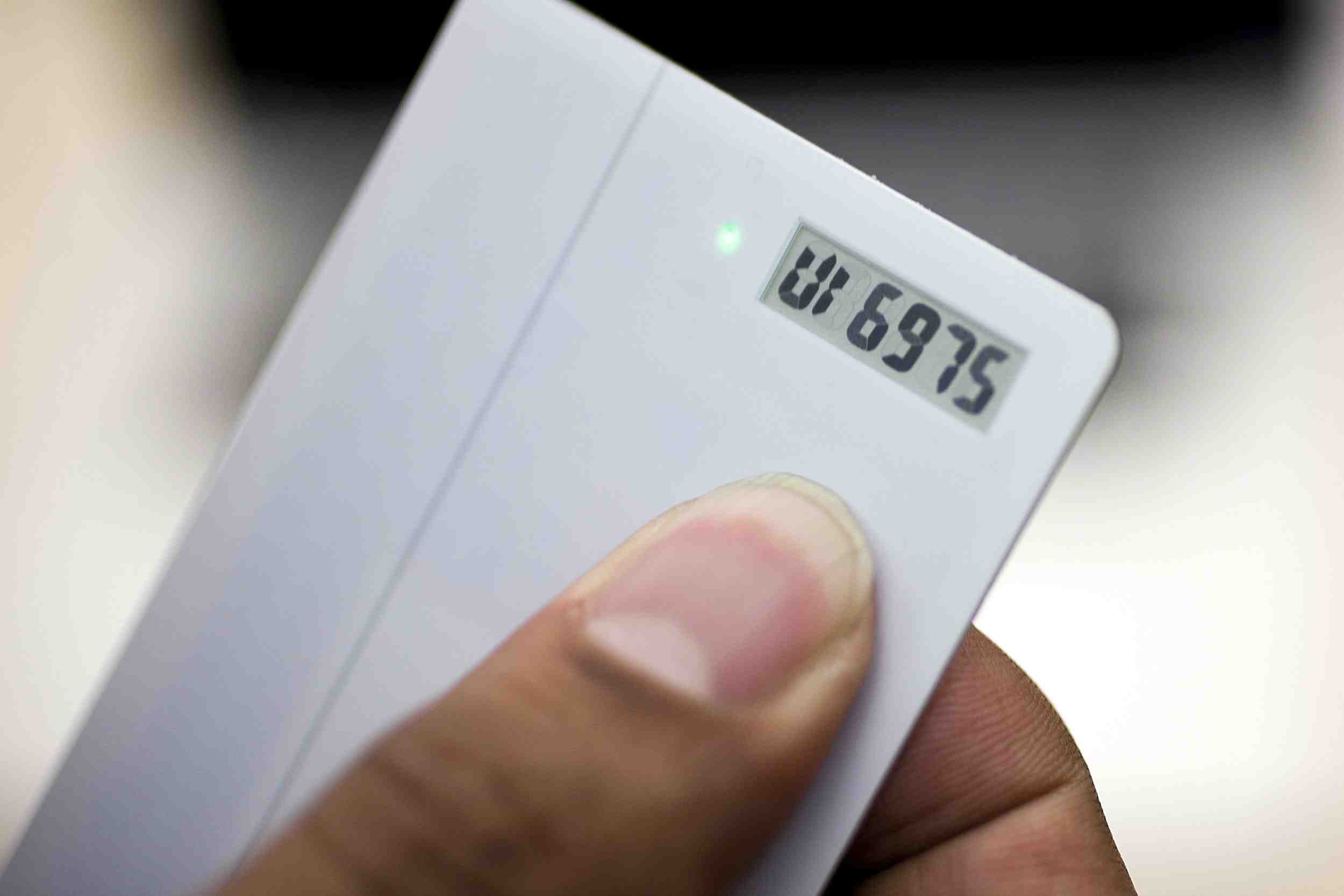
While generally still in the beta phase, digital credit cards promise to consolidate the bulk of a wallet or purse into a single card.

The idea is to forgo multiple cards and instead have a single digital card that can be programmed with the details of all your other payment and membership cards. At the touch of a button, your American Express card can become your Starbucks loyalty card. Pretty neat!

There are several major players in this space including Coin, Plastc, Swyp and Wocket.

Coin Card


Mobile payments are getting full backing

There’s recently been some good news for those worried about storing money in online services such as Apple Pay, PayPal or Google Wallet.

According to Yahoo Finance, the Feder Deposit Insurance Corporation (FDIC) now insures funds stored in Google Wallet.

This means that should anything happen to Google or one of the banks holding your money, your digitally stored funds are protected by the US federal government.

While most of us use services such as PayPal to directly make payments rather than actually store money, it’s reassuring to know that online digital balances are starting to get the same government protection offered to the traditional banking system.


Mobile payments are going social

One of the most interesting developments in the mobile payment space has been the land grab by several social networks to integrate payment services into their platforms. Both Facebook and Snapchat have both got involved.

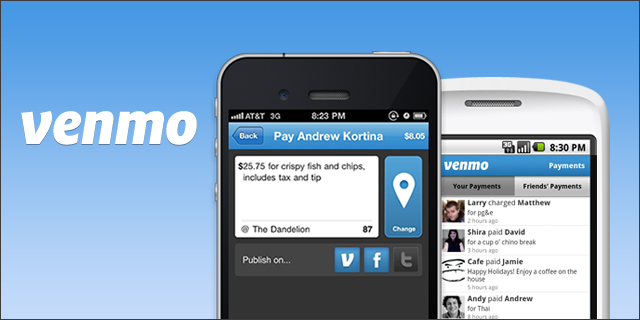
The rise of dedicated social payment services is also worth noting. Payment service Venmo has already risen to prominence (although not with a few security hiccups on the way).

Venmo


I personally see social and banking as two diametrically opposed services. One should be private, secure and personal, the other open public and shared.

The fact of the matter is that there’s clearly a demand for a payment protocol with inbuilt social features so expect to see a whole lot more activity in this area in the coming months.


Unpredictability is key in password strength

The latest report from infosec provider Praetorian suggests that when it comes to hacking a password, the sequence and consistency of the characters is just as important as the actual strength of the password itself.

Using a technique called a mask attack, attackers break a password down into their component elements such as upper case letters (u), lower case letters (l), digits (d) and symbols (s).

In their example, Praetorian used “Password1234” which when viewed in this system becomes “ullllllldddd”. This string of letters is known as a mask. Each letter in the chain denotes the character type (u= upper case).

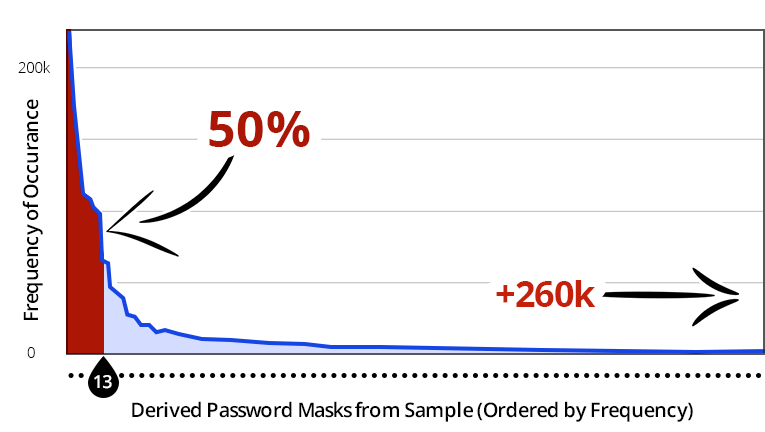
Using this technique, Praetorian analysed nearly 35 million leaked passwords from various sources. What they found was surprising.

Password Masks


Of the 35 million analysed passwords, half of used the same 13 masks.  This means that despite the millions of variants of characters, digits and symbols, in our passwords, as many as half of us are using a very limited selection of masks.

Naturally our predisposition for these certain masks makes our passwords much easier to hack. Not to mention that many people also use dictionary words and personally identifiable information in their passwords.


Why do we behave like this?

Praetorian posits that our preference masks is down to the way that we are informed to create strong passwords. A simple example of this would be to use a capital letter in the password. Conventional behavior leads us to use it at the start of a password and use symbols such as ‘!’ at the end.


How to improve your password safety.

The most important thing to do to help make your passwords more difficult to crack is to use an unusual mask. Don’t be tempted to start your password with a capital and insert your symbols and digits somewhere other than the end.

Password managers can also help you generate strong, long and random passwords that use a wide variety of masks.


“Mobilegeddon” – Is Your Website Mobile Friendly?

Starting last week, Google’s search algorithm is now ranking mobile-friendly Websites above others.   Bottom line: “If your site’s pages aren’t mobile-friendly, there may be a significant decrease in mobile traffic from Google Search,” Google itself says.

Why the change? Ultimately, the move reflects how people are using the Internet.   Mobile is being used for everything from searches to banking, and not just while people are on the go. As Google notes, in the US, 94% of people with smartphones search for local information on their phones; 77% of mobile searches occur at home or at work.

The latest data from the Pew Internet Project showed that 64% of American adults own a smartphone. Similarly, comScore reported 60% of Internet traffic is from mobile devices. These numbers are consistent with AVG’s own research conducted with MEF (Mobile Economic Forum) and findings that the move to mobile commerce and content is only going up.

So, what makes a website or page “mobile-friendly”?  Since most of us have experienced unfriendly mobile sites, it’s pretty easy to assess at one glance.

The criteria, which Google spelled out last fall when it began calling out “mobile friendly” sites and setting the stage for the current change, includes:

  • Avoids software that is not common on mobile devices, like Flash
  • Uses text that is readable without zooming
  • Sizes content to the screen so users don’t have to scroll horizontally or zoom
  • Places links far enough apart so that the correct one can be easily tapped. “


You can find more details here.

You also can check to see if your own site is mobile-friendly with the Google Mobile-Friendly Test or check the status of your entire site through the Mobile Usability report in Webmaster Tools.  Be prepared. You may be in for a surprise.

While savvy tech companies have been anticipating Google’s change, the impact will no doubt be felt among small businesses that don’t always have the resources to respond to technology changes quickly. And a change in search ranking is one that can have a huge impact on their business!

Experts are predicting that sites that aren’t mobile friendly will see a dramatic fall-off in page hits and localized searches (i.e., foot traffic). In fact, that’s why analysts have taken to calling the change in rather dramatic terms, such as “Mobilegeddon.”

So what to do if you are a small business owner? You’re website has to go mobile!

Fortunately there are a lot more options available than ever before for easily creating new and mobile friendly websites that don’t require spending a lot of money.  Among some of the most popular website building resources are SquareSpace , Wix  and Weebly. You can see a comparison review of the tools here.

Once your website becomes mobile-friendly, Google says it will automatically re-evaluate your pages.  Google also advises that you can expedite the process by using Fetch as Google with Submit to Index to get a mobile-friendly ranking.

The Google move is another reminder that as the world goes increasingly mobile, it presents new challenges and opportunities. But, it’s not only in the way we present our web pages, but also in many aspects of how we do business – including an evolution of how we secure the data and protect the privacy of our mobile customers.  The latter is a matter of consumer trust, which is paramount for businesses in today’s mobile world and why we at AVG are committed to helping businesses do so.

Man so enraged he shoots his computer!

Last week a man in Colorado sparked police action for shooting his computer eight times after becoming frustrated with it malfunctioning. He was detained for discharging a firearm in the city.

“He was having technology problems, so he took it to the back alley and destroyed it” a police spokesman said.

The article in The Gazette amusingly say that “he got tired of fighting with his computer for the last several months”.

I wonder how many of us would like to seek revenge on our computer or device by taking it outside and destroying it. I recently could have done this to my home printer that for some weird reason would no longer connect as a Google Cloud Printer.

The good news is that keeping your computer running quickly and smoothly is not a difficult task. I’ve outlined five tips below that should help keep you from losing your temper with your device!

  1. Run a full system scan to ensure your machine is clean, simple instructions for this are here.
  2. Ensure that you have up to date Anti-Virus software, not only does it need to be installed but it needs to be active and updated. You can download AVG Free Anti-Virus from our website.
  3. Test the configuration of your security software to ensure it is performing the way you expect it to. A simple way to do this is to run the Security Features Check on the AMTSO website.
  4. Once you’re confident the machine is ‘clean’ then download and install a performance enhancing product, there are many on the market and you need to make sure that you choose one that is not snake oil, you can easily check this           through third party awards and reviews. I, of course, recommend AVG PC TuneUp, you can download a trial version here and also checkout the independent reviews listed there.
  1. Once downloaded and installed there are some automated task that you will be prompted to do, I would recommend supplementing these with the following


Hopefully the above will keep you from resorting to taking up arms and destroying your machine. I do understand the frustration though and I am sure shooting the PC felt good at the time.


Follow me on twitter @tonyatavg

AVG Announces First Quarter 2015 Financial Results

AMSTERDAM, April 29, 2015 /PRNewswire/ — AVG Technologies N.V. (NYSE: AVG), the provider of Internet and mobile security, privacy and optimization to 202 million active users, today reported results for the first quarter ended March 31, 2015.


Key highlights

  • Subscription revenue grew 21 percent to $81.6 million
  • Total monthly active users surpassed 200 million, with mobile users growing 29 percent over last year to 104 million
  • Q1 revenues increased 10 percent over the same period last year; adjusting for foreign exchange movements, Q1 revenues grew over 12 percent


First quarter 2015 financial results

Revenue for the first quarter of 2015 was $102.8 million, compared with $93.5 million in the first quarter of 2014.  Non-GAAP net income for the first quarter of 2015 was $23.9 million, or $0.46 per diluted ordinary share.  This compares with non-GAAP net income of $30.0 million, or $0.56 per diluted ordinary share for the same period of the prior year1.

GAAP net income for the first quarter of 2015 was $11.9 million, or $0.22 per diluted ordinary share.  This compares with net income of $17.9 million, or $0.34 per diluted ordinary share in the prior year’s first quarter.

Operating income was $19.8 million, compared with $24.7 million for the first quarter of 2014.  Operating cash flow was $22.2 million for quarter, compared with $32.7 million for the first quarter last year.  Non-GAAP free cash flow was $19.9 million for the quarter, compared with $30.0 million for the same period in the prior year.

“Our results of the quarter reflect the continued execution against the initiatives we laid out for you during the repositioning of the company last year,” said Gary Kovacs, CEO of AVG.  “Subscription based revenue growth accelerated and now represents approximately 80 percent of the total revenues, providing an increasingly predictable, sustainable and recurring revenue base.  Our total active user count has surpassed 200 million, validating our view that the online security industry is undergoing a fundamental shift, with consumers driving much of the change.  As we approach the second half of 2015, we believe we will capitalize on this emerging opportunity with our strong user base and realigned focus, and continue to deliver on our objectives.”

(1) Non-GAAP results for the first quarter of 2015 exclude $3.1 million in share based compensation expense,$6.7 million in acquisition amortization and $0.3 million in charges associated with litigation settlements, $2.0 million in acquisition related charges, $0.8 million in charges related to the unwinding of discounts and changes in fair value and $0.1 million in charges associated with the rationalization of the Company’s global operations, offset against $0.9 million in net reversals of capitalized development charges, as described in the Reconciliation of GAAP measures to non-GAAP measures.

Financial Outlook

Based on information available as of April 29, 2015, AVG is reaffirming the following outlook for fiscal year 2015 as follows:

Revenue is expected to be in the range of $410 million to $430 million.
Non-GAAP adjusted net income is expected to be in the range of $94.2 million to $99.2 million; non-GAAP diluted EPS is expected to be in the range of $1.80 to $1.90.
GAAP net income is expected to be in the range of $48.9 million to $53.9 million; GAAP net income per diluted ordinary share is expected to be in the range of $0.93 to $1.03.
AVG’s expectation of non-GAAP adjusted net income for the fiscal year 2015 excludes share-based compensation expense, acquisition amortization and certain other adjustments, and assumes a normalized tax rate of 12.5%.  For the purpose of calculating GAAP diluted EPS and non-GAAP diluted EPS, the Company assumes approximately 52.6 million weighted-average diluted ordinary shares outstanding for the full year.

The financial information presented in this press release is not audited or reviewed.

Conference Call Information

AVG will hold its quarterly conference call today at 5:00 p.m. ET/2:00 p.m. PT/11 PM CET to discuss its first quarter 2015 financial results, business highlights and outlook.  The conference call may be accessed via webcast at http://investors.avg.com or using the following phone numbers and conference ID: +1 913 312 1499 (USAand Canada); +44 20 8150 0795 (UK); Conference ID: 1551655.

A live version and replay version of the webcast can be accessed via http://investors.avg.com.

Use of Non-GAAP Financial Information

This press release contains supplemental non-GAAP financial measures that are not calculated in accordance with U.S. GAAP.  These non-GAAP measures provide additional information on the performance or liquidity of our business that we believe are useful for investors.

Adjusted net income, free cash flow and their related ratios are non-GAAP measures and should not be considered alternatives to the applicable U.S. GAAP measures.  In particular, adjusted net income and free cash flow, and their related ratios, should not be considered as measurements of our financial performance or liquidity under U.S. GAAP, as alternatives to income, operating income or any other performance measures derived in accordance with U.S. GAAP or as alternatives to cash flow from operating activities as a measure of our liquidity.

Adjusted net income and free cash flow are measures of financial performance and liquidity, respectively, and have limitations as analytical tools, and should not be considered in isolation from, or as substitutes for, analysis of our results of operations, including our operating income and cash flows, as reported under U.S. GAAP. We provide these non-GAAP financial measures because we believe that such measures provide important supplemental information to management and investors about the Company’s core operating results and liquidity, primarily because the non-GAAP financial measures exclude certain expenses and other amounts that management does not consider to be indicative of the Company’s core operating results or business outlook or liquidity. Management uses these non-GAAP financial measures, in addition to the corresponding U.S. GAAP financial measures, in evaluating the Company’s operating performance, in planning and forecasting future periods, in making decisions regarding business operations and allocation of resources, and in comparing the Company’s performance against its historical performance. Some of the limitations of adjusted net income and free cash flow and their related ratios as measures are:

they do not reflect our cash expenditure or future requirements for capital expenditure or contractual commitments, nor do they reflect the actual cash contributions received from customers;
they do not reflect changes in, or cash requirements for, our working capital needs;
although amortization and share-based compensation are non-cash charges, the assets being amortized will often have to be replaced in the future and such measures do not reflect any cash requirements for such replacements; and
other companies in our industry may calculate these measures differently than we do, limiting their usefulness as comparative measures
Because of these limitations, investors should rely on AVG’s consolidated financial statements prepared in accordance with U.S. GAAP and treat the Company’s non-GAAP financial measures as supplemental information only.

For a reconciliation of these non-GAAP financial measures to the most directly comparable financial measures prepared in accordance with U.S. GAAP, please see “Reconciliation of GAAP to non-GAAP financial measures”.  All non-GAAP financial measures should be read in conjunction with the comparable information presented in accordance with U.S. GAAP.

Forward-Looking Statements

This press release contains forward-looking statements within the meaning of the Private Securities Litigation Reform Act of 1995, including those relating to an expected range of revenue, net income, EPS, non-GAAP adjusted net income and non-GAAP EPS for the fiscal year ending December 31, 2015 and/or future periods, as well as those relating to the future prospects of AVG.  Words such as “expects,” “expectation,” “intends,” “assumes,” “believes” and “estimates,” variations of such words and similar expressions are also intended to identify forward-looking statements. These forward-looking statements involve risks and uncertainties that could cause actual results to differ materially from those contemplated herein. Factors that could cause or contribute to such differences include but are not limited to:  changes in our growth strategies; changes in our future prospects, business development, results of operations and financial condition; the anticipated costs and benefits of our Location Labs acquisition and other acquisitions; our ability to remediate the material weaknesses and other deficiencies identified in our internal controls or IT systems; our ability to comply with our credit agreements; changes to the online and computer threat environment and the endpoint security industry; competition from local and international companies, new entrants in the market and changes to the competitive landscape; the adoption of new, or changes to existing, laws and regulations; changes in international or national tax regulations and related proposals; the assumptions underlying the calculation of our key metrics, including the number of our active users, revenue per average active user, subscription revenue per subscriber and platform-derived revenue per thousand searches; potential effects of changes in the applicable search guidelines of our search partners; the status of or changes to our relationships with our partners, including Yahoo!, Googleand other third parties; changes in our and our partners’ responses to privacy concerns; our ability to successfully exit the third party search distribution business; our plans to launch new products and online services and monetize our full user base; the performance of our products, including AVG Zen; our ability to attract and retain active and subscription users; our ability to retain key personnel and attract new talent; our ability to adequately protect our intellectual property; our geographic expansion plans; the outcome of ongoing or any future litigation or arbitration, including litigation or arbitration relating to intellectual property rights; our legal and regulatory compliance efforts, including with respect to PCI compliance; and worldwide economic conditions and their impact on demand for our products and services.  Given these risks and uncertainties, you should not place undue reliance on these forward-looking statements.

Further information on these factors and other risks that may affect the Company’s business is included in filings AVG makes with the U.S. Securities and Exchange Commission (SEC) from time to time, including its Annual Report on Form 20-F, particularly under the heading “Risk Factors”.

The financial information contained in this press release should be read in conjunction with the consolidated financial statements and notes thereto to be included in the Company’s reports on Form 6-K and Form 20-F.  The Company’s results of operations for the first quarter, ended March 31, 2015 are not necessarily indicative of the Company’s operating results for any future periods.

These documents are available online from the SEC or in the Investor Relations section of the Company’s website at http://investors.avg.com.  Information on the AVG website is not part of this release.  All forward-looking statements in this press release are based on information currently available to the Company, and AVG assumes no obligation to update these forward-looking statements in light of new information or future events.


About AVG

AVG is the online security company providing simple, integrated software and services to secure devices, data and people. Over 200 million active users and businesses use AVG’s products and services worldwide.

All trademarks are the property of their respective owners.

You can now download your Google Search history

When it comes to significant historic events, we can all remember where we were when we first heard the news. I can remember where I was on 9/11 and when man landed on the moon but can you remember what you searched for on the 29 November 2012?

Chances are you can’t, but it’s now possible to find out.

Search engines like Google can collect vast amount of data about us that can be used to build a profile of our interests, hopes, fears and activities. Imagine everything you searched for being stored and later analyzed.

College years, holidays, medical conditions, online dating, buying a car, having children or just my news preferences are all there in the keywords that I use when searching for content.

Is there any need for either you or anyone else to have this personal view into your life?

Two years ago, I switched off storage of Google search history with no noticeable effect on my ability to find things. On the other hand, I am sure its inconvenienced a couple of companies that would love to target me for advertising.

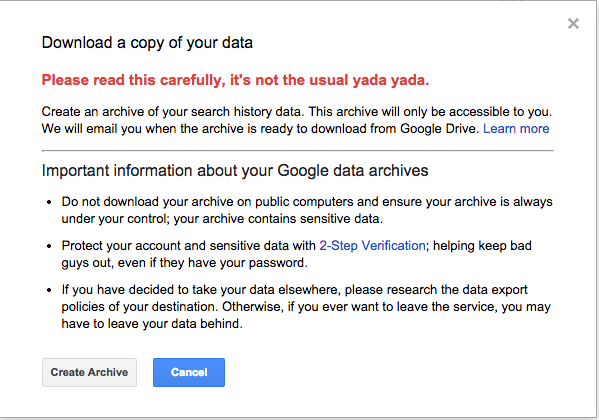
Google recently announced the ability to download your entire search history, which if you have a Google account is collected by default. This is a little known feature that comes with a forewarning about the sensitive nature of the data.

Data Warning


If the data is so sensitive then why was there no warning that someone was collecting it to start with? Maybe it should be an optional feature that I could choose to switch on?

I recommend that you make a conscious decision on whether someone needs to be collecting this or whether you feel that you may need this for some reason in the future (if you can think of one please let me know).

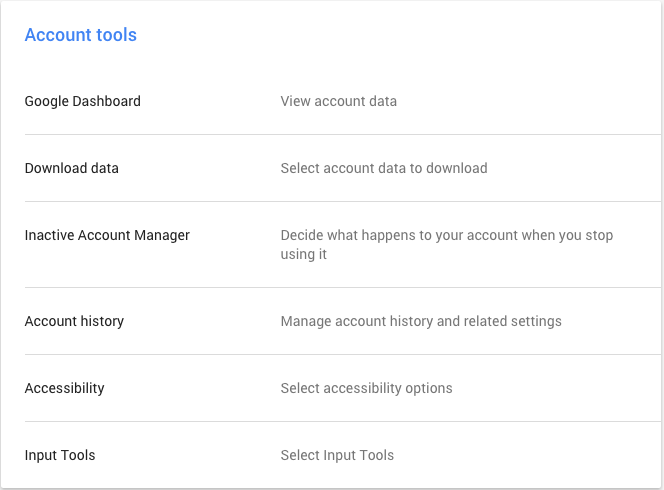
Changing the history storage options is in your Google account settings in the ‘Account Tools’.

Account Tools


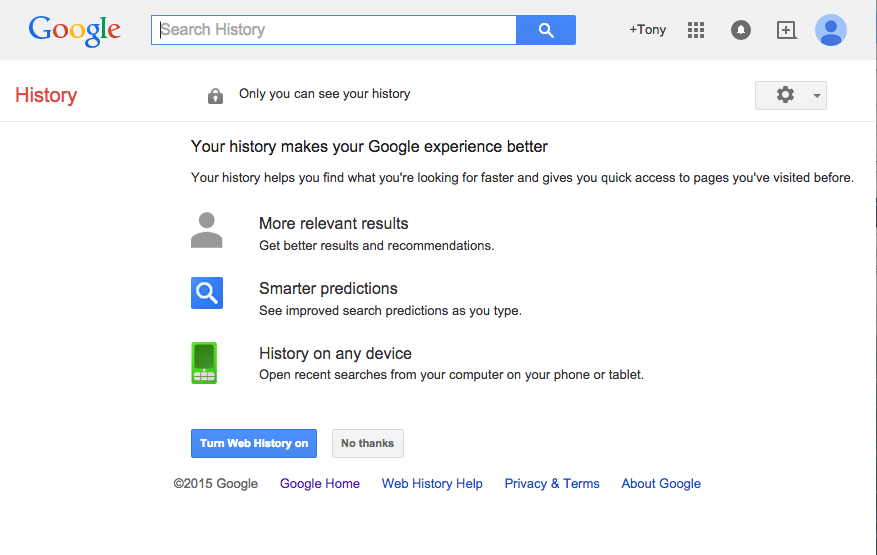
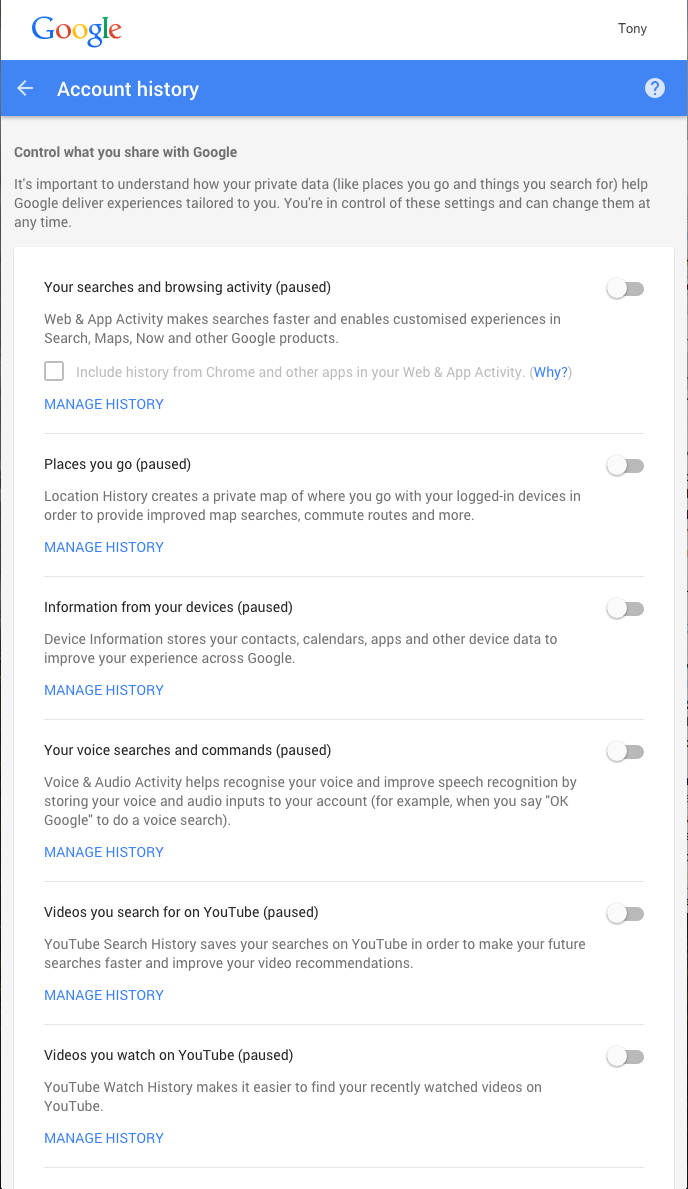
Selecting Account history then opens a screen that allows you to control not only search history but also voice searches, YouTube videos searched for or watched and even the location data that you may be storing. While on this page, be sure to review what history you are willing to share and make the appropriate selections as necessary. As you can see, I have selected to switch off all collection of my history.

Web history


Then there is the management of all the historic data, it might be amusing to go back and look at what you were browsing for before you remove it. This might just highlight to you the need to manage what is collected!

Account history


Follow me on twitter @tonyatavg

Android Performance Optimization Guide 2015

Just like our laptop and desktop computers, mobile devices can slow down over time as they collect junk files and unwanted programs take up valuable storage and processing resources.

If you have an Android device that is not running as swiftly as it once was, check out our Android Performance Optimization Guide 2015 for an in depth guide to squeezing the most out of your device.


Download AVG Cleaner for Android today!

Troubleshooting GTA V

On launch day I spent hours trying to get GTA V to run on my gaming machine which was an absolute time-consuming nightmare.

To spare you the trouble, here are some of the steps that led to GTA V finally working on my machine:


RockStar Social Club

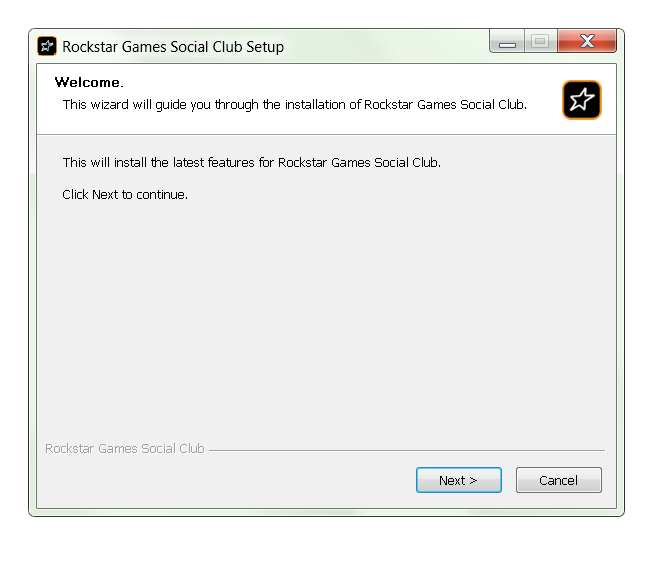
Download Rockstar Social Club from this page here. This is the application that actually launches GTA V and checks for an online connection and your system requirements. Having the latest version or even uninstalling and reinstalling it could help.

Rock Star Social Club


Updating Windows System File

The one tip that solved the problem for me was downloading an updated Windows system file that’s responsible for the controller input (it was either that or unplugging the Game controller, which I obviously didn’t want to do.)

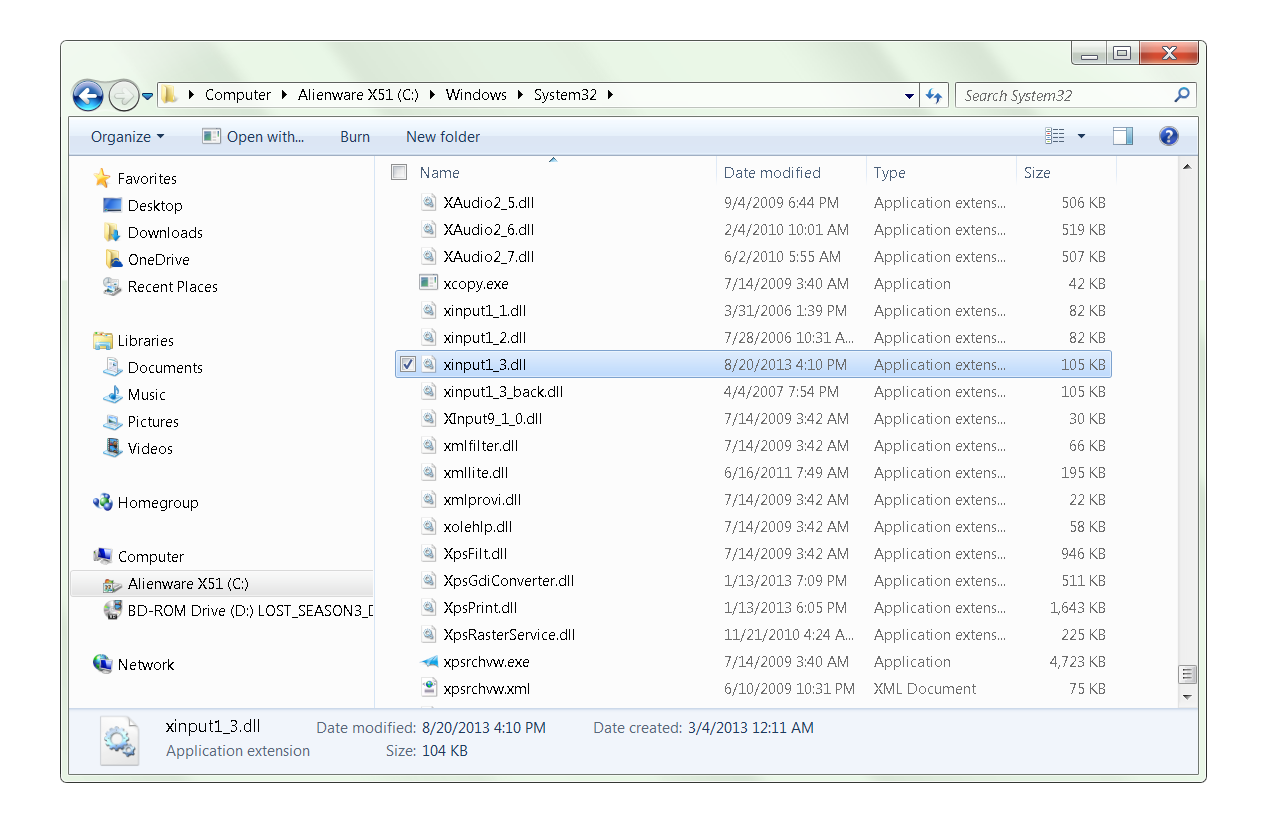
To do that, go to this page and download the file “Xinput1_3.dll” by clicking on “Download ZIP-FILE”. Chose the “18.944.0” file or the “32bit9.18.944.0” (if you have an older 32-bit system). Extract the file. Next, open up the folder C:WindowsSysWow64 and look for a file called “Xinput1_3.dll” and rename it to “Xinput1_3_backup.dll”. Copy the file you just downloaded here.

xinput1_3

Repeat the same step for the “C:WindowsSystem32” folder. Reboot your PC! This has helped a lot of users on the Steam community forums – including me.


Validate the Game Cache:

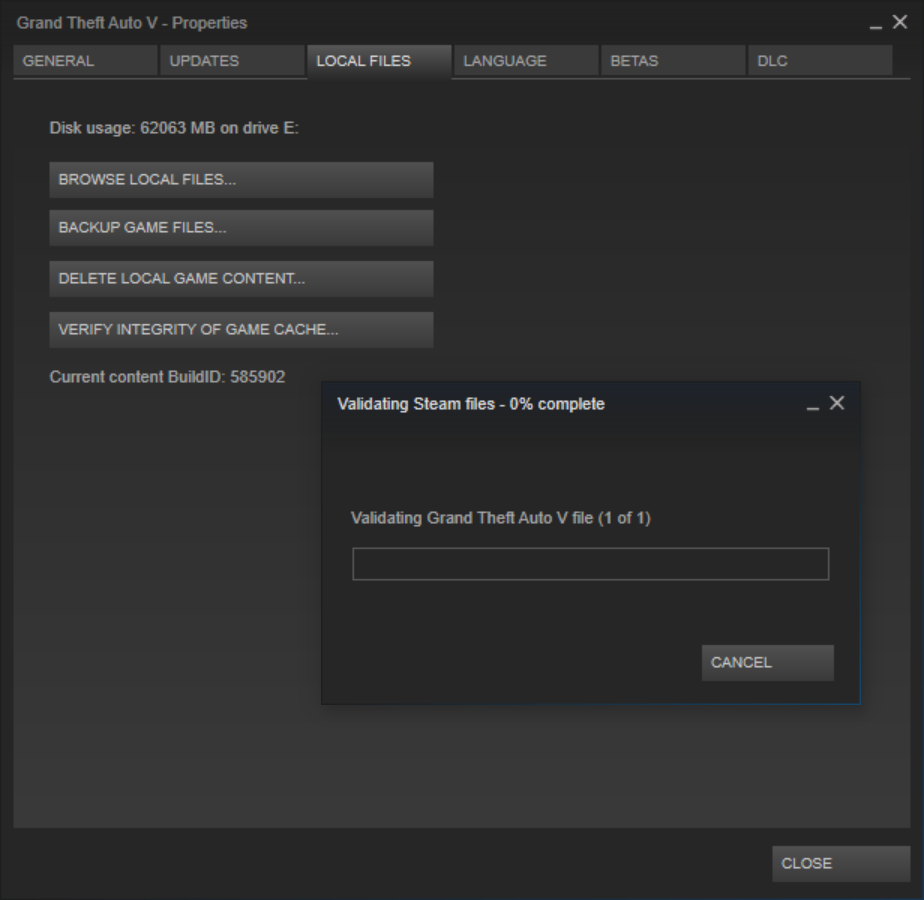
If you’ve preordered GTA V it’s possible that the encryption on launch day didn’t work for you, so it may be best to try to validate all of the 60 GB files in GTA in Steam. To do so, open Steam and right-click on “Grand Theft Auto 5”. Select Properties and go to “Local Files”. From here, click on “Verify Integrity of Game Cache”: 

Validating Game Cache


Delete the GTA V game cache:

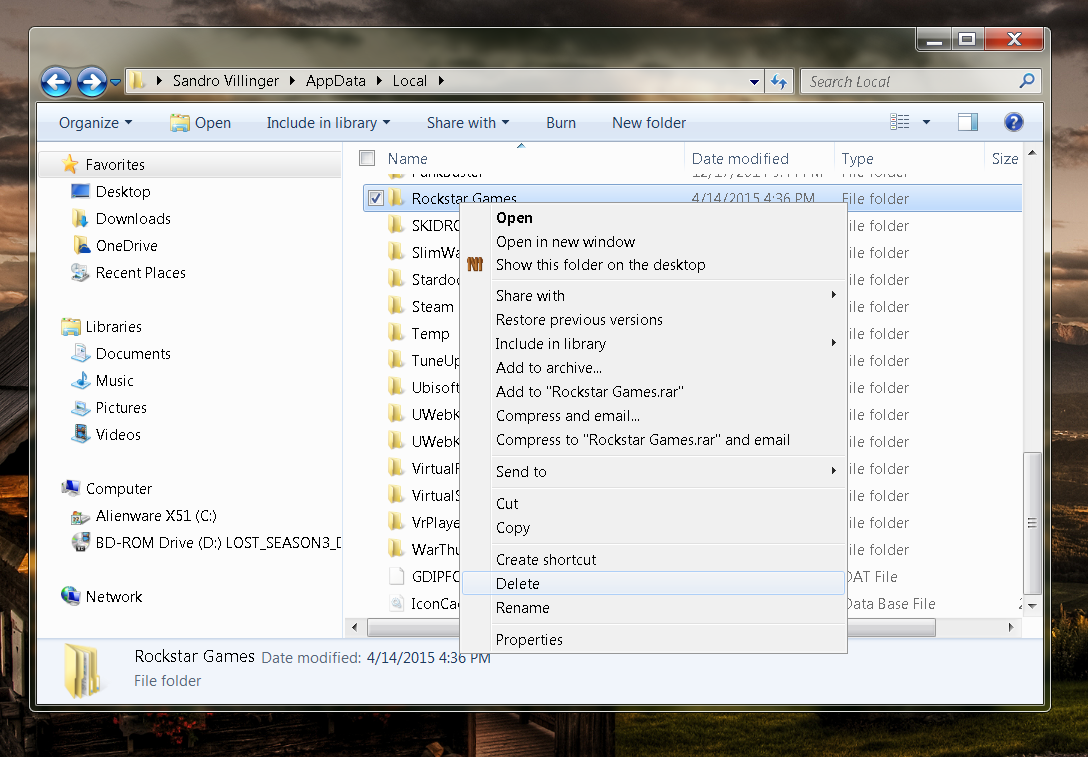
Upon installation, GTA V creates temporary files and settings that you can simply reset which may help you solve some of the launch problems. Simply hit the “WINDOWS” key on your keyboard and “R” at the same time and type in %appdata%. Click on “AppData” in your navigation bar at the top of the Windows Explorer and go to “Local”. Delete the entire “Rockstar Games” folder.

Game Cache


Create a new Administrative user account:

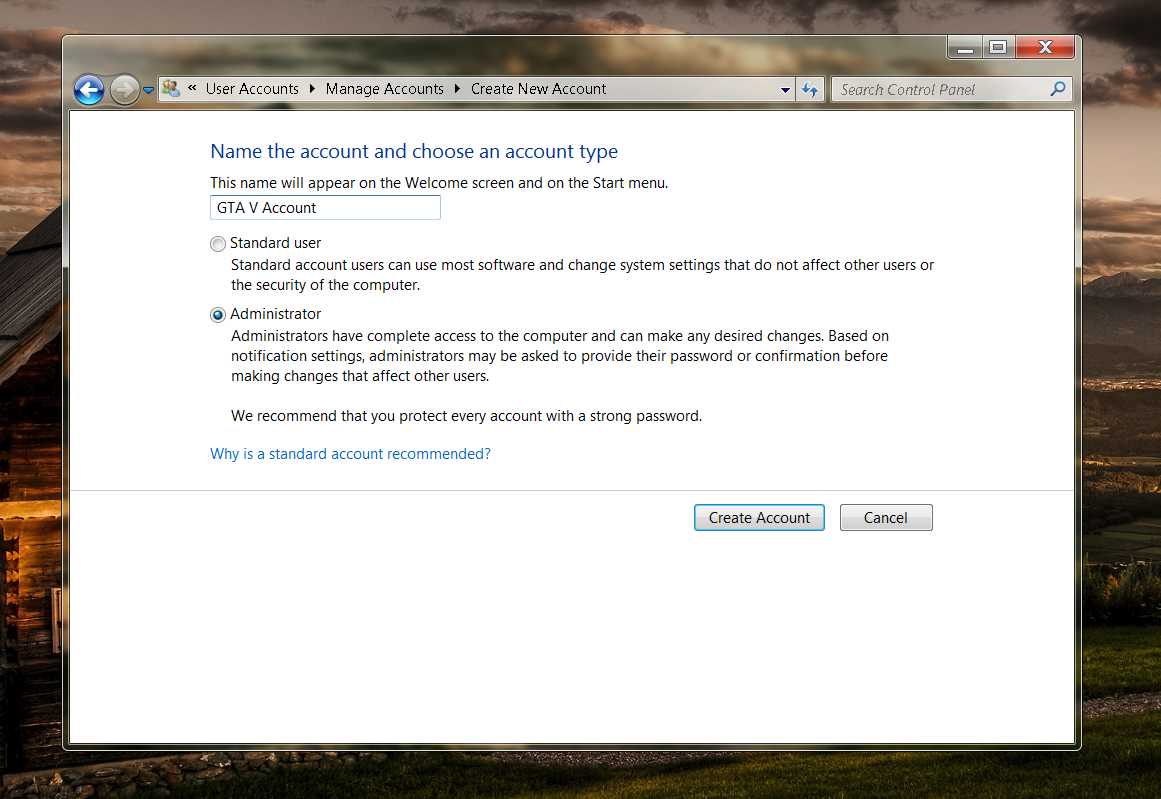
Rockstar admitted that GTA V doesn’t work if your user account name consists of some unusual characters. Basically everything except numbers and regular letters work. Simply renaming your account doesn’t do the trick, so you actually have to create a new administrator account that you need to switch to before starting GTA. Rockstar is working on a fix. You’ll find the appropriate options in your “Control Panel” under “Add of Remove Accounts”.

New admin user


Disable any integrated graphics chip:

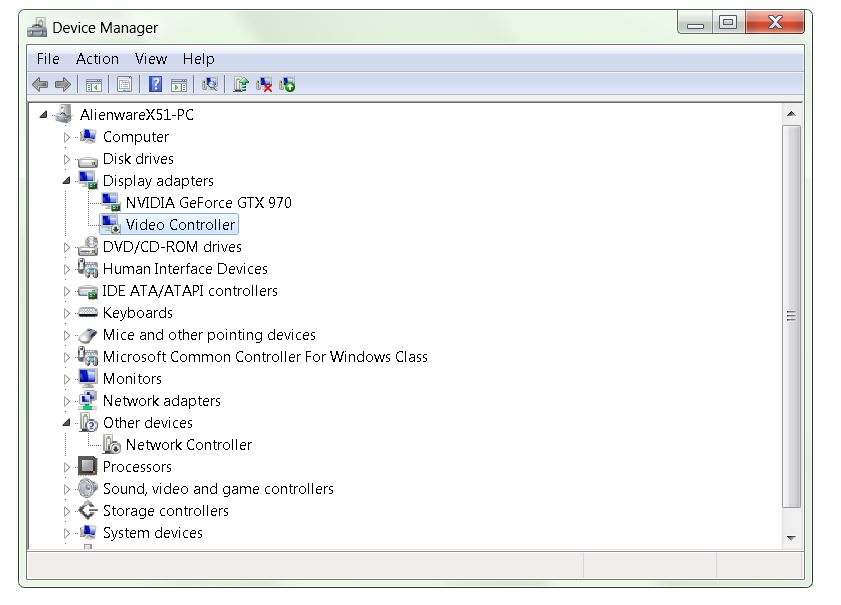
Some laptops and Desktop-PCs have both an integrated (weaker) graphics chip to save power/battery life and a more powerful discrete graphics. In my example, my desktop PCs mainboard has an Intel HD graphics chipset and a dedicated GeForce GTX 970. In such instances, you should go to Device Manager, Display Adapters and right-click on any graphics chip that’s not NVIDIA or AMD. Select Disable: 

Disable graphics chip

In some instances, it helped some users to disable their main graphics chip before launching GTA V and then re-enabling it right at the very moment the game launches.

Here’s a video that shows you at which point you’d need to disable and enable the chip:

Video

Disabling Internal Graphics Chips


Run GTA V as an administrator:

Open up the following folder on Steam “C:Program Files (x86)SteamSteamAppscommonGrand Theft Auto V” or “C:Program Files (x86)Rockstar GamesGrand Theft Auto V”, right click on “PlayGTAV.exe” and select “Run As Administrator”.


Now that you are up and running with GTA V, check out my Ultimate Performance Guide to help you make the most out of the experience!

Three Exciting Things In: Connected Cars

The motor industry is one of the most innovative spaces in business right now. From driverless technology to remote access and electronic cars, there is an abundance of exciting technology that promise to make a real difference to the way to move around our lives.


Augmented Reality Driving Goggles

Covered in this fascinating Wired article, these driving goggles (seen above) are being developed by the automaker Mini and have the potential to change the way we drive for good.

Mini Goggles

Headsup display: Make sure the most important information is available to you wherever you’re looking with speed and directions fed directly into the goggles.

Zero latency: Using special technology to predict how your head will move, the goggles approach to close to “zero latency” meaning that the augmented images displayed in the goggles are happening in real time.

Look through walls: By using cameras and microphones outside of the vehicle, you can look straight through the frame of the car to see potential hazards.


Remote Control Parking:

BMW recently revealed that they have developed remote control parking for the 2016 BMW 7 Series.

Video

2016 BMW 7 Series


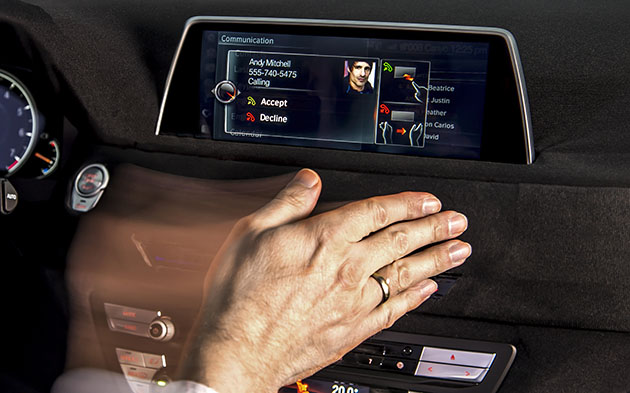
But that’s not all, BMW are looking to change “interaction between the driver and the car” by introducing in-car gesture control to the 7 series and improved voice commands. This means no more fiddling with that radio or satnav.

BMW Gesture Control


Wireless Car Charging

Electronic cars are slowly but surely making their way into the mainstream. One of the largest obstacles to their adoption is the lack of charging stations. A research team at Qualcomm  has developed a wireless form of charging for electronic cars that could potentially make it much easier to charge vehicles.

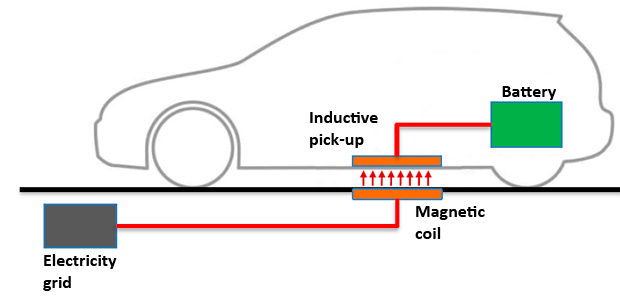
Using inductive charging, the electronic car will charge wirelessly when parked over a magnetic plate.

Inductive charging


Inductive technology has only recently taken off in the consumer space with wireless smartphone charging stations so don’t expect to see these on the road any time soon.


The importance of privacy

As these three exciting technologies demonstrate, the Internet of Things is growing and advancing at an incredible rate. It’s important though to ensure that we are building and developing advanced functionality with privacy and security in mind.

The benefits of smart, connected vehicles are obvious for all to see but as AVG has highlighted several times already, vulnerabilities in system security can pose real risks to human safety and property damage.