Category Archives: AVG

AVG

Almost One in Three Teenagers has Online Regrets by Age 16

AMSTERDAM and SAN FRANCISCO – November 3, 2014 – The latest Digital Diaries research from AVG Technologies N.V. (NYSE: AVG), the online security company™ for 182 million active users, has found that almost a third of teens (28 percent) say they regret posting something online. The research also found 32 percent have had to ask someone to remove content posted online about them, because they didn’t like it (61 percent) or it was too personal (28 percent).

The global research, which questioned almost 4,000 teenagers aged 11-16 years old on the topic of online privacy, painted an overall picture of a struggle for control. Although 70 percent have changed their settings on Facebook to make it more difficult for people to find them and 71 percent say they understand what online privacy means, only 29 percent say they properly ‘know’ all of their Facebook friends.

Speaking in advance of this week’s Child Helpline International Youth Shadow Conference, which focuses on empowering young people through technology, Emily Cherry, Head of Participation at the NSPCC, commented on the results.

“Young people obviously want to get the most out of social media by sharing information. But they should be aware that people are not always who they appear to be online and may pose a threat to them. If we don’t act now and help to guide them, in particular around contact with strangers, we could be facing a privacy time bomb. Online is as important to young people as eating. It is the most important part of their world throughout the day. If we don’t get this right, we will be failing to give them the vital protection they need.”

Even at this age, there are signs that teenagers have differing ideas of how much is too much when it comes to sharing online:

  • One fifth of teenagers would talk to a friend about deeply personal things online.
  • Over one in four (28 percent) have talked to a friend or family member whom they felt shared too much.
  • Of those who asked for online content about them to be removed, 18 percent identified their mom as the posting culprit.
  • Almost one in ten felt they shared too much about themselves online (9 percent).
  • 14 percent have been asked by someone else to remove content they have shared online.
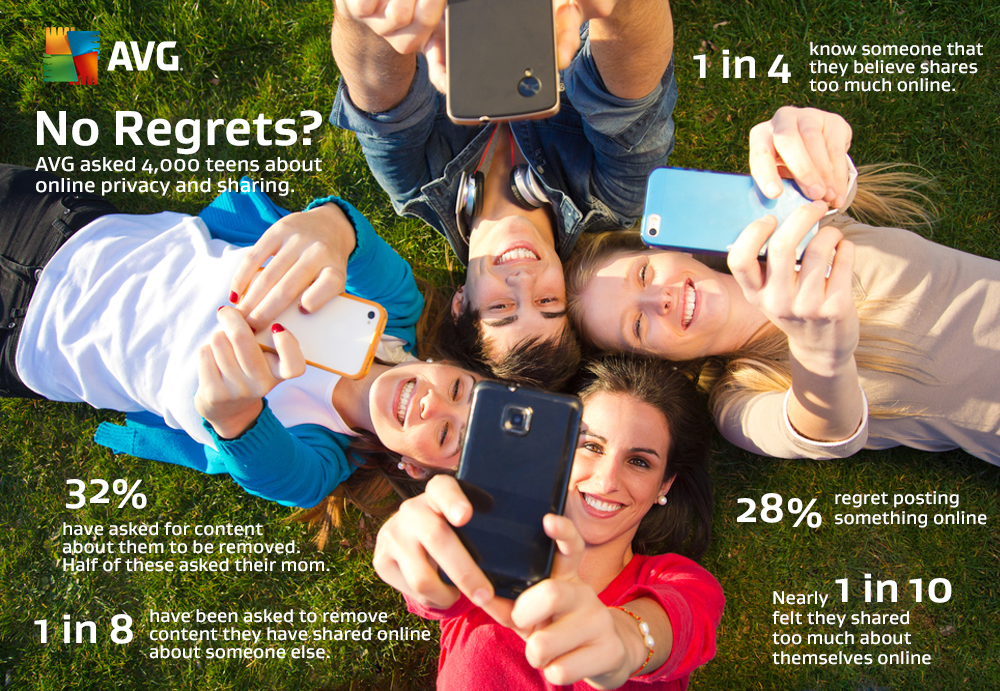
 

Teen online regret

“Everyone assumes that just because today’s teenagers grew up with laptops and smartphones, they somehow have an innate understanding of how to keep themselves safe online and how to behave. The reality is that we have all – teenagers included – embraced technology without much question and the result has been the steady erosion of our online privacy,” said Tony Anscombe, Senior Security Evangelist at AVG Technologies.

“In a way, parents are just as guilty of this as their teens. I’ve talked previously about the concept of ‘sharenting’, where parents share content about their children online, creating a digital footprint for them that they have no control over. As a parent of a teenager myself, I believe we must take some of the responsibility for the social impact of new technologies – both by setting a standard for trust and consideration through our own online behavior, and by guiding theirs.”

Also identified by the research was the struggle teens face retaining control of their online profile:

  • Only 12 percent said they had a lock on their bedroom door. By contrast, the majority (78 percent) had put a password on their device – although 70 percent noted that their parents knew some or all of these passwords.
  • Almost two-fifths (38 percent) were aware of a family member looking at their device without permission. A further 18 percent said that someone in their family had found private information on their device they hadn’t wanted anyone to see.


###


Note to Editors

Methodology:

AVG commissioned an online survey interviewing teenagers between the ages of 11-16 to identify privacy awareness and practices in the following markets; Australia, Brazil, Canada, Czech Republic, France, Germany, New Zealand, the United Kingdom and the United States. A total of 3,999 carried out the survey during September 2014. The market research company Research Now carried out the fieldwork using their proprietary panels.

Further Resources

  • Read AVG’s educational ebook for younger audiences: http://www.avg.com/ebooks/magda-and-mo

More from Tony Anscombe


###

About AVG Technologies (NYSE: AVG)

AVG is the online security company providing leading software and services to secure devices, data and people.  AVG has over 182 million active users, as of June 30, 2014, using AVG’s products and services including Internet security, performance optimization, and personal privacy and identity protection. By choosing AVG’s products, users become part of a trusted global community that engages directly with AVG to provide feedback and offer mutual support to other customers.

All trademarks are the property of their respective owners.

www.avg.com

In Pictures: Child Helpline International, London

Lunch Session in Tower Bridge:

AVG kicked off its session with an informal lunch inside one of London’s most iconic landmarks, Tower Bridge.

Lunch at Tower Bridge


Celebrity Speakers

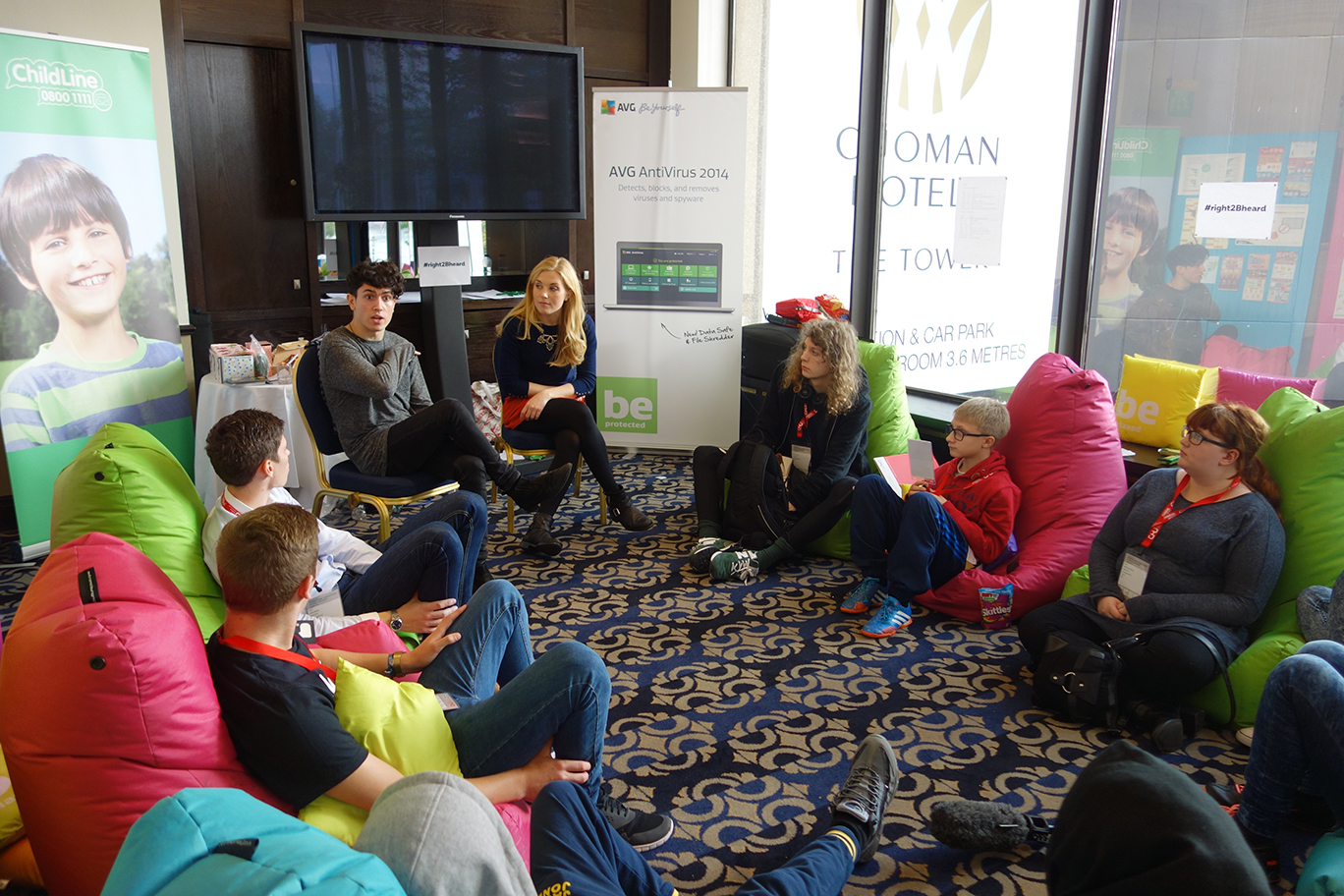
We were very lucky to be joined by Maddie Moate and Luke Franks who have earned thousands of fans on social media. Maddie and Luke gave a talk to the group about how you can stay safe and private while using social media.

Maddie and Luke


Geotagging Workshop

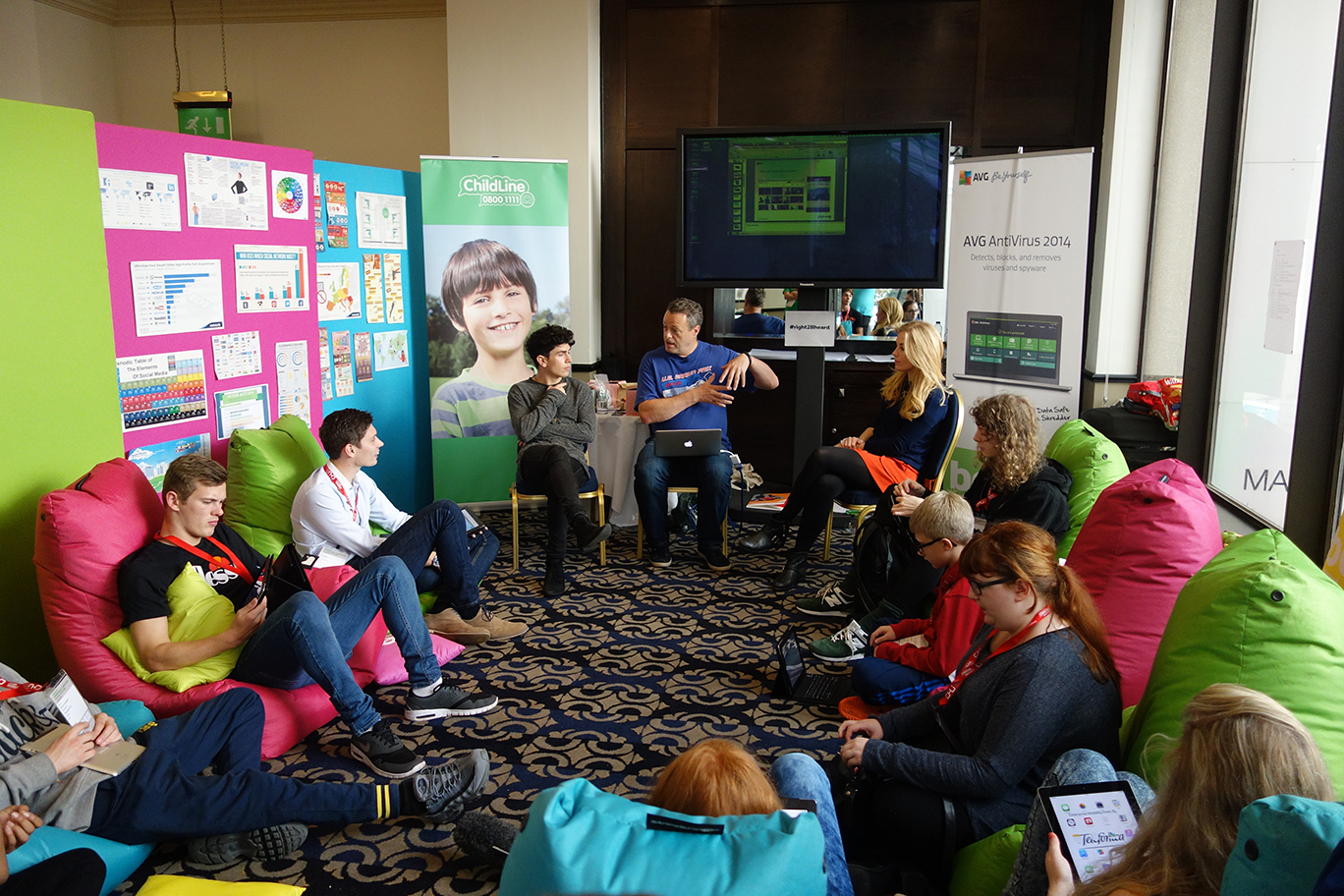
AVG’s own Tony Anscombe then led the group in an interactive sessions to demonstrate just how much they might be sharing online without realizing. In a few simple steps it is possible to find out some very personal information about a complete stranger using nothing but a few public websites.

Tony Session


Social Media Session

In his final session, Tony gave some easy to follow advice on how we can all stay safer while using social media and debunked a myth that messages sent over apps like Snapchat cannot be saved.

Social session


Interview:

Two primary school children, Felix and Tom conducted an interview with our two celebrity guests. They quizzed them on everything from technology addiction to online safety. You can read the full interview here.

Interview


Tips:

After a long day discussing Internet safety, here are some of the best tips raised in our session:

  • Always turn off location tagging when using photo sharing apps like Instagram.
  • When sharing a post on Facebook, always check to see who will be able to see it.
  • Never share any inappropriate images of yourself, even on apps like Snapchat. There are always ways to save the images.
  • Don’t open an email attachment from an unrecognised sender, even if it has your name on it.
  • Using a tool like AVG PrivacyFix can be an easy way to control your settings across several networks.

If you have any tips on how to stay safe on social media, let us know on our Facebook community.


Don’t fall for these scams this Halloween!

Facebook Reset Scam

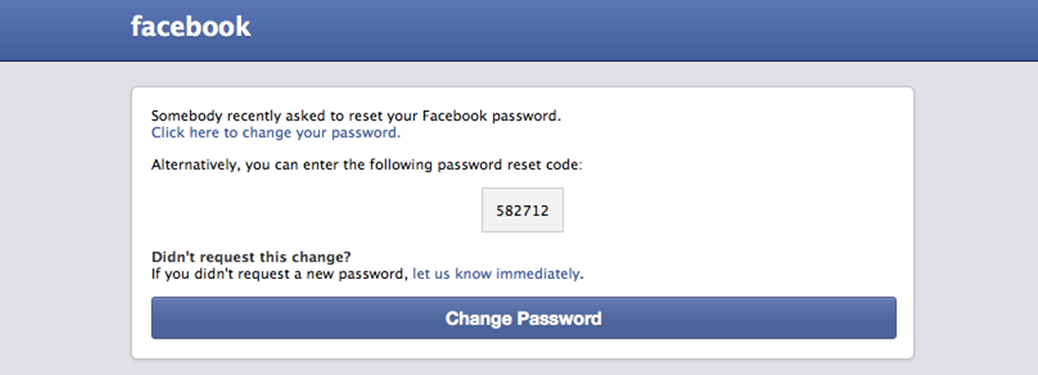
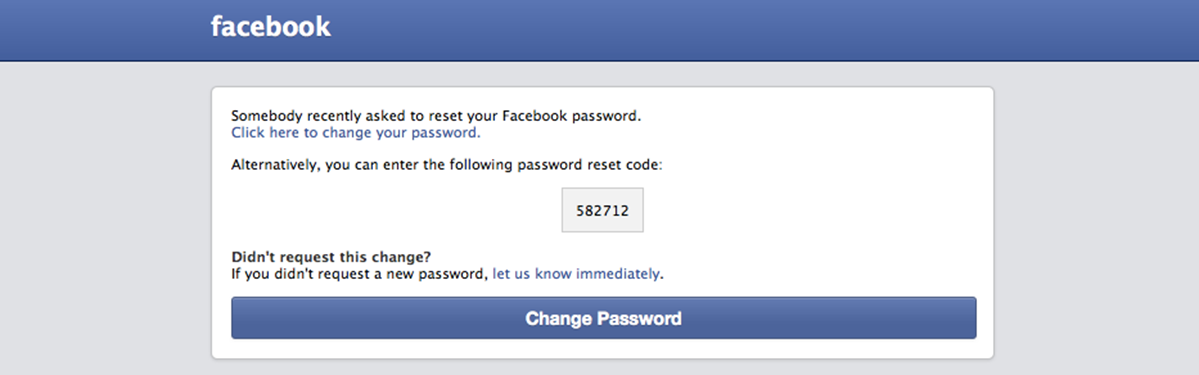
The Facebook reset requests arrived via email and text message: “Somebody asked to reset your Facebook password.” At first it was annoying; then it was worrisome – a possible scam/phishing target.

Facebook says that these alerts are sometimes triggered due to a person mistakenly entering the same name and then, when their password doesn’t work, the customer asks for a reset. That might be possible in certain cases, but just based on the constant messaging, this was clearly beyond a normal user mistake, and an imitator scam.

Facebook Reset Scam

Let’s set aside the fact that although I have unlimited mobile data, many people don’t, and would end up paying for these unwanted texts. What’s more problematic is thinking about the many users who unsuspectingly fall for the request, click away and sign away their passwords.

Facebook says it will never ask you for your password, so if this happens to you, resist the urge to click. Any time you receive an urgent call to action in an email, be wary.  Don’t click on links contained in emails as a general rule. Instead, go to Facebook manually and look at the notifications. Needless to say, keep your anti-virus software up-to-date and use a password manager to keep your passwords safe and secure.


Facebook itself advocates the following steps:

  • Use an up-to-date browser
  • Use unique logins and passwords for each of the websites you use.
  • Check to see that you’re logging in from a legitimate Facebook page with the facebook.com domain.
  • Be cautious of any message, post or link you find on Facebook that looks suspicious or requires an additional login.


IRS and Other Scary Calls

You might imagine getting a voice message from the IRS wouldn’t be good news. And it’s not! This is a current scam making the rounds: Someone claiming to be an officer of the Internal Revenue Office leaves a message for you or your legal representative to call their hotline regarding an extremely time sensitive issue – before they take legal action. I was immediately suspicious: Would the IRS really leave me a phone message if there were an issue? The answer is “No.”

What’s really scary is that the IRS reported in August 2014 it had received 90,000 complaints and identified approximately 1,100 people who have fallen victim, given up credit card numbers, etc. and lost an estimated $5 million from these scams.  You can learn more about the same on IRS. gov.

Fast forward to another cell scam: persistent calls received from an unknown number in the local area code. No voicemails were left. But after the calling persisted several times a day for a few days, you become curious as to who was calling. When I rang the number I got a “This number has been disconnected” message…

Lots of research later and it’s unclear as to whether this is just some weird harassment or part of the “One-ring” cell phone scam that the FTC has issued warnings about. In the latter scenario, scammers are using auto-dialers to call cell phone numbers across the country. They let the phone ring once and hang up — hoping you’ll call back, either because you believe a legitimate call was cut off, or you will be curious about who called. If you do, chances are you’ll hear something like, “Hello. You’ve reached the operator, please hold.” While waiting, you rack up some hefty charges — a per-minute charge on top of an international rate. The FTC notes: There’s no danger in getting the call: the danger is in calling back and racking up a whopping bill. If you’re tempted to call back, try checking the number first through online. Go here to learn more.

As for persistent calls, you can block them. You can block calls on both Android and iOS phones. On an iPhone look on your list of recent calls, just click the “i” in the circle to the right of the number. It will open an info tab, just scroll to the bottom and click block number. You should also report the number to your service provide (AT&T, Verizon, etc.) to get them blocked there.Halloween comes and goes, but scary scams will continue, and it requires a higher level of awareness from all of us! Check out AVG’s Facebook page for ongoing alerts and simple tips to help your friends be more safe online!

What kids want to know about Internet Safety

Who are you and why are you here?

Maddie: My name is Maddie Moate and I am a YouTube Presenter, I make lots of videos mostly about science and technology. I know quite a lot about social media, and how to stay safe using technology. That’s why I’ve been invited here today.

Luke: I’m Luke Franks and I’m a presenter, I present shows on live kids TV but also do the online X-Factor. I spend a lot of time online, on social media in particular so I’ve come along today to talk to people about how they can do that in a safe way.


Have you ever been cyberbullied? Do you think there are ways to stop cyberbullying?

L: I don’t think I’ve ever been cyberbullied, but I’ve had people send me some nasty messages. They don’t make you feel good when you read them. I think the best thing you can do is talk to an adult, either your parents or someone at school who you trust. It’s not okay and it shouldn’t happen!

M: Totally. Just because it is happening online doesn’t mean that it’s okay. It’s just as bad as bullying in real life. I’ve had a couple of instances where people say not very nice things to me on YouTube. It can be very difficult but it’s important to remember that you don’t have to handle it by yourself. Look for some support.

The Interview

What are the pros and cons of social media?

L: Good question. One of the best things about social media is that it’s a very easy way to share things with your friends and build a place online where you can all hang out.

M: Yeah, it’s a great way of sharing photos and memories with friends and family who might live far away. But these days it’s very common to be part of bigger communities that share wider interests or passions for activities, brands or music.

L: Exactly. One of the great things about YouTube is that it can also be a great learning tool. Let’s say you wanted to learn the guitar. You can go onto YouTube and find hundreds of free lessons that will teach you exactly what you want to learn.

And the cons?

L: There are definitely some cons. You don’t always necessarily know who is online or who you are talking to. So you have to be aware and be careful about what you are putting online.

M: There are also lots of people who see what you do online but aren’t speaking up. It’s easy to think that you are just talking to certain people but actually your messages can be seen by many more than you think.


How do you keep safe on the Internet?

M: Check your privacy settings. You want to make sure that what you are posting can only be seen by the people you want to read it. Remember that anything you put online can be discovered, so try and make sure that you are showing a good representation of yourself.

L:  Yeah, settings can be quite complicated sometimes but it’s worth checking them from time to time to make sure you’re not sharing with too many people.


Can someone be addicted to technology?

M: Yes! Definitely.

L: I think you can. I spend so much time on my phone and I love tweeting and finding out about stuff online. But there’s a real world too and it’s important to learn skills for the real world and not just online. You can’t stay on your phone forever!

M: It can be very easy for people to get addicted to creating an online personality or life that doesn’t actually exist. It can seem more exciting online where you might be more cool or popular but actually the most important thing is to look after the real you in the real world.

Internet of Things and Managed Workplace v9

Press Releases

IoT Video

Video


IoT Survey Results

Managed Workplace 9 Screenshots


Digital Dating @ 50+

I noticed that this past weekend marked a lesser holiday known as ‘Sweetest Day’ (also known as a Hallmark holiday), which is celebrated in some parts of the U.S. – largely in the Midwest and Northeast.  Very similar to Valentine’s Day, it offers an opportunity to bestow candy and cards to those you are “sweet on.”

Sweetest Day

It’s a holiday my generation grew up with, though I’m not sure how the holiday is faring in terms of current popularity. But it brought to mind the latest stats on Internet dating: more than a whopping 41,000,000 Americans have gone online to find a match or a date.

Increasingly, it’s the most popular way for people over 50 to meet and marry. Research suggests that Boomers who date online is now growing two times as fast as the number of younger users. According to recent research by eHarmony, the biggest growth segment in online dating for the next decade is going to be the 55-64 age group.

Match.com, one of the largest online dating sites, claims that 25 percent of its membership is between the ages of 50 and 65 and Boomer members have grown 90 percent in the last 5 years. With at 21 million plus members, that’s approximately 5 million Boomers on Match.com alone!   (You can find all sorts of online dating stats, if you are interested, on Statisticbrain.)

There also has been a notable rise in dating sites specifically catering to Boomers and Seniors, such as Ourtime.com, SilverSingles.com and SeniorPassions.com.

Why this growth? A study conducted for OurTime.com reveals unmarried people over 50 consider companionship more important now than they did during their 20s. There also are numerous studies that support a correlation between one’s interpersonal relationships and their health and longevity. Plus, let’s face it, dating can fun!

But for many people (Boomers and not), especially those who are newly single because of divorce or death, the thought of dating and finding a partner also can be daunting and scary. And though society’s comfort level has grown with the emergence of respected online dating communities over the last decade, a healthy amount of cautiousness persists – and rightly so.

So, where to start?

If you’re trying online dating for the first time, or even if you’ve tried it before and it didn’t work out, and you may want to try it again, you should look at one of our own resources, the AVG Guide to Dating Safely Online (free download here).

In the meantime, here are a few tips:

  • Figure out what you want. You may want to date only people your age and in your local geography. Or you may have certain religious affiliations, or hobbies, or interests that you are looking for in a potential partner. With literally thousands of dating sites out there, you have options to tailor your search to your desire.
  • Once you’ve narrowed down the sites and apps you would consider signing up to, look for any articles, blog posts or social commentary that illustrate other users’ experiences. Are there any problems, such as privacy concerns, associated with the site?
  • Use technology that you are comfortable with. There are of course many dating sites that are pretty much like digital classifieds. But increasingly there are other options, such as mobile apps that let you find singles in the area.  (More than half of eHarmony users now use mobile devices to interact with the dating service.)
  •  Don’t provide intimate details about yourself until you feel comfortable with the person you are dealing with. By the same token, realize that any content you share – from your interests to your photos – becomes the property of that site, and you lose the rights to control how it’s used. That means your picture could pop up as a “Date Of The Week” promotion – or your dating profiles can turn up on Internet searches. So look in the privacy settings to make sure yours is only available to other users logged into the site.

Readers of my column know that I’m a big fan of second acts (and third acts, and beyond!). And that doesn’t only apply to careers – but to relationships as well. J So whether you decide to try online dating – or to go the old fashioned route – I say do some homework and then just go for it!


On a separate note, but on the topic of choices: I’m delighted to report that I have just learned that I have been selected to speak at SXSW 2015 Interactive on “Boardroom or Baby? The Choices Women Have in Tech.” A big thank you to everyone who supported me and voted for my submission. I hope to see many of you in Austin next March 13-17!

MEF Appoints Judith Bitterli to Global Board

Established in 2000, MEF is the global trade association for companies wishing to monetize their products & services via mobile. It is a global presence offering impartial and powerful voice for pioneering companies from across the mobile content and commerce value chain.

AVG has been a member of MEF for two years, and has already participated in the AppPrivacy working group to develop a quick and easy privacy policy generator for app developers. AVG also sponsored the MEF Global Consumer Trust Report which examines trends in mobile business and examines barriers to growth for the mobile economy.

The MEF Board

In her new role, Judith will be providing insight and expertise to the MEF as the world becomes more focused on the Internet of Things.

Judith won’t have long to wait to get involved in MEF activities as she will be participating in a panel on trust, privacy and consumer engagement in mobile at the MEF Global Forum in San Francisco in November.

Images courtesy of MEF

Fever Pitch: Live Final is inspiration to us all

By the time I arrived for The Pitch Live Final on 23rd October, 1,000 of the original competition entrants had been whittled down to just 30 of Britain’s brightest new entrepreneurial talents.  The event was held in Bristol, a city well-known for its strong start-up culture, its growing reputation as a technology hub and enlightened University initiatives. I took my place alongside my three fellow panellists: Karen Darby of CrowdMission; Lara Morgan of Company Shortcuts and Charles Carter of ICAEW.  Ours was the unenviable task of deciding which one of these great new business ideas should be the overall competition winner.  Judgement day was upon us.

The Contestants

We heard inspirational stories from guest speaker entrepreneurs who had successfully completed their journey interspersed with pitches from the finalists all of whom demonstrated no shortage of creative flare, energy and passion of their own.  Listening to them some common themes began to emerge including:

Judith and the winner of The Pitch

Certainly the business pitches made to the judges were of a very high calibre. I personally found it found it all very inspiring and a little bit of Christmas for the brain.  Deciding on a top five and eventual winner was no easy task.  Finally, after much deliberation, propertECO , the company that tests buildings for cancer-causing radon, was chosen as the competition winner.

It was particularly thrilling to see Rebecca Coates, co-founder of propertCEO, crowned the champion, as she became the first female winner of The Pitch since the competition’s inception in 2008!  In fact, women entrepreneurs were well represented in this year’s competition, earning 10 out of the 30 finalists.

Congratulations to Rebecca and all the finalists!  In fact everyone taking part deserved to be considered winners for creating a display of ingenuity and inventiveness that may one day benefit all our lives.  Photographs capturing the atmosphere of the event have been uploaded to the AVG Flickr account and may be viewed here.

I’ll close by saying; AVG’s active participation in the year-long competition was an extremely positive experience. Perhaps most important of all, it has provided AVG with an invaluable platform to engage directly with the small business community. And, hopefully we have started to make a lasting impression on their consciousness.

To sum up, the real winner is……all of us!


AVG Technologies Announces New Managed Workplace® Enhancements to Partners at Cloud Summit

AVG’s RMM platform continues to evolve to give partners even tighter applications’ integration experience, reducing cost and complexity

AMSTERDAM and SAN FRANCISCO – October 23, 2014 – AVG Technologies N.V. (NYSE: AVG), the online security companyâ„¢ for 182 million active users, today gave partners attending its Cloud Summit in Arizona a first-look preview of key new features in AVG Managed Workplace®9.0, its open eco-system Remote Management & Monitoring (RMM) tool for IT resellers and managed services providers (MSPs).

Following continued close consultation with its partner-base, AVG is unveiling a number of significant technical refinements to its RMM platform that will enable MSPs to deliver an even more tightly integrated range of streamlined services through the same integrated management console.

Key advances among the new integration features and benefits for MSPs of the enhanced AVG Managed Workplace RMM platform are:

  • Increased automation – extends automation best practices in a scalable, repeatable manner to transform an MSP’s service delivery, thereby reducing the cost of creating and maintaining secure compliant devices
  • Enhanced reporting and alerting – refinements in automated, real-time alerting increase quality and breadth of data available to enable a fast, focused response to help remediate issues before they have a chance to escalate, helping to save time and money.
  • Boosted patch management – increases in efficiency of patch scheduling ability help proactively close the gap between patch availability and patch application, reducing vulnerabilities on individual devices and avoiding costs.

“Recent industry events like Shellshock and Gameover Zeus have shown businesses that it is still best to leave your IT in the hands of experts,” said Mike Foreman, General Manager, SMB, AVG Technologies. “Incorporating the constructive feedback from our partners, combined with a set of technical enhancements to our RMM platform provides our partners with enhanced levels of protection and control that will let their customers sleep at night.”

AVG’s business security portfolio is supported by a worldwide network of more than 10,000 partners.  Its pedigree in this area makes it ideally positioned to help smaller IT companies and MSPs harness low cost, cloud-based tools so they can transition into fully-fledged managed services businesses.

In October 2012 AVG introduced AVG CloudCare™, a cloud-based administration platform offering resellers a new way to implement and manage services such as antivirus, content filtering, online backup and email security services for their business customers. In June 2013 it added AVG Managed Workplace, an open eco-system Remote Management & Monitoring (RMM) tool. AVG‘s vision is to make the lives of MSPs and their business customers as easy as possible, regardless of whether staff are in the office, at home, or on the road.

AVG Managed Workplace 9.0 is scheduled for general availability from November 2014.

About AVG Technologies (NYSE: AVG)

AVG is the online security company providing leading software and services to secure devices, data and people.  AVG has over 182 million active users, as of June 30, 2014, using AVG’s products and services including Internet security, performance optimization, and personal privacy and identity protection. By choosing AVG’s products, users become part of a trusted global community that engages directly with AVG to provide feedback and offer mutual support to other customers.

Good News from the Government

With all the data breaches making headline news, and more importantly, affecting millions of Americans, the Obama administration announced a strong government plan to add security for debit cards that are used for federal benefits such as Social Security.

Specifically, in an executive order signed at the Consumer Financial Protection Bureau, President Obama ordered that government agencies that process payments employ enhanced security features.

Those measures include launching a chip and PIN initiative that the government has named “BuySecure” initiative. Chip and PIN means that secure information is embedded in a chip in a credit card and users must enter a PIN number in order to use the card, much like they currently do with a debit card. The President moved without Congress on this one, which if anything highlights the importance and the need for haste in this matter.

Chip and PIN reduces the chance of fraud, as I pointed out in an earlier post (see here).

The point is that smart cards are revamped credit cards with microchips that store your data on the card. Chips are better than magnetic strips because the strips use the same technology as a cassette tape (remember those?) and thus are easy to copy. But chips generate a unique code each time they are used. So, while criminals can still steal your card and still commit fraud and sell data, they can’t copy your card and create more fraudulent ones under your name. It’s a big step in the secure data direction.

The major catch with the chip cards, until now, is that most retailers don’t have the technology for them just yet. The main companies that have had breaches have announced plans to install the new technology (this includes Home Depot, Target, etc., and it is also interesting to note that Walmart was ahead of the curve on this one).

But no doubt with the government behind this movement, it’s going to push this technology and added security into the mainstream, essentially making it the new way of doing business via credit.

Thus far there has been some foot-dragging on chips, not just because retailers will have to upscale to the new technology, but also as banks and retailers have argued over who is in fact responsible for security. This should definitely speed up, and resolve, the process.

“There is a need to act and [to] move our economy toward stronger, more secure technologies that better secure transactions and safeguard sensitive data,” the White House said in a statement.

President Obama, speaking about the motivation behind the order, said, “Identity theft is now America’s fastest growing crime. These crimes don’t just cost companies and consumers billions of dollars every year; they also threaten the economic security of middle-class Americans who worked really hard for a lifetime to build some sort of security.”

AVG is glad that the government recognizes identity theft, cyber security, and data breaches as increasingly crucial problems. These are definitely issues that is not only a drag on the economy and businesses, but also affect peoples’ lives, and livelihood. I applaud the President’s bold move on chip and PIN.