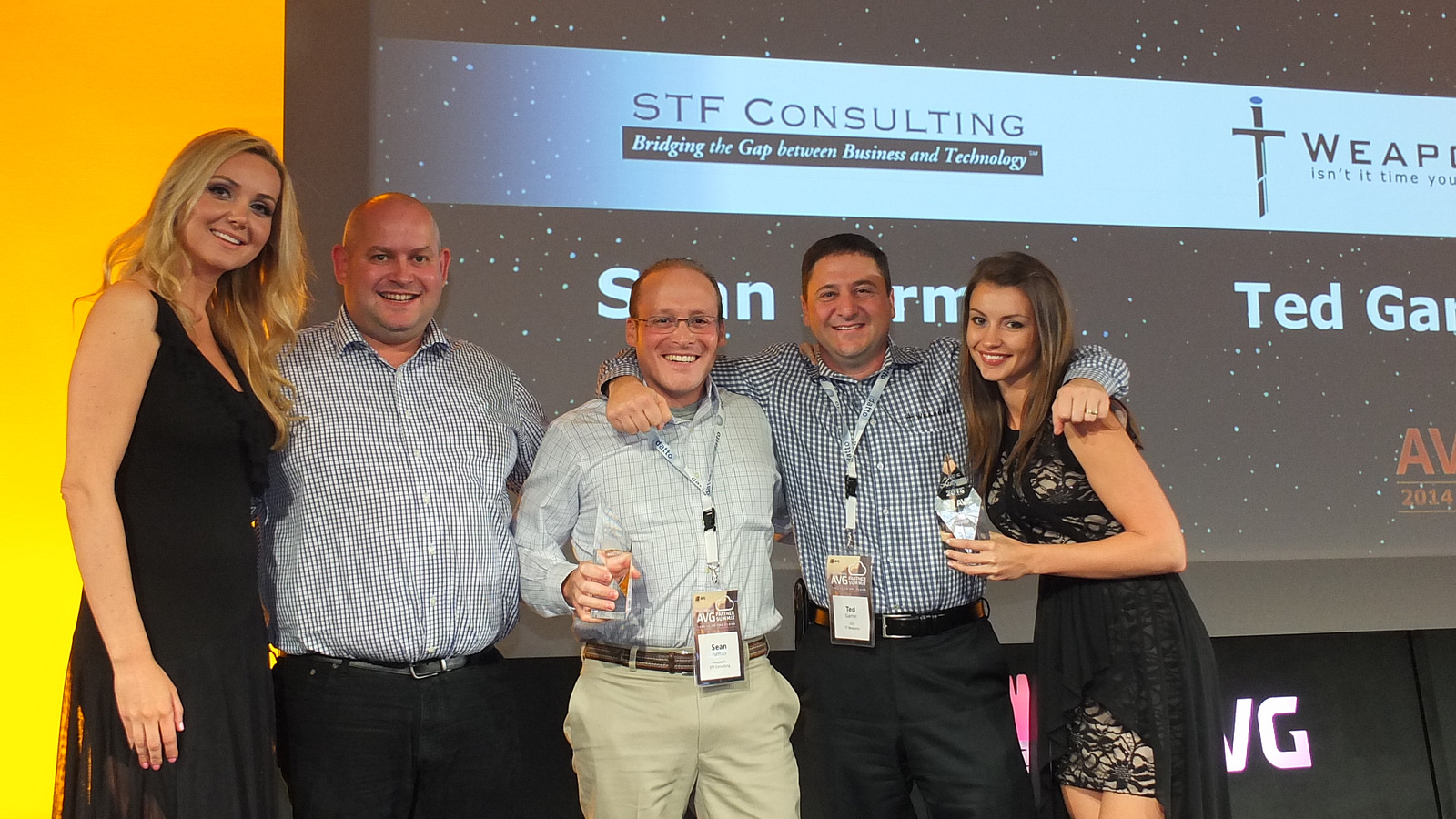
AVG Awards Gala celebrates exceptional partners of 2014

Our hugely successful Cloud Summit in Phoenix for partners and managed services providers (MSPs) came to a fitting conclusion with a dinner to celebrate the winners of the AVG 2014 Awards Gala.  AVG’s first ever event of this kind celebrated top performing partners from all over the world that were judged to have shown outstanding commitment, entrepreneurship and technical proficiency in protecting and managing their customers’ critical business systems during 2014.  It was a great thrill to be able to honor so many partners for their exceptional contribution to our success this year and I am proud to hold up their accomplishments as standards of excellence for every partner to follow.

We had over 150 nominations from around the world contesting awards in eight categories. Each nomination was judged by our panel of AVG CloudCare™ and Managed Workplace® experts.  I saw dozens of examples of the highest caliber from familiar, long-standing names to new cloud-oriented start-ups working on some highly innovative and exciting projects across the globe.

Winners were selected on the basis of such criteria as their outstanding levels of professionalism to customers, their market influence and their exemplary use of the AVG cloud-based security and remote monitoring & management (RMM) business solutions portfolio.

The complete list of categories and winners is as follows:


Largest Deployment of Managed Workplace

Awarded to the partner with the largest deployment of our managed workplace solution

Winner: Corporate Technologies

Recipient: David Pekarna: Senior Networking Engineer


Largest Growth with Managed Workplace, NOC & HD

Awarded to the partner who has had the largest growth with our managed workplace solution, NOC & HD offerings

Winner: Net@work

Recipient: Mohit Govani: IT Director


Most Complete MSP offerings

Awarded jointly to two companies adjudged to have leveraged all the tool sets within AVG’s product offerings

Joint Winner: Tekmate

Recipient: Jason Reopelle


Joint Winner: Alura Business Solutions

Recipient: Jason Derstine, President & CEO


Most Innovative Partner

Awarded to the partner that has shown the most growth and advancement through innovative business strategies

Winner: Advanced Technology Solutions

Recipient: Bob Ascherl, Product Development Manager


Community Partner of the Year

Awarded to individual MSP partners who have engaged, enriched, and helped to grow the AVG MW community

Winner: STF Consulting

Recipient: Sean Furman, President & CEO

Rookie of the Year

Awarded to a partner in their first year with AVG Managed Workplace who has shown the highest growth by aggressively deploying the solution and successfully launching their Managed Services offerings

Winner: 365 Managed IT

Recipient: Ken Stewart, Founding Partner


MSP of the Year

Awarded to the partner who has demonstrated outstanding growth, industry leadership, and customer service excellence with their Managed Services practice

Winner: TDARX

Recipient: Mike Shuping, President


To conclude, I should like to personally thank everyone that participated in our inaugural Partner of the Year Awards and many congratulations to the winners.

Already the bar has been set very high and I’m truly excited at what we can achieve together for our customers in the year ahead.

TA14-310A: Microsoft Ending Support for Windows Server 2003 Operating System

Original release date: November 10, 2014

Systems Affected

Microsoft Windows Server 2003 operating system

Overview

Microsoft is ending support for the Windows Server 2003 operating system on July 14, 2015.[1] After this date, this product will no longer receive:

  • Security patches that help protect PCs from harmful viruses, spyware, and other malicious software
  • Assisted technical support from Microsoft
  • Software and content updates

Description

All software products have a lifecycle. End of support refers to the date when Microsoft will no longer provide automatic fixes, updates, or online technical assistance.[2] As of July 2014, there were 12 million physical servers worldwide still running Windows Server 2003.[3]

Impact

Computer systems running unsupported software are exposed to an elevated risk to cybersecurity dangers, such as malicious attacks or electronic data loss.

Users may also encounter problems with software and hardware compatibility since new software applications and hardware devices may not be built for Windows Server 2003.

Organizations that are governed by regulatory obligations may find they are no longer able to satisfy compliance requirements while running Windows Server 2003.

Solution

Computers running the Windows Server 2003 operating system will continue to work after support ends. However, using unsupported software may increase the risks of viruses and other security threats. Negative consequences could include loss of confidentiality, integrity, and or availability of data, system resources and business assets.

The Microsoft “Microsoft Support Lifecycle Policy FAQ” page offers additional details.[2]

Users have the option to upgrade to a currently supported operating system or other cloud-based services. There are software vendors and service providers in the marketplace who offer assistance in migrating from Windows Server 2003 to a currently supported operating system or SaaS (software as a service) / IaaS (infrastructure as a service) products and services.[4,5] US-CERT does not endorse or support any particular product or vendor.

References

Revision History

  • November 10, 2014: Initial Release

This product is provided subject to this Notification and this Privacy & Use policy.

CVE-2014-3610 (linux_kernel)

The WRMSR processing functionality in the KVM subsystem in the Linux kernel through 3.17.2 does not properly handle the writing of a non-canonical address to a model-specific register, which allows guest OS users to cause a denial of service (host OS crash) by leveraging guest OS privileges, related to the wrmsr_interception function in arch/x86/kvm/svm.c and the handle_wrmsr function in arch/x86/kvm/vmx.c.

CVE-2014-3687 (linux_kernel)

The sctp_assoc_lookup_asconf_ack function in net/sctp/associola.c in the SCTP implementation in the Linux kernel through 3.17.2 allows remote attackers to cause a denial of service (panic) via duplicate ASCONF chunks that trigger an incorrect uncork within the side-effect interpreter.

CVE-2014-3645 (linux_kernel)

arch/x86/kvm/vmx.c in the KVM subsystem in the Linux kernel before 3.12 does not have an exit handler for the INVEPT instruction, which allows guest OS users to cause a denial of service (guest OS crash) via a crafted application.

CVE-2014-3673 (linux_kernel)

The SCTP implementation in the Linux kernel through 3.17.2 allows remote attackers to cause a denial of service (system crash) via a malformed ASCONF chunk, related to net/sctp/sm_make_chunk.c and net/sctp/sm_statefuns.c.

CVE-2014-3646 (linux_kernel)

arch/x86/kvm/vmx.c in the KVM subsystem in the Linux kernel through 3.17.2 does not have an exit handler for the INVVPID instruction, which allows guest OS users to cause a denial of service (guest OS crash) via a crafted application.