Two Cisco Products Vulnerable to POODLE Attack on TLS

Two of Cisco’s products are vulnerable to the POODLE attack via the TLS implementation in those products. The vulnerability affects Cisco’s Adaptive Security Appliance software and its Application Control Engine module. The POODLE attack was disclosed in October by researchers from Google, who discovered that if an attacker can force a vulnerable Web server to fall back from […]

Is lack of trust limiting the potential for new online services?

If you do any or all of these, do you ever stop to think about whether you can trust these online services with your private data like bank details, personal health information, on top of the usual address and date of birth?

With the rapid development and uptake of the Internet of Things, 2015 is set to be the year where the choice of connected devices and services will really take off. With an estimated two billion new people coming online in the next four years across the world, the consideration of who they can trust with their data online has never been more relevant.

Building trust online isn’t as easy as it sounds. It involves every one of us, as individual web users, businesses leaders, policy makers and governments. It’s an agreement of rights and responsibilities on both end-user and provider sides of connected services.

With mobile being the most accessible and affordable means to connect to the Internet for billions of people in developing economies, the telecoms industry at large is going to have a very large role to play in building trust. This means anyone who is providing a mobile service or product needs to be part of this debate.

AVG’s CEO Gary Kovacs recently took part in a debate at GSMA’s Mobile 360 event on the steps needed to build a digital future for Europe. He outlined three principles that the industry must consider in this area.

First, we can’t expect users to simply understand the implications of going online for public services. The industry has a responsibility to help educate the web’s newest arrivals to understand the implications what they do online. Personal data is traded and marketed, and individual privacy can be eroded both with express user knowledge and without.

AVG recently attended the Clinton Global Initiative and announced its Smart User Mission which aims to help first time smartphone users better understand how their data and privacy is affected by the apps and services that they use. The main aim is to help consumers understand that sharing data is not bad; it simply needs to be consensual.

Smart User Iniative

Second, understanding and consenting to personal data exchange bring us to another issue; transparency. At some stage, we’ve all blindly accepted privacy and usage policies for apps and services. Businesses must take steps to become more transparent about their data policies and give users a clear explanation of how their data will be used. AVG has already done this with its Short Data Privacy Notice for its mobile apps but we recognize there is always more that can be done.

Finally, whatever actions the industry takes, we have to enforce it; it has to have teeth and it has to matter if it is to be meaningful. The need to grow consumer trust with the next generation of online services represents the next obstacle in our connected journey and the framework we work to put in place today will set the tone for users’ experiences online in the future.

Image courtesy of GSMA

Leave the tracking to the post office – not online advertising!

The holidays are here and many are opting to shop online for their holiday gifts, whether it’s to avoid the crowds or because time is running out. Online shopping is a convenient option, everything is almost guaranteed to be in stock, there are no lines and your purchase gets delivered to your doorstep. But, can this season’s holiday shopping come back to haunt you online? 

Ad networks, whether via browser extensions or cookies, track your online browsing activities to target ads tailored to your interests. Some see this is as a good thing as you are only shown ads for products or services that would be useful for you, while others may think it’s creepy that the Internet knows about your guilty pleasures. The holidays are about giving and generosity, so your online browsing activities may differ from what they are the other eleven months of the year. You may be researching whether you should purchase a round or square shovel for Uncle Jack, who put gardening tools on his holiday wish list, or which game you should order for your daughter. Now, do you really want to have ads for gardening tools and games for kids following you around the Internet?

How to shop undercover

Whether you want to protect your privacy or simply want to avoid targeted ads that may result from holiday shopping for family and friends, Avast is here to help!

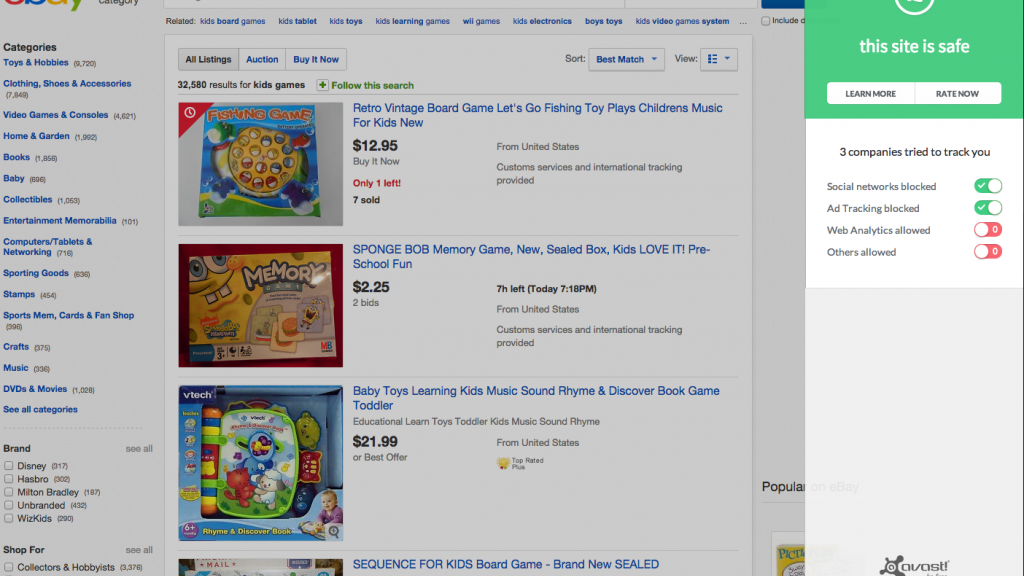
Avast Online Security comes with a Do Not Track feature. Do Not Track identifies tracking software and shows you a list of all tracking and analytics programs that are trying to track your online behavior. You then have the option to choose which tracking software you want to deny or allow to track your online behavior.
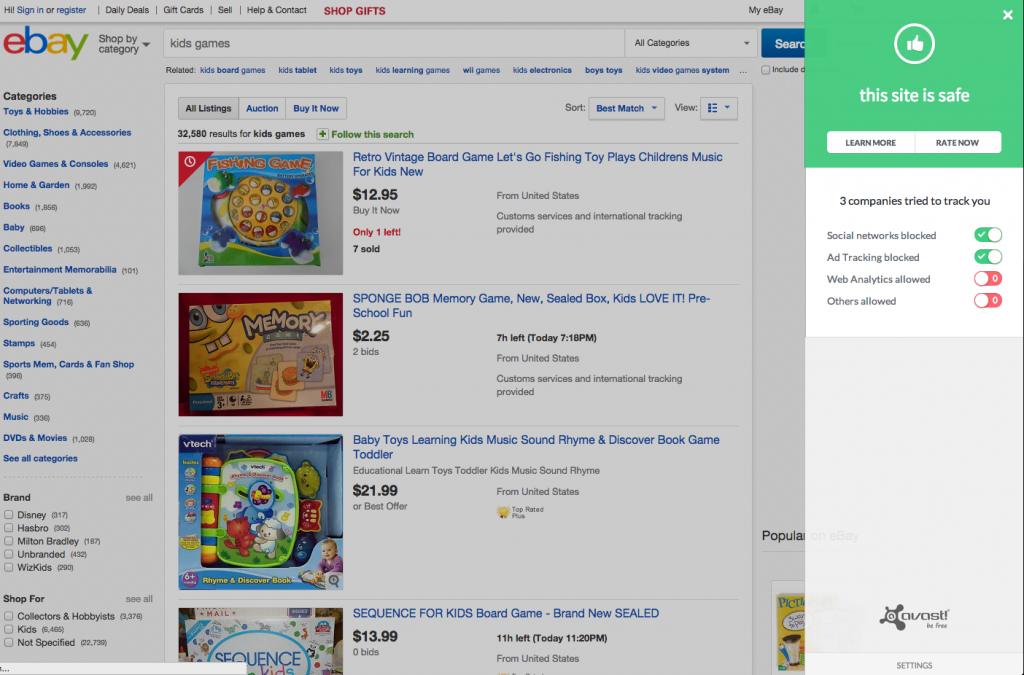
Online ad tracking Do Not Track

By denying tracking software, you eliminate your digital footprint and exclude targeted ads from following you while you browse. Most browsers do come with some form of Do Not Track, but they rely on HTTP Do Not Track headers. Avast on the other hand uses proprietary technology that cannot be overridden by servers.

Avast Browser Cleanup is another tool that will help ward off targeted ads. Browser Cleanup removes unwanted or poorly rated toolbars that could also be keeping an eye on your browsing sessions. Since Avast Browser Cleanup launched in February 2013, it has identified more than 40 million different toolbars, 95 percent of which have been rated as “bad” by Avast users.

Leave the tracking this holiday season to shipping companies and the post office, not online advertising! Avast wishes you and your loved ones safe and happy holidays (and shopping :))!

Avast Software’s security applications for PC, Mac, and Android are trusted by more than 200-million people and businesses. Please follow us on FacebookTwitter and Google+.

The message that can crash WhatsApp

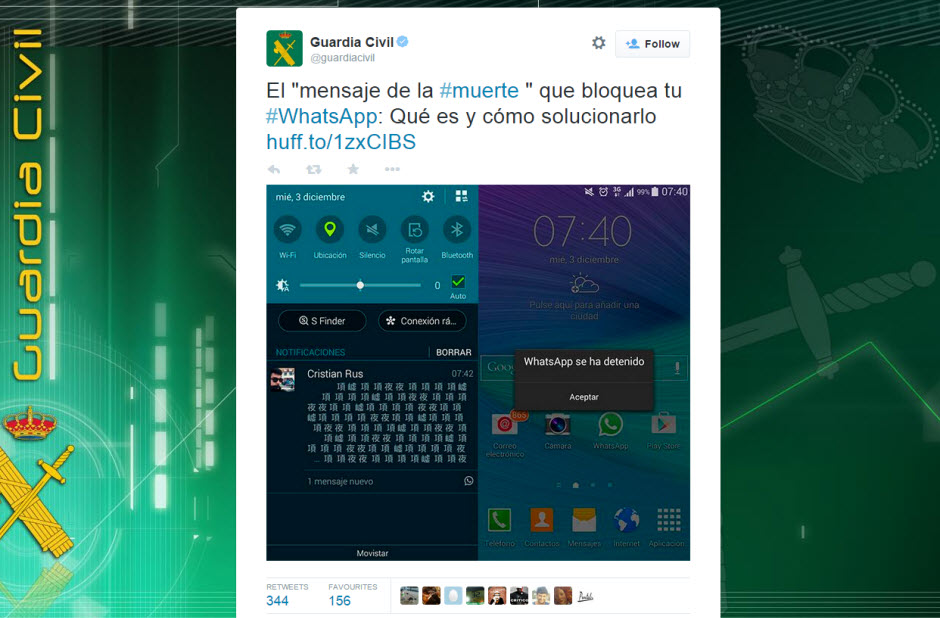
Warning! The Spanish Civil Guard is warning of a new threat on WhatsApp!

whatsapp-death-message

Known in Spanish as the “mensaje de la muerte” (the message of death), it only affects Android devices, not iPhones.

It works as follows: You receive a text message with Chinese-type characters which, having been copied and pasted to Whatsapp, will crash the application on Android devices. This is particularly dangerous for WhatsApp groups, as it blocks WhatsApp for all group members and deletes the group.

How to resolve the WhatsApp ‘message of death’

  • If received from another user: just delete the chat to resolve the problem.
  • If the message comes through a group, go to “Settings”, “Applications” “Manage Applications”, “WhatsApp”, “Clear Data”. Be aware however that all chats and messages histories for all groups will be deleted.

The post The message that can crash WhatsApp appeared first on MediaCenter Panda Security.

[SE-2014-02] Google App Engine Java security sandbox bypasses (status update)

Posted by Security Explorations on Dec 16

Hello All,

We would like to provide a status update to the initial
announcement [1] made a week ago regarding our SE-2014-02
security research project targeting Google App Engine
for Java.

Information regarding vulnerabilities and associated PoC
codes (Issues 1-22 / unconfirmed Issues 23-35) was sent
to Google on Dec 07, 2014.

Google has been able to reproduce the issues locally, but
when tried in production some of them didn’t seem to…