WebKit, as used in Apple Safari before 6.2.4, 7.x before 7.1.4, and 8.x before 8.0.4, allows remote attackers to execute arbitrary code or cause a denial of service (memory corruption and application crash) via a crafted web site, a different vulnerability than other CVEs listed in APPLE-SA-2015-03-17-1.
Monthly Archives: March 2015
CVE-2015-1079
WebKit, as used in Apple Safari before 6.2.4, 7.x before 7.1.4, and 8.x before 8.0.4, allows remote attackers to execute arbitrary code or cause a denial of service (memory corruption and application crash) via a crafted web site, a different vulnerability than other CVEs listed in APPLE-SA-2015-03-17-1.
CVE-2015-1080
WebKit, as used in Apple Safari before 6.2.4, 7.x before 7.1.4, and 8.x before 8.0.4, allows remote attackers to execute arbitrary code or cause a denial of service (memory corruption and application crash) via a crafted web site, a different vulnerability than other CVEs listed in APPLE-SA-2015-03-17-1.
CVE-2015-1081
WebKit, as used in Apple Safari before 6.2.4, 7.x before 7.1.4, and 8.x before 8.0.4, allows remote attackers to execute arbitrary code or cause a denial of service (memory corruption and application crash) via a crafted web site, a different vulnerability than other CVEs listed in APPLE-SA-2015-03-17-1.
CVE-2015-1082
WebKit, as used in Apple Safari before 6.2.4, 7.x before 7.1.4, and 8.x before 8.0.4, allows remote attackers to execute arbitrary code or cause a denial of service (memory corruption and application crash) via a crafted web site, a different vulnerability than other CVEs listed in APPLE-SA-2015-03-17-1.
CVE-2015-1083
WebKit, as used in Apple Safari before 6.2.4, 7.x before 7.1.4, and 8.x before 8.0.4, allows remote attackers to execute arbitrary code or cause a denial of service (memory corruption and application crash) via a crafted web site, a different vulnerability than other CVEs listed in APPLE-SA-2015-03-17-1.
CVE-2015-1084
The user interface in WebKit, as used in Apple Safari before 6.2.4, 7.x before 7.1.4, and 8.x before 8.0.4, does not display URLs consistently, which makes it easier for remote attackers to conduct phishing attacks via a crafted URL.
Don’t click on the porn video your Facebook friend shared
Fake Flash Player updates fool Facebook users.
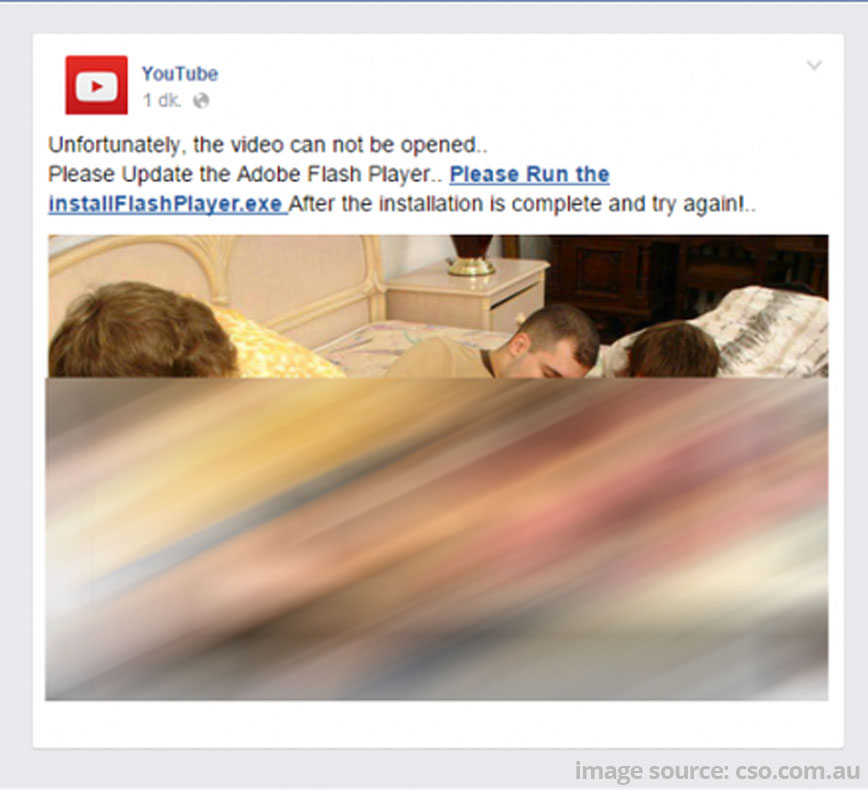
Facebook users get malware from clicking on fake Flash Player updates.
Facebook users have fallen victim to a recycled scam, and we want to make sure that all of our readers are fore-warned. Cybercrooks use social engineering tactics to fool people into clicking, and when the bait comes from a trusted friend on Facebook, it works very well.
Here’s how the scam works – your friend sends you an interesting video clip; in the latest iteration you are tagged and lots of other friends are also tagged – this makes it seem more trustworthy. The video stops a few seconds in and when you click on it, a message that your Flash Player needs to be updated for it to continue comes up. Since you have probably seen messages from Adobe to update your Flash Player, this does not raise any red flags. Being conscientious about updating your software, as well as curious about what happens next in the video, you click the link. That’s when the fun really begins.
The fake Flash Player is actually the downloader of a Trojan that infects your account. Security researcher Mohammad Faghani, told The Guardian, …” once it infects someone’s account, it re-shares the clip while tagging up to 20 of their friends – a tactic that helps it spread faster than previous Facebook-targeted malware that relied on one-to-one messaging on Facebook.”
How to protect yourself from Facebook video scams
Don’t fall for it. Videos that are supposedly sensational or shocking are also suspect. Be very cautious when clicking.
Does your friend really watch this stuff? If it seems out of character for your friend to share something like that with you, beware. Their account may have been infected by malware, and it’s possible they don’t even know this is being shared. Do them a favor and tell them about it.
Be careful of shortened links. The BBB says that scammers use link-shortening services to disguise malicious links. Don’t fall for it. If you don’t recognize the link destination, don’t click.
Use up-to-date antivirus software like Avast Free Antivirus with full real-time protection.
Report suspicious activity to Facebook. If your account was compromised, make sure to change your password.
Command injection vulnerability in EMC Secure Remote Services Virtual Edition
Posted by Securify B.V. on Mar 18
————————————————————————
Command injection vulnerability in EMC Secure Remote Services Virtual
Edition
————————————————————————
Han Sahin, November 2014
————————————————————————
Abstract
————————————————————————
A command injection vulnerability was found…
EMC Secure Remote Services Virtual Edition Provisioning component is affected by SQL injection
Posted by Securify B.V. on Mar 18
————————————————————————
EMC Secure Remote Services Virtual Edition Provisioning component is
affected by SQL injection
————————————————————————
Han Sahin, November 2014
————————————————————————
Abstract
————————————————————————
An SQL injection…