Buffer overflow in Canary Labs Trend Web Server before 9.5.2 allows remote attackers to execute arbitrary code via a crafted TCP packet.
Monthly Archives: October 2015
CVE-2015-6308
Cisco NX-OS 6.0(2)U6(0.46) on N3K devices allows remote authenticated users to cause a denial of service (temporary SNMP outage) via an SNMP request for an OID that does not exist, aka Bug ID CSCuw36684.
CVE-2015-6309
Cisco Email Security Appliance (ESA) 8.5.6-106 and 9.6.0-042 allows remote authenticated users to cause a denial of service (file-descriptor consumption and device reload) via crafted HTTP requests, aka Bug ID CSCuw32211.
Please Welcome Avira Scout …
… and congratulate the Browser Name Contest winners!
The post Please Welcome Avira Scout … appeared first on Avira Blog.
Avira cleans up in malware removal test
Everyone knows: When it comes to a malware infection, someone has to clean up the mess afterwards!
The post Avira cleans up in malware removal test appeared first on Avira Blog.
Experian experiences T-Mobile data breach
Experian has revealed that information belonging to T-Mobile, which was housed on one of its servers, has been accessed by cybercriminals in a data breach.
The post Experian experiences T-Mobile data breach appeared first on We Live Security.

WordPress Jetpack Plugin Patched Against Stored XSS Vulnerability
The popular Jetpack WordPress plugin was updated this week in order to patch a critical stored cross-site scripting vulnerability.

Avast at Virus Bulletin Conference 2015
Our team had a wonderful time meeting and networking with the crème de la crème of security industry professionals at this year’s Virus Bulletin Conference in Prague, of which we were a proud platinum sponsor. Throughout the conference, a handful of Avast employees presented talks a variety of today’s most prominent security-centered topics. For those who weren’t able to make it to the conference, we’d like to provide a brief recap of the content that was covered.
Taking a close look at denial of service attacks
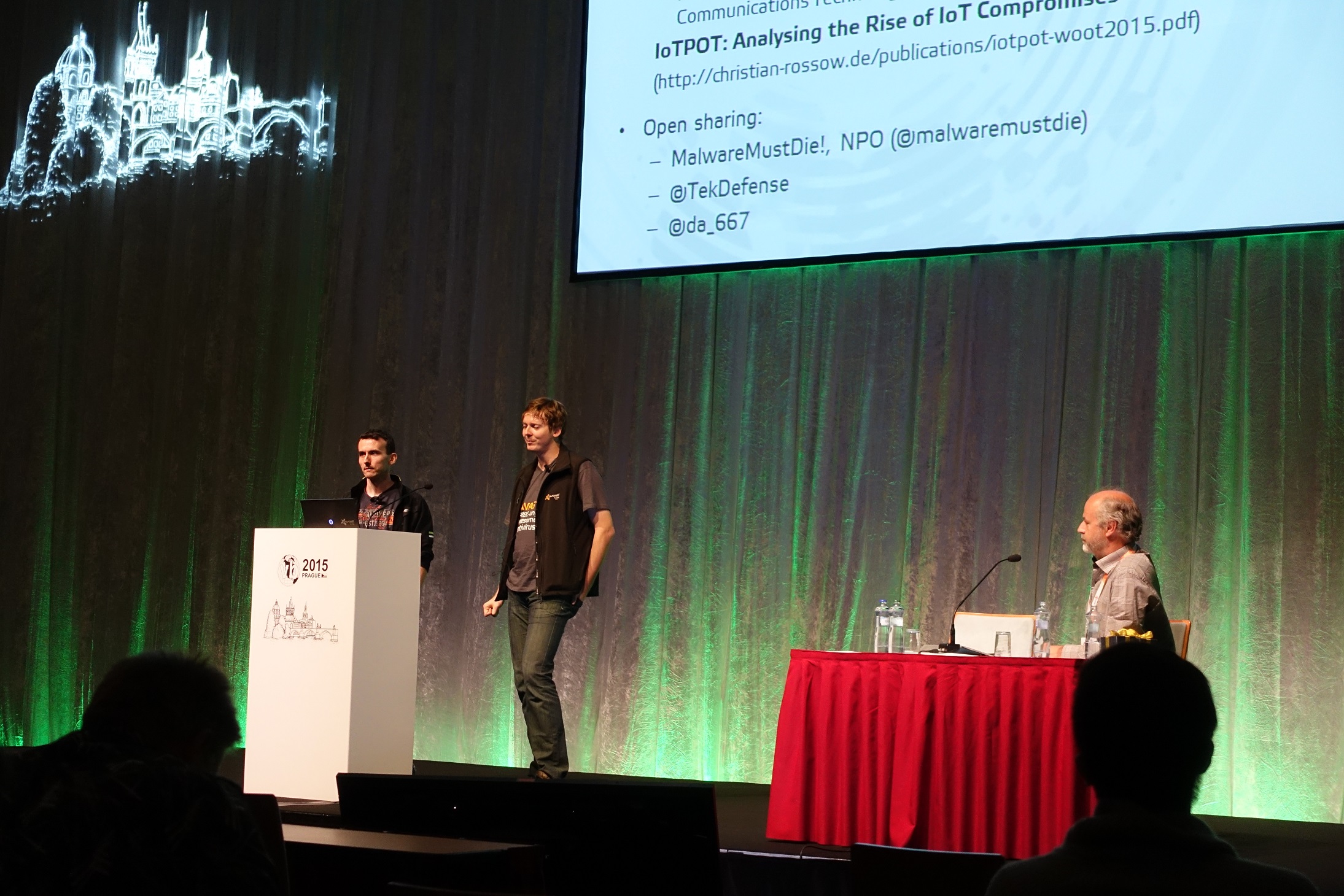
Avast senior malware analysts Petr Kalnai and Jaromir Horejsi discuss distributed denial-of-service (DDoS) attacks.
In their presentation, “DDoS trojan: a malicious concept that conquered the ELF format“, senior malware analysts Petr Kalnai and Jaromir Horejsi discussed the serious issues relating to distributed denial-of-service (DDoS) attacks.
Abstract: DDoS threats have been out there since the Internet took over half of global communication, posing the real problem of denial of access to online service providers. Recently, a new trend emerged in non-Windows DDoS attacks that was induced by code availability, lack of security, and an abundance of resources. The attack infrastructure has undergone significant structural, functional and complexity changes. Malicious aspects have evolved into complex and relatively sophisticated pieces of code, employing compression, advanced encryption and even rootkit capabilities. Targeted machines run systems supporting the ELF format – anything from desktops and servers to IoT devices like routers or digital video recorders (DVRs) could be at risk.
In this session, Petr and Jaromir examined the current state of DDoS trojans forming covert botnets on unsuspecting systems. They provided a technical analysis of the most important malware families with a specific focus on infection methods, dynamic behavior, C&C communication, obfuscation techniques, advanced methods of persistence and stealth, and elimination of rivals. After studying cybercriminals’ behavior, our two speakers introduced their operation tools, including vulnerability scanners, brute-forcers, bot builders and C&C panels. They explained that in many cases, it’s unnecessary to apply reverse engineering within the analysis — the original source codes are indexed in public search engines and their customization is a subject of monetization. The pair concluded their presentation by introducing tracking methods and techniques and revealed the targets of these attacks.
Taking mobile security to the next level

Avast security researcher Filip Chytry talks about privacy in the mobile sphere.
Next up was security researcher Filip Chytry’s talk, “Privacy: a growing commodity in the modern age and our Remotium virtual solution to protect it“. Filip’s presentation focused on a few mobile apps that have experienced privacy leaks and provided insight on what could be used as potential solutions to these types of security breaches.
Abstract: Today, we are surrounded by millions of sensors that measure and monitor our lives, cities, travels, homes and communities. There are currently more online endpoint devices and sensors in existence across the globe than there are human beings. Smartphones have become unbelievably integrated into our daily lives, and these tiny gadgets are just the tip of the iceberg that is the modern spying age. Take cameras, for example — when you get the chance, try taking a stroll around a city and see how many cameras you can spot. These could be cameras belonging to other people or surveillance cameras capturing public images. Whether they were taken accidentally or intentionally, it’s difficult to argue with the fact that each of us is featured in public images and visual data that we remain largely unaware of.
Filip pointed out that when examining this issue through a mobile lens, it’s interesting to take a look at apps which benefit us in some way. Although these apps can lend us a helping hand or aid us in socializing with our peers, they often sharing certain data with developers that the average person is likely unaware of and would be uncomfortable with sharing. Filip went on to explain that in the worst case scenario, these apps’ developers can implement poor security standards which could permit leakages of data shared by the user. Concluding the presentation, Filip explained that Avast Remotium is a virtual space that allows users to mask their data, delivering unidentified data in its place in order to protect against data leaks and privacy breaches.
Home Network Security in the spotlight
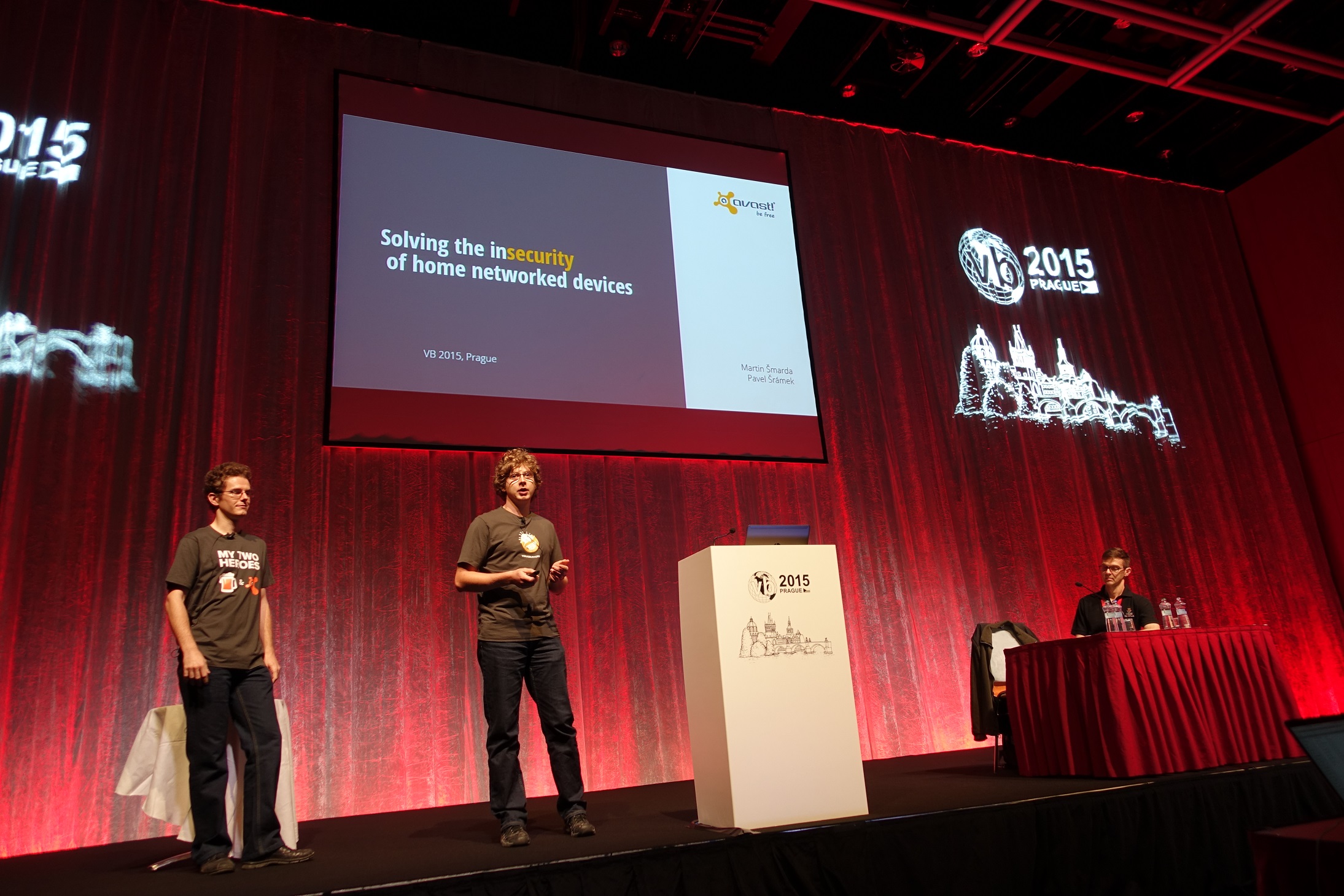
Pavel Sramek and Martin Smarda discuss home network security issues.
Another two stellar Avast malware analysts, Pavel Sramek and Martin Smarda, presented “Solving the (in)security of home networked devices“. This talk outlined real-life issues of home network devices and examined potential risks related to the devices, a topic which is extremely relevant at this time.
Abstract: In the past few years, there has not been a VB conference without a talk about someone hacking the devices they have at home. Be they routers, NAS-es or ‘smart’ TVs, there is always one thing in common — the vendors ignore the problems and refuse to patch their products. We are developing an automated vulnerability scanner intended to test devices without our code running on them. The intention is to educate users about the misconfigurations and vulnerabilities that are detectable from another device in the network. Integrating such a scanner into consumer AV brings home network security to a new level and increases user awareness of those issues. We will present the technology and the challenges we faced on the way towards accomplishing this goal via maximizing the impact of even the simplest vulnerability scans.
Pavel and Martin acknowledged that while a couple researchers reporting an issue is simply not enough pressure to affect manufacturers’ decisions, the possibilities could be huge if millions of users reported this problem to their vendors or made the decision to replace their devices with more secure ones.
Fun at the Avast booth

A bottle of our own Avastweiser beer!
In addition to the presentations given by our talented speakers, Avast had a handful of fun activities to offer to Virus Bulletin attendees. At the Avast booth, our team served three types of Czech beer in addition to our own Avastweiser brew, which we handed out to visitors free of charge.
Attendees had the opportunity to join Avast in a tournament of old-school Arcade Games, which we rented from Prague’s Arcade Museum. Among the prizes were a smartphone-controlled paper airplane and a Cheerson CX-20 drone!
We’d like to thank everyone who attended Virus Bulletin 2015 for their interest and support in the security and antivirus industry. We look forward to what next year’s conference has in store!
Follow Avast on Facebook, Twitter, YouTube, and Google+ where we keep you updated on cybersecurity news every day.

5 things you’ve done wrong when asking your techie for help
Next time your computer breaks down or appears not to be working right, consider what not to do before you call your techie for some help.
The post 5 things you’ve done wrong when asking your techie for help appeared first on We Live Security.


How the Internet of Things will change cybersecurity as we know it

Analysts have been saying for a long time that the Internet of Things (IoT) is about to become a fundamental element in the transformation of businesses – its impact will end up influencing all social and industrial sectors. Recently, the technology consultancy Gartner placed this technology as one to watch (along with machine learning), and estimated that it would reach its full potential within 5 to 10 years.
IoT and the challenges of an imminent roll-out
However, according to this company it won’t be long before we can see how the Internet of Things will begin to generate visible changes – a study presented this month by the Gartner team predicts a transformation in the world of cybersecurity within the next two years, thanks to the Internet of Things. Therefore, by the end of 2017 more than 20% of businesses will be using security services dedicated to protecting businesses initiatives, and that use devices and services based on the Internet of Things.
Likewise, Gartner also predicts that IT and security strategies will need to be redefined as a consequence of adopting this new technology, along with the 26,000 thousand new devices that come with it. This, obviously, will massively increase the number and reach of technological vulnerabilities.
With the massive implementation of the IoT, intelligent gadgets will lose importance against the rise of omnipresent sensors (and the huge amount of information that they generate). In short, the lines between the physical and the digital will become blurred and BITS will act as the engine that allows devices connected to the IoT to change the state of its environment, including their own.

Gartner gives a few examples of this – a sensor that detects a temperature that is too low in a room will raise it automatically, or another that readjusts the dosage of medication for a patient in their hospital bed according to their medical records. This is without even mentioning the potential for IoT to change the way we drive on our highways (or, even better, how we stop doing it altogether).
The main challenge for the Internet of Things will be security
Businesses that adopt the IoT (the demand driven by providers and customers will ensure that they do) should increase their connectivity and readjust their maintenance policies. In any case, the main challenge will still be in the security systems. The Internet of Things is set to redraw the lines of responsibilities for the enterprise – security policies will have to be open to different profiles of employees and updating protocols, the same as what happened with the introduction of BYOD or cloud computing, but on a much larger scale, and with a far more visible impact.
“Ultimately, the requirements for securing the IoT will be complex, forcing CISOs to use a blend of approaches from mobile and cloud architectures, combined with industrial control, automation and physical security,” says Ganesh Ramamoorthy, Vice President of Gartner.
“However CISOs will find that, even though there may be complexity that is introduced by the scale of the IoT use case, the core principles of data, application, network, systems and hardware security are still applicable.”
The post How the Internet of Things will change cybersecurity as we know it appeared first on MediaCenter Panda Security.