ALCASAR versions 2.8.1 and below suffer from a remote code execution vulnerability.
All posts by 007admin
Beware overdue invoice malware attack, wrapped in an .ARJ file!
If you’ve been messing around with technology for a while, you may remember the good old days of acoustic couplers, ZModem, and Bulletin Board Systems (BBSes).
These were the days before the worldwide web had taken off, when even the slowest broadband speeds would have been sheer fantasy.
And because getting an online connection was slow and sometimes flakey, it wasn’t at all uncommon for techies to compress their programs and downloadable files into tight little packages, to make the download as painless as possible for users. The most famous compression tool of all was PKZip, created by the late Phil Katz, and versions of the .ZIP file format are still widely used today in some circles.
But there were other data compression tools which competed for .ZIP’s crown, each with their own loyal bands of followers. And one of the most famous was .ARJ.
And, to be honest, ARJ was pretty cool.
So you can imagine my delight when I discovered today that .ARJ wasn’t entirely forgotten and consigned to the dusty annals of history. Instead, it is still being used – albeit by malware authors…
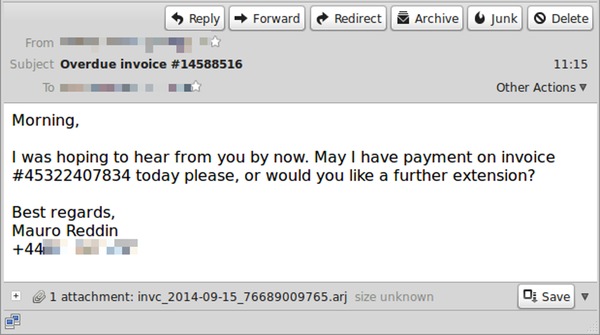
Here is an example of a typical malicious email, spammed out by online criminals:
<blockquote style=”margin: 15px;padding: 15px 15px 5px;border-left: 5px solid #ccc;font-size: 13px;
font-style: normal;font-family: ‘Helvetica Neue’, Helvetica, sans-serif;line-height: 19px;”>
Subject: Overdue invoice #14588516
Attached file: invc_2014-09-15_7689099765.arj
Morning,
I was hoping to hear from you by now. May I have payment on invoice #45322407834 today please, or would you like a further extension?
Best regards,
Mauro Reddin
Of course, the social engineering might have been a little better thought out. For instance, the invoice numbers quoted in the email don’t match each other.
But it’s easy to imagine how many users might be alarmed to hear that it is being suggested that they are being accused of a late payment, and would click on the attached .ARJ file without thinking of the possible consequences.
At that point the .ARJ file will decompress, spilling out its contents.
As Conrad Longmoore explains on the Dynamoo blog, inside the .ARJ archive file is an executable program – designed to infect your Windows computer.
Before you know it, your Windows PC could have been hijacked by a hacker and recruited into a botnet. Whereupon the remote attacker could command it to send spam on their behalf, launch denial-of-service attacks or steal your personal information.
That’s why you should always be wary of opening unsolicited files sent to you out of the blue via email.
The good news for users of ESET anti-virus products is that it is detected as a variant of Win32/Injector.BLWX. But if you are using a different vendor’s security product you may wish to double-check that it has been updated to protect against the threat.
The post Beware overdue invoice malware attack, wrapped in an .ARJ file! appeared first on We Live Security.

SNMP-Based DDoS Attack Spoofs Google Public DNS Server
SNMP-based DDoS attacks spoofing Google’s public recursive DNS server have been spotted by the SANS Internet Storm Center.
Open-Xchange 7.6.0 XSS / SSRF / Traversal
Open-Xchange versions 7.6.0 and below suffer from absolute path traversal, server-side request forgery, XXE injection, and cross site scripting vulnerabilities.
Briefcase 4.0 Code Execution / Local File Inclusion
Briefcase version 4.0 suffers from code execution and local file inclusion vulnerabilities.
PASSWORDS'14 Norway Call For Papers
The PASSWORDS’14 Norway Call For Papers has been announced. It will take place December 8th through the 10th, 2014 in Trondheim, Norway.
Aztech DSL5018EN / DSL705E / DSL705EU DoS / Broken Session Management
Aztech DSL5018EN, DSL705E, and DSL705EU ADSL modems/routers suffer from broken session management, denial of service, file exposure, and parameter tampering vulnerabilities.
Maligno 1.3
Maligno is an open source penetration testing tool written in python, that serves Metasploit payloads. It generates shellcode with msfvenom and transmits it over HTTP or HTTPS. The shellcode is encrypted with AES and encoded with Base64 prior to transmission.
Red Hat Security Advisory 2014-1188-01
Red Hat Security Advisory 2014-1188-01 – OpenStack Dashboard provides administrators and users with a graphical interface to access, provision, and automate cloud-based resources. A cross-site scripting flaw was found in the way orchestration templates were handled. An owner of such a template could use this flaw to perform XSS attacks against other Horizon users. It was found that network names were not sanitized. A malicious user could use this flaw to perform XSS attacks against other Horizon users by creating a network with a specially crafted name.
Red Hat Security Advisory 2014-1187-01
Red Hat Security Advisory 2014-1187-01 – KVM is a full virtualization solution for Linux on AMD64 and Intel 64 systems. The qemu-kvm-rhev package provides the user-space component for running virtual machines using KVM in environments managed by Red Hat Enterprise Linux OpenStack Platform. Two integer overflow flaws were found in the QEMU block driver for QCOW version 1 disk images. A user able to supply a malicious image file to QEMU or to helper tools used in image conversion by services such as Glance and Nova could potentially use these flaws to cause memory corruption, resulting in a crash or possibly arbitrary code execution.