Tag Archives: featured1

How Twitter aims to prevent your timeline from filling up with spam

As with so many of today’s technological tools, while many people use them to make their lives easier, or to keep in touch with friends and family, there are some that take advantage of them simply to annoy others.

So while most of us use social networks to chat with friends, meet new people and keep abreast of what’s happening in the world, there are those that saturate our accounts with messages that are not just of no interest, they are downright annoying: the infamous ‘spam’.

Now, tired of users having to endure this continuous bombardment of unwanted advertising, those responsible for several social networks have decided to go on the offensive. One of these is Twitter, which has taken action as spammers have been increasing their unhindered presence on users’ timelines and direct message inboxes. Finally, those in charge of the social network have said enough is enough.

twitter spam

As the company has revealed on its blog, over the last six months its developers have been working on the design of a system that can detect and block the actions of these annoying spammers. They have called it ‘BotMaker’ and its objective is to counter the actions of those who, whether for commercial reasons or otherwise, are dedicated to annoying other users of the social network.

The plan that Twitter has come up with to prevent these unwelcome users from doing whatever they please has three objectives.

  1. Firstly, it aims to reduce the options for spammers to create content.
  2. Secondly, it wants to restrict the visibility of spam messages launched on the social network.
  3. Finally, the most difficult objective is to reduce reaction times between spam attacks and the system’s ability to detect and stop them.

To achieve its aims, BotMaker has been designed to apply a series of rules that allow it to determine who is annoying other users with spam. When there is a suspicion that a tweet breaks the rules on spam, Twitter’s new platform will activate a protocol to ensure that either the message is deleted immediately or the user that sent it is vetoed to prevent them from further annoying users.

twitter no interest messages

Moreover, to prevent any unwanted messages from bothering other tweeters by trying to sell something, Twitter’s newly devised anti-spam system includes different bots that act at different stages of the hunt for spammers. The first to come into play is Scarecrow, which intervenes immediately in real time. Sniper comes next, eliminating any spam messages that have slipped past the previous filter. It also carries out a second appraisal and makes a record of suspicious users. If this weren’t enough, BotMaker also sets certain controls on users over long periods of time to prevent them from getting around the rules.

Nevertheless, the main advantage of Twitter’s new system is that it can detect spam even before the account in question can send junk mail to other users. This was the biggest challenge that the team at the social network faced because, whereas with email the delivery is delayed for a few seconds while Google or Microsoft robots check it to ensure it is not spam, with tweets this isn’t the case. These messages are sent and, theoretically, should arrive on your timeline immediately.

Users are also involved in the successful operation of BotMaker as they have the chance to identify those accounts that are flooding their timelines with spam. In this regard, the cookies that users have to accept to use Twitter also play an important role, by analyzing the traces left by tweeters. Despite this, BotMaker has no negative effects on users whatsoever. In fact, the system has been configured not to interfere with the bots that users install to automatically tweet on those topics that they have previously selected.
twitter unwanted messages

Trails carried out by the company with BotMaker have shown it to work efficiently. In the six months that Twitter tested its own invention, it managed to reduce by 40 percent the billions of unwanted messages aimed at selling or promoting products to other users of the social network.

Yet although these results may seem encouraging for those who regularly use Twitter, the truth is that all is not what it seems. Beyond its firm desire to counter the intentions of spammers, the social network is also striving to improve its own targeting of advertising.

As the epicenter of thousands upon thousands of comments about all types of events taking place around the world, the filters that BotMaker uses can also be used to select users who may be interested in advertising of one product or another.

More | How to protect your Twitter account

The post How Twitter aims to prevent your timeline from filling up with spam appeared first on MediaCenter Panda Security.
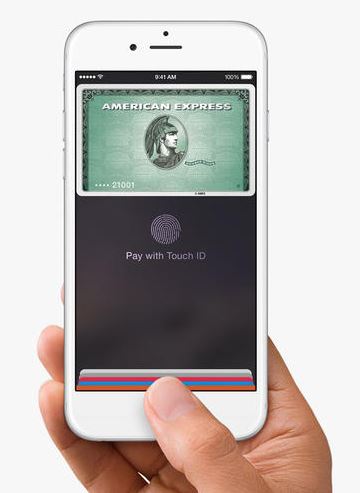
Leave your credit cards at home; Apple Pay lets you buy things with your phone

source: CNET.com

In the wake of the Target, and now Home Depot, security breaches, Apple Pay wants to provide a safer way to make a purchase.

Nestled in-between this week’s announcements of the iPhone 6 and the Apple Watch, Apple CEO Tim Cook announced a new mobile payment system called Apple Pay. New iPhone and Apple Watch owners can leave their credit and debit cards at home because the devices come with a chip that lets them tap-to-pay at major retailers.

When you are in one of 220,000 participating stores, like McDonald’s, Walgreens, Disney, or Macy’s, you use the magic of near-field communication (NFC) to hold your phone by a terminal to pay. It also requires that you place your finger over a sensor to verify your fingerprint. The Apple Watch works the same way, without the added security of the fingerprint, and syncs to your iPhone 5, iPhone 5c, and iPhone 5s. The payment system will work with American Express, Mastercard, and Visa.

Sounds pretty good. But, Google Wallet, PayPal and other NFC systems have failed to really take off; will Apple give us a better way? I asked mobile malware analyst Filip Chytrý to share his thoughts about the security of Apple Pay.

Deborah: From a security perspective, what do you think about Apple Pay?

Filip: I have some concerns. Communications between your device or watch is through Bluetooth, and we have already seen many incidences of intercepted communication between two devices using a man-in-the-middle attack. Generally, anytime you use a pay system there is communication between the phone or watch over Bluetooth. This communication works over a much longer distance than NFC, so payment interception would be easier.

Deborah: I understand the convenience of paying with Apple Pay, but how is this more secure than paying with a credit card?

Filip: Apple says, that “Each transaction is authorized with a one-time unique number, and instead of using the security code from the back of your card, Apple Pay creates a “dynamic security code” to securely validate each transaction.“ It really depends on the type of encryption which is used, but I have to admit this sounds pretty cool, but who knows how long it’s going to take to decrypt this system.

Deborah: It has to be better than the magnetic stripe cards that are still widely used in the USA. Credit card companies have given their customers until 2015 to make the transition to EMV cards using smartchip technology. These cards are supposed to help increase security and reduce fraud. Isn’t that good enough?

Filip: Generally, Apple Pay sounds like it is better secured than the current magnetic stripe cards. NFC payments are just tags which can be easily copied, but magnetic stripes are even worse. A PIN number adds an extra layer which is good, but Apple Pay might provide an even better way in future.

Deborah: Other than the basic security concerns, what happens when your phone battery dies (this will happen to me when I am on a deserted rural highway and need to fill up with gas) or you spill your coffee on it before you can pay, or you break your finger and it’s in a cast?

Filip: Those are real world problems that can’t be solved by Apple. ;) But you’re an Android user, right? Didn’t you have a Nexus 4?

Deborah: Yes, I did. Until I accidentally went in the swimming pool with it. :(

Filip: Not even avast! Mobile Security can protect you from that! But still, you will find this hilarious.

Read more about Apple Pay.

Thank you for using avast! Antivirus and recommending us to your friends and family. For all the latest news, fun and contest information, please follow us on Facebook, Twitter, Google+ and Instagram. Business owners – check out our business products.

Winners of the ‘Betatester 2015′ competition

best antivirus

At last we can announce the names of the winners of the Panda Global Protection 2015 beta competition! :)

Our Betatester of the Year and winner of €600 is:

  • Saravana Kumar S., India

The winners of €200 are:

  • Anil Kumar E.S, India
  • Jayakrishnan P., India
  • Alex Molina, Spain
  • Binshad Shahul, India
  • HUANG JING-KAI, Taiwan
  • Andreas Ntonas, de Greece
  • Kevin Appel, Switzerland
  • Lauri Säde, Estonia
  • Saqiya Maghisla, India

We have also awarded another 250 prizes of a one-year Panda Global Protection 2015 licence for three devices.

Thank you very much to all those who entered for your comments and suggestions!

More | Maximum protection with Panda Security’s new 2015 consumer solutions

The post Winners of the ‘Betatester 2015′ competition appeared first on MediaCenter Panda Security.

5 million Gmail passwords leaked

gmail

Do you have a Gmail account? This may interest you! A Russian cybersecurity forum has published a file containing more than 5 million Gmail accounts.

According to several experts, more than 60% of the username and password combinations were valid. However, Google says that the information is “outdated“, that is, these accounts have been suspended or the users no longer access them.

In a statement, Google said that it has no evidence that its systems have been compromised, but explains that “whenever we become aware that accounts may have been compromised, we take steps to help those users secure their accounts.“

The file published mainly contains British, Spanish and Russian accounts. If you want to know whether your account is on the list of those affected, you can do so here.

Panda Security recommends you increase the security of your passwords and use two-step verification of your Gmail account.

More | How to increase the privacy of your Gmail account

The post 5 million Gmail passwords leaked appeared first on MediaCenter Panda Security.

Facebook offers a new tool for configuring privacy

privacy facebook

As Facebook is always changing, keeping your profile private and secure is a complicated and time consuming task. The social network therefore, aware that this could put many users off sharing their news with contacts, has developed a new tool to simplify the job.

With this new feature, a friendly blue dinosaur helps you to quickly and simply check which of your contacts can see your latest posts.

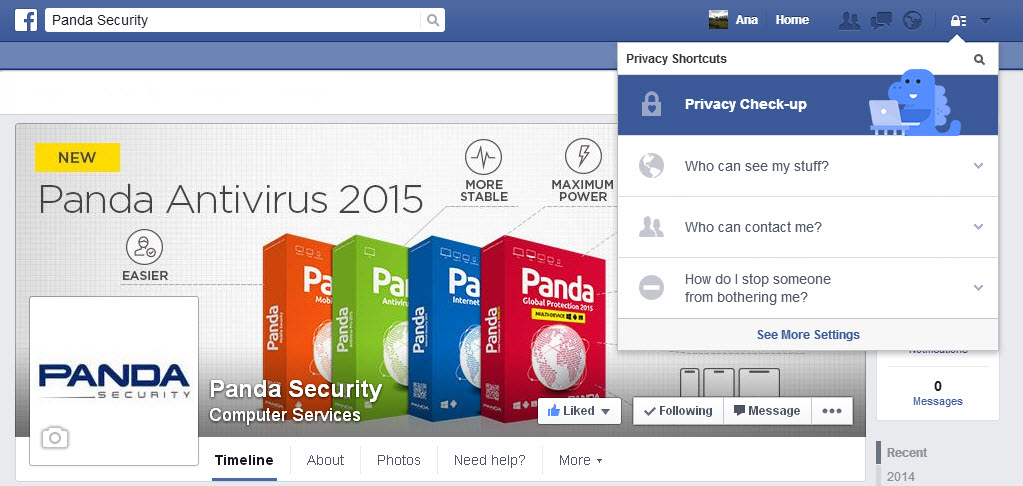
To access it you have to click the padlock symbol in the top right of the screen and select “Privacy checkup

facebook privacy check - up

A dialog box then opens with three simple steps.

How to configure privacy settings in Facebook

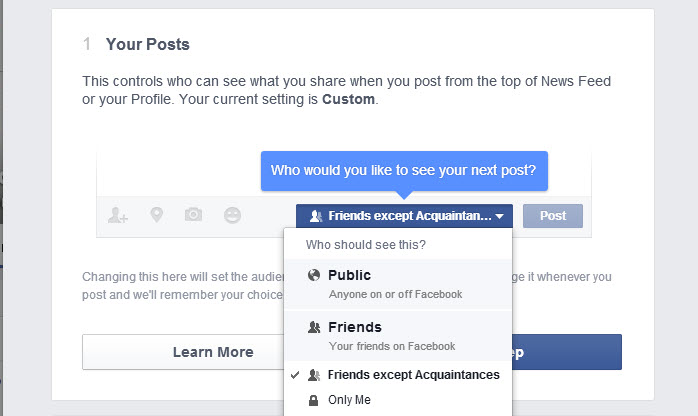
  1. The first option lets you control who can see your posts when you update your status from the news section or from the wall. As well as telling you the current settings, you can also change them to suit your preferences

facebook privacy check - up posts

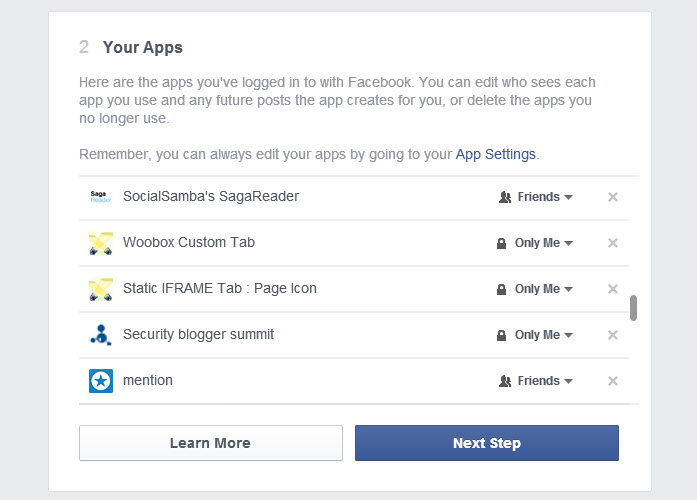
  1. The next step displays a list of all the applications that can access your profile and information. Here you can also prevent this access if you no longer use the application in question. What’s more you can see which of your contacts can see posts that the applications publish ​​in your name.

facebook privacy check - up apps

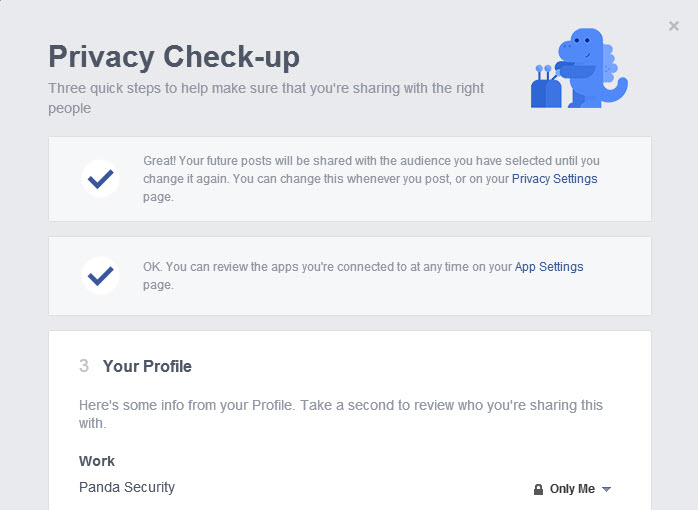
  1. Finally, Facebook helps you check which personal information you’re sharing on your profile: your job, school and college background, where you live … you can add or delete data and restrict access to it.

facebook privacy check - up profile

Although none of these settings prevent Facebook from using your personal information for advertising, it can help you know which contacts can see which posts.

At present this help feature does not include settings for albums or photos as a profile or homepage, which you will have to check directly.

If after meeting Facebook’s new dinosaur you still have questions about the privacy settings of your profile, you can always check our guide.

More | Facebook Privacy Guide


The post Facebook offers a new tool for configuring privacy appeared first on MediaCenter Panda Security.

As Mobile Malware Hits the Million Samples Mark It Becomes More Devious than Ever Before

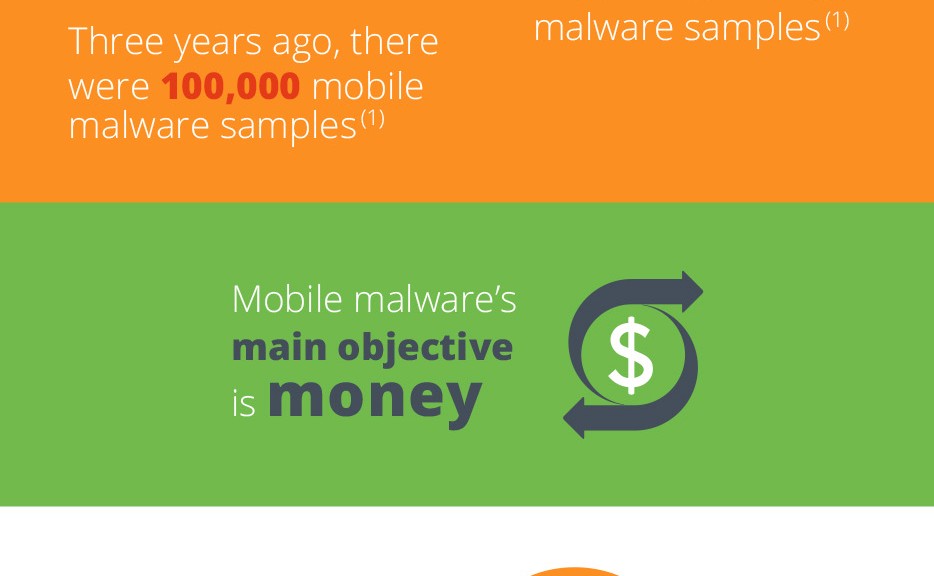
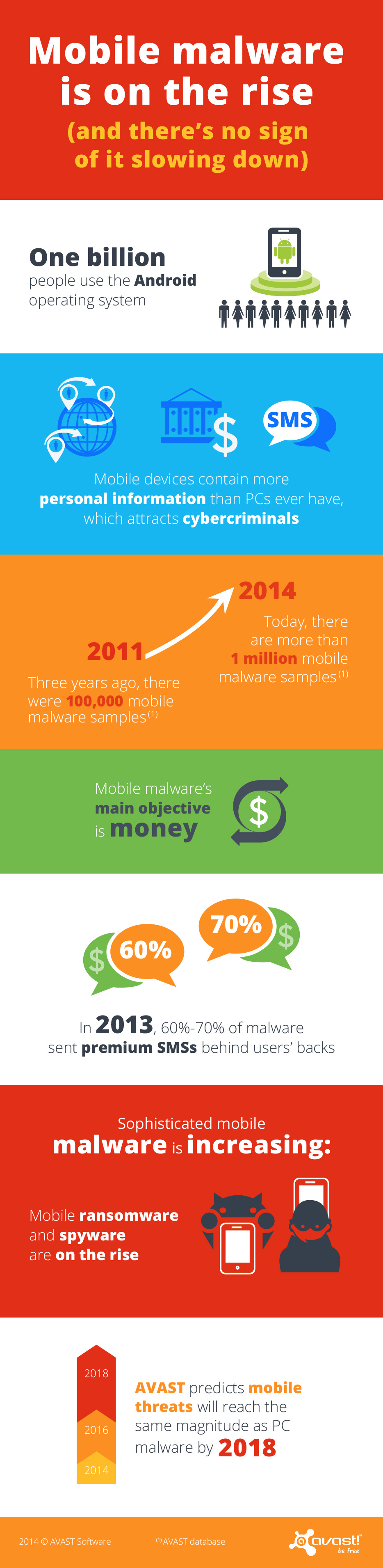
Mobile malware is growing exponentially. We now have more than 1 million malicious samples in our database, up from 100,000 in 2011. Still relatively young, most mobile malware has a pretty simple structure, yet it is designed to effectively steal people’s money. Newer mobile malware is, however, adapting and evolving, slowly embracing more deceitful and complex tactics to target users.

PC malware authors started in a garage, mobile malware authors in an office

Mobile malware is undergoing a similar development as PC malware did years ago with two significant differences: First, PC malware, in its early stages, was created by hobbyists and has only slowly evolved into a serious business within the last 10 years. Mobile malware, even with its simple structure, has been a serious business from the get-go. Smartphones and tablets are capable of gathering and storing more personalized data than PCs ever did – there is an abundance of valuable data to collect, including personal data and financial information. Thus, the focus of mobile malware has always been on monetization, meaning that even early mobile malware posed real-life threats to its victims, stealing money from them. Secondly, even though malware targeting smartphones and tablets is still young, it’s developing much faster than PC malware did in its initial years.

There are multiple entry points for mobile malware; apart from malicious apps placed in app stores and in-app ads linking to malicious content, malware authors also often take advantage of bugs in mobile operating systems, in popular apps or carrier billing structures. In 2013, around 60 to 70% of malware was tailored to send premium text messages behind users’ backs, a simple trick malware authors took advantage of to get into people’s wallets. The industry is catching up to malware and retaliating – carriers in the US and other countries have banned premium text messaging services. As the industry reacts, mobile malware authors start thinking of and using much more sophisticated and deceitful ways to get to people’s money.

The next generation of mobile malware

Elaborate malware, such as ransomware and spyware, is on the rise and is slowly taking control of mobile devices and the pool of potential victims can only get larger. Google now has more than 1 billion Android users. Formerly only known on the PC platform, a Cryptolocker-like ransomware has recently targeted Android devices for the first time, scaring users by holding their devices hostage, claiming to encrypt files until the user paid the ransom. Mobile spyware, on the other hand, is capable of tracking user location and a variety of other personal data, which can later be used to hack accounts or for identity theft.

We predict that with the emergence of new technologies, malware authors will find new ways of taking advantage of them. For example, as the use of new payment methods like Near Field Payment (NFC) increases, we expect hackers will change the way they go after money.

Users need to become aware of how valuable smartphones really are – not just the hardware, but the data it contains

Mobile threats are increasing – we expect them to reach the same magnitude as PC malware by 2018. However, out of the more than 1 billion smartphones that were shipped globally last year, only a small percentage are currently protected with antivirus software.

To make mobile devices safer and more secure, we need to collectively work together – the security industry, carriers, app store providers and consumers. At AVAST, we are constantly refining our tactics to detect mobile malware, to protect our users with our free and paid solutions. Actions like major carriers in the US, Brazil and the UK no longer billing customers for most forms of commercial Premium SMS messages, thus shutting an important door for malware creators, are a great initiative – and we hope carriers in other countries will follow this step, soon. Also, stricter security rules for apps on Google Play and other app stores could help make some types of malware extinct.

In the end, it’s also up to users to protect their devices and data with security solutions. People need to understand that there are new threats being built to target their mobile devices. Phones and tablets contain people’s personal treasures, in the form of data, whether that be personal information about loved ones or bank details – all of which is interesting for cybercriminals. Therefore, it is essential that people care for their smartphones and tablets in the same way as they protect their PC, the majority of which has antivirus installed.

AVAST Mobile Malware infographic

Thank you for using avast! Antivirus and recommending us to your friends and family. For all the latest news, fun and contest information, please follow us on Facebook, Twitter and Google+. Business owners – check out our business products.


avast! Mobile Security quiz winners!

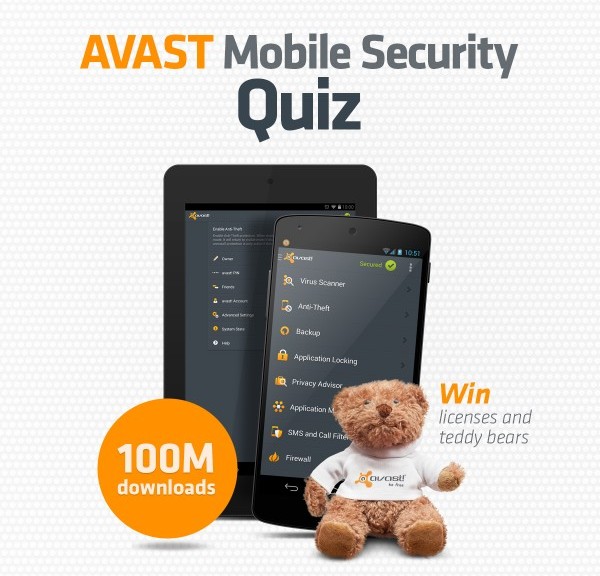
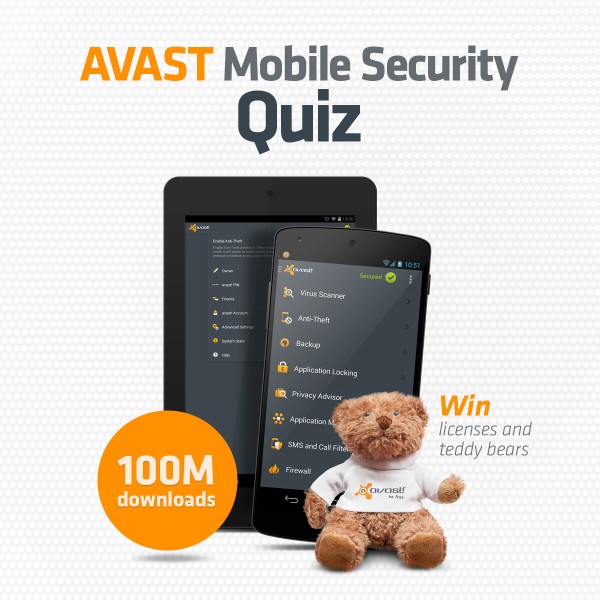
AVAST recently surpassed a major milestone:  More than 100 million downloads of avast! Mobile Security & Antivirus for Android.

To celebrate the phenomenal popularity of avast! Mobile Security, we organized a test-your-knowledge quiz on our popular avast! Facebook page. Our goal was not only to test your knowledge and award participants, but also bring your attention to and educate users about mobile security. Our knowledge quiz wasn’t easy, but we made sure that you received a hint to answer the questions correctly. Thousands of you submitted answers to our 5 questions as well as shared your thoughts about what the greatest threat to mobile security is today.

Here are the quiz questions and answers:

  • How many Smartphones are lost or stolen every minute of every day?  The correct answer was 100! The answer was found in this blog post.
  • avast! Anti-theft helps you locate your lost or stolen mobile device. There are various methods used. Which of following is NOT one of the methods? The correct answer was ‘Communicate via your GPS device.’  The hint was hidden in this blog post.
  • Based on users’ answers in an AVAST survey, which group of people are more vulnerable to mobile malware? The correct answer was ‘Males.’ The answer was found in this infographic.
  • When was the first version of avast! Mobile Security released? The correct answer was ‘December 2011.’ The hint was hidden in this YouTube video.
  • The AVAST team demonstrated our Mobile Security product at one of the largest mobile conferences in the world. In which great city did it take place?  The correct answer was ‘Barcelona.’ The hint was hidden in the following blog post.

BLOG-en

Here are the results:

  • 2,400 participants answered all the questions correctly
  • 1,900 participants answered four questions correctly
  • 1,400 participants answered three questions correctly
  • 3,300 participants answered one or two questions correctly

We promised to give away 1,000 Premium licenses to participants. However, we changed our mind. We decided that we want to protect your Android phone and tablets, so we well be awarding everyone who answered 3 and more answers correctly with a  free license for the most trusted Android security product in the world! :)

Now check your mailbox and search for the email from us. It will contain a special voucher with instructions on how to activate your Premium license. It might end up in the Junk/Spam folder, so please make sure you double check it too. In the following blog post we will announce winners of our VIP #AVASTteddy and the lifetime license, so please stay tuned!

For those who didn’t succeed this time, we have also something.  Install avast! Mobile Security and Antivirus for FREE from the Google Play store, https://play.google.com/store/apps/details?id=com.avast.android.mobilesecurity

Thank you for using avast! Antivirus and recommending us to your friends and family. For all the latest news, fun and contest information, please follow us on Facebook, Twitter and Google+. Business owners – check out our business products.

Entrepreneurs set high standard at The Pitch, UK

Thursday September 4th , 50 budding small businesses and entrepreneurs from around the UK gathered in London to attend Southern leg of The Pitch boot-camp.

The UK’s largest small businesses competition has reached the midway stage and contestants gathered to receive further mentoring and training from industry experts, including AVG at the 15 Hatfields events venue in London.

Click here for our full gallery

The boot camp was broken down into four separate sessions:

Marketing:

This session was led by Jeffrey Ferrazzo from Constant Contact and focussed on some of the most effective strategies that emerging businesses can use to maximise their limited marketing budget. As you might expect, there was a heavy focus on winning social media strategies and how to define a brand and drive engagement in what is a very crowded environment.

Pitch (24)


Overcoming objections:

At some stage in its development, every business will encounter roadblocks and objections from potential clients. This lively workshop session, led by Mike Byrne from AVG, prepared each contestant with techniques for mitigating and overcoming common objections to their product or service during the sales process.

Pitch (36)


Financial Planning:

You can have the best product in the world but without the proper financial planning, your business may still struggle to turn a profit. A group of helpful tutors from the Institute of Chartered Accountants (ICAEW), also sponsors, were on hand in this session to help the contestants set up clear and sustainable financial numbers to back up their business plans.

Pitch (40)


Pitching and Presentation:

Pitching and being able to sell your business idea in as short a time as possible can often make the difference between getting investment or sales and falling short. Contestants at this year’s The Pitch were given mentoring and individual feedback from one of the leading pitch experts in the UK, Annette Kramer.

Pitch (47)


The Pitching:

After a busy day of thorough training and preparation, all 50 competitors had only 90 seconds to pitch their business, on camera, to the rest of the attendees. The business ideas were as varied as the competitors themselves and there were excellent pitches for everything from lifesaving medical equipment to artisan marshmallows to workplace pension brokers.

Click here for our full gallery

The next phase:

The next step of The Pitch will be the Northern leg of the boot-camp to be held in Manchester later in September. After both boot camps have taken place, the video pitches will be narrowed down from 100 to 30 applicants to proceed to the final where a winner will be chosen by a panel of judges including AVG’s own Judith Bitterli.

The overall winner of The Pitch will win a priceless prize package that includes expert mentoring from business leaders and free access to world leading products and services including free AVG CloudCare services for two years.


A website set up to shame the guilty: the list of companies that don’t protect customers’ data

data company

There is an ever increasing amount of personal data circulating on the Internet, yet the security in place to safeguard this data is not evolving at the same rate. Many applications and Web services jeopardize user information by not employing any encryption system to protect it.

Given this situation, IT engineer Tony Webster has set up a website to draw attention to those who are reckless in their approach to safeguarding data. At HTTP Shaming you can find the names of the ‘guilty’ websites and how they are violating users’ privacy. If they abuse the trust of their users, it’s only fair that the users should know.

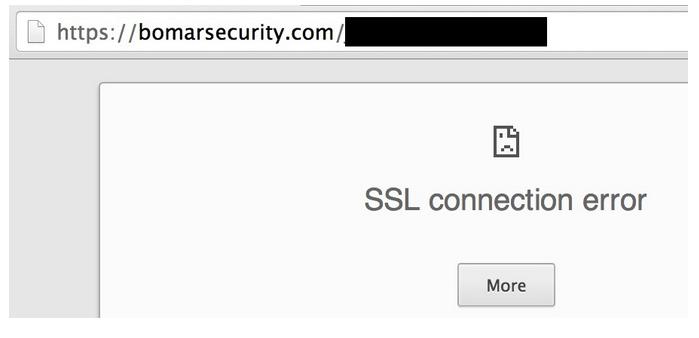
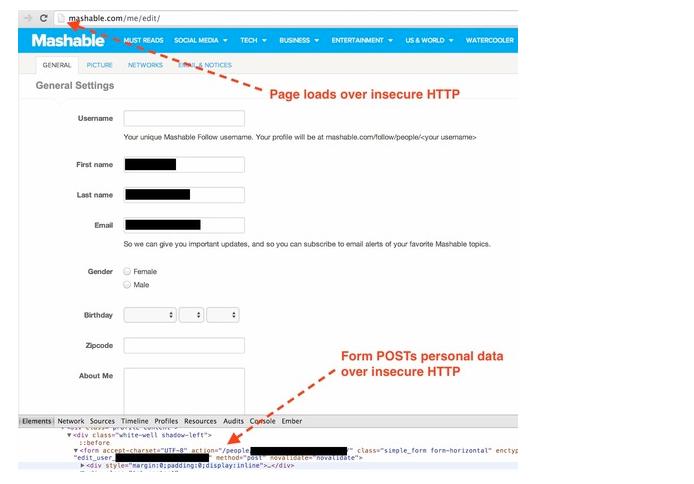
One of the names that appears on the website is Mashable. According to Webster, this news website enables users to connect using their social networks accounts and interact through them. The problem however is that all this activity is happening on an HTTP address, instead of the secure HTTPS internet protocol, which encrypts the information transmitted with the SSL (‘Secure Sockets Layer’) system.

SSL system
An SSL certificate, which guarantees the security of Internet communications, works by assigning keys to files exchanged between a client computer and the server of the company providing the service, so that only the company can access the file content.

If however you use the service offered by Mashable while connected to an open WiFi network, as with many public sites, your email address, alias and passwords could be stolen by cyber-criminals (those you use for Mashable as well as the social networks you use to access the page).

mashable
The TripIt travel planning site, where you can manage bookings, check timetables and flight schedules, and share all of this with other users, is another similar case.

In both the Tripit versions for smartphones and for websites, users are first asked to enter an email address and password. Webster highlighted this site as it does not encrypt the information displayed to others through the calendar feature. As is the case with Mashable, a criminal could discover your full name, phone number, email address and the last four digits of your credit card.

Those responsible for the website have reported this summer that the problem is now fixed and that security measures are now applied to all communications.

Such poor security practices also occur on other e-commerce sites where companies and customers exchange more sensitive information. Research by the IT security consultants High-Tech Bridge showed that 73% of the top 100 online stores don’t use the HTTPS protocol for data they consider less sensitive, and only two of them apply it in all cases.

The same applies to apps running on mobile devices. In a recent study by HP, a group of IT experts analyzed the security measures in place on 2,107 apps and found that 75% of them do not encrypt stored data. Some 18% didn’t even encrypt data exchanged across the Internet.

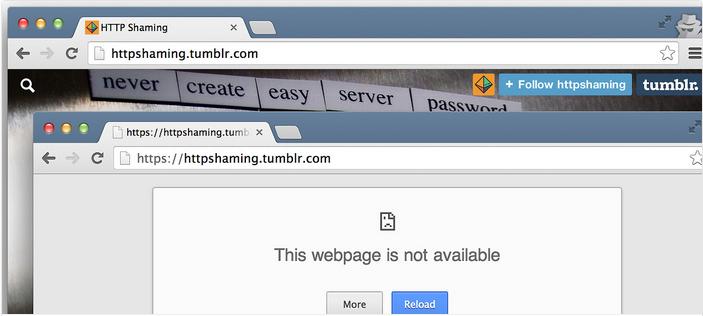
Webster’s list of shame now has 19 names, many of these put forward by others who wanted to take part in the project. These names include Creative Cloud, VLC and Adobe Flash Player. Even the Tumblr microblogging site, where the HTTP Shaming page is hosted, doesn’t have a secure protocol. In the worst cases, the IT engineer has directly contacted companies to let them know the error of their ways.

tumblr
Webster fails to understand why some companies are subjecting customers to unnecessary risks, as there is no reason not to use HTTPS, which is available to anyone offering services on the Internet.

The post A website set up to shame the guilty: the list of companies that don’t protect customers’ data appeared first on MediaCenter Panda Security.

Avast! Free Antivirus for Mac outperformed competitor products in the independent tests!

Compared to Windows users, Mac users have been relatively unaffected by malware attacks. Cybercrooks, however, are just as aware as antivirus vendors are about Mac vulnerabilities. With the growing number of Mac users, cybercrooks see more potential for malicious activities, especially as Mac users tend to have a false sense of security and not usesecurity software. You only have to read this blog to learn that cybercrooks are adapting Windows malware to target their Mac counterparts.

We should never underestimate Mac security. Avast! Free Antivirus for Mac offers free protection against the latest malware designed to attack Mac operating systems. As all other Avast security products, the Mac version participates in frequent, independent tests. Recently avast! Free Antivirus for Mac was not only certified by AV-TEST but it also received 100% in the latest Mac Security Test & Review conducted by AV-Comparatives in July-August.

We are proud to share the results with you!

logos

More about AVAST’s performance in both tests.


AV-TEST GmbH
is a leading worldwide operating service provider for IT security testing services. The latest test was focused on Mac OS X security products and took place in July and August 2014. Eighteen AV products participated, and the tested platform was MacOSX 10.9.4. The results can be found here.

The new version 9 of avast! Free Antivirus for Mac has easily outperformed competitor products. The security software offered high malware detection rates, does not decrease Mac performance and did not cause false positives in our tests. ~ Andreas Marx, CEO of AV-TEST

Below is a short summary of AVAST’s performance!

Q: Which product was tested?

A: avast! Free Antivirus for Mac

Q: Which version was tested?

A: ’9.0 (41877)

Q: How did avast perform in the detection on-demand test?

A:  avast! Free Antivirus for Mac received a scored of nearly 97.5%

Q: How did avast perform in the on-access detection test?

A:  avast! Free Antivirus for Mac scored 100%

Q: How many false positives were recorded in the on-demand and on-access tests?

A: None; avast  didn’t make any mistakes and recognized all malware correctly!

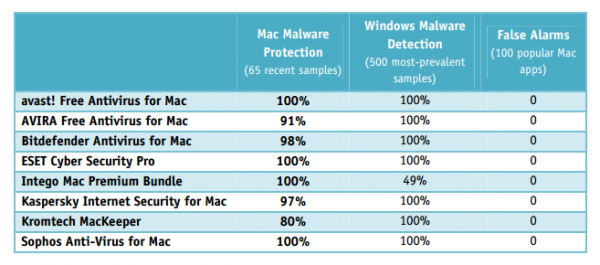
AV-Comparatives is an independent not-for-profit organization offering systematic security tests of antivirus products for PC and Mac, as well as mobile security solutions. The test conducted in July and August 2014 reviewed the performance of eight security software for OS X 10.9 Mavericks.

We found Avast’s phishing and malware alerts to be very good. The pop-up messages make it clear that the threat has been blocked and provide useful information for advanced users, such as the URL or file path (…) avast! Free Antivirus for Mac identified 100% of samples in both Mac malware and Windows malware tests and has a largely very straightforward program interface, albeit with the odd quirk.  ~ AV-Comparatives said in its report


Below, find the overview of avast’s performance versus its competitors

AV-Comparatives results

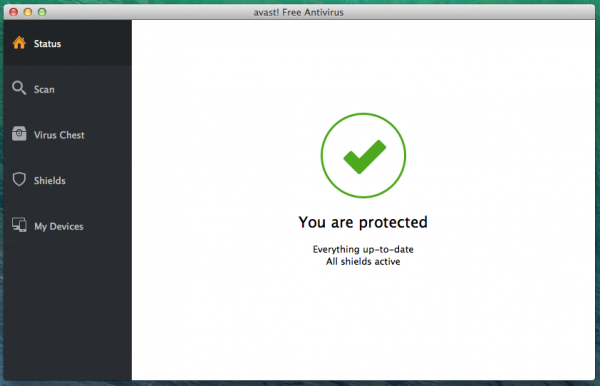
Last but not least, a picture is worth a thousand words, and we believe your Mac is worth it! Download it here.

avast

Thank you for using avast! Antivirus and recommending us to your friends and family. For all the latest news, fun and contest information, please follow us on Facebook, Twitter, Google+ andInstagram. Business owners – check out our business products.